
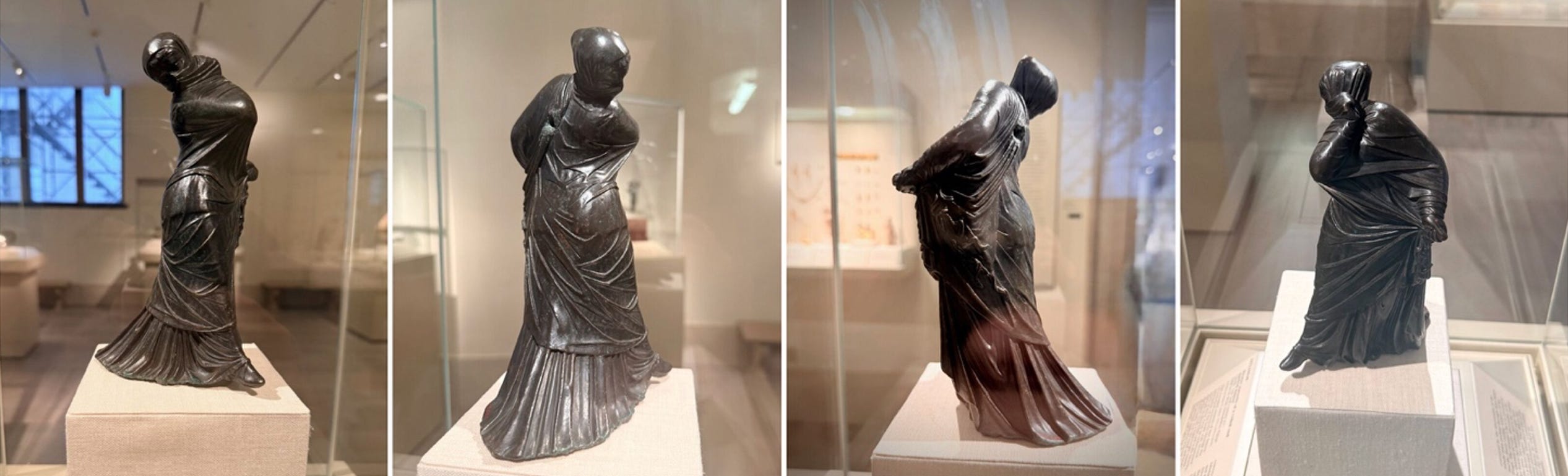
On a recent visit to the Metropolitan Museum of Art, I joined a guided tour that paused before a small bronze statuette in the Hellenistic Treasury. The figure was a stunning, veiled dancer from the third or second century BCE, frozen in a moment of elegant motion. Her body is balanced mid-step, weight shifted in a pose that could only exist between movements, her swirling garment caught in permanent sway. Only her eyes and one foot are visible beneath layers of drapery, yet the artist rendered each fold with such precision that the fabric seems to move. It is hard to believe she is cast in hard bronze.
The museum labels her simply “Bronze statuette of a veiled and masked dancer.” Scholars call her the Baker Dancer, after the collector who donated her in 1971, but the docent referred to her as “the Modest Dancer”—a moniker she found ironic. This was a public performer, the docent explained, most likely entertaining in houses of ill repute in the port city of Alexandria. The woman was technically following the rules of decency while still offering immodest views of her body for salacious purposes. Yet when I looked at the figure, I saw something different. Perhaps she was simply a woman dancing, allowing her body to move and flow in grace and rhythm.
Scholars have debated this statuette’s meaning for decades, and their disagreement is itself revealing. Who decides whether a covered, dancing woman is virtuous or provocative? And what does this centuries-old debate have to say to contemporary conversations in Sunday school classes and youth groups about applying Paul’s call in 1 Timothy 2:9 for “decency and propriety” to leggings, bikinis, and a woman’s responsibility to manage male lust? The scholarly debate over the Baker Dancer may offer an unexpected resource for considering what the New Testament actually asks of us.
The Baker Dancer belongs to a well-attested iconographic tradition called the “mantle dancer” or “veiled dancer.” Her body is entirely wrapped in a thin himation—the draped outer garment worn by Greek women—with an additional veil covering her face, leaving only her eyes visible through narrow slits. In 1950, Dorothy Burr Thompson dated the statuette to the late third century BCE and argued for Alexandrian provenance based on a dealer’s recollection. Thompson was captivated by the figure’s artistry, describing her as “a great artiste” who “danced so alluringly to tantalize the citizens of Alexandria.”1
Frederick Naerebout, a Dutch classicist specializing in ancient Greek dance, notes that when the Baker Dancer appeared in the 1998 Paris exhibition “La Gloire d’Alexandrie,” the catalogue described her as “an accomplished artist, a virtuoso apt to seduce the Alexandrians and their kings.”2 Naerebout finds such readings symptomatic of a deeper problem. Modern commentators, he argues, project onto the figure a “dance of the seven veils” sensibility that says more about orientalist fantasy than about the ancient Mediterranean. He offers an alternative. Veiling, he observes, served practical purposes such as shielding the complexion from sun and dust, while simultaneously “underlining and safeguarding a woman’s sōphrosynē, her required modesty, chastity and so on.”3 The mantle dancers, he proposes, may simply represent ordinary upper-class women performing in civic or religious contexts, their veiling a conventional marker of respectability rather than exotic allure.
When trained experts examine the same maximally-covered figure and arrive at opposite conclusions—pious matron or seductive performer—they expose modesty not as an objective property of dress but as a judgment made by the viewer. Interpretations may reveal more about the observer’s social location than the one observed. After all, the Baker Dancer has not changed; she remains frozen in bronze. What changes is the cultural lens through which she is viewed. Modesty, it turns out, is not in the fabric. It is in the gaze.
This background illuminates how we might read 1 Timothy 2:9-10, a text that has shaped, and often distorted, evangelical conversations about women’s dress. The passage instructs women to “dress modestly, with decency and propriety, adorning themselves, not with elaborate hairstyles or gold or pearls or expensive clothes, but with good deeds, appropriate for women who profess to worship God” (1 Ti 2:9–10, NIV). The Greek terms translated as “decency” (Greek aidōs) and “propriety” (Greek sōphrosynē) are easily misunderstood by modern readers.
Susan Hylen observes that by the first and second centuries, “modesty in dress more often meant simple (as opposed to lavish) attire.”4 The adornments Paul names—braided hair, gold, pearls, expensive clothing—would have been markers of economic status, not necessarily sexual provocation. Sōphrosynē was the preeminent feminine virtue in Greco-Roman culture. But as Hylen explains, the word denoted “self-control,” with its opposite being akolasia, “self-indulgence.” The virtue was not primarily about covering skin but about the disposition to prioritize others over oneself. Aidōs, often translated “decency” or “modesty,” and appearing only here in the entire New Testament, was similarly relational. It’s an awareness of how one stands before others, a felt sense of honor and appropriate self-presentation.5 Both terms describe dispositions of the heart that dress could express but never substitute.
Philip Towner agrees in his commentary on 1 Timothy. He sees Paul as targeting “insensitive women flaunting their dress, jewelry, and hairstyles in a way that hurt the feelings of the poor and disturbed the church.”6 The issue was congregational unity disrupted by wealth display, not male lust provoked by female bodies. Sōphrosynē and aidōs are not simply measurements of hemlines or sleeve lengths, but qualities of character that manifest in how one treats others, particularly the vulnerable. As Towner observes, “It is the invisible force behind good deeds, love for others, that creates and sustains unity.”7
Much popular evangelical teaching on modesty has not caught up with this scholarship. In youth group talks and Sunday school classes, 1 Timothy 2:9-10 still gets deployed as a proof text for policing women’s clothing. The underlying logic is familiar. Women’s bodies are dangerous, and modest dress is the solution. If a man “stumbles,” the woman who caused it must accept some blame. In its darkest forms, this argument forces women to bear responsibility for their own assaults, as if a change of clothing would prevent it. No woman is “asking for it.” When our teaching on modesty places the burden of male sin on female bodies, we have misread the text and failed the women in our care.
The Baker Dancer exposes the flaw in the logic that blames women for male lust. “Modesty” is not a property inhering in fabric; it is a judgment made by the viewer. Scripture points us toward a different framework. Sōphrosynē was about self-governance, the capacity to prioritize the needs of others over one’s own desires for status and display. Aidōs was about a felt awareness of how one’s actions affect the community. Both virtues found expression not simply in what a woman wore but in how she lived—in “good works,” as 1 Timothy 2:10 asserts. And both were expected of men as well as women. The New Testament does not place the weight of chastity on women’s shoulders alone, and neither should we.
The Baker Dancer remains in her showcase at the Metropolitan Museum, frozen mid-step, her bronze drapery swirling around a body we cannot see. Scholars will continue to debate what she means, but the controversy itself has already taught us something. Modesty has always been a virtue of character and communal awareness. A woman adorned with good works is recognizable not by her hemline but by her life. This is the modesty the biblical text commends. It cannot be measured. It can only be lived.
About the author: Lisa Scheffler is the Pastor to Women at Christ Fellowship McKinney, where she writes and hosts Engage God Daily, a weekly devotional and podcast. A graduate of Northern Seminary, she is currently pursuing a Doctor of Ministry at Houston Theological Seminary, where her work explores how a narrative encounter with Jesus forms faith for suffering. She lives in McKinney, Texas, with her husband, Steve, and the last of their three children—a final "bird" getting ready to launch.
Dorothy Burr Thompson, “A Bronze Dancer from Alexandria,” American Journal of Archaeology 54 (1950), 385.
Frederick G. Naerebout, “The Baker Dancer and Other Hellenistic Statuettes of Dancers,” Imago Musicae 18/19 (2001/02), 61.
Susan E. Hylen, Women in the New Testament World (Oxford University Press, 2019), 42.
Lloyd Llewellyn-Jones, Aphrodite’s Tortoise: The Veiled Woman of Ancient Greece (Classical Press of Wales, 2003), 161.
Philip Towner, 1–2 Timothy & Titus, vol. 14, The IVP New Testament Commentary Series (InterVarsity Press, 1994), 1 Ti 2:9–10.
Comments
Nothing yet. Say the first thing.
Sign in to join the conversation.