
Caution: This essay contains sensitive material regarding the violence of Christ’s crucifixion.
This year, my family and I spent Good Friday with close friends. Unfortunately, we didn’t attend the service at their church because our two-year-old and infant were exhausted from the two-hour trek to their house. But we still spent time in remembrance. Upon our friends’ return from the service, we sat together in the dark with their children and sang the hymn “Were You There?” This song originated as an African-American spiritual in the late 19th century, and there are now several versions. Some include a verse about the Resurrection, and others do not. The lyrics of this version hung on their wall:
Were you there when they crucified my Lord?
Were you there when they crucified my Lord?
Oh, sometimes it causes me to tremble, tremble, tremble.
Were you there when they crucified my Lord?Were you there when they nailed him to the tree?
Were you there when they nailed him to the tree?
Oh, sometimes it causes me to tremble, tremble, tremble.
Were you there when they nailed him to the tree?Were you there when they laid him in the tomb?
Were you there when they laid him in the tomb?
Oh, sometimes it causes me to tremble, tremble, tremble.
Were you there when they laid him in the tomb?Were you there when God raised him from the tomb?
Were you there when God raised him from the tomb?
Oh, sometimes it causes me to tremble, tremble, tremble.
Were you there when God raised him from the tomb?
As bedtime approached, I brushed my toddler’s teeth and sang “Were You There?” to her. She gazed into my eyes as if pondering the lyrics. We talk about Jesus a lot, so surely she recognized the names ‘Lord’ and ‘God’. After I put her to sleep, I continued to sing, but this time to myself. The song gave me pause. Who was there for the entire story, from start to finish? Mary Magdalene.
Though the Gospels vary in the details of the Crucifixion and Resurrection, Mary’s presence is consistent whenever women are named. She was one of the women who followed Jesus and ministered to him (Matt. 27:55-56; Mark 15:40-41), and she stood at the cross immediately before Jesus’ death, alongside his mother, his aunt, and Mary, the wife of Clopas (John 19:25). While Luke does not name any of the women, he notes they watched from afar and followed Jesus to the burial site (23:27, 49). However, he names Mary among the women who proclaimed the Resurrection to the eleven disciples (24:10). Mary Magdalene witnessed the entirety of Jesus’ suffering, culminating in his death.
She helplessly stands by as Pontius Pilate released the criminal, Barabbas, and convicts her innocent Rabbi; as Jesus is beaten and flogged by the Roman soldiers and mocked by bystanders; as some of God’s chosen people yell “Crucify him!”; as he is nailed to the cross and pierced in his side; as he is stripped not only of his clothes and but also his dignity. She trembles as the soldiers torture him.
Remember that when Jesus met Mary, he exorcised seven demons from her; she was already acquainted with deep pain and grief. But she experiences something new at Jesus’ death, and this lament wells up inside her like a dam about to break. She cannot hold it in and cries out. She is close enough that Jesus could see her and make eye contact. He tells her not to wail at his death, but it continues to pour out of her nonetheless. She holds her tears in her hands as she wipes her face, trembling as he breaks eye contact on the brink of death.
Despite the piercing grief she felt at the cross, she follows him still, just as from the moment they met. She sees where he is buried and hurries home to prepare the spices and perfumes to best preserve his broken body. The smell of myrrh is no longer soothing. She tries to mentally prepare herself as she imagines anointing him, touching his body. Every time she closes her eyes to pray, she sees the crown of thorns on his head, blood dripping down his face. Her hands shake, and she almost drops the ingredients on the ground from her trembling.
The morning after the Sabbath, Mary and the other women, smelling the spices of death in their hands, wearily walk toward the tomb. They wonder how they will roll away the stone entrance, but when they arrive, they notice that someone has already moved it. Jesus’ body is gone. John gives the most detailed account of Mary Magdalene at this point in the story, and Giotto brings the scene to life in his fresco, Noli me tangere.
Giotto was an Italian painter and architect from the 14th century. Prior to him, the Byzantine era still influenced Italian art, and painters made art for the church, portraying individuals iconographically. They often painted these icons emotionless with a gold background that created a heavenly space. Giotto, however, broke from this tradition and started his own style, using vibrant colors and realistic scenes to add flesh and a sense of three-dimensionality to his paintings. He paid attention to his characters’ emotions. These innovations are why he is considered the father of Western art.1
Commissioned by Enrico Scravegni in the early 14th century, the Scravegni (Arena) Chapel in Padua, Italy, became home to Giotto’s renowned fresco cycle of the life of Christ, which starts at the Annunciation. The entire cycle is striking, and he was committed to painting each panel as faithfully as possible, given the details provided by Scripture and tradition. However, his intention was not to paint from a church perspective or to create icons; rather, he sought to convey emotions. Noli me tangere is part of the cycle, and it is in this piece that Giotto depicts Christ as he says to Mary, “do not hold onto me” (John 20:17).
Now Mary stood outside the tomb crying. As she wept, she bent over to look into the tomb and saw two angels in white, seated where Jesus’ body had been, one at the head and the other at the foot. They asked her, “Woman, why are you crying? “They have taken my Lord away,” she said, “and I don’t know where they have put him.” At this, she turned around and saw Jesus standing there, but she did not realize that it was Jesus. He asked her, “Woman, why are you crying? Who is it you are looking for?” Thinking he was the gardener, she said, “Sir, if you have carried him away, tell me where you have put him, and I will get him.”
Jesus said to her, “Mary.” She turned toward him and cried out in Aramaic, “Rabboni!” (which means “Teacher”). Jesus said, “Do not hold on to me, for I have not yet ascended to the Father. Go instead to my brothers and tell them, ‘I am ascending to my Father and your Father, to my God and your God.’” Mary Magdalene went to the disciples with the news: “I have seen the Lord!” And she told them that he had said these things to her. (John 20:11-18).
After Mary realizes that his body is gone, she runs to Simon Peter and another disciple. They see that something strange has happened. Simon Peter first notices that Jesus is gone but his grave clothes are still there, and the other disciple has faith that something strange has occurred. The two disciples return to where they have been staying, but Mary Magdalene does not leave. Instead, she stays and weeps at the tomb. The two angels who were standing with her ask why she is crying, and she responds in her grief that “they” have taken her Lord from the tomb. Rodney Whitacre explains that “they” were likely Joseph of Arimathea and his workers, who may have brought Jesus to a permanent location. Mary is distraught as she doesn’t know where this site is; her loyalty remains with her Lord. Then Jesus appears behind her and the angels. Perhaps Mary hears someone behind her, or maybe the angels are awed by the appearance of Jesus. She turns around, confused about who this man is. Is he the one who moved Jesus to a new location? Does he know who did?2
He replies. “Mary.”
She recognizes his voice. Before she cries out “Rabboni!” was she overcome with more than just awe? Imagine her mixed emotions. Was it really him? Were his prophetic proclamations of his resurrection fulfilled, or was she just seeing things? Luke reports that she was frightful and had bowed down to the angels when they told her he had risen. Did anxiety lurk in the background that their words were not true? Despite her alarm, she goes to him. Imagine her running into his arms, sobbing in relief that he returned to her, and collapsing at his feet to worship him. In every Gospel account, she was the only one each author names as returning to his burial site. Her devotion is distinct from each disciple.
But then, as she clings to him, Jesus tells her not to. When I first read this passage, John 20:17 confused me. Why would Jesus not want Mary to hold onto him? Did he not save her from both her demonic oppression and for a restored relationship with himself? Did he not want her loyalty? I asked the wrong questions and wholly misunderstood the passage. Whitacre, instead, argues that “The use of the present test (haptou) suggests in this context that he is not forbidding her to touch him but telling her to stop that which she is already doing. Apparently, then, when Mary recognizes Jesus, she approaches him and touches him…It is possible that she is touching him on the arm or hand, to be assured that he is really there.”3 Or maybe she touches his leg, kneels before him, and grabs onto him. Jesus reassures her that she does not need to touch him; he is with her because he has not yet ascended to the Father. But he must, so she cannot cling to him. As Jesus goes, so must Mary.
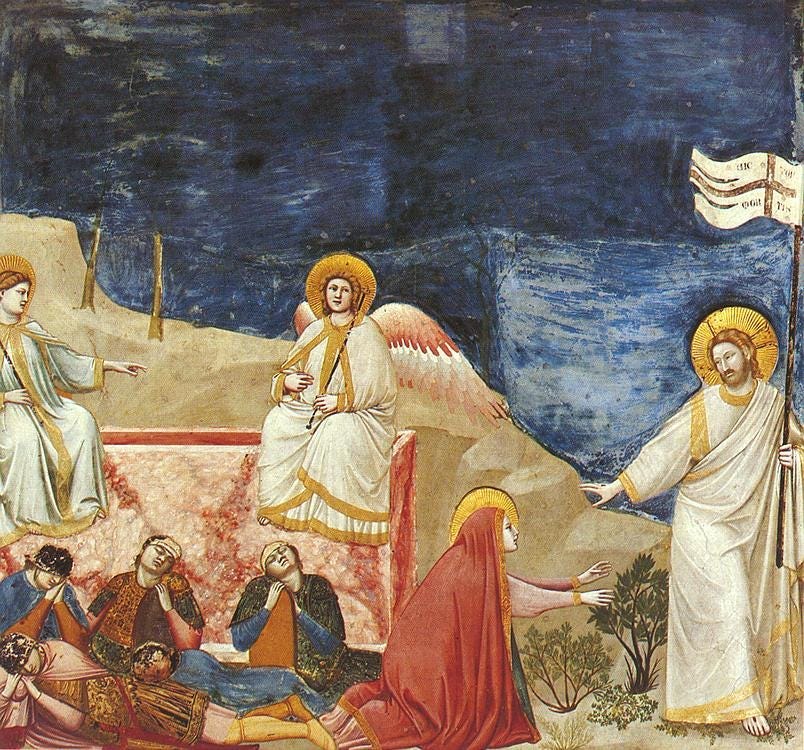
In the fresco Noli me tangere, Giotto communicates Mary’s emotions as she encounters Jesus after the resurrection. Mary lies at the feet of Jesus and reaches toward him. She is the only non-divine character who actively moves in this image. There are guards who sleep on the ground, but Mary is on her knees, crawling toward her Lord. Her face is one of longing rather than grief. Mary no longer wails; instead, she peacefully reaches toward him. They make eye contact. He moves away from her because he will soon ascend to the Father, but he doesn’t turn around. He faces her and keeps looking at her. Jesus is not aloof, but his face is kind and empathetic. He knows that she needs him, but gently moves away from her as he must ascend to the Father. And she must go out to proclaim his Resurrection.4
Jesus did save her and wants her devotion. He also wanted her love for him to flow out to others, proclaiming his Resurrection and ascension to the Father; his prophetic words were true, and he is their Lord. So she runs, faster than she ever has, racing to the disciples with an adrenaline rush that far surpasses the experience of Jesus exorcising the demons from her body. She trembles with awe, joy, and reverence as she runs and exclaims the news to the others.
Mary Magdalene proclaims the resurrection of Jesus to the disciples. Understandably, they did not believe her or the other women. But women were consistently viewed as unreliable witnesses in the ancient world, whether in relationships (like Rhoda in Acts 12) or in court, due to their lower social status. Jesus, however, trusted them to be reliable in their proclamation of his resurrection. Addressing Matthew 28:16-20, Craig Keener says that “The testimony of the women thus becomes a model for the disciples who will follow them. Jesus commissions them as his…agents of apostled ones to bring news of his resurrection to his own disciples.”5 This designation for the women continued throughout church history. Hippolytus, Augustine, and John Chrysostom all called Mary Magdalene the “Apostle to the Apostles,” and Thomas Aquinas continued to honor her with that title.
Mary Magdalene provides a framework for our witness today. She had a genuine encounter with Jesus and continued to follow him, allowing him to shape her into a disciple who lived in allegiance to him. As she saw him suffer, she did not run from him but to him, embracing the suffering that it caused her because she loved him. Giotto helps us to imagine her faithfulness and the relief she experienced when she was able to touch him after witnessing his gruesome crucifixion. It is no surprise that he entrusted her to be the first person to proclaim the good news of his resurrection.
As I ponder the words to “Were You There?” I like to imagine Mary singing it to us today as our commission to go forth. With tears in her eyes, she recalls seeing her Lord suffer. Were you there when they crucified him? I was there. Were you there when they nailed him to the tree? I had to turn away from the horror. Were you there when they pierced his side? I saw the blood, and somehow water, pour out from him. Were you there when they buried him? I carried the burial spices to his tomb and prepared myself to anoint him. Were you there when God raised him from the dead? I touched his very body and trembled at the sight. Will you cling to him, or go forth and proclaim the Good News of the Resurrection?
Let us go forth like Mary Magdalene.
About the Author: Taylor Yoder is a master’s student at Northern Seminary, pursuing a degree in Theological Studies. Her areas of interest include early church history and theology, women’s contributions to the life and faith of the church, and translating scholarship for the broader Christian community. She also works as an editor and manages the Tell Her Story Substack. Taylor lives in southwest Michigan with her husband and two young daughters, where they are members of a small Nazarene church in the country.
Jazmine Sanchez is credited with the information about Giotto and Noli me tangere. An artist herself, Jazmine has studied art history extensively and has a wealth of information. She has taught me much since I studied abroad with her in Italy in 2023.
Rodney A. Whitacre, The IVP New Testament Commentary Series: John, ed. Grant R. Osborne (IVP, 1999), 474-478.
Craig Keener, A Commentary on the Gospel of Matthew, (Eerdmans Publishing Co., 1999), 699.
Comments
Nothing yet. Say the first thing.
Sign in to join the conversation.