
At Leadership Now Project, we were saddened by the passing of Senator Lindsey Graham over the weekend. Graham was 71 and by all accounts a capable Senator. Nevertheless, the death of a sitting senator — along with the ongoing hospitalization of Senator Mitch McConnell and the growing cohort of young candidates challenging aging incumbents — has reopened a national conversation about the importance of succession planning. A New York Times article published Sunday underscores that calls for changing the system to address an aging Congress are growing louder.
Late last year, Leadership Now Project analyzed the age and tenure of Congress. The findings point to a Congress that is rapidly aging and at risk for sudden vacancies. The House and Senate are now among the oldest “industries” in the country, with more than twice the share of officeholders over 60 compared to other major democracies. And while China has no formal retirement age, it has long enforced a strict norm requiring most senior political leaders—from provincial governors to Politburo members—to retire at 68 (with Xi Jinping as a notable exception).
Analysis findings include:
Nearly 60 percent of U.S. senators will be 65 or older by the end of the current Congress in 2027;
More than 50 members of the House will be 75 or older by the end of the current Congress;
50% of House Democratic Committee Leaders and 25% of House Republican Committee Leaders are over 70 years old;
There are few incentives that encourage leadership transitions, which can lead to chaos when vacancies happen without warning.
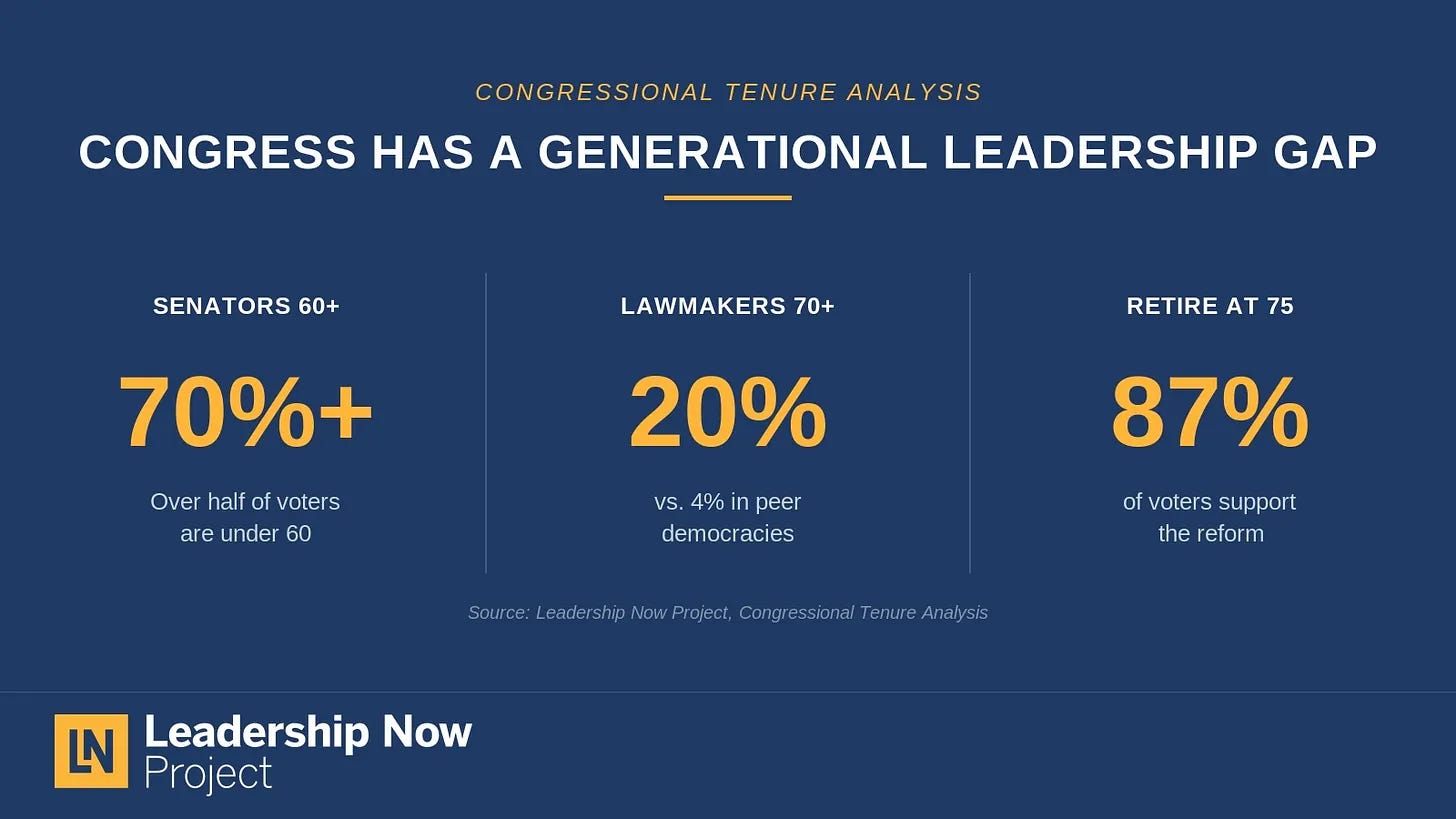
The questions about age and succession are not about any one official or party. Experience is also essential to governing. At the same time, Congress should adhere to the same succession norms applied to successful organizations in the business world. These include developing a pipeline of new leaders, engaging in succession planning, and encouraging regular turnover at the top.
Generational change is a multigenerational story. It includes Gen X and Millennial leaders with experience in business, the military, science, engineering, and other non-political fields, alongside emerging Gen Z leaders.
Leadership Now has long encouraged bipartisan reform on this important issue and urges congressional leaders to take concrete actions:
Institute a retirement norm of 75 for members of Congress to bring congressional leadership in line with workforce norms. Set the expectation that members do not seek reelection after age 75, and that they begin a defined succession-planning process at 70;
Establish term limits for Democratic House committee leadership. Cap service as chair or ranking member at four terms (eight years);
Apply merit-based House committee appointments, making demonstrated expertise and capability — not seniority — the primary criterion for committee leadership positions.
Strong organizations don’t wait for a crisis to plan for succession. Congress should hold itself to the same standard.
Read Leadership Now’s recommendations for talent renewal for the next Congress.
No posts
Comments
Nothing yet. Say the first thing.
Sign in to join the conversation.