
A friend recently blew up at a colleague. She came to me, fuming. “She was so toxic. What would you have done? Be honest,” she asked.
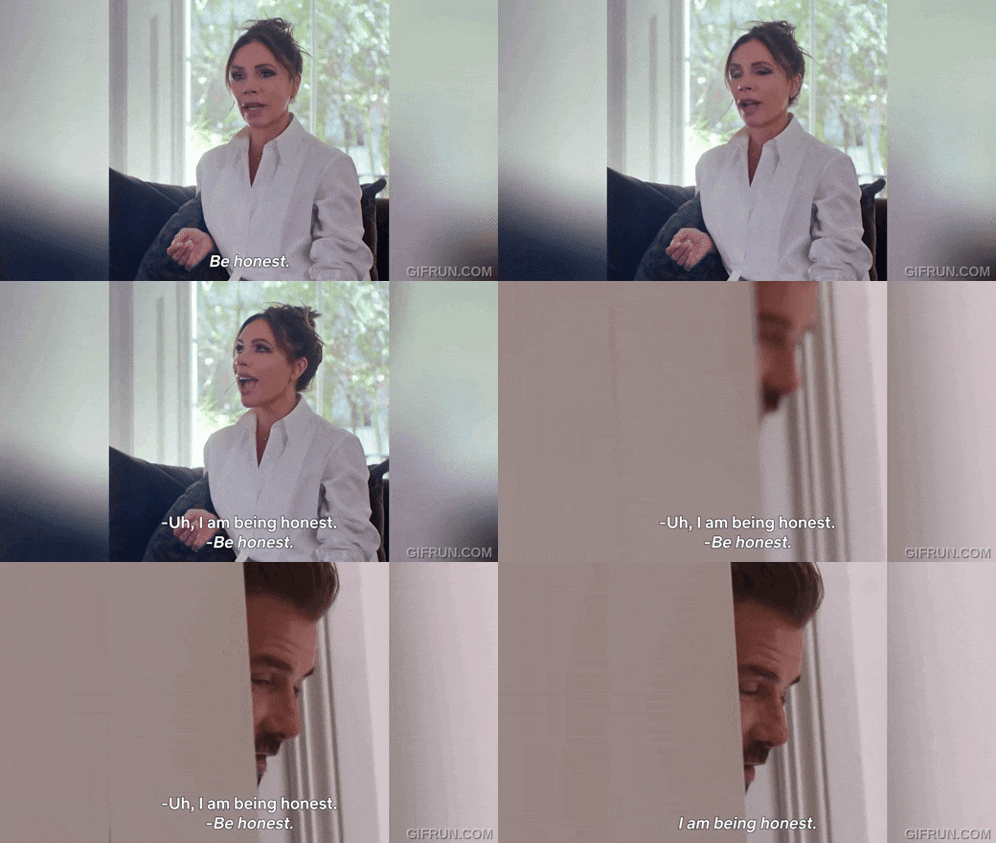
“Toxic is a conversation-ender, not a diagnosis. And calling someone toxic is an easy and unspecific reason to quit something without doing the work of alignment. What was the goal of the conversation?” I replied.
“I just wanted to be authentic.”
At that moment, her fallback on authenticity was a red-flag. Let’s get into it.
When you disagree with someone, you have 4 options and all of them depend on what you are working towards. This applies to anything — whether it is work, marriage, kids, sport, etc.
When you disagree, you could:
Get aligned
Disagree and commit
Disengage and walk away
Defame

And the options hinge on how productive you want the outcome to be.

Sometimes being productive and aligned really matters. For example, when raising kids, you probably want to be aligned with your partner. You need to agree on what matters and how to raise them.

Other times forcing alignment is the best path to productivity. As a founder, I am either fully aligned with my exec team or I disagree and commit. My goal is a productive outcome, so I will row in the right direction regardless of how we got to the boat.

Sometimes a neutral response is best. If someone is trying to force beliefs on me or get a rise out of me, disengagement is often my approach. You can afford to disengage when the outcome is irrelevant. Or when the outcome is relevant, but nothing you can influence. Or if you have a bias towards the status quo. I disengage all the time on social media, including yesterday when someone called me a “head cage wearing tradwife.” Not sure why she was so venomous towards people with head cages or trad-wives, but I am not planning to find out. Because the outcome of any conversation with this stranger is irrelevant to me.

And sometimes, you take a scorched earth approach — the last path. Maybe you argue. Maybe you cut the person out of your life. Maybe you villainize them. Maybe you call them toxic to convince others of your point of view. This path is always destructive. It will never build a relationship.
In the scorched earth approach, you grip to your position. Nothing else can fit in your hand.
And all four paths are shaped by how coachable you are. And all paths will pretty much guarantee different outcomes. And if you know the outcome you are working towards, you can pick the path that makes the most sense.
Being coachable doesn’t mean being agreeable. Being coachable means being able to assess tough feedback with objectivity, and either mold or respond productively.
Alignment — not agreement, authenticity, or diagnosing someone as toxic — is the real driver of progress in any relationship.
And alignment comes down to one underlying skill: coachability.
Coachability is a skill that is developed early through training.
I was recently reading Coachable, where the author cites research from Kimberly Shaffer at Barry University. Shaffer says that whether a kid becomes coachable — good with feedback, good with hard things, willing to be pushed — isn’t something they are born with. It’s modeled. It comes from how their parents handle failure, how their parents give feedback, how their parents respond when something gets hard.
Kids don’t learn how to handle failure from being told. They learn it from watching. Modeling beats instruction.1 And kids also inherit their parents’ beliefs about failure — they hear what you say about their ability.2
TL;DR: treat your kids’ limits like something plastic, not something fixed. I was recently hanging with a six-year-old at a birthday party, and the girls were singing. “I want to sing, but my mom told me I don’t have the voice,” one girl casually stated — like fact. My heart shattered for the child who self-selected out of the activity due to a comment her mom probably made in passing, and probably to get a few minutes of reprieve.
A few hours later my kid was singing, and I heard the same girl tell my son “You don’t really have a voice, you can’t sing. You just can’t do it.” I stepped in to gently challenge her belief.
I stepped in because belief is contagious. And belief determines effort.
The moment reminded me of a study where researchers tracked over a million runners for five years and found that exercise is contagious, but not symmetrically. A less active runner pulls a more active one down toward their pace harder than the reverse ever happens.3
Belief works the same way. A person’s reference group sets their ceiling — what they believe they can achieve and what they’ve decided is impossible. And the pull always runs downhill. If you teach your kids to have a low and fixed bar, they’ll teach it to everyone standing next to them.
One of the most effective ways to encourage plastic thinking is sports, because sports reverse the pull. Instead of standing next to the least effort in the room, you’re standing next to the most. Sports test your emotional, physical, and psychological limits — and the more you believe those limits can move, the more effort you’re willing to put in. An athlete that lacks self-belief won’t succeed.
Which is also why sports shape you for alignment. The best athletes have to think bigger than themselves. The best athletes know they can improve to benefit the team. A misaligned player pulls a team down the same way a less-active runner pulls down a friend.
Like the author of Coachable says, “You are never bigger than the team.”
Similar to sports, coachability is relevant in leadership. I will never forget when a girl who worked for us told me I “leave bodybags,” because my speaking style was forceful and lacked alignment.
Like sport, your limits are often tested in leadership. Specifically your emotional and psychological limits (and sometimes physical, when you are on the road for weeks at a time). I am grateful to that girl, because my headspace and communication style were derailing alignment. And if I couldn’t listen and coach my way out, I would hurt the whole business.
And I will never be bigger than the company strategy.
I grew up being called a leader, so the moment was shocking — but not unique.
I recently ran into a girl I grew up with who was incredibly intelligent, and everybody knew it. She was praised for her grades. Got away with murder due to her academic prowess. Her sister was always compared to her. After college, her life took a variety of random and unrelated directions, and decades later she hadn’t settled on a path.
A 2024 synthesis pulled together 33 studies on gifted kids who never hit their potential. The finding: giftedness identified early — without a matched history of struggle and correction — breeds a fragile sense of self. These kids developed a fixed mindset about their own intelligence. Compared to kids who kept performing, they believed they were smart enough to coast. They were never challenged enough to find out otherwise.4
The real drivers of their underachievement were perfectionism and fear of failure. The logic: if something’s fundamentally wrong with you, don’t risk finding out. Researchers called it “self-handicapping” — these kids engineered their own excuses in advance. They would procrastinate, disengage, or not really try. That way, failure could always be pinned on effort and not ability. Protecting their identity as achievers mattered more than the outcome of achievement.
I was fortunate to want to change when I was told I leave body-bags.
None of these kids lacked ability — they lacked a history of taking a hit and realizing they were still fine. Talent gave them early performance with little effort. By the time effort became a key ingredient, they hadn’t developed the focus or emotional regulation required to sustain effort.
There’s a real cost to growing up naturally talented and never coached. How you’re spoken to determines whether you can handle the next setback. If you were told you were “so smart,” you might find that repeated failure breaks you. If you were told you “found a good way” to do something, you may be more likely to keep going.5
And likewise — how you praise your kid today shapes how they handle failure later. Specifically, how they manage a setback when their brain can’t predict the outcome.
Coachability is effective when you’re clear-eyed and have an action plan.
A clear plan forces you to focus only on what you can act on. Your brain treats anything it can't predict like an unresolved threat. Give it something actionable — a plan, a step — and your prefrontal cortex engages, which is linked to quieting the amygdala's threat response. Your alarm settles enough for you to think.
The more you focus on things you can’t predict, the more you trigger the brain’s anxiety circuit.
When something isn’t predictable, the threat signal never gets the chance to settle. It keeps firing. Your brain keeps trying to solve something it has no lever for. So it doubles down on threat monitoring at the cost of pursuing your goal.6
Your brain is constantly trying to predict outcomes. Neuroscientist Lisa Feldman Barrett describes the brain as a prediction machine, constantly trying to reduce uncertainty about what’s coming next. And unpredictable situations give the model an error because your brain can’t model an outcome that it doesn't have enough information to predict. That shows up as anxious arousal.7

Back to my friend. She didn’t reach for “toxic” because she’s dishonest. She reached for it because nobody taught her how to survive a hard conversation without it becoming a referendum on her. She had a training gap in the school of life. The same training gap that turns gifted kids into fragile adults, the same one that makes a six-year-old inherit a ceiling based on words she’s heard.
Being able to align or disagree and commit aren’t communication styles. They are tools to coach yourself into an outcome you want. And you’ll be better at aligning if you’ve survived enough correction to know that friction isn’t bad.
So the next time you reach for the word “toxic” to describe being misaligned, think about your outcome. What do you want out of the conversation?
What do you think? I always love your comments.
Hi friends! I recently launched a paid tier. If you are already a subscriber, nothing will change. You will still get articles like this in your inbox for free. I appreciate and value your support so much. If you go paid, you have access to my lives and Q+As and some additional posts. I hope you caught the last live on why you have to be good at being bad at things.
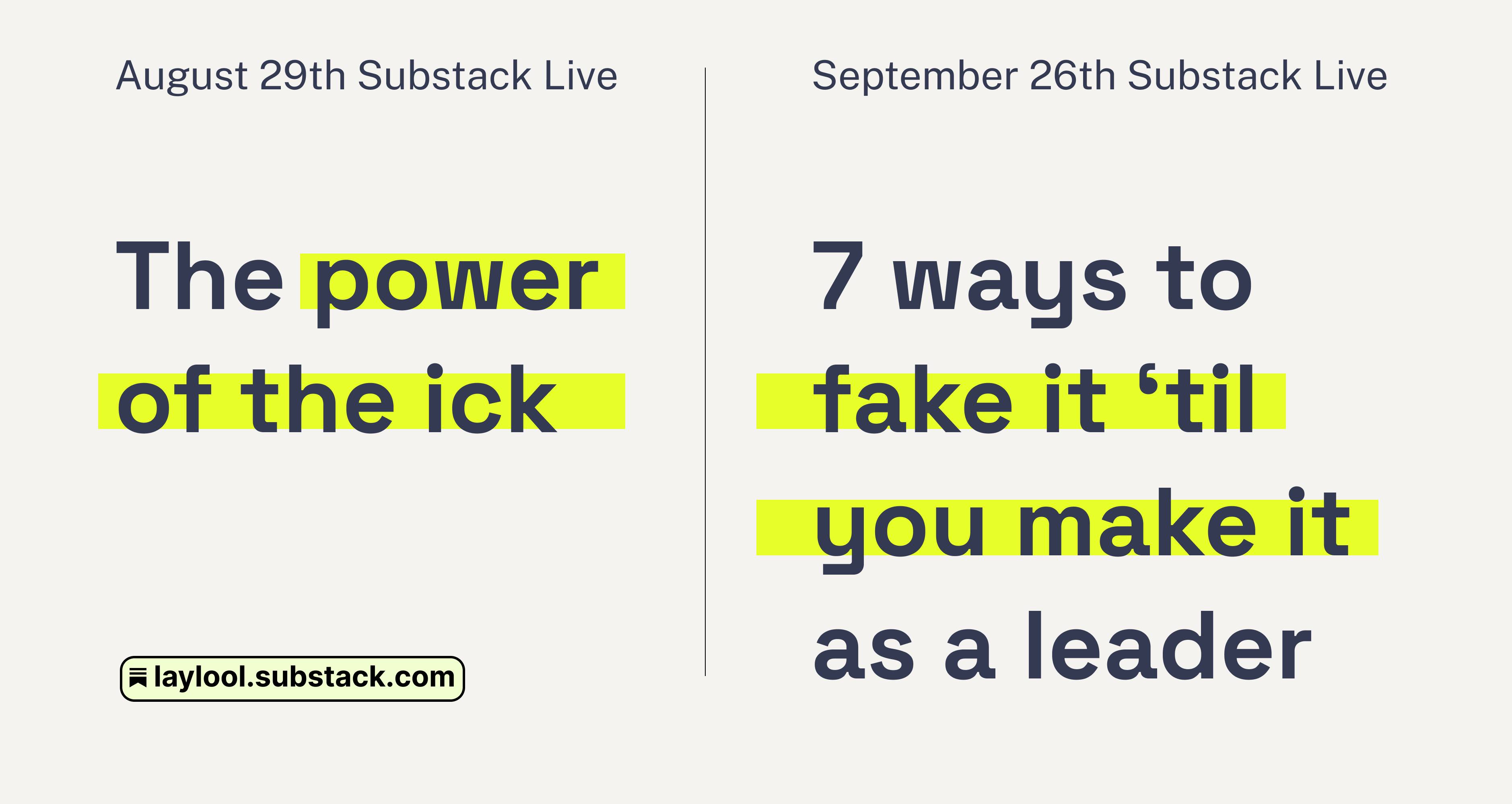
On August 29th, we are gonna talk about the power of the ick. The TL;DR here is that being able to withstand the ick is literally all it takes to do whatever you want.
On September 26th, we are going to talk about the 7 differences I have seen between junior and senior people in the workplace. These strategies will level you up in literally an hour.
And recordings for both will go out after!
Bandura, A., & Walters, R. H. (1963). Social Learning and Personality Development. Holt, Rinehart & Winston.
Haimovitz, K., & Dweck, C. S. (2016). Parents' views of failure predict children's fixed and growth intelligence mind-sets. Psychological Science, 27(6), 859–869.
Aral, S., & Nicolaides, C. (2017). Exercise contagion in a global social network. Nature Communications, 8, 14753.
Raoof, K., Shokri, O., Fathabadi, J., & Panaghi, L. (2024). Unpacking the underachievement of gifted students: A systematic review of internal and external factors. Heliyon, 10(17), e36908.
Kamins, M. L., & Dweck, C. S. (1999). Person versus process praise and criticism: Implications for contingent self-worth and coping. Developmental Psychology, 35(3), 835–847.
Touroutoglou, A., Andreano, J., Dickerson, B. C., & Barrett, L. F. (2020). The tenacious brain: How the anterior mid-cingulate contributes to achieving goals. Cortex.
Barrett, L. F. (2017). The theory of constructed emotion: An active inference account of interoception and categorization. Social Cognitive and Affective Neuroscience, 12(1), 1–23.
Comments
Nothing yet. Say the first thing.
Sign in to join the conversation.