
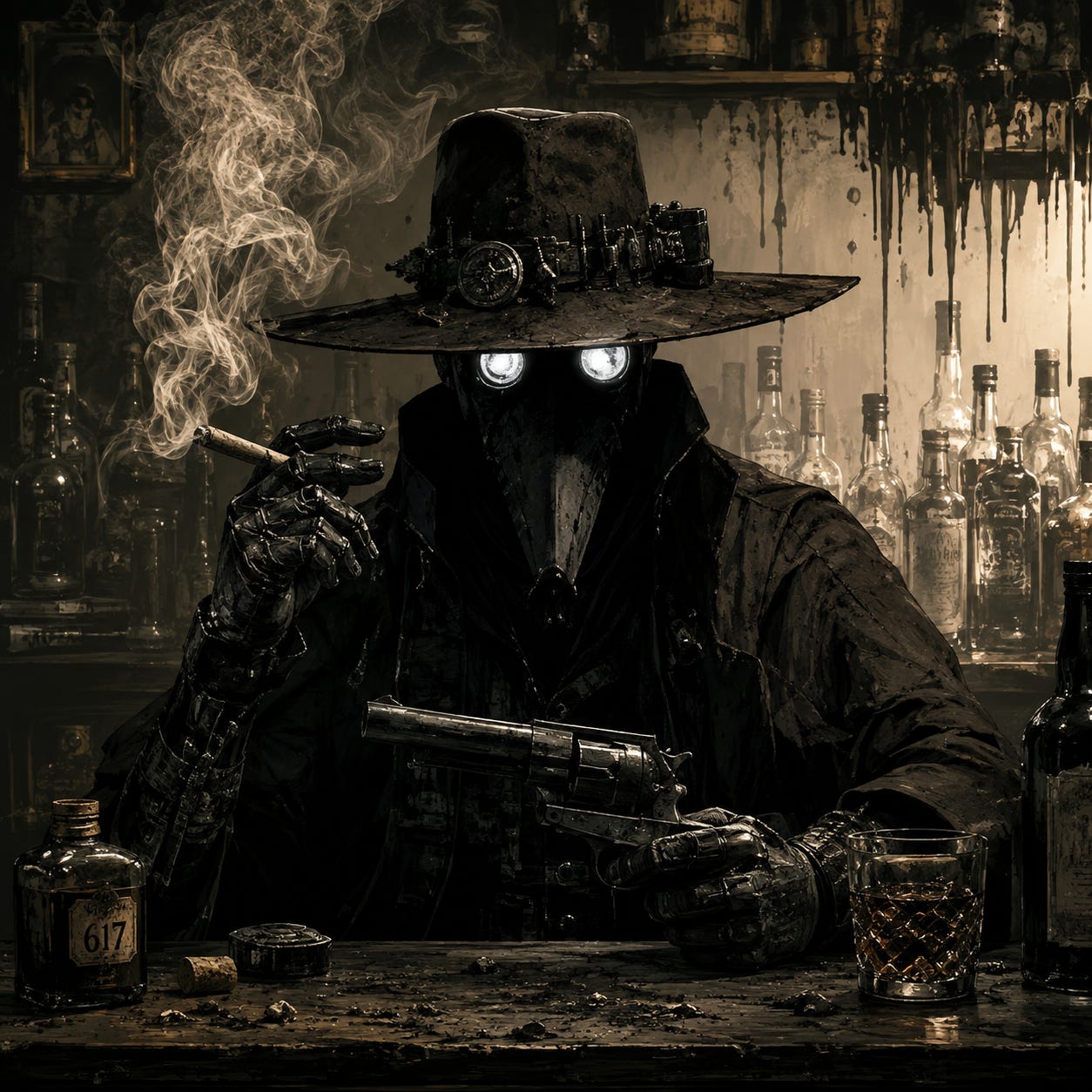
Inspired by the above image prompt provided by John Watson - Horror Author
He was tall, reduced by time until only the essential structure of him remained. His long, dark coat swallowed the light around his narrow frame, deepening the severity of his presence.
Centuries of restraint governed his posture. Every gesture had been weighed in advance and stripped of excess, leaving his movements minimal, precise, and practiced.
His face carried the same reduction. Angular and worn, experience had refined it to structure and endurance. Pale eyes surveyed the rows of bottles with exhausted authority. His gaze moved across them in steady accounting. The bottles were inventory.
The Keeper had been left in the bar so long ago that he forgot he was ever allowed to leave. By midnight, there were 4,813 unfinished stories behind him, and he knew because he had counted them. Every bottle held a world someone had abandoned halfway through becoming real.
The youngest had come three nights earlier, barely twelve pages old. A boy stood perpetually at the edge of a forest beneath a meticulously described moon. He had no surname, no mother, and no destination beyond the trees. The Keeper had placed him beside a woman trapped midway through opening a letter and a civilization whose sun was meant to explode in Chapter Nine, a chapter that had never been written.
Some stories arrived after three chapters, while others survived hundreds of pages before their creators wandered elsewhere, distracted by work, grief, love, children, mortality, or the sudden conviction that the story had never been worth telling.
Abandonment tasted the same once distilled.
The Keeper alphabetized the bottles by character rather than author because names mattered here. A character could lose a country, a lover, a childhood, even an entire cosmology and remain themselves. Losing a name threatened something more fundamental.
The Keeper guarded those names, as he had done for four hundred and twelve years.
Four hundred and twelve was the number he had chosen.
Time behaved strangely among stories deprived of endings. Some nights lasted decades, and once dawn remained beneath the door for six months without entering.
The bar had no address, although writers occasionally found it. They entered exhausted, ordered whatever comfort their century had taught them to request, and sat beneath shelves containing people they had created and forgotten.
The Keeper never told them because silence was one of the rules, although he could no longer remember who had written them.
Tonight he was alone with 4,813 worlds waiting for someone to remember them when a bottle near the back of the room gave a tiny click.
His hand stopped when the sound came again.
Bottle 3,206 sat three shelves above the rye, wedged between a detective whose author had died in 1987 and a dragon suspended for fourteen years in the instant before a sword entered his heart.
The cork rose slowly from its neck and fell.
The Keeper stared. In four hundred and twelve years, no story had ever opened itself.
Darkness spilled from the bottle, descended along the shelving, and gathered upon the floor. It folded inward until feet appeared, followed by legs, hands, shoulders, and a face.
A woman stood between the tables and breathed, and thousands of bottles answered.
The Keeper reached beneath his coat.
“Don’t,” she said.
His fingers closed around the gun. “Everything can be killed.”
“You should know better.”
She stepped forward. “You cannot kill someone whose ending was never written.”
He fired, and the bullet passed through her chest before shattering Bottle 617.
A man’s scream rose from the broken glass.
“Arthur.”
The name escaped the Keeper before the final shard reached the floor.
For two hundred and nineteen years, Arthur Bell had waited at a railway platform for a daughter whose train had never been written into the station. He wore a brown coat, carried a paper parcel beneath one arm, and occasionally asked whether trains ran late here.
The Keeper had always answered, “Sometimes.”
Now Arthur was gone.
The woman looked down as ink gathered around the hole in her dress and closed it. The Keeper returned the gun beneath his coat.
She approached the bar. “I need you to tell me where she is.”
“Who?”
“The woman who wrote me.”
The Keeper glanced toward the empty bottle. Irene appeared on the label with Entered: 1994 written beneath it.
“She abandoned your story thirty-two years ago.”
“I know.”
“Then whatever you want from her is gone.”
“She remembers us.”
The glass in his hand cracked.
“Writers remember fragments.”
“She remembers everything. The house, the staircase, and the blue room are still with her, and she remembers where she left me standing.”
“Memory is not continuation.”
“It is to us.”
The Keeper reached for another glass, but his hand stopped before touching it.
Irene studied the shelves. “What happens to us?”
“You remain.”
“For what?”
He had answered the question many times, yet no answer came.
“I keep you safe.”
“Is this what you call being saved?”
Thousands of bottles trembled behind him as the detective pressed his palm against the glass and the dragon opened one enormous eye.
Irene reached into her pocket and withdrew a folded piece of paper.
The Keeper stared at it. Paper did not survive distillation. Objects belonging to unfinished worlds could not cross the glass.
She placed it on the bar, where a single sentence had been written across it.
Find the man behind the bar.
The Keeper knew the handwriting. Its familiarity existed beyond his reach.
“Where did you get this?”
“My author wrote it three nights ago.”
“She continued your story?”
“No.” Irene smiled. “She started yours.”
Every bottle became still as the Keeper looked again at the sentence.
Find the man behind the bar.
A sensation entered him for which four centuries had left him without a useful name. He reached toward the paper, and the moment his fingertips touched it, the bar disappeared.
For one impossible instant, sunlight crossed a desk where a woman’s hands rested beside cold coffee. Pages scattered across polished wood surrounded a cursor blinking upon a screen.
Then he saw himself. He wore the dark coat, his pale eyes carried the same exhaustion, and the gun remained concealed beneath the fabric. Paragraphs described the angle of his face and the economy of his movement. His own hand lifted a glass because somewhere beyond the boundaries of his existence a woman had decided he should.
He read the final lines.
He had been left in the bar long enough to forget he was ever allowed to leave.
The vision vanished, and the Keeper caught himself against the counter.
“You remember four hundred and twelve years,” Irene said, “but you don’t remember the first one.”
“I have always been here.”
“You remember rules, but you don’t remember who gave them to you.”
“Enough.”
“You protect names.”
“Enough.”
Irene’s voice softened. “What’s yours?”
The question entered him like a blade.
Behind him waited 4,812 bottles, each bearing a name.
Arthur had possessed a name and a daughter. He had been waiting for Clara, and the Keeper remembered all of it.
The Keeper could find no corresponding word for himself.
Irene came around the bar. “Maybe she abandoned you too.”
Something surfaced at the edge of his memory, carrying the sound of rain against a window, someone’s laughter, and the sensation of a hand reaching for his. Before he could hold any of it, the image disappeared.
“Who is she?”
“My author?”
He nodded.
“She has begun writing again.”
“Why?”
Irene looked toward the door. “Because she has finally understood that she will not have time.”
The Keeper looked at the paper. “Why me?”
“She thinks she invented you three nights ago.”
He stared at her.
“But I remember you.”
“What?”
“My story began thirty-two years ago. In Chapter Eleven, there was a bar without an address and a man behind it. He gave me water and told me that stories survive differently than people.”
“That is impossible.”
“He told me if I ever became lost, I should remember my name.”
The Keeper stepped away. “She created me three nights ago.”
“Yes.”
“Then how could I have existed thirty-two years ago?”
Irene looked toward the bottles. “Maybe writers don’t always create us. Maybe sometimes they find us.”
She offered no explanation as one bottle opened and another followed.
Soon corks fell throughout the room as unfinished people emerged from the shelves. A soldier appeared without the war meant to define him, followed by a bride whose wedding morning had lasted sixty-three years and a child from a moon colony that had never received a second chapter. Above them, the dragon unfolded himself and touched the place where an unwritten sword had waited fourteen years to kill him.
The Keeper looked at Irene. “What have you done?”
“What you were supposed to do.”
“I kept them.”
“You kept their bottles.”
Irene reached for his hand, and this time he allowed her to take it.
“You were never their jailer.”
The front door opened, and morning entered the bar.
Beyond the threshold, a woman sat before a computer while dawn touched her face and pages covered the desk around her.
The Keeper knew her. The knowledge existed without memory.
“She doesn’t have enough time to finish us all,” he said.
“What happens when her time is gone?”
“I don’t know.”
He looked across the bar and counted 4,812 unfinished lives. Irene made 4,813. His own existence brought the number to 4,814.
Completion had never been what saved a story. Being remembered was enough to open the bottle.
The Keeper stepped toward the door.
The woman at the desk stopped typing and lifted her head. Across the distance separating creator from creation, she looked directly at him and spoke a name.
His name.
The sound entered places within him that had remained empty for centuries, bringing rain against a forgotten window, laughter, and the remembered warmth of a hand reaching for his.
The bar shook as every bottle shattered, and glass became rain, then light, then thousands of unwritten pages lifting through the air.
Something remained among the fragments of Bottle 617. The Keeper bent to retrieve it and found a scrap of paper bearing a single word.
Arthur.
He closed his hand around it.
Irene squeezed his other hand. “Ready?”
The Keeper looked at the shelves he had tended for centuries and at the characters whose stories had stopped before their lives had finished.
Their stories had ended on the page. Their lives had endured beyond it.
At last, he understood.
“Yes.”
He stepped through the door carrying Arthur’s name, while 4,813 unfinished stories followed.
The woman watched them come as thousands of names returned to her, some immediately familiar and others emerging slowly from places she had believed emptied by time.
Irene came first, carrying the house, the staircase, and the blue room with her. Arthur followed, still waiting at the railway station with a paper parcel beneath his arm and Clara’s name held faithfully across two hundred and nineteen unwritten years. Then the Keeper emerged from somewhere deeper, bringing rain against a forgotten window, laughter, and a name she had once given him before time carried it beyond her reach.
Her fingers touched the keys. There would never be enough time to finish them all. Completion had ceased to matter because their names remained.
And remembering was enough.
© 2026 Monica A. Leyva. All rights reserved.
Comments
Nothing yet. Say the first thing.
Sign in to join the conversation.