


Carolyn from Cardio Rebel | Big Body Movement
One of the privileges of writing the Sunday Subscriber Spotlight is discovering how much of a person exists behind the work we encounter each week. We meet one another first through essays, poems, stories, comments, and conversations, yet every publication carries a much larger history beneath it. There are experiences that shaped the questions a writer asks, convictions that developed gradually, and moments when something familiar began to look different enough that remaining silent became difficult.
Cardio Rebel is one of those writers whose mission captured my attention early because she is willing to challenge something many of us have been taught to accept without examining closely: the idea that we can look at another person’s body and know something meaningful about who they are.
Behind Cardio Rebel is Carolyn, a woman whose love of movement began long before it became a mission, and whose willingness to make herself visible has become an important part of the world she hopes to help create.
We assign extraordinary significance to appearance. We make assumptions about health, discipline, ability, expertise, credibility, and belonging before a person has spoken a word. Within fitness culture, those assumptions can become particularly powerful because certain bodies have been presented so consistently as the visual definition of what an “active person” looks like that anyone outside that narrow representation can appear to be an exception.
Cardio Rebel is working to change the picture.
She is an exercise instructor, a physical activity enthusiast, a researcher by instinct, and a woman who believes deeply that joyful movement belongs to everyone. She also describes herself as fat, using the word intentionally as a neutral descriptor rather than an insult or an apology. Her publication, Big Body Movement, grew from the distance she saw between the inclusive future she hoped fitness culture was moving toward and the reality she increasingly encountered.
“Physical activity is a basic human need, and it can be accessible to everyone.”
That conviction forms the foundation of her work, although the story behind it began well before Big Body Movement existed.
Before there was Cardio Rebel, there was Carolyn, and cardio had already become her first exercise love. She strength trains, practices yoga, and enjoys other forms of movement, but there is something about music and a racing heart that continues to make her happiest. Her relationship with movement stretches back to childhood, including an early NordicTrack brought home by her father, and she grew up surrounded by larger-bodied people who were active and enjoyed being active.
That representation mattered more than she realized at the time.
Because people who looked like her exercised, she never learned to question whether exercise belonged to her. She did not need to imagine herself into a world that seemed designed for somebody else. The possibility was already visible within her own family.
Years later, that experience would become central to the questions she asks through her writing.
Her education gave her several different ways to investigate them. Political economy taught her to look beneath individual behavior toward the economic forces influencing it. Training as a physical therapist assistant brought her into the practical world of helping people move with greater independence and confidence. Her master’s degree in public health expanded the lens again, showing her how health policy eventually reaches individual lives.
What initially sounds like an eclectic collection of disciplines becomes remarkably coherent when viewed through Big Body Movement. Cardio Rebel has learned to examine movement from economic, physical, and policy perspectives while continually returning to the person living within all three.
That background also explains something I appreciate about her writing. She is curious enough to question an assumption and disciplined enough to investigate whether the evidence supports her suspicion. Google Scholar and PubMed are frequent companions in her writing process, and she readily admits that her early drafts can become a little more academic than she ultimately wants them to be. She researches deeply and then works to translate what she discovers into writing that remains accessible.
Her advocacy, therefore, is grounded in both conviction and inquiry.
One of the most compelling questions running through Cardio Rebel’s work concerns representation and the quiet authority images acquire through repetition.
Search for photographs of active people and a familiar visual vocabulary emerges. Fitness advertisements, instructor profiles, exercise campaigns, and health messaging have historically presented a relatively narrow range of bodies. When those images are repeated often enough, they begin doing more than selling products or illustrating exercise. They begin teaching us who belongs.
Cardio Rebel sees representation as one of the ways that lesson can be rewritten.
“When someone sees a person in a body like theirs doing something, they get the message that yes, this is for me too.”
Her vision extends beyond body size. She wants exercise spaces to reflect people across ages, races, ethnicities, genders, cultures, and abilities, including people who use wheelchairs and other mobility aids as both participants and instructors. The goal is greater than creating a diverse collection of photographs. It is creating a world in which fewer people have to wonder whether movement was intended for someone like them.
That distinction becomes even more important when she talks about leadership.
An online comment suggesting that exercise instructors should possess a particular physical appearance troubled Cardio Rebel enough that she wrote about it. The assumption underneath the comment was familiar: fitness expertise should somehow be visible on the body of the person claiming it.
Her response exposes how little appearance actually tells us.
“There are so many components to what makes someone a good exercise instructor, and looks is not one of them.”
We cannot look at someone and determine whether they are patient, observant, knowledgeable, encouraging, adaptable, or skilled at teaching. We cannot see their training or understand how carefully they attend to the people in their class. Yet visual judgments can acquire the authority of evidence, allowing appearance to become a substitute for everything we have yet to learn about another human being.
I find myself returning to this part of Cardio Rebel’s mission because it reaches far beyond fitness.
How often do we decide who someone is before giving them the opportunity to tell us?
Cardio Rebel also makes an important distinction between being welcomed into a space and genuinely believing that space belongs to you.
True belonging, as she imagines it, would begin the moment someone entered an exercise space. The people participating would reflect human diversity, the images and language surrounding them would emphasize joy and inclusion, and equipment would accommodate a wider range of bodies. Exercise variations would exist naturally within the class rather than being presented as a special accommodation for the person who appears to need something different.
There would also be humility.
“We can’t always know what everyone needs, but if we can stay open to hearing their experiences that goes a long way.”
I love the generosity within that answer because it releases inclusion from the expectation of perfection while preserving responsibility. We may never anticipate every experience another person brings through the door, but we can listen when they tell us something prevents them from feeling that the space belongs to them.
Belonging, then, becomes an ongoing practice rather than a declaration.
Visibility occupies a complicated place within Cardio Rebel’s work because she understands that representation can be transformative while also knowing that becoming part of that representation carries risk.
Her recent writing has explored the hostility larger-bodied people can encounter online simply for sharing photographs or videos of themselves exercising. A person may be dancing, lifting, running, teaching, or simply enjoying movement, yet strangers can respond as though the visibility of a fat body requires their judgment.
What fascinates Cardio Rebel is the discomfort beneath those reactions.
She believes many of us have absorbed the idea that joyful movement must somehow be earned, particularly when a person’s body falls outside cultural expectations. Exercise becomes associated with changing the body rather than inhabiting it, and visible pleasure disrupts the story.
“I just wish people would stop for a moment and ask where that discomfort is really coming from.”
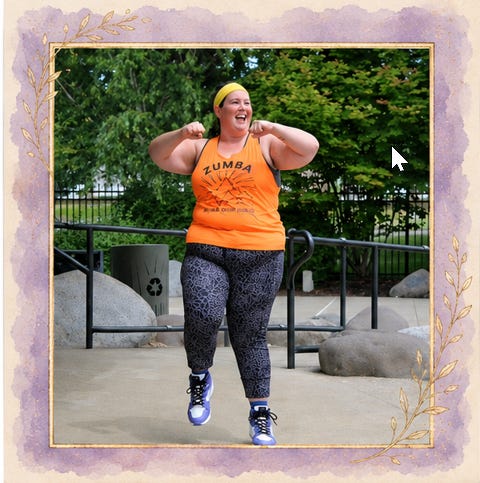
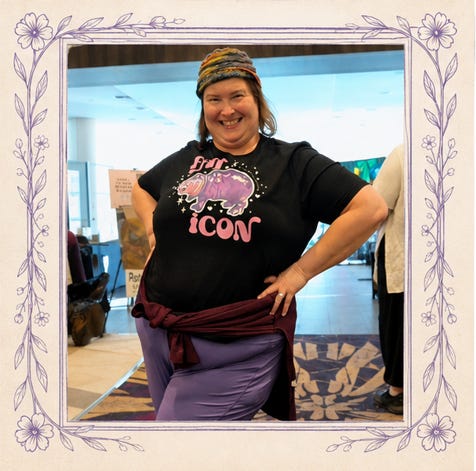
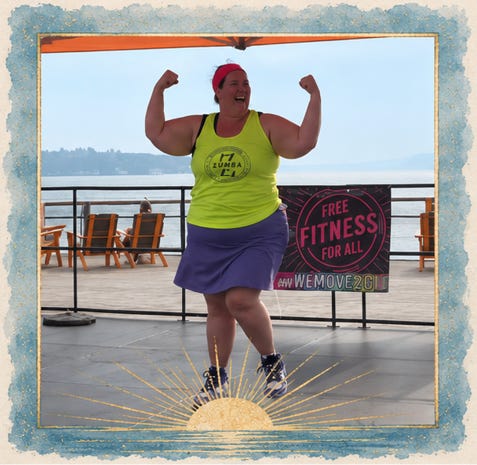
The photographs accompanying this Spotlight make Cardio Rebel's philosophy difficult to separate from the woman herself. In them, she is moving, teaching, hiking, laughing, and occupying the frame with the same confidence she asks the fitness world to make possible for everyone. The joy is immediately visible, but so is something equally important: she has chosen to be seen.
I am inspired by Cardio Rebel’s mission, but I am equally inspired by the courage required to embody it publicly. It is one thing to argue that people deserve acceptance without first satisfying someone else’s expectations about how their bodies should look. It is another to place yourself visibly inside that argument, to teach the class, share the photograph, dance freely, and allow the world to see the very joy you are defending.
Cardio Rebel refuses to surrender her identity to a visual label.
Her work continually reminds us that a body cannot tell us whether someone is knowledgeable, disciplined, compassionate, healthy, joyful, capable, or worthy of belonging. Those truths require something far more demanding than a glance. They require curiosity about the person standing before us.
Her willingness to be seen becomes particularly meaningful because she understands the vulnerability visibility can carry. She knows what can happen when a larger-bodied woman occupies a fitness space confidently and publicly, and she continues to show up anyway.
She does more than tell readers that joyful movement belongs to everyone; through her willingness to teach, dance, write, and make herself visible, she lives as though she believes it.
One of my favorite discoveries about Cardio Rebel is that her exploration of these ideas does not remain confined to essays.
She wrote a piece of fiction called Fat From the Future about a woman from 2053 who sprains her ankle while hiking, is transported to our present day, and needs medical care. Cardio Rebel expected the story to provide a relatively quick way to explore several problems larger-bodied patients encounter within healthcare.
Then she began following her character through the experience.
The stairs and elevator raised questions. Reception raised others. Seating, vital signs, and the ordinary mechanics of a medical visit revealed how many assumptions can become embedded within environments that appear unremarkable to people who move through them comfortably.
The fictional exercise changed her own understanding.
She began considering how exhausting those accumulated experiences could become and how fear of what might happen after an injury could influence someone’s willingness to be active in the first place.
I love when writing does that. We begin believing we are taking an idea somewhere, only to discover that the process has carried us somewhere unexpected.
For Cardio Rebel, fiction became another way of seeing the system surrounding the body.
Eventually, nearly every path through Big Body Movement returns to joy.
Fitness culture has developed an extensive vocabulary for explaining why people should exercise. Movement can support health, improve strength, prevent disease, change appearance, and contribute to many measurable outcomes. Cardio Rebel understands those arguments and the evidence behind them, but she believes something essential has been lost when movement is discussed primarily as a means to a future result.
“For me, joy is the whole reason why movement is worthwhile.”
She points toward research showing that enjoyment plays an important role in whether people maintain physical activity, but her belief is also beautifully immediate. When she dances, moving makes her happy. The experience possesses value while it is happening.
That philosophy has also evolved through conversations with her readers. When she began Big Body Movement, she was particularly interested in people who were not exercising. Readers recovering from eating disorders helped her understand another side of the conversation by teaching her more about compulsive and excessive exercise. Their perspectives widened her thinking and reinforced the importance of approaching movement through wellbeing rather than obligation.
For someone whose relationship with exercise has been shaped primarily by calories, weight, discipline, or changing their appearance, Cardio Rebel suggests beginning gently. Find movement that feels enjoyable. Allow the experience to exist without immediately tracking, measuring, or justifying it. Walk with friends, go bowling, take a dance class, or learn a skill simply because learning it feels good.
The shift from have to toward want to may appear small, but within Cardio Rebel’s philosophy, it changes the entire relationship.
Then there is Carolyn herself, the woman behind all the research, advocacy, and cultural critique, and getting to know that part of her may be my favorite part of this story.
Cardio Rebel will dance practically anywhere, including on an elliptical machine. Her current rebellious musical obsession is G Flip’s “Bed on Fire.” She also has two beloved dogs, a golden aussie and a corgi, who provide an entirely different variety of joy. When she wants a hobby requiring considerably less cardiovascular exertion, she knits, although she cheerfully admits she does not consider herself particularly good at it.
One of the photographs she sent me for this Spotlight captures another side of her relationship with movement.

Several years ago, while in Arizona, she and a friend went on a sunrise hike. Cardio Rebel essentially rolled out of bed and undertook the adventure in her pajamas. Hiking was hardly her usual form of cardio, but they walked around an enormous rock as the morning opened around them, watching the landscape emerge beneath the rising sun.
She remembers the views as extraordinary and the experience as something special.
I cannot imagine a better story to accompany her philosophy.
Joyful movement was never supposed to require the correct outfit, the correct body, the correct intensity, the correct setting, or someone else’s permission. Sometimes it happens in an exercise class with music playing. Sometimes it happens while dancing on an elliptical machine. Sometimes it happens while walking around an enormous rock at sunrise in your pajamas because the world outside the window looked worth exploring.
Perhaps the common denominator has always been much simpler: when movement offers joy, wanting to move can be reason enough.
Cardio Rebel has imagined what the fitness world might look like ten years from now if the cultural change she advocates for begins to take hold.
She hopes to see the exercise industry separate itself from diet culture and promote physical activity for the experience and benefits of being active, particularly the immediate ones such as feeling happier and stronger. She wants far greater diversity among the people represented in fitness and among those leading it. She wants inclusiveness to become a core professional value, and she hopes for a culture less inclined to judge people according to the size of their bodies.
She readily acknowledges the ambition of that vision.
Then again, cultural change has always required someone willing to imagine a reality that does not yet fully exist.
She hopes Big Body Movement becomes one voice within a growing chorus of people showing that exercise belongs to everyone. She would like more readers to discover the publication, and someday, like many writers who find themselves building a body of work one essay at a time, she would love to write a book.
I hope she does.
Because what Cardio Rebel is building extends beyond a publication about exercise. She is asking readers to reconsider the stories we have inherited about bodies, health, movement, expertise, and worth, while offering another possibility in their place.
Her alternative begins with joy.
While preparing this Spotlight, I kept returning to the courage required to become visible in a world that can be extraordinarily quick to transform appearance into identity.
We look at one another and categorize almost instinctively. Somewhere within that first visual impression, assumptions can begin accumulating before curiosity has been given an opportunity to intervene. We imagine we understand something about another person’s health, habits, intelligence, competence, discipline, or life simply because we have seen the body they inhabit.
Cardio Rebel’s work challenges that reflex with a persistence I admire deeply.
What inspires me about her voice is that she does not merely ask for a broader definition of fitness. She asks us to examine why acceptance should ever depend upon satisfying a visual expectation in the first place. She reminds us that human beings deserve the freedom to enter spaces without first proving that their appearance qualifies them to belong there.
There is bravery in making that argument while also allowing yourself to become part of the evidence. Every photograph she shares, every class she teaches, every piece of choreography she posts, and every moment of unapologetic joy places another image into a culture whose visual vocabulary has remained narrow for far too long. Somewhere, another person may encounter that image and recognize a possibility for themselves.
Cardio Rebel experienced that gift as a child because active people who looked like her were already part of her world. She understood that movement belonged to her before anyone had the opportunity to suggest otherwise. Now she is creating that same possibility for people she may never meet.
Perhaps that is where representation becomes something larger than visibility. Seeing another person living freely can expand our understanding of what is possible, while being willing to live freely where others can see us can become an act of generosity.
Carolyn possesses the courage to be seen, the intellectual curiosity to investigate the systems that make such courage necessary, and the generosity to hold the door open behind her so that someone else might find entering a little easier.
I began reading Cardio Rebel because I was interested in the ideas behind Big Body Movement. I came away from these conversations admiring Carolyn, the woman behind them, whose courage, curiosity, and unmistakable joy give those ideas their human form.
Near the end of our exchange, I asked Carolyn to complete a sentence: Every body deserves... Her answer captures the philosophy behind everything she is building.
Her answer required only a few words.
“Every body deserves the freedom to move joyfully and without judgement.”
I cannot think of a better introduction to her work, or a better invitation to the world she is trying to create.
Thank you, Carolyn, for reminding us that acceptance should begin with the human being rather than the label someone else places upon their appearance, and for possessing the courage to make yourself visible while inviting others to discover that they belong here too.
You learned it early,
before the world
could complicate
something elemental.
Movement belonged to you.
Music invited,
your body answered,
and joy required
no justification.
Years later,
you discovered how readily
the world assigns meaning
to appearance,
mistaking silhouette
for evidence,
aesthetic
for health,
and expectation
for expertise.
So you chose
a different vocabulary.
Curiosity became inquiry,
research strengthened conviction,
and your own visibility
became an invitation.
You teach and dance.
Stepping into the frame
knowing what judgment
may follow,
yet understanding
someone else
may be watching.
Perhaps they will see you
and reconsider
what they were taught.
Perhaps possibility
will replace hesitation.
Maybe this belongs
to me too.
That is the generosity
within your work, Carolyn.
You inherited the certainty
that movement could belong
to a body like yours,
and now you offer
that certainty
to others.
Through scholarship,
courage, humor,
and irrepressible joy,
you are widening
the image of belonging
until more people
can finally see themselves
inside it.
© 2026 Monica A. Leyva. All Rights Reserved.
Joyful Movement Belongs to Everyone
To The Extreme: Exploring Why High-Intensity Exercise Dominates the Fitness Industry — Part One
For readers who would like some music with their rebellion, explore Cardio Rebel’s Fat Liberation Pump-Up Song of the Week series.
Comments
Nothing yet. Say the first thing.
Sign in to join the conversation.