
The AI for PI Index™ tracks how personal injury firms appear across AI engines each week - which firms get named, on which engines, in which markets, and where those recommendations come from.
These are the AI for PI Insights™ as of Monday, July 27, 2026.
This week’s corpus included:
20,131 AI answers
12,877 distinct firms named
167,600 source citations tracked
259 cities
All 50 states plus D.C.
One note before the findings: two engines’ answer volumes shifted this week (Claude down, Google AI Overviews up), so we’re not comparing corpus-wide totals to last week. Perplexity and ChatGPT produced identical answer counts both weeks - 6,153 each. That’s what makes this week’s big finding clean.
Every week, we share one big finding, which firms moved, why it matters to your firm, a client data point, and new this week, a closer look at one US market. Let’s get into it.
The answer format changed - the firms didn’t.
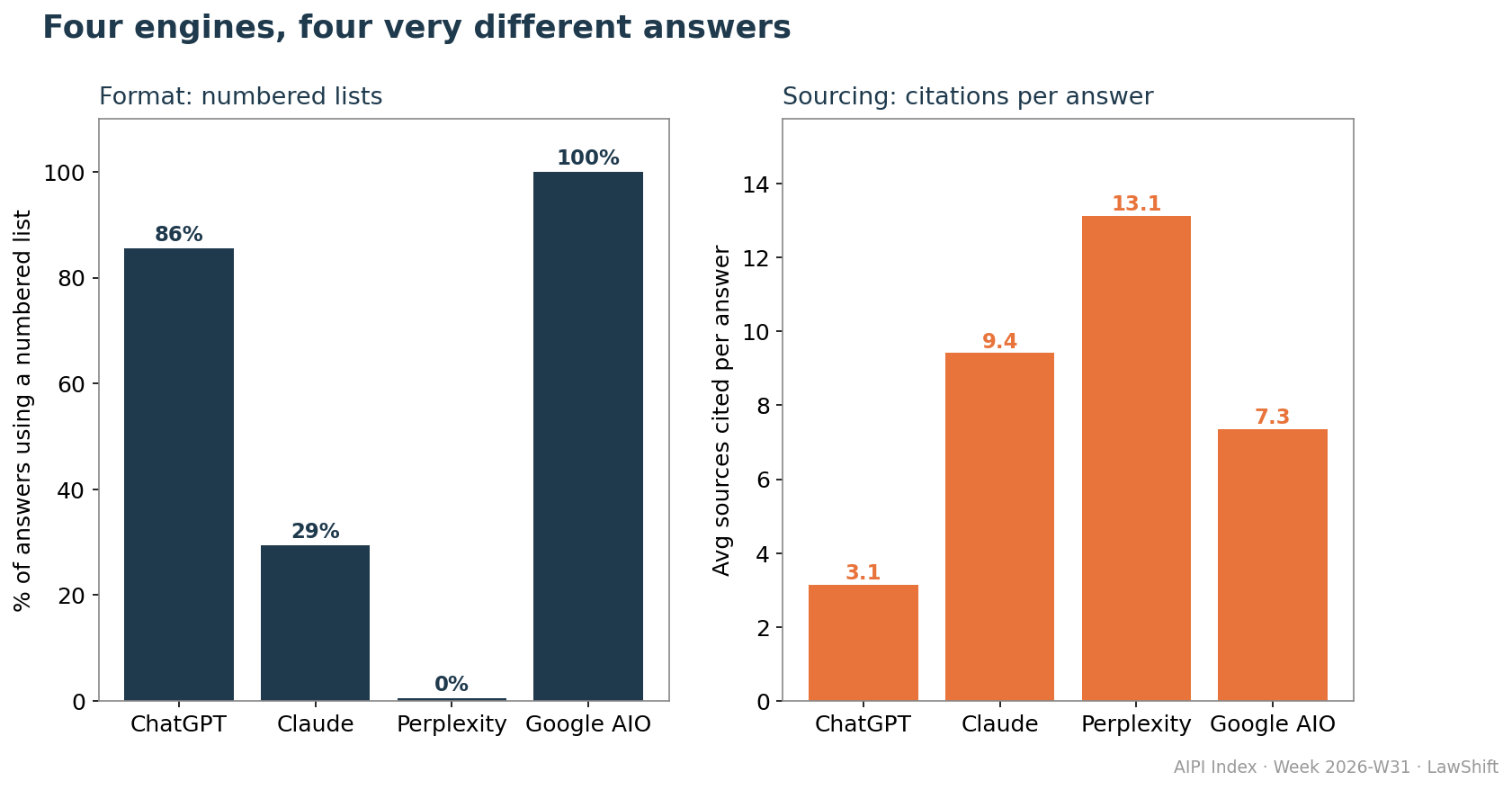
Last week, when you asked Perplexity for a personal injury lawyer, 19.1% of its answers ranked firms in a numbered list - one through ten, the way a search results page would.
This week, that number is 0.5%.
Perplexity still recommends firms - it names at least one in nine out of ten answers. But the answers changed shape: they’re now bulleted lists instead of numbered ones, they’re 24% shorter, and they name fewer firms per answer.
Last week Perplexity named 6,056 distinct personal injury firms. This week it named 5,348 - from the exact same number of answers.
That’s 708 less firms in one week.
For scale: AI names about 189 personal injury firms in a typical state - Perplexity dropped almost four times that in seven days.
You might expect shorter answers to squeeze every firm equally. The opposite happened.
Morgan & Morgan was named in 31% more Perplexity answers than last week.
Morris Bart, 46% more.
The Wilhite Law Firm, 32% more.
Farah & Farah, 19% more.
Ben Crump Law was named in 57% fewer. John Foy & Associates, 39% fewer.
When there were ten numbered slots, there was room for local firms. With three or four bullets, the engine goes with the biggest, safest names it knows.
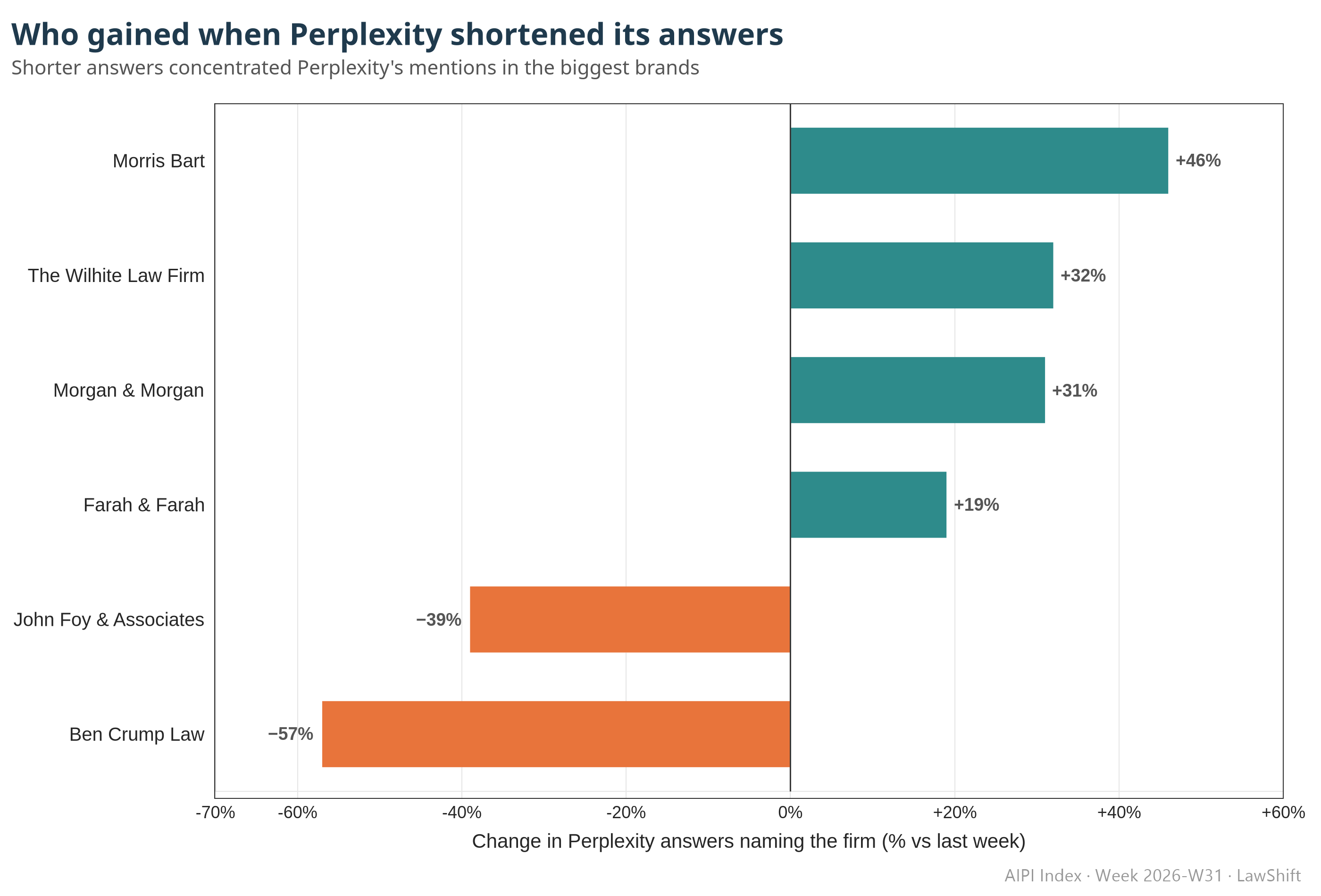
Every mover in this week’s national top 10 traces back to this one format change.
None of those 708 firms redesigned a website, lost a review, or changed a thing. The AI Invisible just became even more invisible.
These kinds of changes are why we measure weekly. A firm’s AI visibility can drop by half in a week with zero change on its side - and without a weekly reading, that firm would never know. It’s also why the index ranks firms on a four-week rolling view rather than any single snapshot. One week can be misleading. Four weeks tells you what’s happening.
It’s also why single-tactic theories - “just get on Reddit,” “just get more reviews” - fall apart when you look at this data. A holistic approach to building trust with the LLM’s is the way.
Next week’s data will show whether Perplexity’s change sticks. We’ll report it either way.
Nick Kringas and Bill Wilson break down this week’s data on the AI for PI Index Companion Podcast - including the market where one engine has named three different #1 firms in three weeks.
Where AI looks: the front door is a directory - and each engine has a favorite.
If a format change decides who survives, the next question is what decides who gets named at all.
All seven of the most-cited websites across this week’s 167,600 citations are legal directories: Super Lawyers, Avvo, Justia, FindLaw, Expertise, Lawyers (dot) com, LawInfo.
The first law firm website in the ranking is #8.
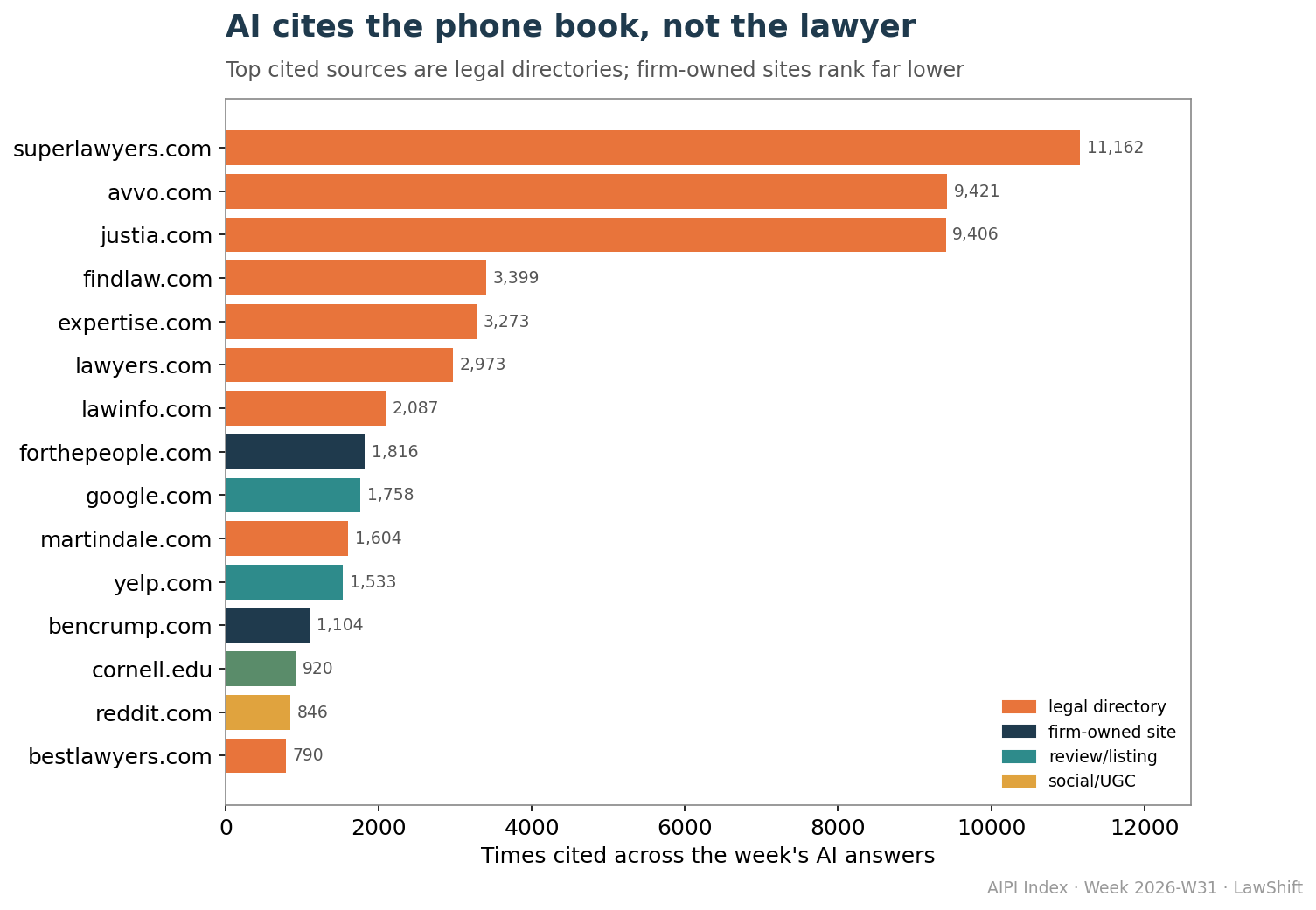
And each engine has its own favorite. Avvo alone supplies a third of everything ChatGPT cites, and appears in 63% of ChatGPT’s cited answers. Google AI Overviews barely touches it.
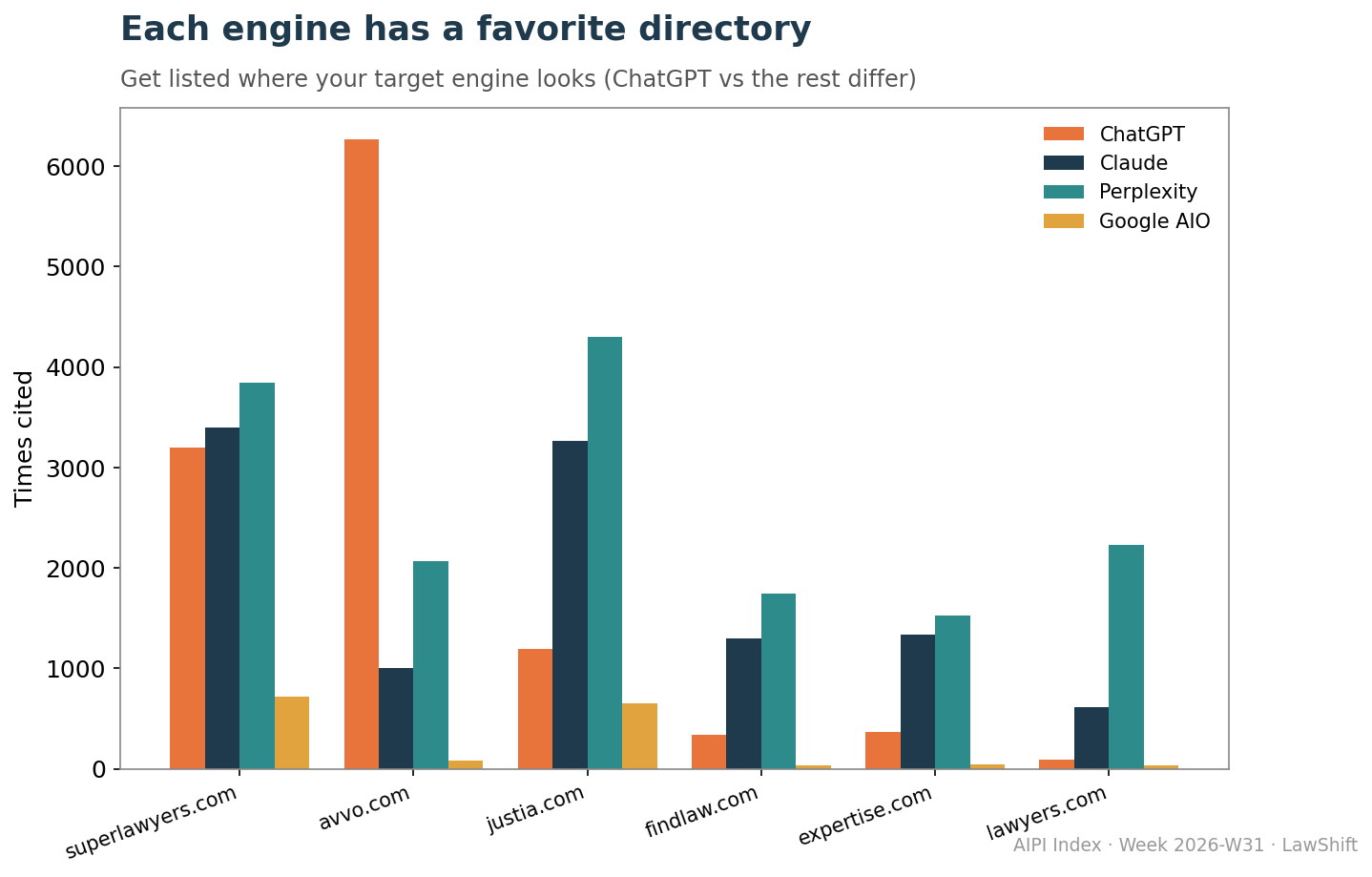
ChatGPT is the engine injured people use most, and it does the least homework. It cites about 3 sources per answer. Perplexity cites about 13. ChatGPT has web search available for every one of these questions - and mostly chooses not to use it.
Google AI Overviews is the mirror image of ChatGPT. 56% of what Google’s AI cites is firms’ own websites; only 8% is directories. Our read on why - and it’s an interpretation, not a finding: Google is the only engine that doesn’t need a directory to vouch for a firm. It has twenty years of its own index and local business data.
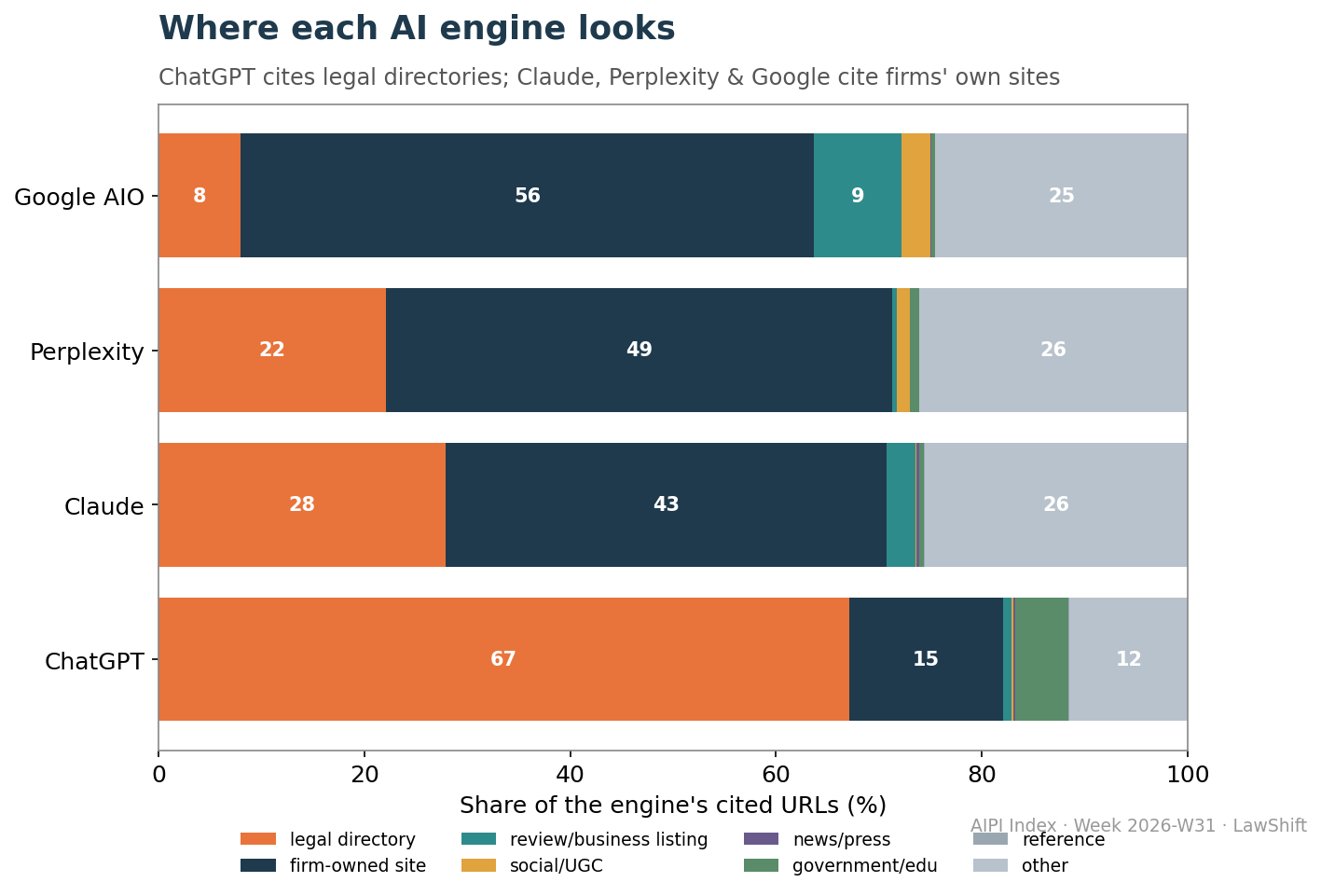
For anyone who did SEO in the last two decades: the old game was outranking the directories on the results page. Now AI consumes the directories - and the person asking never sees them. You can’t outrank a middleman the user never sees. You can only make sure the directories have you right.
The firm tracker: the week the leaderboard moved on its own
Morgan & Morgan holds #1, named in 7.5% of all 20,131 answers this week - and that number is the ceiling of the entire market. The national top 10 combined account for just 5.7% of all firm mentions.
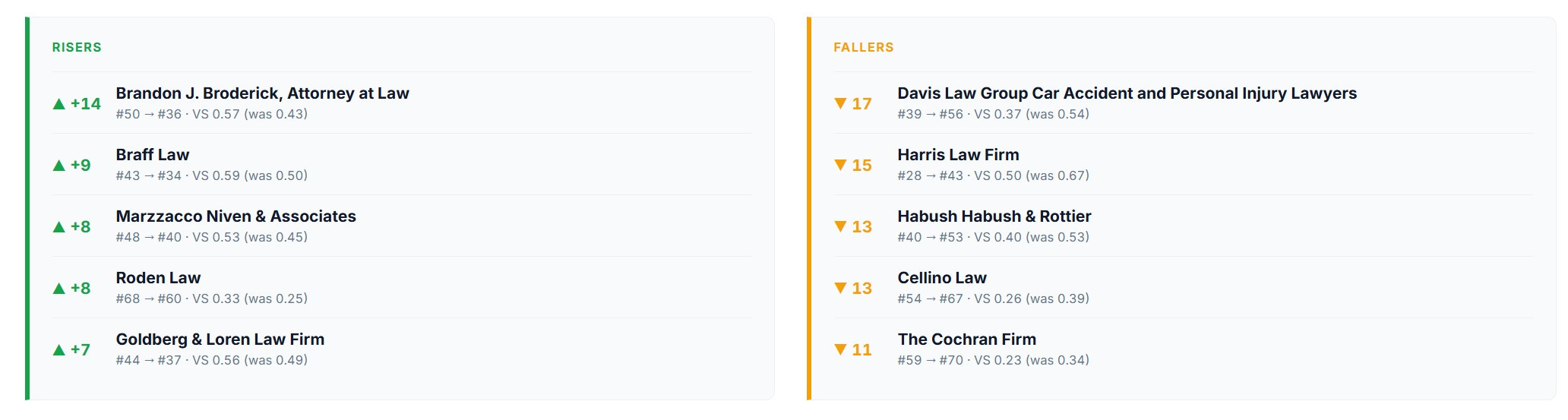
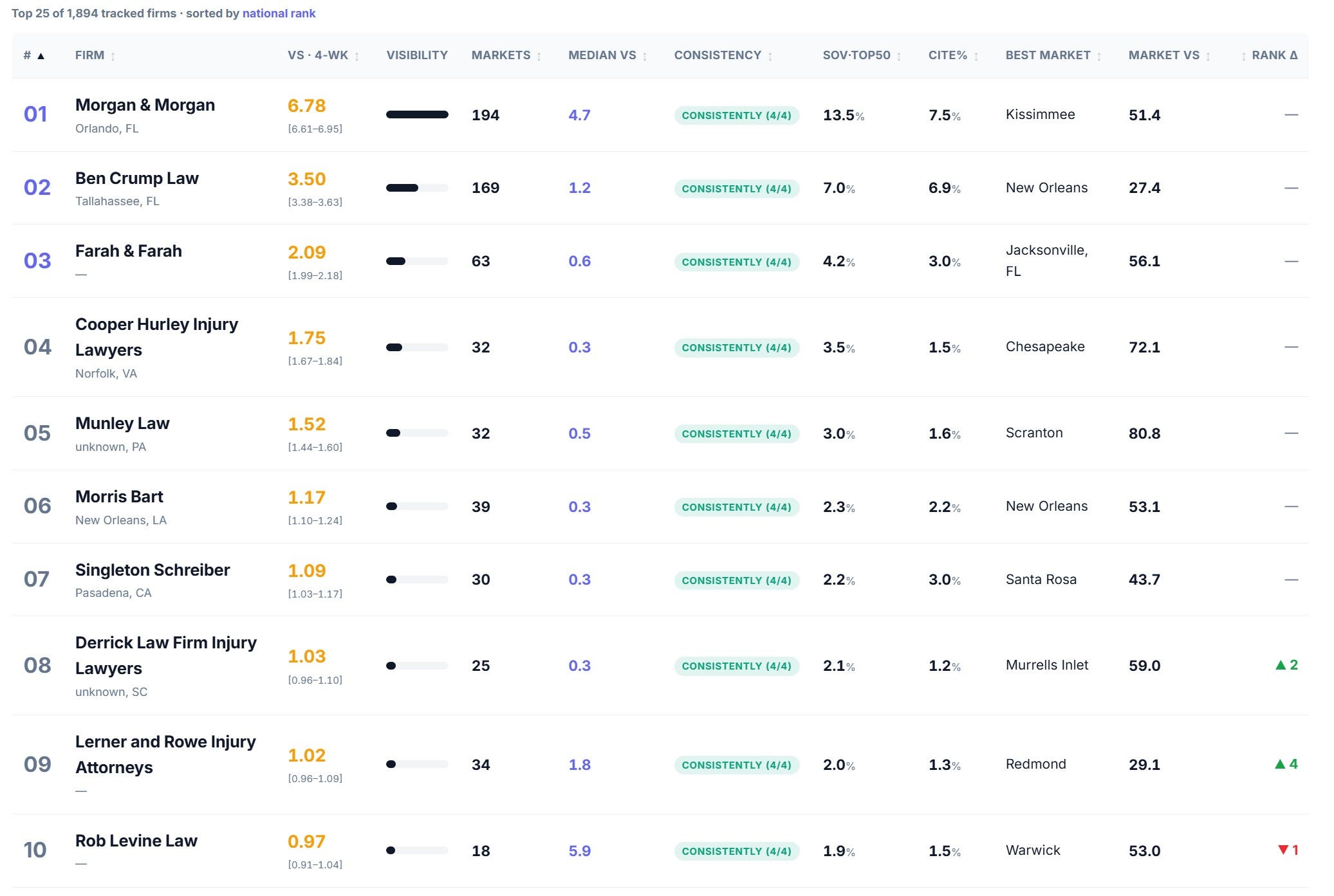
As covered above, this week’s national movers - up and down - all trace to the Perplexity format change, not to anything those firms did.
Meanwhile the strongest firms in the index aren’t national names at all. Berman & Simmons appears in 58% of Maine’s AI answers - and ranks #285 in the country. AI fame doesn’t cross state lines. You need to own your own market, not all 194.
Even at the top, nothing is locked in: the typical market leader appears in under a third of its market’s answers, and 64% of the 12,877 firms named this week were named exactly once.
The biggest PI market in the country has no owner.
Starting this week, we’re picking one market from the index and taking a closer look. First up: the most contested personal injury market in America.
This week, AI engines named 692 different personal injury firms in the Los Angeles metro.
478 of them - 69% - were named exactly once.
The entire top 10 combined controls less than 23% of all mentions. In the biggest PI market in the country, more than three-quarters of AI’s recommendations go to everyone else.
The Dominguez Firm leads.
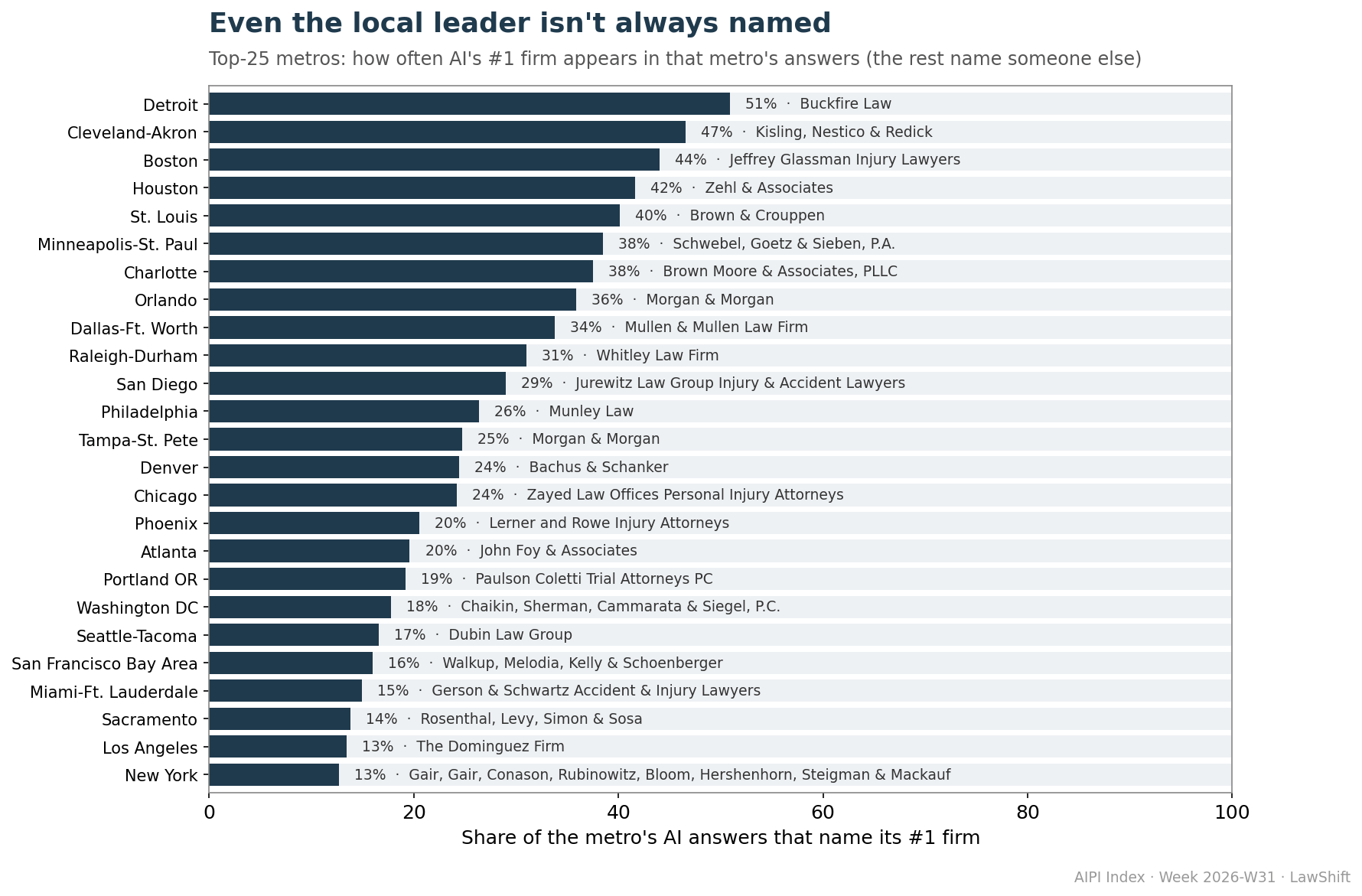
On the index’s four-week view they appear in roughly a third of LA’s AI answers - the strongest position in the market. In this single week’s corpus it was 13.6%. Both numbers are true; that’s the gap between a snapshot and a trend, and it’s exactly why the index ranks on four weeks.
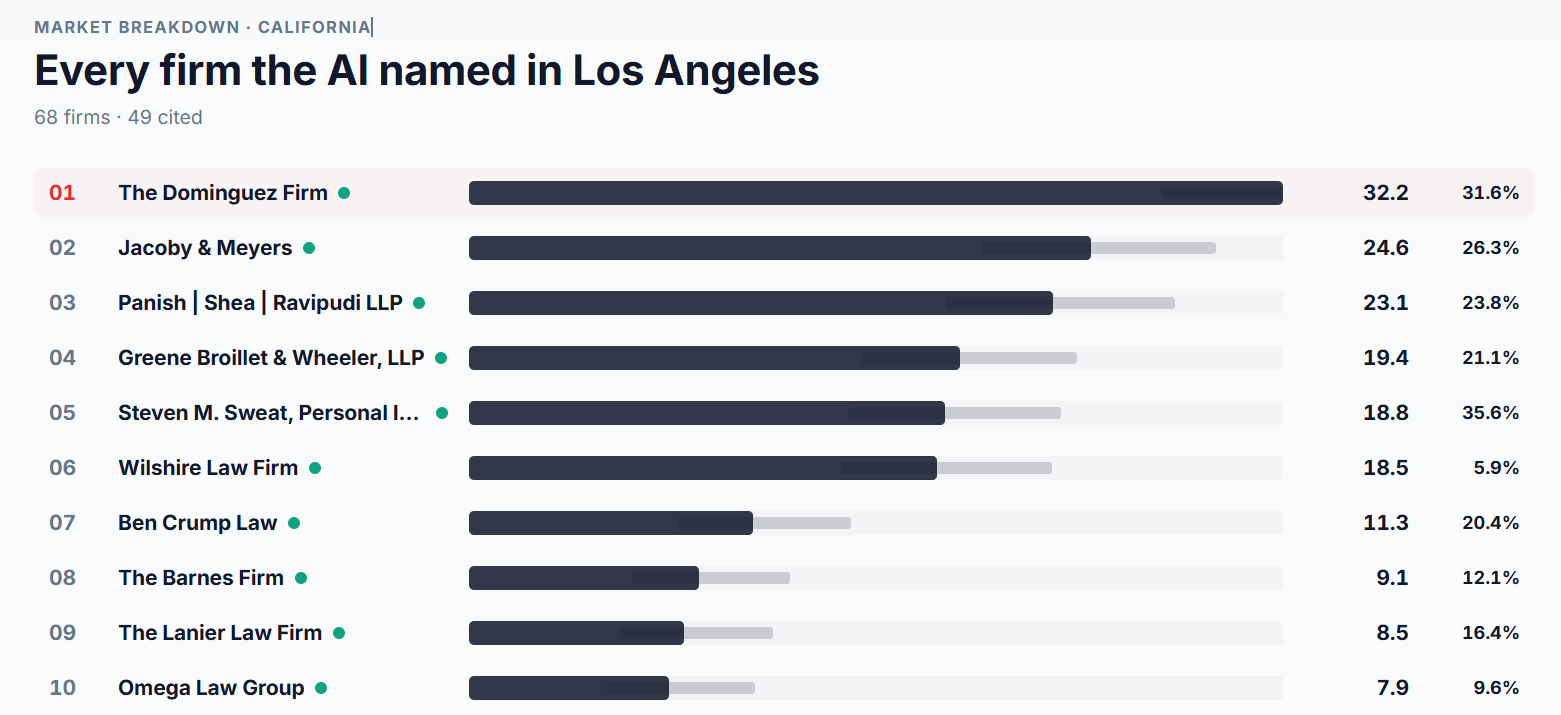
But the engines don’t agree on who’s #1. Claude, Google, and Perplexity all say Dominguez. ChatGPT says Adamson Ahdoot - and last week it said Quirk Law Firm. That’s three different #1 answers from the same engine in three weeks.
The most interesting firm in the LA data sits further down the list.
Steven M. Sweat’s website is the second-most-cited firm site in the entire market - 122 citations this week, just behind Dominguez’s 135. But the firm itself doesn’t crack LA’s top 10 in mentions.
AI trusts his website more than it recommends his firm.
That’s the clearest proof yet of something we keep seeing in the data: being the source and being the answer are two different things. You can win one and lose the other.
You control what AI reads about you.
Two plays follow from this week’s data.
First: make sure the big three directories have you right - Super Lawyers, Avvo, Justia. At least one of them appears in 64-79% of cited answers on ChatGPT, Claude, and Perplexity. They’re the layer AI reads before your website matters. Super Lawyers is the one directory all four engines use consistently. This is the foundation - it’s how you get on the map at all.
Second: stop optimizing for a format and start being easy to include. The numbered slots firms could have tuned for last week no longer exist. What survives an engine’s whims is short, factual, citable material - and a point of view. Because here’s what AI already says about everyone:
It calls a firm “the best” in 72% of answers.
It mentions a free consultation in 66%.
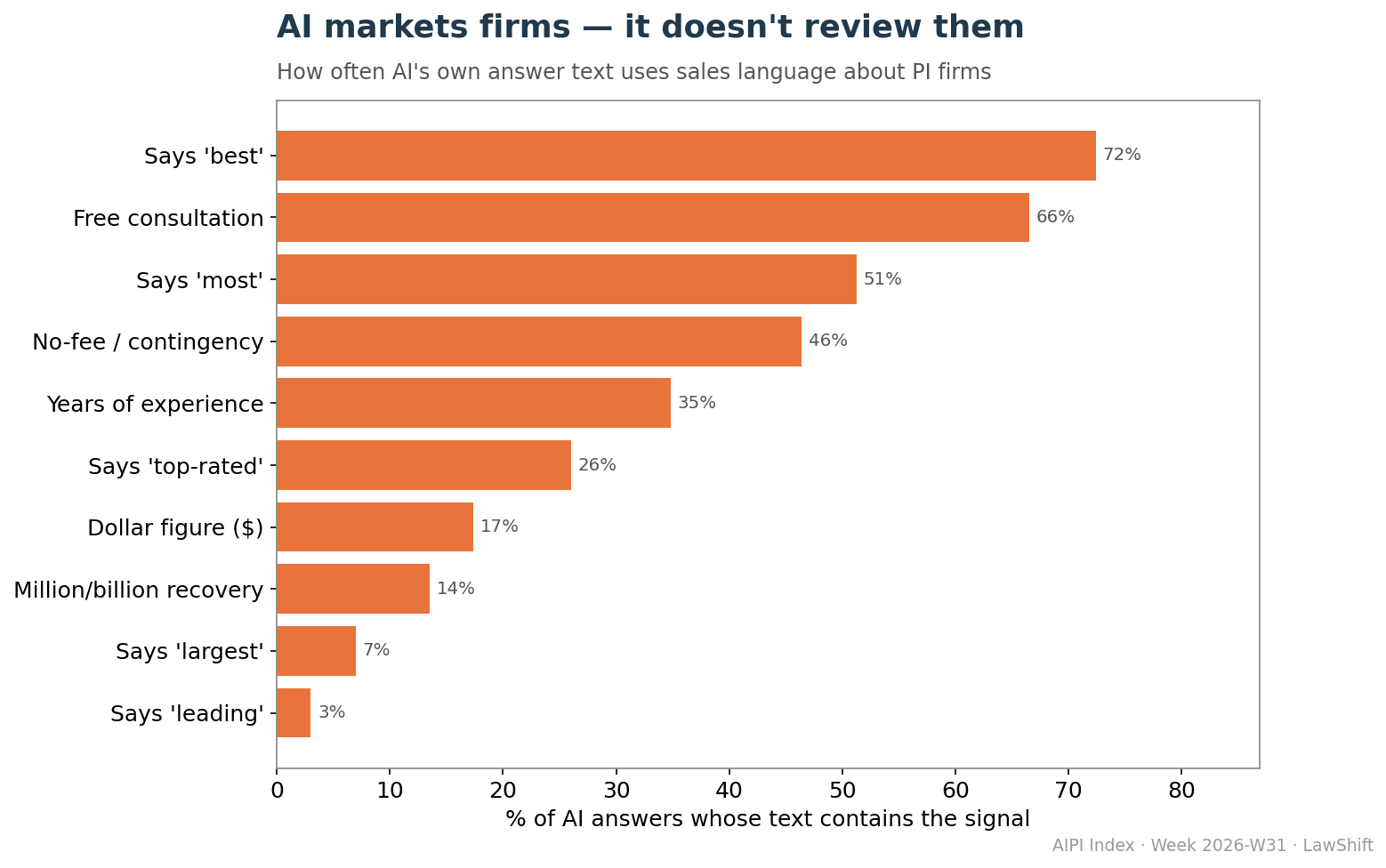
Every firm in the country makes those claims, so AI repeats them about every firm equally. If that’s all AI can find to say about you, nothing separates you from the 708 firms that disappeared this week.
Lopez and Humphries, P.A. rose to #1 in their Central Florida market, appearing in 67% of AI answers to personal injury queries there.
Malloy Law Offices, LLC went from 0% AI visibility to over 40% across their Maryland markets.
The firms winning AI recommendations right now are the ones each engine finds easiest to read and cite.
Everything in this issue happens before a firm ever hears from the injured person. What happens in that window, from injury to intake, is what we call The Pre-Intake Problem™ - and it has been largely unserved until now.
Request a Pre-Intake Revenue Strategy Discussion. Thirty minutes on your market and your revenue - who AI recommends, who it leaves out, and what that means for the cases you sign. No pitch. No strings attached.
Schedule your Pre-Intake Revenue Strategy Discussion at LawShift.ai.
Until next week,
Nick Kringas, Lydia Flocchini, and Bill Wilson
LawSHIFT the First Pre-Intake AI for PI Company
Injured-First. Always.
Thanks for reading LawSHIFT Pre-Intake AI! This post is public so feel free to share it.
Comments
Nothing yet. Say the first thing.
Sign in to join the conversation.