
Those of you who have followed me on twitter may be aware that I have a recently-teenage son with wide and varied scientific interests who, over the last year and before his thirteenth birthday, demonstrated his academic acumen by passing GCSE (Year 10 or School Certificate) exams in Math, General Science, Biology and Computing.
His academic and scientific interests have seen him, after visiting Bletchley Park and seeing and having the engineering and technical processes of Turing and Keen’s Bombe machines used for breaking Germany’s Enigma code during the later stages of World War 2 explained to him, develop a python program that can perform the decryption of a whole wall of Bombe machines in seconds. He has since gone on to add such things as identification, encryption and decryption of morse code to his personal ‘digital bombe machine’.
It was therefore no surprise that he also has a keen interest in astronomy and astrophysics. He loves documentaries about the formation of planets, the processes inside stars and, naturally, is an avid consumer of science fiction books - with a personal bookshelf of space stories from James S. Corey (thanks to my PhD supervisor Professor Norman Fenton), Sir Isaac Asimov and Arthur C Clarke, just to name a few. He was even given the opportunity through contacts at the university where I worked to meet Astrophysicist Brian Cox when he was going to be making an appearance to talk to students at a school in Tower Hamlets, and front row seats at the O2 dome to see Cox’s show ‘Horizons’... except that Covid intervened in 2020 when these things were supposed to happen.
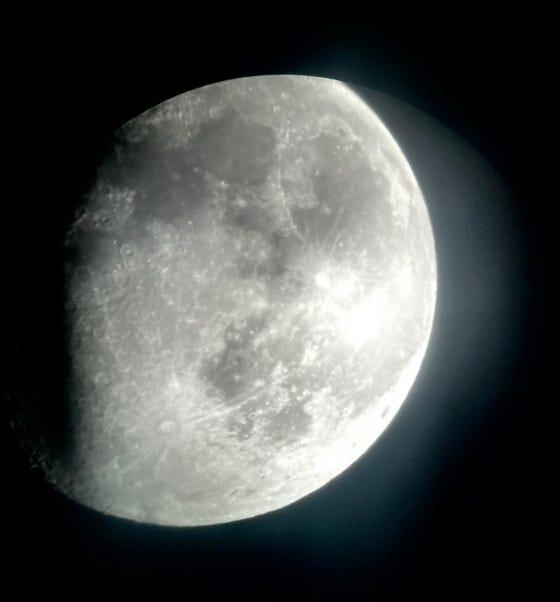
In late 2017 when the interstellar Oumuamua comet passed through the solar system I purchased an old 8” or 200mm Dobsonian telescope. I took my son out in the country north of Cambridge in the UK and set the telescope up in a cow paddock. While we couldn’t see Oumuamua, he did get to see Jupiter and at least six of its moons and, sort of peeking over the shoulder of Jupiter, Saturn and her rings. This ignited his interest in astronomy. In 2025 he received the gift of a Celestron 8SE Schmidt-Cassegrain telescope that he only got to use once before I was denied tenure and our lives changed. During that one use and in spite of significant light pollution in Derbyshire, he was able to clearly see craters on the surface of the moon. The image below was taken that night through the Celestron using a 25mm lens and an iPhone mount.
It was quite disheartening for my son when, after it had spent six weeks on a container ship catching up with us, we unpacked and set up his telescope to find it could not even focus on something as large and obvious as the moon. This was an incredible bit of potentially expensive bad luck. It was clear that something had happened during its long journey. Telescopes are, after all, finely tuned and easily misaligned scientific instruments.
In desperation I looked to see if there was a local astronomical society or amateur astronomy group and, as luck would have it, there was. I reached out and they made contact and. while they normally had public open nights on Thursdays, they happened to be having an extraordinary Friday night session in their observatory for a small handful of club members. We were, I was told, welcome to bring the telescope up in the hopes that one of the members might be able to assist us in identifying what was wrong.
What we found was nothing short of amazing. During the preceding decade a small group of amateur, semi-professional and even one or more professional astronomers had secured funding to build a museum and education centre, along with an observatory space that was around ten-by-five meters with a ceiling that slid away on motorised rails to expose the sky above. Indeed, it also transpires that some of the very small handful of original members (four or five in total) were the people responsible for my own interest in astronomy and astrophotography. Four decades ago in 1986 when Halley’s Comet last visited they had set up telescopes in the centre ring of the race course in my home town and invited members of the public to come at 4am to view the comet at the closest point to Earth on its passing. That had been in the last days of March 1986, weeks before my eleventh birthday. Today, their membership numbers in the several hundred and includes people living and working not just in New South Wales, but even some who have or are working for Nasa, and many from quite disparate scientific domains.
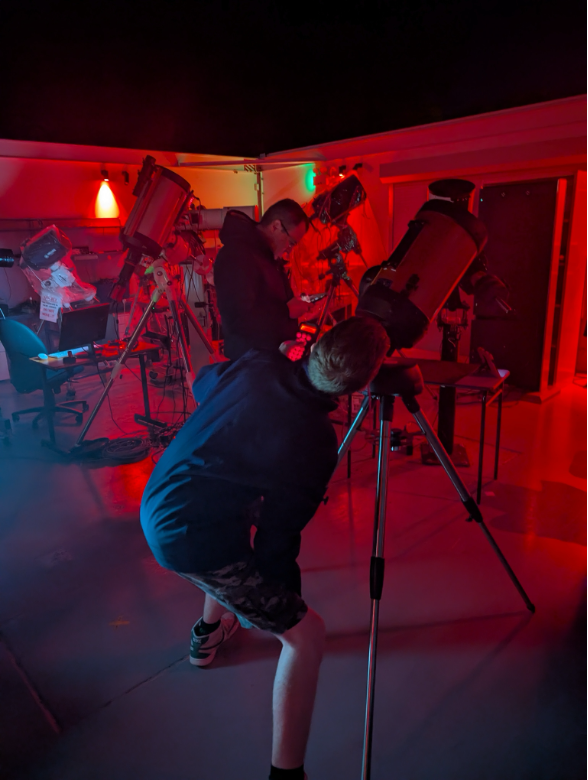
A pair of older affable gents introduced themselves. After a brief tour of the observatory space that was being used that evening by around half a dozen people aged, I would estimate, from an eight or nine year old all the way up to septuagenarian. Indeed, I gathered that the youngest and oldest people using the scopes were grandfather and grandson, with one of the other gents completing what was three generations of the same family that were all keen astronomers.
The two older chaps with cordial and cheerful banter worked through potential sources of the issue we were seeing with my son’s Celestron, very quickly resolving that the issue was actually not with the telescope itself. Rather, and in what can only be described as really good luck, it was an issue with possibly the cheapest and easiest component to replace, the component known as the star diagonal - an L-shaped accessory containing a mirror that sits between the telescope and the eyepiece lens.
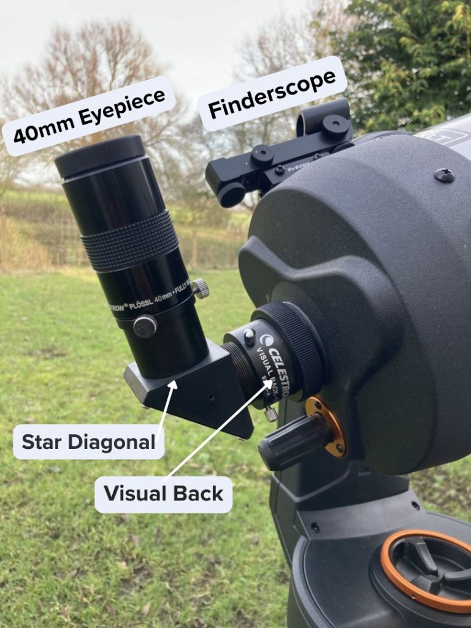
Another suitable star diagonal was located amongst the spare parts the observatory had collected and once it was temporarily installed, the image below shows my son again observing individual craters on the surface of the moon.
While my son was once again pleased to be distracted by the sights amongst the stars, I happened to open my laptop in the communal office space next to the observatory - with the following image that I took almost 14 years ago in New Zealand showing on the desktop.
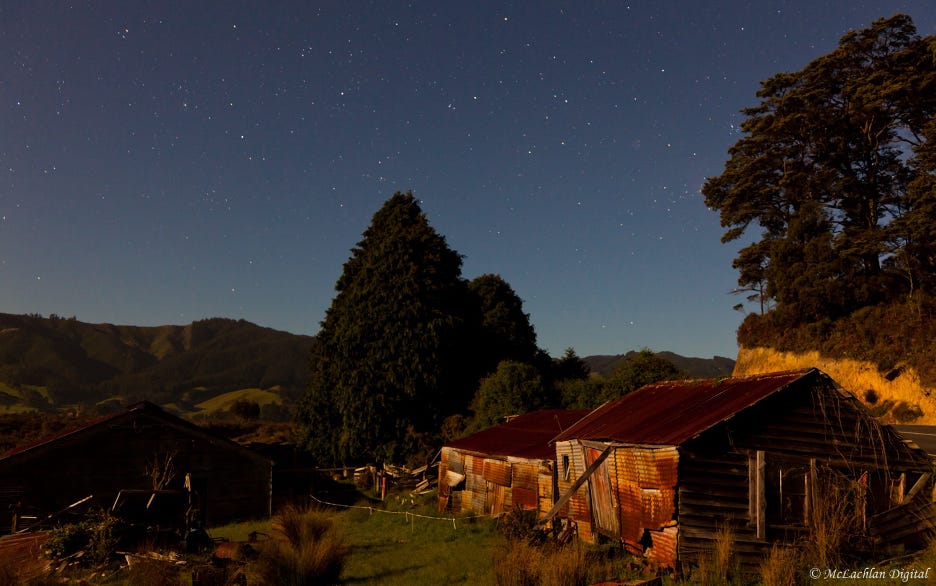
One of the two older chaps seemed amazed at the content of the image. Based on his questions, I believe he thought the image was either the product of AI or a photoshop of two images, with the sky taken at night and the rusty sheds taken in a separate frame during the day. He asked me about the light source illuminating the sheds, and seemed surprised to learn that it was a half-moon located that night over my left shoulder as I took the image. He also seemed surprised to learn that the entire image was the product of a single long exposure of around eighteen seconds duration.
You see, unlike much of the astrophotography we see today that is nothing more than the product of photoshop manipulation and the merger of multiple exposures, my rule has always been that what you see in my own astrophotography must be what the camera saw. What you see above, except of course for my copyright logo in the bottom right, is also what you find in the original over-50mb RAW image file recorded by the CCD in my Canon 5D Mark III. The same is true for the images below.
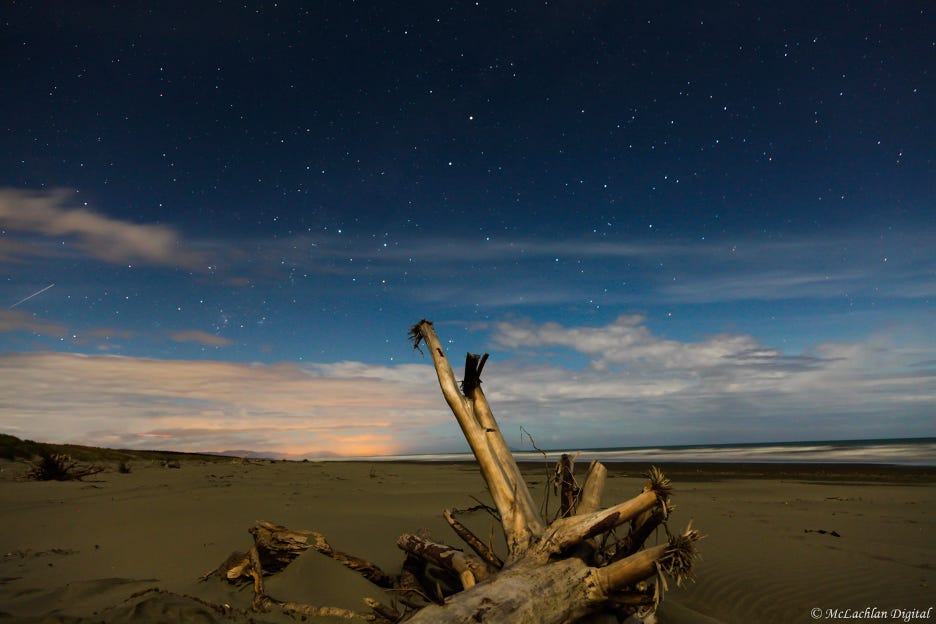
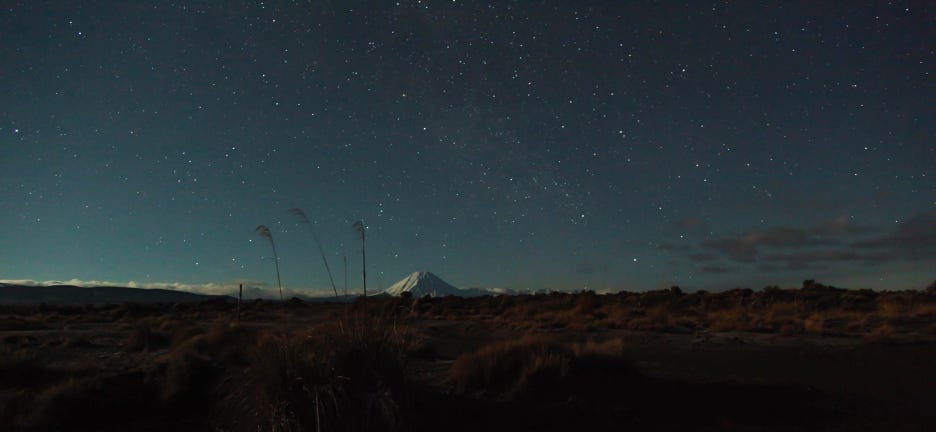
Given my need for a new income stream, if there ends up being any interest in these or my other (low resolution) collections, I may partner with my wonderful friend Tracey Ashton ’s company My Canvas to offer a limited run of numbered photographic and large canvas prints.
**************
Don’t forget that my book about the corruption between academics and big pharma is available via a donation and digital distribution model. Anyone who would like a digital copy can donate GBP £12, AUD $23, CAD $22, USD $17 via my Buy-Me-A-Coffee page. Forward the receipt or drop me an email to redscott@techie.com so that I can match it up at my end and I will reply with a copy of the digital PDF file.

Law, Health and Tech is a user funded publication. You can support this publication and my ongoing work either through a paid subscription here on Substack, or by making a donation on my Buy Me A Coffee page.
Erratum: I realised this morning I made a typo… 1996 should have been 1986.
No posts
Comments
Nothing yet. Say the first thing.
Sign in to join the conversation.