
Today I would like to suggest the following two maxims, and explain how I come to be discussing them:
Medical Advice tainted by pharma money is no better than marketing
and
Optometry is not Ophthalmology
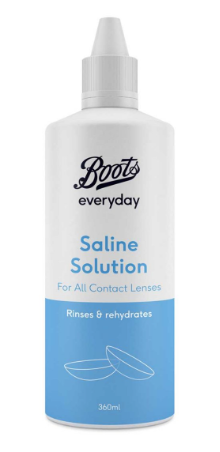
Over the last three-to-four weeks I have experienced a rapid deterioration in my eyesight. I went from occasionally having dry and tired eyes, to having chronic dry eyes (keratoconjunctivitis Sicca most likely related to an exacerbation of preexisting meibomian gland dysfunction) and losing visual acuity, both nearfield (myopic) and distance (hyperopia). I had already been to several pharmacies looking for preservative and additive free saline solution - which is what I had always used. In the UK pharmacy chains like Boots sold a brand of saline solution whose ingredients, even the small amount of stabiliser (0.025%) and pH buffer, are sodium-based (disodium edetate and sodium phosphate). Both have been heavily studied and by all accounts there is so little in their saline that I have never noticed any effect from them.
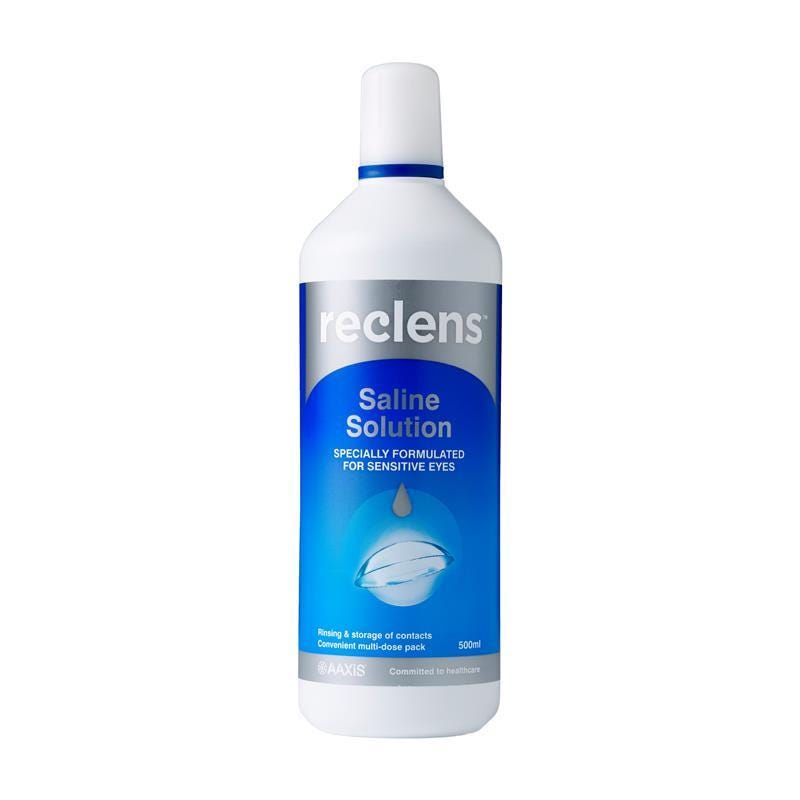
In Australia I can see that every saline solution offered for sale in pharmacies is ‘enhanced’ or asserts its suitability for people with ‘sensitive eyes’. However, I am yet to find one without a laundry-list of such additives. These include:
potassium dihydrogen phosphate - which the manufacturers claim is there to treat low blood phosphate levels without actually explaining the mechanism by which it is supposed to get from the outer sclera of your eye into your blood stream, nor how they come to think that people using their saline product universally have low serum phosphate levels in the first place. This is much like the government’s idea that a little bit of folate or thiamine is good for pregnant women, so a lot of it in practically every flour, bread or baked comestible consumed by everyone, pregnant or not, is better... right? Except it really isn’t.
phosphate stabiliser salts - such as disodium hydrogen phosphate, that are also known to laboratory scientists to have interesting effects on proteins and DNA, and are claimed by manufacturers to ‘enhance protein functionality’. When used in milk products they were seen to increase viscosity and particle size of some proteins (retenates) while markedly lowering natural sugar levels. The laboratory product sheet provides significant warnings that even the most minor exposure to this additive will irritate eyes and can cause severe inflammation and corneal calcification - exactly what you don’t want to hear about the second highest ingredient by concentration after the saline itself in your eye wash or saline solution.
polyaminopropyl biguanide - added as a cationic surfactant preservative supposedly to stop the saline, a salt-water solution, becoming infested with microorganisms. This additive is well known to result in significant ocular toxicity with extended use (some studies suggest toxicity can arise in as little as 6-10 days). Curiously, the manufacturer reports on the Boots saline suggest this additive is included in batches manufactured in India, but at a much lower concentration (less than 0.001%) than that which is included in some Australian ‘saline solutions’ (closer to 0.04% - or 4000 percent more). Further, this additive is banned or strictly limited to very low concentrations in the EU.
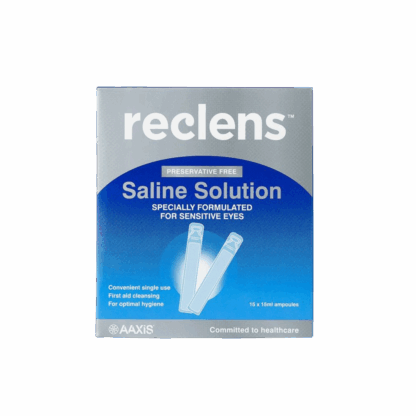
An ophthalmologist (eye doctor) who only offered non-emergency and non-surgical consults over the phone told me the loss of visual acuity was most likely related to an exacerbation of my meibomian gland dysfunction (MGD), and simply to keep wetting/flushing my eyes with the Reclens brand of product, preferably their “Saline Solution” which he said was for people like me with “sensitive eyes”. Perhaps not surprising, his website even had advertising for Reclens products that linked through to an online pharmacy that offered “click-thru” loyalty discounts for his patients. The issue here was that I had already been using the Reclens ‘saline solution’ for ‘sensitive eyes’ - and I was finding the more I used it the more I had to use it (i.e. that it was making my condition worse), and I was at the point that I was now experiencing minor swelling and discomfort around my eyes, down into the back of my nasal cavities and even into my ears (presumably via the Eustachian canals). That consult was $300 not well spent.
A trip to the optometrist for an eye test resulted in the diagnosis that I had age-related presbyopia and, again unsurprisingly, separate pairs of glasses for distance and nearfield vision were recommended. Even while having trouble focusing on anything, I found it curious to observe that once the optometrist had done the eye test and shooed me out the door into the waiting arms of his bevy of mostly young, female, sales assistants, they were all wearing the store’s products on their faces - except that even I could see that four out of the five young hotties had no actual prescription in their frames. When one put hers down and walked away I picked them up and looked through them myself, finding that they offered no magnification and were nothing more than window dressing with straight glass - much like an actor with 20/20 vision might be made to wear when in character for a film.
It seemed to me that much like all modern medicine now, neither so-called specialist was interested in actually identifying the root cause or curing the issue. Partnership deals, product placements and upselling are perhaps the medicine of the future... So yet again, I decided to deal with it myself. Your eyes don’t just go from working to completely useless in three-to-four weeks for no reason... and in my case, there were several differences to consider (different location, different house, different food... well same food but grown in a different country, and different saline solutions). I decided to focus on the saline, as that seemed to be the one with the most direct connection to my eyes.
Given I was hitting a brick wall trying to find saline solutions that didn’t contain the additives described above, I asked a nurse friend to look into what they had in the hospital. She identified two products - a 500ml large open bottle saline product that was, as it said on the tin, 0.9% salt water absent preservatives and enhancers, and the little saline for injection pods that, when I was training, we used for mixing medicines for injection or flushing an intravenous (IV) line. She grabbed a handful of these and gave them to me, suggesting I try them for a day.
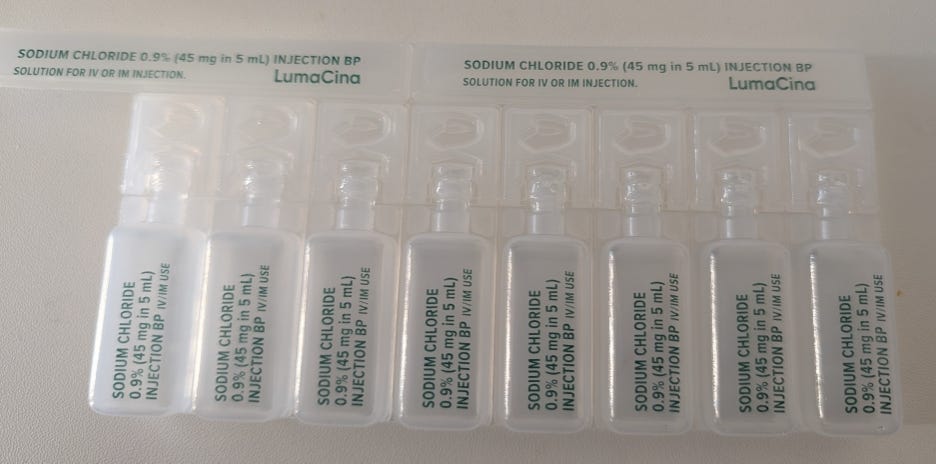
That was two days ago. I used them exclusively for the rest of that day and into the night and awoke yesterday with slightly clearer vision than I had had for almost a month, and with slightly less facial pain. In order to give it a full test, I went to several chemists yesterday until I found one who could sell me a whole box (50) of the same little ampules, and continued using these exclusively yesterday and into last night. This morning, much to my surprise, I found that when I sat up in bed, I could see the tiny print on my phone screen that had looked more like a long furry grey worm the morning before. It was clear and I could actually read it!
That was 90 minutes and this post ago.
Returning to the two maxims I posited at the start of this post... some of you will rightly see that they are essentially the same. Both identify a present day medical person who is more salesman than clinical professional. One is increasing his income by promoting the products of those pharmaceutical companies who financially support him in some way - whether through free trips to Continuing Professional Development (CPD) conferences, visits from bimbos with pens and notepads, or advertising sponsorship on his website. The other uses his younger attractive female staff rather than a website as the advertising medium and makes money by solving every problem that comes through the door, even those that don’t need it, with the products of his suppliers. The first extensively trained but for many patients only pretends to be the learned white lab coat wearing professional at the top of his game, failing those like me that he possibly deems to be beneath his vast skillset. The second is in no way but extensively pretends to be something alike the first - a peer professional perhaps one level removed, but is little more than a marketing vehicle for selling Gucci, Tom Ford, Prada and Versace designer glasses frames. Neither provides that old fashioned medical service where you treat each patient as the individual that they are walking through the door. Neither is learning or developing their skill.
Well... unless that skill is grafting for money.
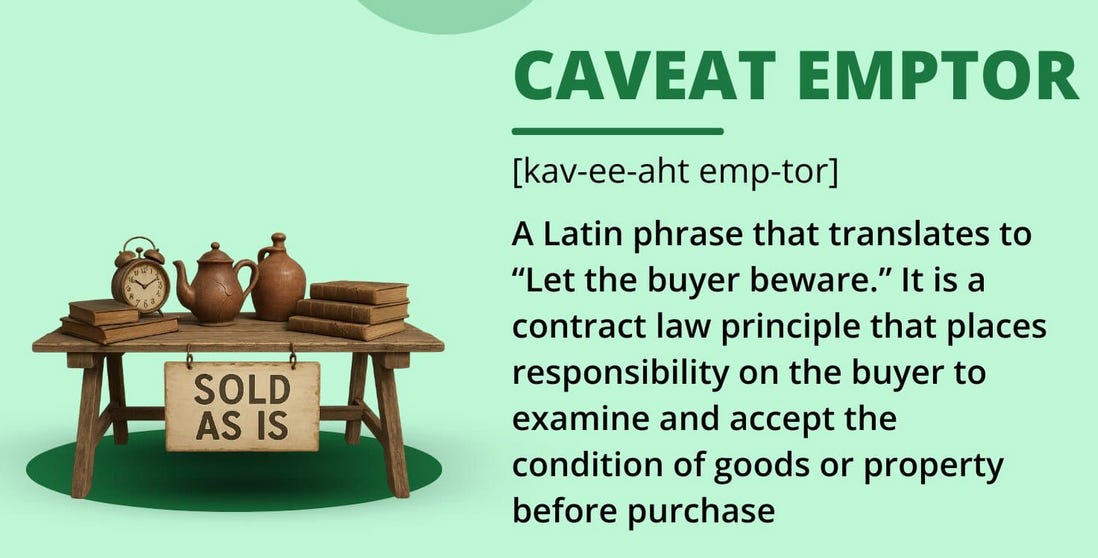
And let us not forget that Australia’s Therapeutic Goods Administration, long known for hiding the documents and burying the bodies well and deep, lets this happen. Various product sheets and laboratory analyses posted online also suggest they allow as many as six other additive ingredients that the manufacturer is exempted from having to declare. So when you are buying eye wash and saline solutions in Australian pharmacies... caveat emptor.
Buyer Beware!
No posts
Comments
Nothing yet. Say the first thing.
Sign in to join the conversation.