
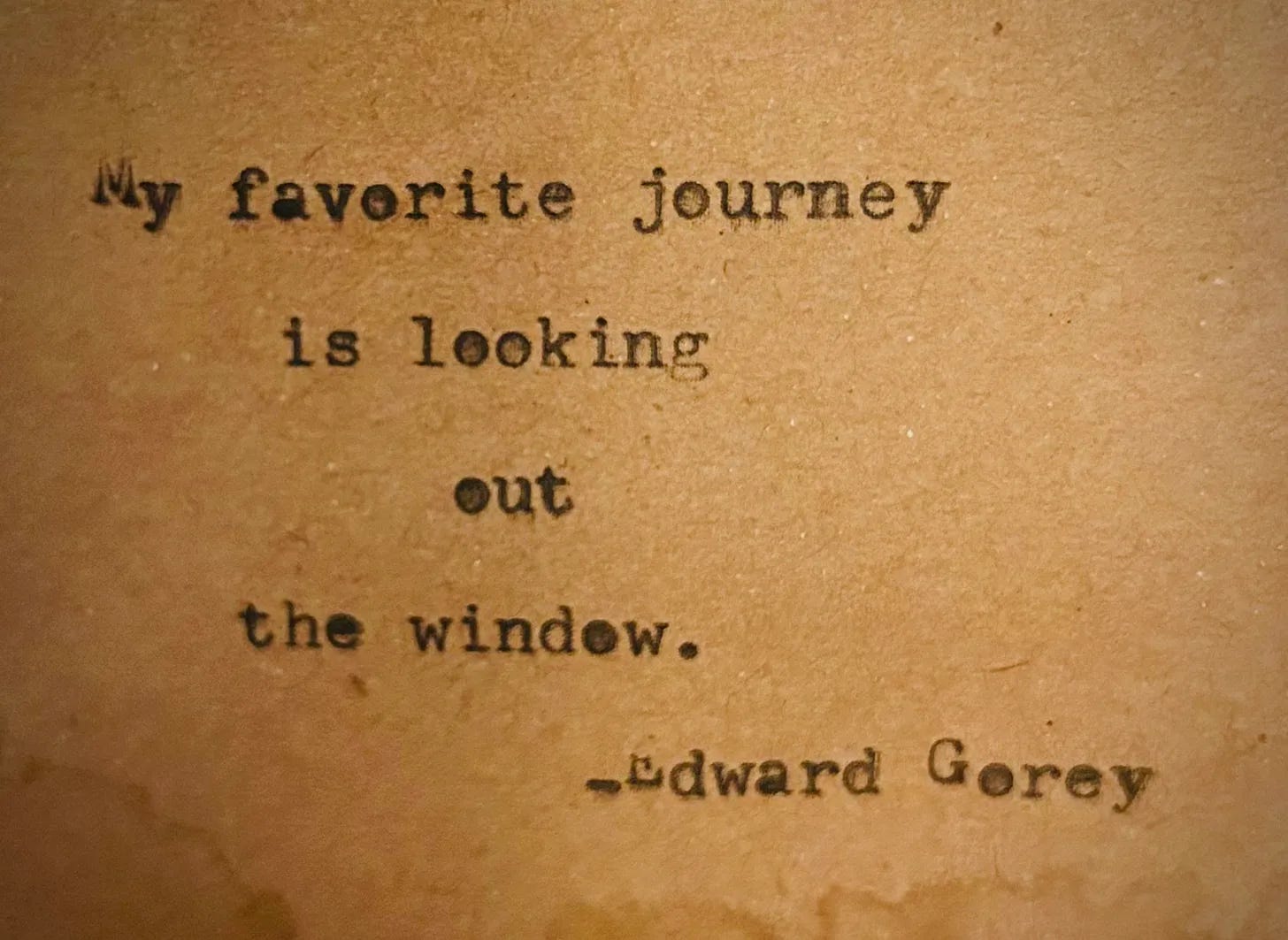
In the Cape Cod house where I spend the second part of summer, there’s a framed quote I typed up a decade ago. It says: My favorite journey is looking out the window. — Edward Gorey
It’s a funny quote for a traveler to love. Usually when I’m asked about favorite journeys, I think of living in South Korea or backpacking around Europe and Asia and Australia or teaching in places like Peru, Morocco, and Nepal. Looking out the window does not jump to mind.
Still, I’ve always liked Gorey’s quote. And on this beautiful Cape Cod day, I find myself in front of a window, embodying his words.
Gorey wasn’t a traveler, so I suspect that when Vanity Fair put its Proust Questionnaire to him in 1997, he was being literal in his answer to the question of a favorite journey. But I imagine the artist and illustrator, who would have turned 100 this year, was also referencing the window of his mind. When he gazed out, the external must have given way to the internal. And if you’re familiar with Gorey’s work, you know a view into his head would have been … interesting.
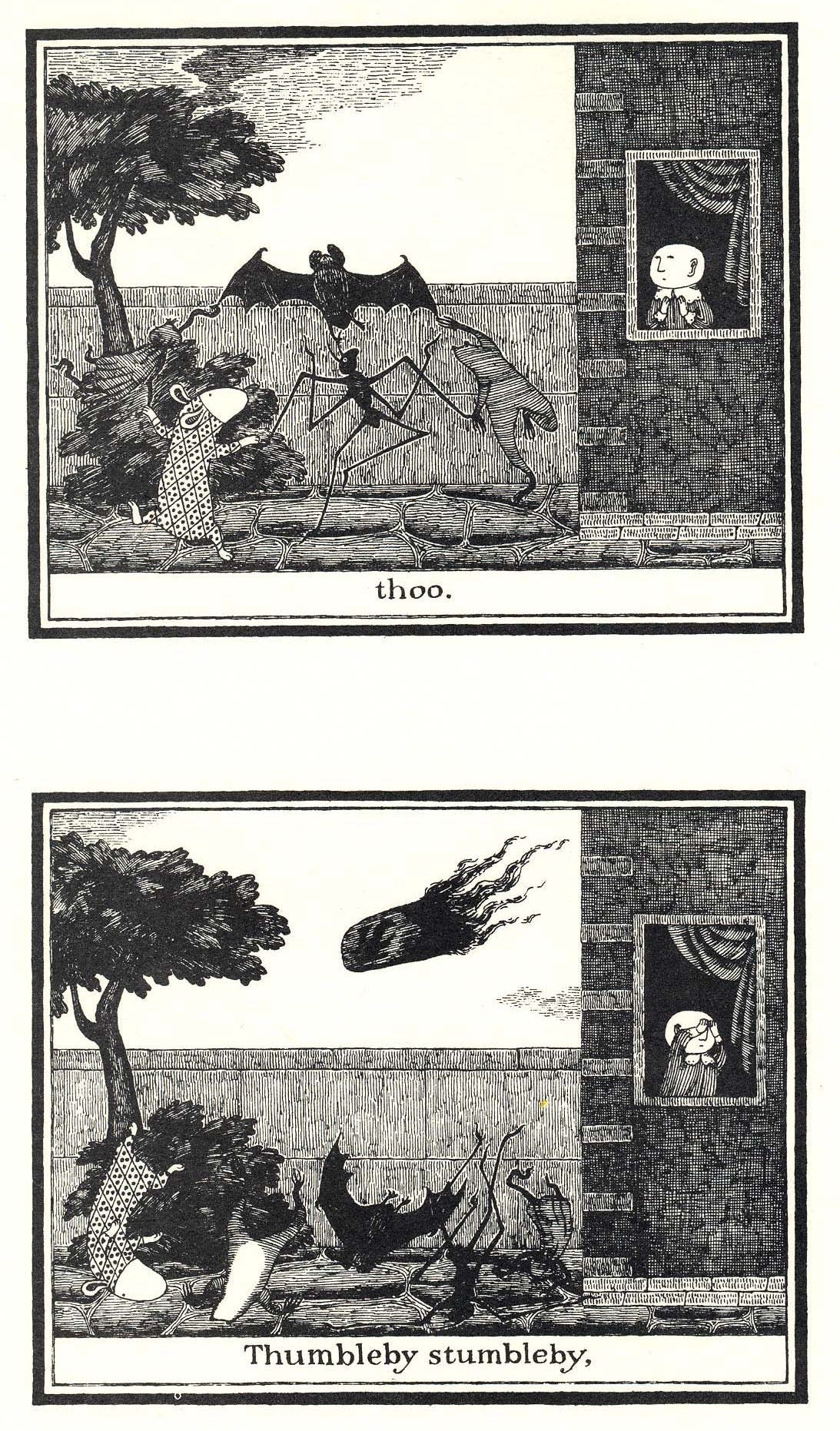
Before I go further, I should say that I don’t presume to understand the inner workings of Gorey’s genius mind. (I doubt anyone ever could.) I’m also not a Gorey expert. I’m just here to share my own journey with him, which has come unexpectedly full circle.
I grew up a few hours from Cape Cod, in a house in New Hampshire that was built in 1730 but had been in my family since 1837. From various windows there were views of fields, cornstalks, dense woods, and quiet country roads. And because I was a daydreamy kid with writing aspirations, I spent a fair amount of time staring out windows, thinking up my own stories and journeys.
I also spent a lot of time sitting on a toilet reading Edward Gorey. My parents, who were fans, kept a stack of his books in the downstairs bathroom, which happened to be my favorite hiding spot because it was the rare space with a locking door, and the only one that wasn’t haunted. My parents assumed this was due to that bathroom being a later addition to the house — unlike the upstairs bathroom, where a woman in a blue dress sometimes appeared, terrifying guests as they used the toilet.
Elsewhere in the house, I was convinced that eyes were always secretly on me. But in the downstairs bathroom I felt safe and gloriously alone, unmonitored by parents, siblings, and ancestral ghosts. So I’d lock the door and read books with titles like The Haunted Tea Cozy, Dancing Cats & Neglected Murderesses, The Doubtful Guest, Amphigorey, and my favorite, the Gashlycrumb Tidies, an abecedary of children who meet their doom in various ways, told in charming rhyming couplets. If memory serves, I knew that one by heart.
A is for Amy who fell down the stairs
B is for Basil assaulted by bears …
and on it went.
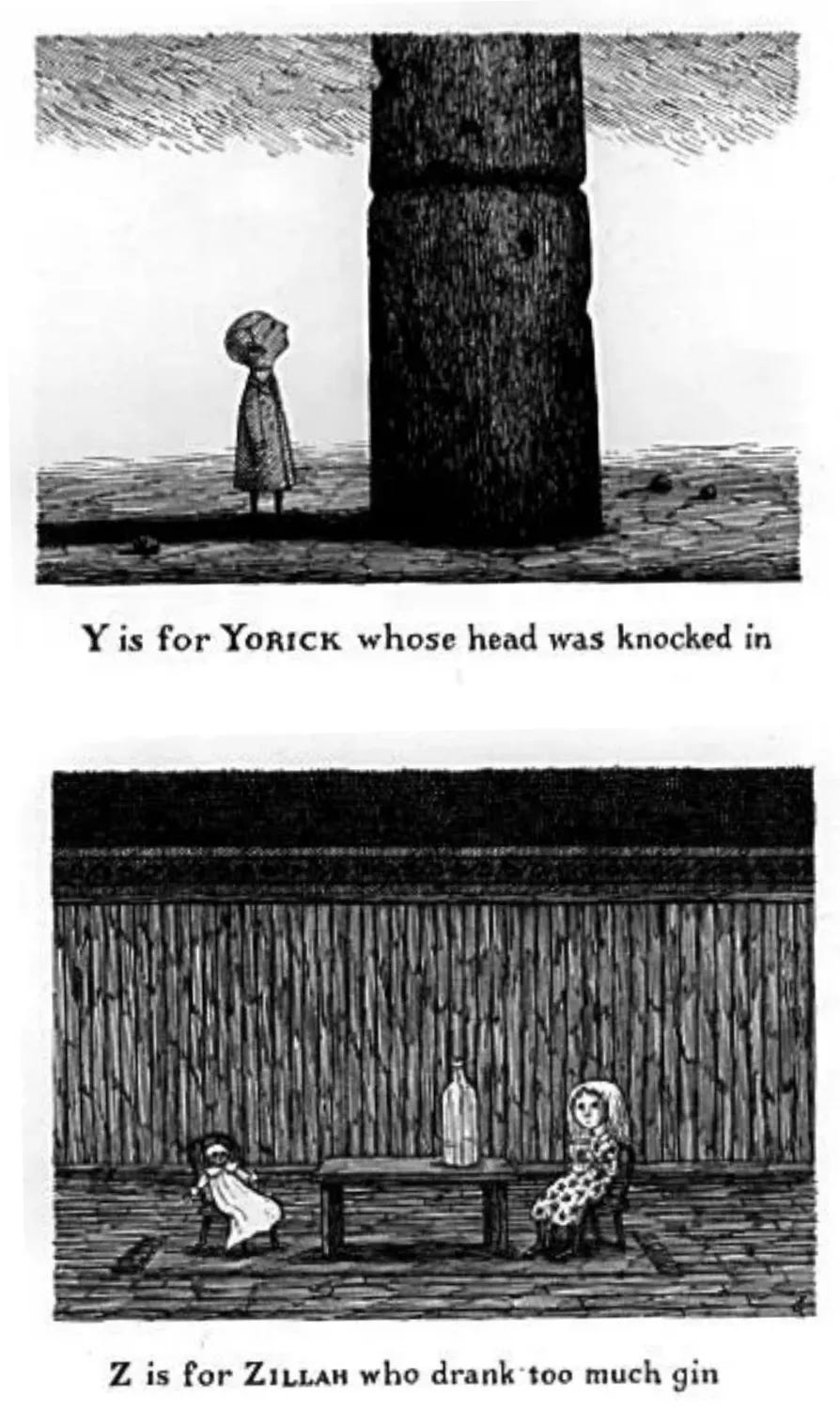
I can’t recall all the Gorey books we owned, only that they featured innocent, expressionless characters dressed in old-fashioned clothing, and that sinister fates invariably befell those characters.
For some kids, Gorey’s books must have offered an escape from their prosaic lives into a strange and paranormal world. My case was more about affinity. I read his stories and laughed at his offbeat humor and entertained the possibility that I wasn’t the only kid living inside the pages of a weird story. Maybe there were other little girls who shared their homes with noisy, long-dead relatives who appeared in rocking chairs and occasionally hurled coffee cups across the kitchen. Maybe I wasn’t the only one whose friends were afraid to sleep over.
Of course, I didn’t blame my friends. I was a fearful child myself, occasionally scared of the ghosts, but more so of drowning in the Atlantic or in my friend’s swimming pool or in the pond down the street or the well behind our house. I was afraid of getting mauled by the neighbors’ Saint Bernards, falling into a gap between open stair steps, being spanked, eating a poisoned apple, trying new foods, ice skating, tumbling down steep stairs, and, perhaps worst of all, being locked overnight in our cellar with the spiders and — we were convinced — the buried bodies of those who haunted us.
I had many additional fears, all of which Gorey normalized. It’s possible, of course, that he fueled them, too. For instance, I sometimes believed I was disappearing, which could have been the influence of the boy in The Shrinking of Treehorn, whose parents failed to notice he was getting smaller. And I was highly suspicious of drains, perhaps thanks to The Gashlycrumb Tinies’ Una, who slipped down one.
More than anything, though, I probably found relief in Gorey’s narratives, whose characters suffered far worse predicaments than I. My life was not, by comparison, so bizarre and scary. At least I wasn’t the little girl in The Insect God who got kidnapped by giant mosquitos. At least I wasn’t carried off by an eagle and dumped in the sea, like The Beastly Baby.
When I was eight, I began writing a book of my own, a novel called Lenny, Jenny, and Me. If I had been writing in the style of Gorey, Lenny might have been swallowed by a snake while Jenny was brained by a rake and Penny (the narrator) choked on cake. Alas, I didn’t write like Gorey, so my characters (loosely based on my siblings and myself) played with kittens, built treehouses, rode bicycles, ate candy, argued, and developed crushes on neighbor kids. That novel, needless to say, was not published.
But I’m convinced Gorey influenced me in other ways. Maybe it was he who first whispered in my ear that we can write whatever we want, and that it’s ok to be unusual, and that a creative mind can turn anything possible. Or perhaps I gleaned from him the understanding that life is an amalgam of all things: beauty, tenderness, terror, mystery, tragedy, whimsy, absurdity, mundanity.
Gorey influenced countless others, of course, including Maurice Sendak, Daniel Handler (aka Lemony Snicket), Tim Burton, Wes Anderson, and Gary Larson. Over the course of his career, he wrote, illustrated, and hand-lettered 116 of his own books, and illustrated at least 500 books by other authors. He created the animated introduction for the PBS Masterpiece Theater “Mystery!” series, and his costume designs for a hit Broadway production of Dracula won him a Tony Award and earned him millions of dollars.
He was prolific in creating, and also in consuming. While living in New York City he’d sometimes see a thousand movies and attend three hundred ballet performances in the same year. He loved television, with soft spots for true crime, soap operas, horror, Buffy the Vampire Slayer, Doctor Who, Cheers, and the Golden Girls. He was a voracious speed-reader, too, and spent his whole life devouring literature. He began with Agatha Christie and Dracula when he was five years old, and by seven was reading Melville and Henry James. By all accounts, every time he left his house, he returned with a new book.
And Gorey cut a figure; he was tall and flashy, wearing loads of jewelry (pendant necklaces, enormous rings, earrings in both lobes) to accessorize his ripped jeans, white tennis shoes, and signature item, a long fur coat. He owned 21, some dyed bright colors. But before you judge him: he also relocated worms to save them from being stepped on, and when a colony of raccoons moved into his attic, he let them live there, perhaps as recompense for wearing a raccoon coat. Eventually he stopped wearing fur, and in his will, he left almost his entire estate to benefit animals, including bats and invertebrates.
But of all creatures, Gorey loved cats most. He lived with six, including a calico named Jane (full name: Jane, you ignorant slut), who often draped herself around his neck like a scarf.
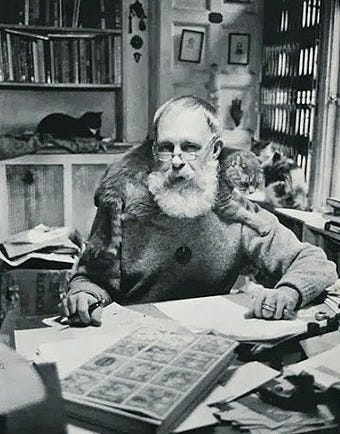
It was a full house — especially when you consider Gorey and his cats shared the space with more than 26,000 books and countless collected objects, such as cheese graters, potato mashers, salt and pepper shakers, stuffed animals, ceramic frogs, glass insulators, bottles, skulls, duck decoys, finials, flatirons, rocks, shoe trees, doorknobs, tongs, and random pieces of metal.
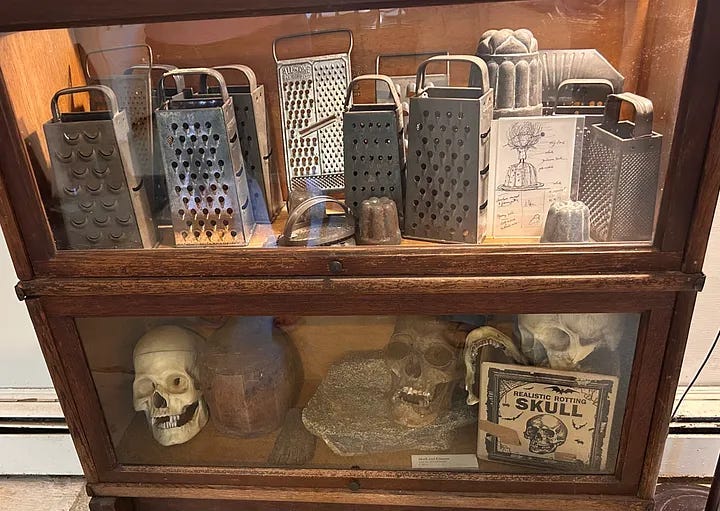
Gorey purchased the house in 1979 (presumably at the exact moment I was hiding in a bathroom reading his books). It was in serious disrepair, but carpenters worked on it for two years, and he moved in after five years. It was an old sea captain’s house in Yarmouth Port, and Gorey would end up spending the last 15 years of his life there. Because it had an antique toilet in an upstairs bathroom that resembled an elephant’s head and rough grey shingles on the exterior, like an elephant hide, he called it The Elephant House.
And here’s where we come to the full-circle part of my journey with Edward Gorey: when I look out my Cape Cod window, his house is part of my view. In fact, I can see his bathroom window from my bathroom window.
Coincidence, or just creepy?
Gorey died in 2000, a decade before we bought our own old sea captain’s house across the street, so I never met him, sadly. But I’ve been inside his home every summer for the last ten years.
The Elephant House was turned into a museum a few years after Gorey died, with a selection of his art and collections on permanent display (including his earliest drawing, done at 18 months), along with revolving exhibits such as “Exquisite Corpse,” “Dressed to Kill,” “Hapless Children,” “Murder He Wrote,” and “Happly Wippity.” The raccoons are no longer there, but the coat is. The cats are gone, too; those who survived Gorey were bequeathed to friends after his death. Following Gorey’s wishes, when the last died (Jane), her ashes were mixed with some of his and the other cats’ ashes and scattered around the yard.
The first time I crossed the street to visit the museum, Rick Jones, an old friend of Gorey’s, was the director. We chatted, and I told him my parents kept Gorey’s books on the back of the toilet. Rick nodded, thinking a bit, and then smiled.
“Perfect,” he said.
One of the main features of the museum is The Gashlycrumb Tinies scavenger hunt. My son and I have participated half a dozen times, joining other kids and adults who scour the house for signs of unfortunate children and squeal with delight upon discovering a squashed doll, an empty bottle of gin or lye, or a box of tacks. Neville, who died of ennui, is especially hard to find — but worth the effort.
Some years ago I asked a docent if the children who visited the museum ever seemed freaked out by Gorey’s work.
“Nah, she said. “Kids really get him.”
Did I “get” Gorey when I was little? I don’t know. But I think he got me—and still does. I’ve never been a fan of horror, true crime, anything dark. I’m all about feel-good stories with happy endings. But I believe Gorey helped me feel less alone by not only mirroring aspects of my peculiar reality but making light of them.
And maybe this is why he remains so popular with kids. Not every child grows up in a house with ghosts, but any way you slice it, childhood isn’t all kittens and treehouses.
Gorey once said, “I really think I write about everyday life. I don't think I'm quite as odd as others say I am. Life is intrinsically, well, boring and dangerous at the same time. At any given moment the floor may open up. Of course, it almost never does; that's what makes it so boring.”
Maybe this is why he’s so popular with adults, too. Because adulthood isn’t all sunsets and travel (even if social media tries to convince us otherwise).
And because the floor is opening up.
The world we inhabit deals out daily events just as atrocious as anything Gorey could have imagined. The news is heartbreaking, cruel, unfair. Each day a new abomination, an even more chilling headline.
We can’t put on blinders or become complacent. But if we’re ever getting out of this dystopian mess, we also can’t lose sight of life’s amalgam. There’s far too much terror and tragedy surrounding us, but there’s also too much beauty, tenderness, mystery, mundanity, absurdity, and whimsy to fall into paralyzing despair. If we forget what we love, what lights us up and makes us laugh, we risk forgetting what we’re fighting for. And if that happens, we’re hosed.
So I’ve turned to Gorey again, for delight, distraction, and dark comic relief. He’s my unlikely shelter in the storm.
Thanks for reading Writing Away! This post is public so feel free to share it.
I’ll go first.
Just outside, I see the roses my husband, Dan, secretly dug up near his childhood home and transplanted in our yard. I see in those thriving roses the sentimental Cape Codder I married, the reason I’m here.
Behind the roses I see other flowers in various states of furl and unfurl, beginnings and endings, constant reminders of the fragile beauty of life in all stages — even decay, even death.
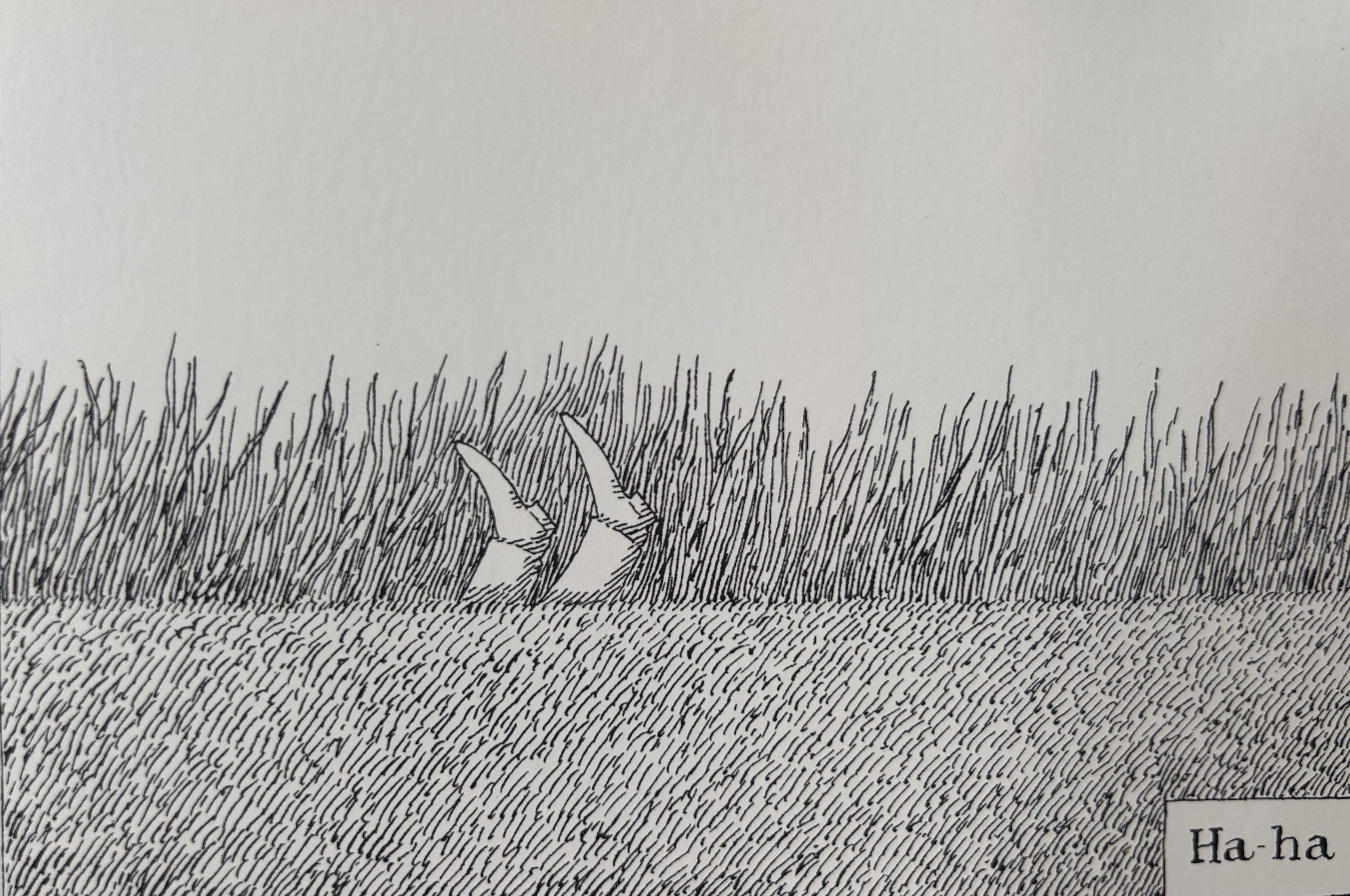
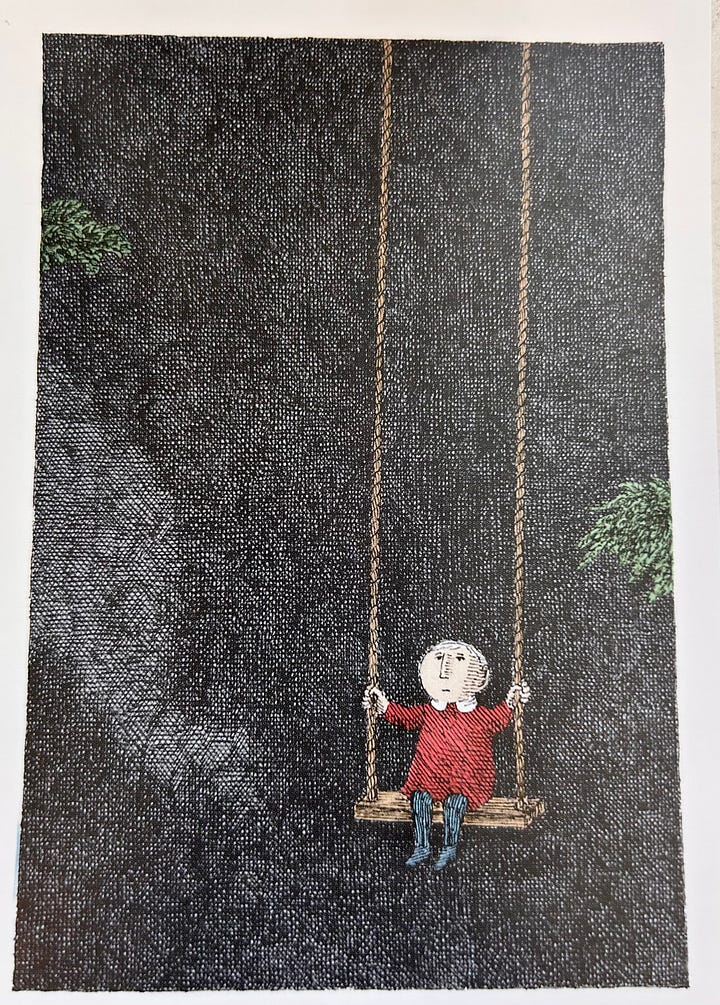
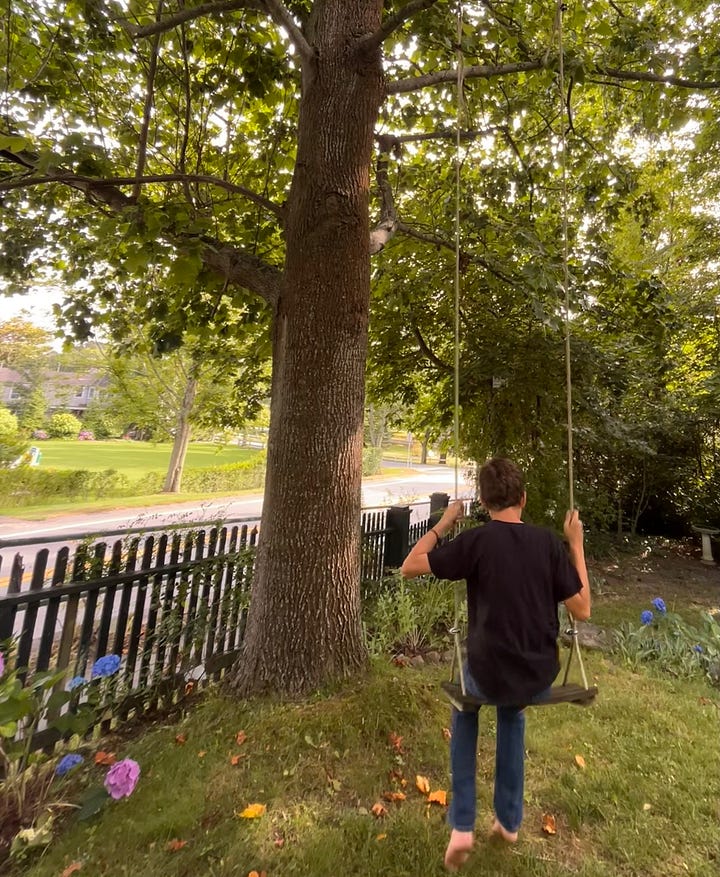
Farther back, I see the tulip tree that holds a swing we hung up for our son when his feet didn’t yet reach the ground. It’s eerily identical to the one in Gorey’s “Approaching Elephant.”
Behind the swing, on the other side of Route 6A, I see a hotel built in 1716 that is famously — can you guess? — haunted.
One night long ago I sat in the hotel bar swapping ghost stories with a bartender who had worked there for decades. He didn’t believe in ghosts but told me about the night he was alone, late, and heard the doorbell ring. He went to the other room to answer it, but no one was there. When he returned after a few seconds, all the plates, cups, and silverware in the dining room had been turned upside down. The hotel changed hands after a few years, and the new owner and I sat on the lawn some evenings, sipping rosé. She didn’t believe in ghosts either but said her dog had a curious relationship with one of the rooms; he’d go in and lie down, then make strange sounds and refuse to leave. The hotel has changed owners again. It’s fancier now, but I’ll bet the ghosts don’t care.
Finally, just to the right of the hotel, I see the Edward Gorey House.
I always wonder if it’s haunted, too. Gorey once told an interviewer that he’d witnessed all his cats freezing and staring at something invisible. My pets in New Hampshire did the same — they’d raise their heads in unison with their fur standing straight while they watched something move across the room, something the rest of us couldn’t see.
So I have no doubt Gorey’s house was haunted when he lived there. What I wonder is if it could now be haunted by him. After all, with his extraordinary imagination, it seemed he, too, could see what the rest of us couldn’t. Also, he was a practical joker, famously wreaking havoc on the bookkeeping of his friend’s diner down the street where he ate twice a day, sometimes ringing himself up for amounts like $1,400. It stands to reason he’d have enjoyed some posthumous pranks. On the other hand, he might have considered it too obvious a postscript.
All I know for sure is that when Gorey lived in the house across the street, he created work that influenced and entertained countless people, including a little curly haired girl. I know he sketched and wrote there, designed puppet shows and plays and operas, sewed dolls, made toys and pop-up books, read books, drank tea, and watched tv. And I know he looked out his window.
He would have seen my house sometimes, and the window I’m looking through now, as I write this.
So I give a little wave, in case he’s still there.
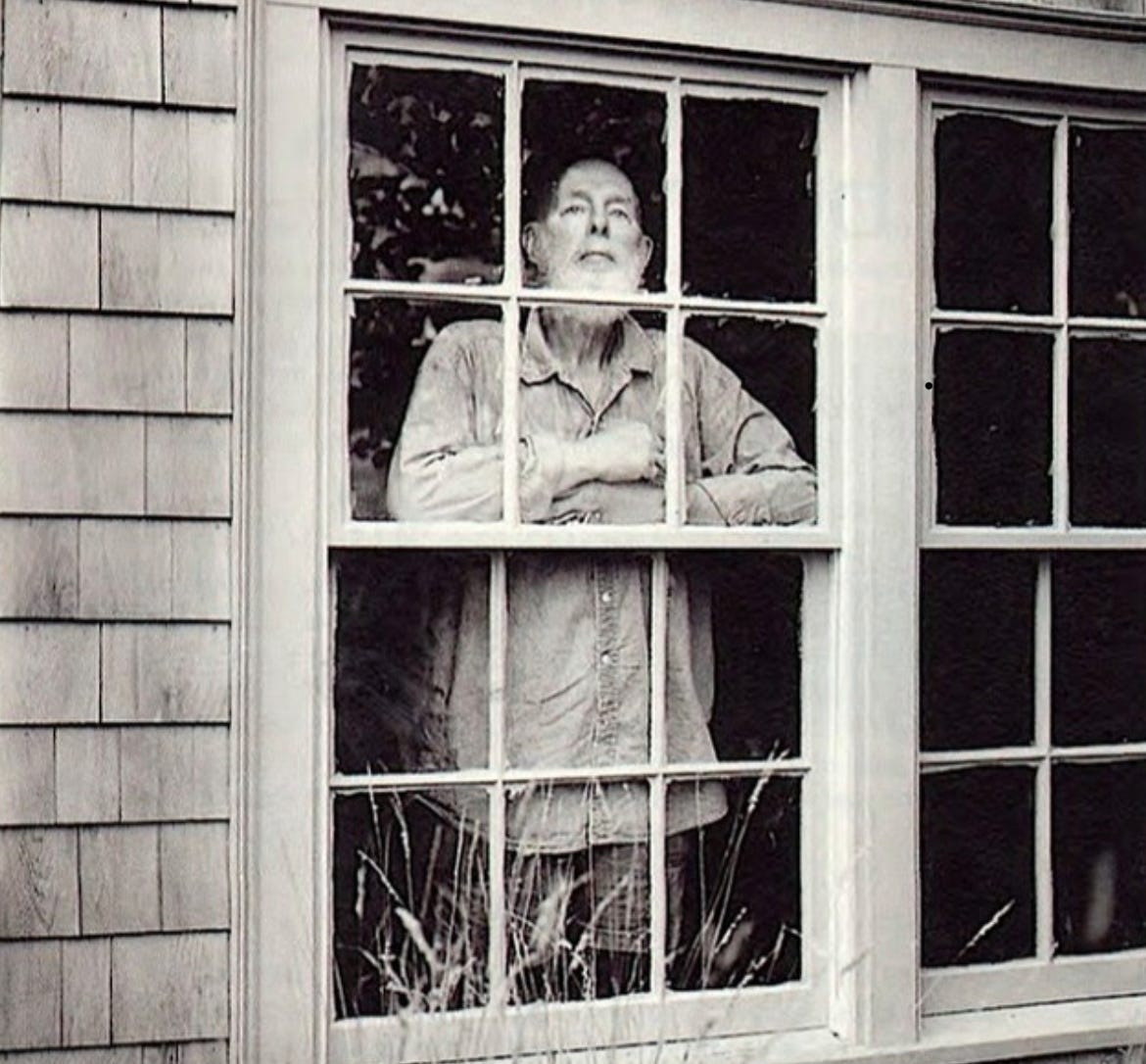
Look out the window. Summon memories and stories in the view. Search for details in the images. Seek the macro in the micro, the universal in the distinct, the extraordinary in the ordinary. Let your mind open wide to weird ideas, and meander through them. What do you see out there? Go on a journey. And if you’re willing, take us with you by sharing in the comments.
Comments
Nothing yet. Say the first thing.
Sign in to join the conversation.