

It’s been a while since I’ve sent a Substack; I’ve been on book deadline, and I have carpal tunnel syndrome—and I’m terrible at dictating, so it was slow and painful going. I’ve also been traveling a lot to see family. And, if I’m being honest, I’ve been reticent to share news and stories, when the world is so heartbreaking and horrifying. But a friend recently took me to task on this, saying it’s even more important now to share stories and good news. And I’ve come to agree. By not sharing, we’re letting the authoritarians win, because it means they’re silencing not only our words, but our hopes and plans.
So I’m back, with both a story to share, and news about a creativity retreat in Mexico.
I’ll start with the story. It’s about an afternoon five months ago, when I received a call from the principal’s office at my son’s school.
You can imagine how a call like this sends the mind spinning through questions and scenarios. Is he ok? Did he crack his skull on the playground equipment? Is it an emergency? A lockdown? Is he sick? In trouble? Maybe he’s just sad and wants to come home. Please, let him be ok.
My gut tightened.
“Mommy?” his little ten-year-old voice asked.
“Yes, honey?” I braced myself.
“I have exciting news!”
I started breathing again.
“What is it?” I asked.
“Taylor Swift got engaged!”
I exhaled, laughed, and said that was fun news.
“I knew you’d want to know because you’re a Swiftie,” he said.
I am? I thought.
“That’s so sweet!” I said.
Doubt crept into his voice. “You are a Swiftie, right, Mommy?”
It seemed important, somehow, that I answer correctly.
“Totally!” I said.
We chatted for another minute about the celebrity gossip his Spanish teacher had delivered to her students, then he went off to science class, and I returned to highlighting repeated words in student essays. But five months later, I’m still thinking about that call.
Stay with me here, even if you’re not a Taylor Swift fan; this isn’t about her.
My son started fifth grade at a new middle school this year, and it came with a learning curve—and not just for him. For his dad and me, changing schools meant decoding the homework and testing schedule, downloading nine new apps, memorizing the pick-up and drop-off driving route lest we find ourselves rule breakers (or the bozos stuck in another school’s thirty-minute carpool line). It meant advocating for him while sifting through sixty-five emails about PTA meetings and dress codes and Dads’ club and spirit week and fundraisers and field trips. It meant learning the names of teachers and support staff and kids who might be potential friends for our son. There was a lot to know. But in a way, that call told me almost everything I needed to know about my son’s new school.
Here’s why:
How easy would it have been for a middle-school principal to say no to a kid who wanted to use her office phone to call his mom about Taylor Swift? How simple to refuse his cockamamie request and shut him down and send him back to class or lunch or wherever he was supposed to be?
No one could have blamed her. It was only weeks into the school year, which must be an intense time for a principal—especially now, when more than education hangs in the balance; when safety concerns extend beyond playground accidents; when the trouble students can find is more accessible (literally at their fingertips); when kids with differences are increasingly marginalized by the government; when administrators and educators can get canned for not toeing the line; when vaccination rates are declining; and, oh yeah, when the education department is being dismantled.
And yet, she didn’t shut him down.
I don’t really know the principal—I’ve spoken to her only a few times, briefly—but I know there’s a sign hanging in her office that says, “Scatter kindness like confetti.” And I know that when my son burst into her office like a cyclone, talking loud and fast and insisting his mom had to hear this news right away (I’m confident this was the scene), she confetti’d him with kindness.
When my son and I hung up, I was still laughing.
I hadn’t lied about being a Swiftie. I do really like Taylor Swift. But I skipped her Eras tour when it came to New Orleans; I was feeling broke and couldn’t justify the cost. But also: I regret that decision. And I have my favorite songs (big fan of “The Last Great American Dynasty”), but you’re more likely to hear me cranking Brandi Carlile or the Chicks. Does all this qualify or disqualify me from being a Swiftie? No matter. Either way, I was in a different space after my son called—lighter, more energized—and better prepared for what the day might throw at me.
I probably don’t need to go into the state of the world. I don’t need to list all the horrendous and inhumane acts of ICE. I don’t need to tell you about murder, fascism, war, gun violence, the climate emergency, the theft of public lands, the decline of human rights, the demise of decency. Instead I’ll say that waking up every day and reading the news feels like a moldy science experiment left on the kitchen counter, spreading and darkening. The headlines are black and bold and bad, and it’s no way to live, pummeled on the daily. We’re not meant to absorb this much wreckage and rage with our coffee.
I’ll confess I’ve been cutting back. Not on the coffee (as if!) but on the news. And not because I’m sticking my head in the sand (though that’s exactly where my head would like to live) but because, as the parent of a sensitive young boy who manages best when his mom isn’t a frazzled, freaked-out, emotional dumpster fire, I have no other choice. I need to hold it together.
Most days, I succeed. Most days, instead of reaching for my phone first thing and letting the mold engulf me, I head downstairs to help ready my son for school. I make his lunch and try to find space for it in his ridiculously heavy backpack.
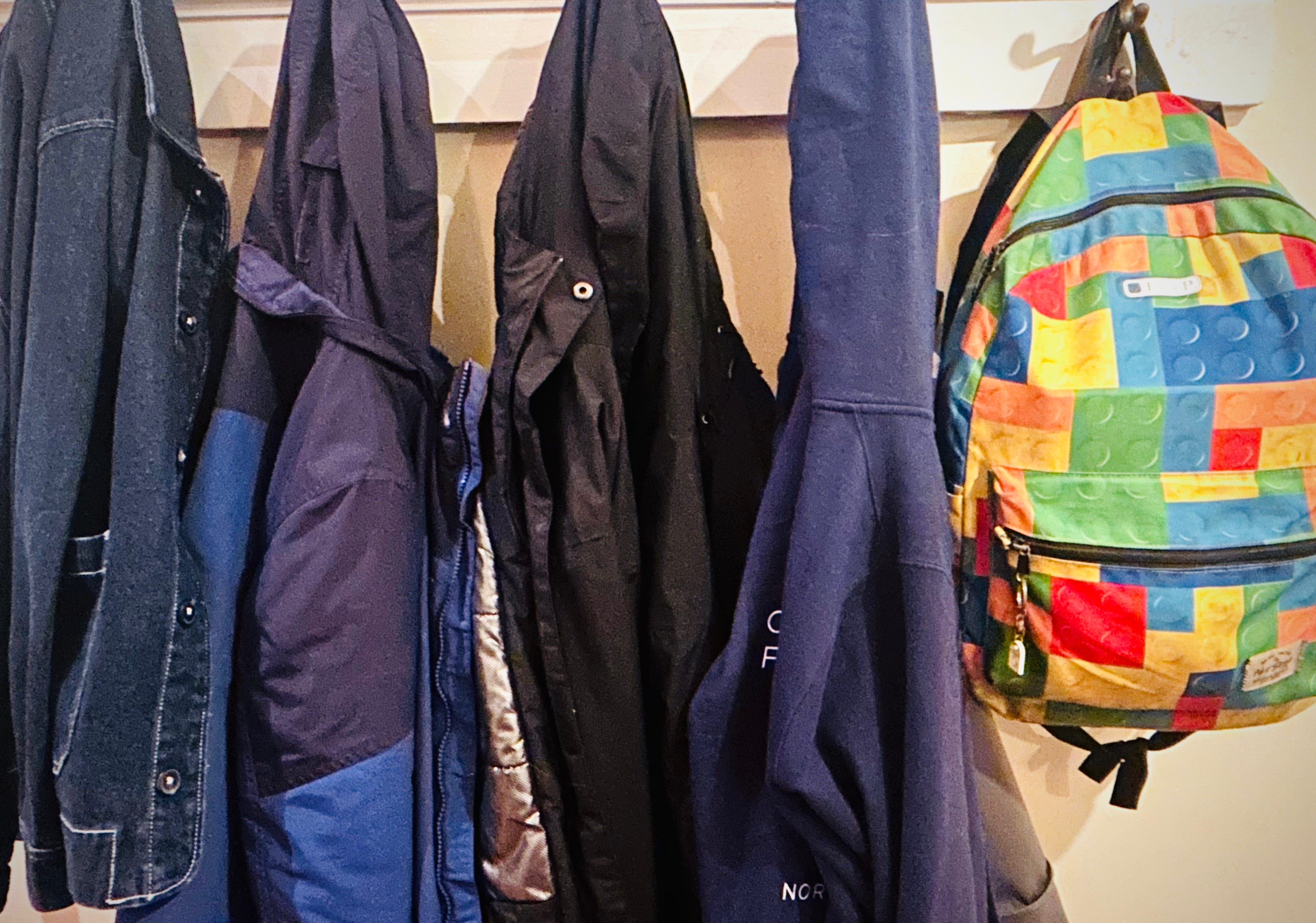
Truly, the thing is a monster—filled also with textbooks, a novel, a water bottle, a Chromebook, and thick homework binders. What he doesn’t know is that he’s also secretly carrying my heart, tightly folded and squeezed. Heavy.
When it’s time for him to go, I kiss and hug him and stand on the porch in my PJs as his dad backs the car out of the drive. Then my son rolls down his window, and we start yelling “I love you” in different languages.
“Jeg elsker deg!” he hollers.
“Salanghey!” I holler back.
“Seni seviyorum!”
“Je t’aime!”
“I love you!”
The car rounds the corner, and we lose sight of each other.
Back inside, I sit with my coffee and hope he has a good day. Hope there won’t be an emergency phone call from school. Hope for good news only.
And I know how absurd this sounds, but I breathed easier after receiving that call from the principal’s office about Taylor Swift’s engagement. (This is a sentence I never imagined writing.)
A call like that can’t guard against much. It can’t guard against my little boy getting hurt or bullied or acquiring, say, measles. And it can’t guard against my worst nightmare, the one his school prepares him for, with lockdown drills.
To me, what the Taylor Swift phone call guards against is indifference. It tells me my husband and I are sending our son to an institution where kindness matters; where the grownups in charge listen and respect when something seems important to a child, and where they don’t shut him down or dim his light—even when doing so would be more convenient.
I think about that call a lot, and about this: How easy would it be now to shut ourselves down, too, and spiral into a bottomless pit of despair and cynicism? How simple would it be to spread fury like confetti? It would be the easiest thing, and I am, like most people, teetering on that precipice, fists full of rage.
Fury is warranted right now, for all the reasons—for the lives taken, kids taken, neighbors taken, human rights taken. And yet, at the same time, we have to protect our hearts and minds. We have to take care of ourselves. We can’t spiral into that deep, dark hole. We’re needed up here.
So then, what do we do with all the anger?
I’ve been thinking about something my Tibetan Buddhist teacher, Khentrul Lodrö Thayé Rinpoche, once said at an event for his book, The Power of Mind. He’d been talking about the importance of pacifying negative emotions, such as anger, when an audience member asked, “But can’t anger be useful, in terms of activism and standing up for human rights?” It was such a good question, and I don’t remember my teacher’s precise words, but it was something like this:
Even if anger feels warranted, we’ll have more success in our efforts if we control our emotions. We’re always more effective when we remain calm.
His words have stayed with me, a steadying compass.
So then … what do we do?
Here’s my take, for what it’s worth—though I encourage you to seek out other on-the-ground, diverse voices.
We use our anger and sadness as a vehicle for focus and purpose. We don’t exacerbate the situation by losing our shit.
We keep resisting. We show up to protests and make our five phone calls. We do something—anything—to stand up and fight back.
We vote in every single election. Even the tiniest ones. We use our voices, votes, and money—and the withholding of said money—to create change. And we never stop believing in our ability to do so.
We donate to local charities and mutual aid funds, as well as the ACLU and Immigrant Defense Project and Everytown for Gun Safety and Direct Relief and Planned Parenthood and World Central Kitchen and SUWA, and all our other favorite charities. We send our money there—not to Amazon.
Not only do we protect our vulnerable neighbors and look for the helpers, as Mr. Rogers taught us, but we become the helpers—even as it requires bravery and comes with risk. Also, we remember the risk is much greater for some.
If we have kids, we encourage them to also look for the helpers, help the helpers, be the helpers. Maybe we tuck encouraging Mr. Rogers cards into their lunchboxes, along with string cheese and baby carrots.
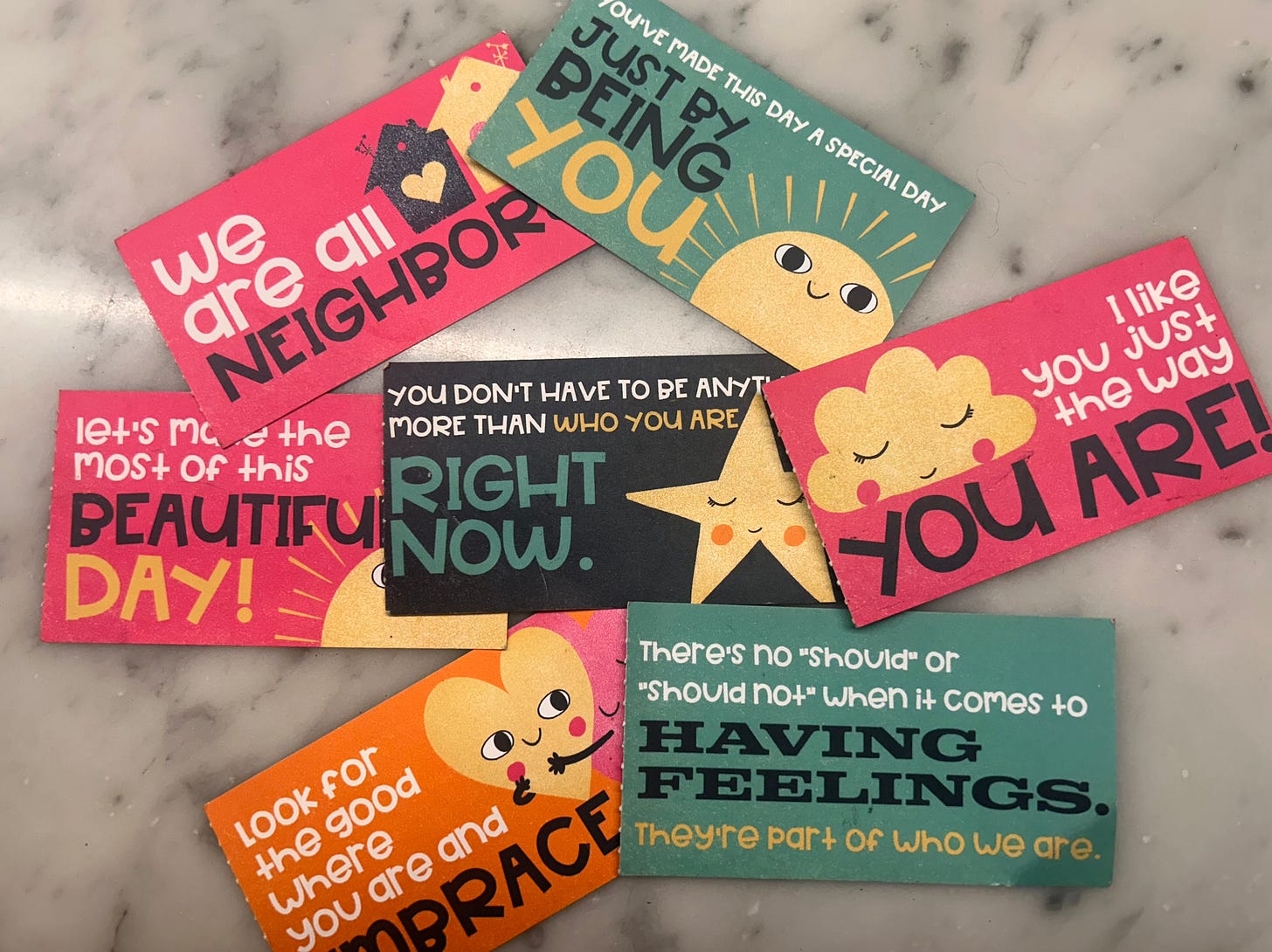
We read enough news to stay well-informed, but we refuse to let it spread like mold through our hearts and minds. We try not to let the mold sicken or scare us to the point of inaction.
We seek seeds of hope, and pass them on. We share news that bolsters us (such as videos of tens of thousands of brave Minnesotans marching peacefully in the freezing cold).
We make sure not to dim our own lights. We keep tending our creative fires. As Toni Morrison once wrote, “This is precisely the time when artists go to work. There is no time for despair, no place for self-pity, no need for silence, no room for fear. We speak, we write, we do language. That is how civilizations heal.”
I keep thinking about something Krista Tippet said on her podcast On Being, in an interview with Ross Gay:
I have heard in the last few years a question rolling around the world. It goes something like this: “How could you be joyful in a moment like this, in a world like this?” And the question troubles me because it suggests that joy is a privilege. But joy in human life is a resilience-making, life-giving birthright of being human. And to suggest that we can’t be joyful in a time like this is akin to the idea that you can’t be hopeful unless everything has gone right for you. Joy is a companion to hope as a wellspring of resilience.”
Lest I be accused of toxic positivity or something else, let it be said that I can get real dark and twisty. I’ve succumbed plenty to the little voice in my head that says, keep scrolling, need more. I’ve sat in a dimming room as the voice drowns out every other voice, until I look up from my phone an hour later, flattened.
Another thing Toni Morrison said is this: “I know the world is bruised and bleeding, and though it is important not to ignore its pain, it is also critical to refuse to succumb to its malevolence.”
We can’t afford to look away now—we have to pay close attention and take action again and again, until things actually change—but we also need to keep seeking goodness. And when we find it, we need to scatter it like confetti.
I still smile every time I think about my son’s phone call. Not just because it was sweet and funny but because I believe he and his principal knew something essential about keeping our hearts open. Sharing good news brings connection, and when we feel connected, we find more space and energy to move through fear—and to keep fighting for what we love.
And now I hope you’ll indulge me as I share some of my own news…
**Update: it’s in November now!

Creativity is an invitation to possibility—especially when life feel impossible. Traveling to another country is embracing another culture’s gifts. Gathering with others is deciding to continue believing in the goodness of humanity. And (as I wrote in an essay in the Walrus) the act of leaving home is so imbued with transformation that it invites contemplation and self-expression. I think every one of us could use every bit of that.
So it feels nourishing beyond measure to be returning soon to the stunning, car-free village of Yelapa, Mexico, where dear friends Colette Hannahan and Christina Ammon and I will lead another Deep Travel workshop. Colette will teach art, I’ll teach writing, and Christina will connect all the dots between people and place to create a magical, immersive experience. When we’re not writing or painting, we’ll read in hammocks or on the beach, swim in the bay, watch magnificent frigates soar, hike to a jungle waterfall, look for whales, pet the sweetest dogs, eat fish tacos, drink passionfruit margaritas, play ukuleles, do yoga, laugh, cry, meditate, seek beauty…and share our stories.
This retreat is almost sold out, so if you’re interested, don’t delay! Contact Deep Travel Workshops for info, or register here. March 8-15.
I think I’ll wrap this up with some simple words from Thich Nhat Hahn: “Life is suffering, but it is also wonderful.”
I hope that even now, in this deeply disturbing time, you can find some wonder and wonderfulness. And I hope you’re being gentle with yourself, and continuing to write or paint or build or craft—whatever you do that makes you who you are. There’s so much brokenness now; let’s make sure we keep ourselves whole.
And if you have any good news to share, it would help my heart to hear it. Consider it a kindness confetti…
Write about a time you received news, good or bad. Who delivered it? Where were you when you got it? What else was going on in your life then? How did the news sit with you, or change things for you? Set a timer for one minute, and just think. Then set another timer for five minutes and write.
Love,
Lavinia
Comments
Nothing yet. Say the first thing.
Sign in to join the conversation.