
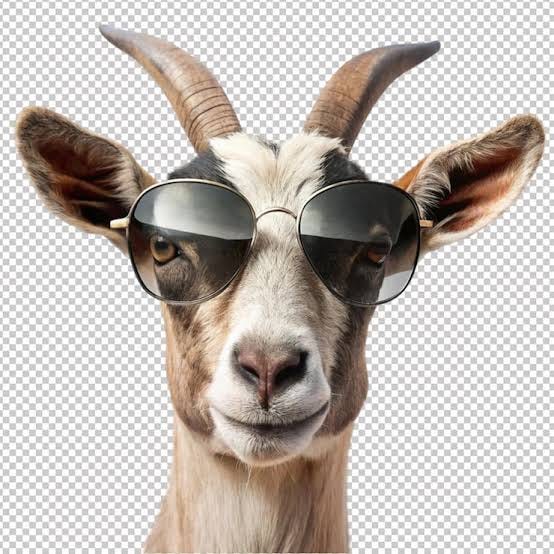
TWICE A DAY, I WALK A THREE-MILE COURSE on a country road that banks the artist colony where I’m staying. Along the blacktop, I pass magenta pea blossoms and a huge Rose of Sharon bush. I’m in rural Virginia, in the Blue Ridge Mountains, where the air is still and it seldom rains. Sleepy houses are set back from the road, and people sit out on front lawns and wave. I wave back. Dogs sniff around me. I like them.
A wooden church sits on a hill, and a little further along a herd of goats with thoughtful faces stare out. Cows graze in a farmer’s field and beyond is a pond, and when you take in the scene as the road sweeps up, you see rolling hills in the background and puffy clouds above, and the view suggests the English countryside. It’s a little like a Constable, and it makes me happy.
One day, I pass a goat who maahhs. It sounds like he’s saying “hello.” I maahh back. He maahhs again, only this time the note rises at the end, and it sounds like he’s saying, “Don’t leave me.” I return his maahh, walking fast, but then I turn and see that his head is stuck in a fence. He’s locked himself in by his horns. I go to him through tall grass and brambles. He’s standing with his head turned to the side.
One of the writers at the colony is named Joe. He says there’s a text in the I Ching called “releasing the goat.” It means your stubbornness. I hold the goat’s head, and he stops crying. His face is white with black markings, and two horns sweep back from his forehead. The horns are extensions of bone, and they feel strong and hard. I don’t think I have ever before touched the horns of a goat, and I realize I have wanted to touch these animals since I first saw them. I wonder what it would be like to have horns growing out of my head, and then I remember that’s what some people think Jews already have.
The goat’s fur is soft and at the same time a little bristly, like the coat of a Jack Russell terrier. The wire fence holds him in on four sides, and I can’t understand how he could have pushed his head through. I tug at the wires. The geometry doesn’t let him move out. What was he looking for? Maybe a place without a fence.
According to Joe, the phrase “to get your goat” comes from the practice of calming a skittish race horse by placing a goat in its stall for company. Competitors wanting to spook the horse would steal the goat—hence, “get your goat.” The way to detach from anger, Joe says, is to recognize it as a moment and move on.
The road is not well lit after dusk, so I carry a flashlight, and when I see headlights or hear tires whirring, I step off to the side. Sometimes, the drivers lean out the window and say, “Be careful.” People stop and say, “You shouldn’t walk on the road at night.” That’s all it takes, a woman alone on a road. The heads of these people are bent at the angle you talk to children or idiots. In Arizona—the melanoma capital of the country—I walk with an umbrella under blazing skies. Middle-aged men in cars or in golf carts shout at me, “Hey, it’s not raining.” I go up to them and say, “How’s your erection going?” When they look surprised, I say, “Yeah, well, nobody likes rude strangers.”
I reach through the wires and pull the goat closer to me. His feet are planted. His eyes are black. His eyelids are melting. I feel love for the goat. I work on the fence until there’s a little more room for him to maneuver.
In some traditions, the goat is a sexy satyr whose horns the devil has borrowed. In other traditions, he is surefooted and represents escape from guilty feelings. I grasp one of the goat’s horns and ease it out of the cage. To release the other, I have to press his neck hard against the bottom wire, and he doesn’t squirm or bleat. I want my memory of the road to be about the goat. I want my memory of everything to be about the goat.
At last, he’s free. He looks at me for a moment or maybe he doesn’t. Maybe he has already kicked away the fence as he runs up the hill to join his mates. I sniff my hands. It’s the sweet and sour tang of freedom.
(It still amounts to self-promotion, which of course is no recommendation.)
On August 9, Everything is Personal, will be four years old. I have not missed a post in all that time, meaning I have published 329 literary pieces. According to Substack’s statistics, approximately 5% of Substack publications continue that long and a tiny fraction of that 5% have not missed a scheduled deadline. Everything is Personal is recommended by 424 other Substacks. It’s grown entirely through word of mouth. Readers have let other readers know. No one has covered me. I was once included in “Substack Reads,” and that was a boost. Please come and get me again.
I haven’t missed a post because I like becoming a better writer. It makes you better to work at stimulating and entertaining readers. That’s our contract. That’s it. I don’t have anything to sell, and I don’t deliver knowledge.
What will the stack become in year five? I’m curious to see.
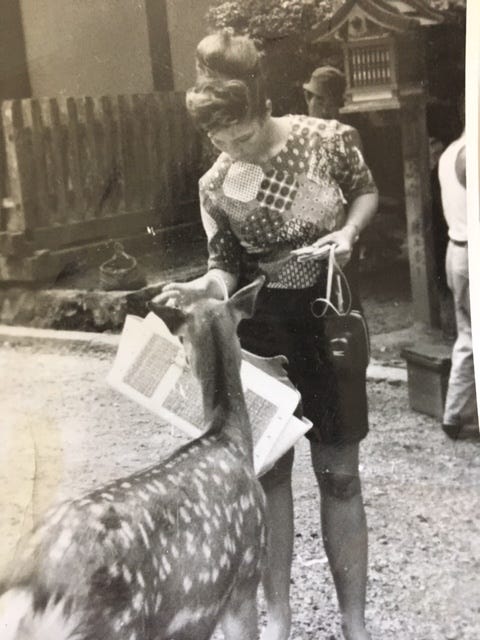
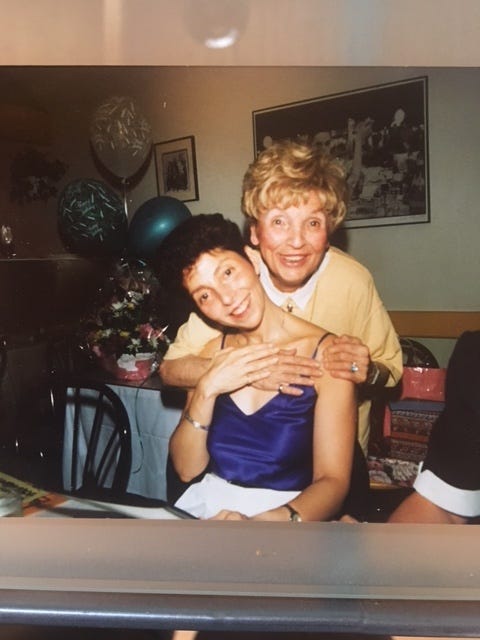
ONE DAY, IN THE MONTHS BEFORE TOBY DIED, my sister called and said, “She’s not our mother, she’s not here.” She meant Toby was unable to keep track of her age, the year she lived in, who was alive, and what dead person was due back soon. In our mother’s mind, my sister still had babies.
I wonder now if she was pulling a fast one on us.
On February 7, 2008, my sister called to say Toby had died. I said, “How do you feel?” She said, “Bad in a way I can’t put into words.” I said, “Do you miss the person she had been?” Ellen said, “Exactly. I had this connection with her all my life, and now she’s gone.” She said she didn’t know how to mourn because in another way Toby was still there. Her body, her gestures, her phrases were in our bodies.
Oliver Sacks makes this point in his essays. Limits on our capabilities don’t exhaust the self. We don’t have an essential self. We have a self that continues to reconstitute itself and recognize itself as it seems we are falling apart.
Ellen said, “I could tell Mom anything, and she wouldn’t judge. Daddy was a moralist, but Mom didn’t disapprove. I knew whatever I told her she would never betray me, and I didn’t betray her. I was talking to her when the kids still lived in the house, and she said, ‘I was tempted to have an affair, but I didn’t do it. I was afraid. You go, Ellen, if you ever want to, get what you can’.”
Ellen said, “I could ask Mom’s advice about things. She had a sense of the world from all the reading she’d done. Daddy didn’t have that. If I was thinking about making a decision in my career or something involving Peter or the kids, I could talk it over with her, and she would listen.”
I could see them together at a table, their heads close. Ellen said, “I don’t think Mom was a good mother. She was too anxious. She didn’t let me make my own mistakes.”
I said, “Your regard for Toby made her the best version of herself she could be. You made her feel smart, needed, compassionate, appreciated. She didn’t believe in her value. She didn’t feel confident that she was intelligent or could move around in the world without being stopped. I’ll never forget what she said when we were getting her into rehab. She said, ‘Will they think I’m important enough to save?’ It had never crossed my mind she could think that way.”
My mother was 89 when she had a stroke and 92 when she died. In October, I will be 80, and now I understand the way she feared she could be overlooked and considered disposable. It’s a wonderful feeling, getting to know my mother.
When Ellen called about Toby’s death, I was walking around a golf course in Arizona near the house where Richard and I were then living. The lawns were freshly seeded and were an electric green. Ellen said, “Now I have you.” She meant I was someone she could talk to freely and could trust. I wanted to be this person, and I thought the best way to do it was to listen to her love our mother without saying a word.
Keeping FEMINIST WRITING alive and fighting without a pause.
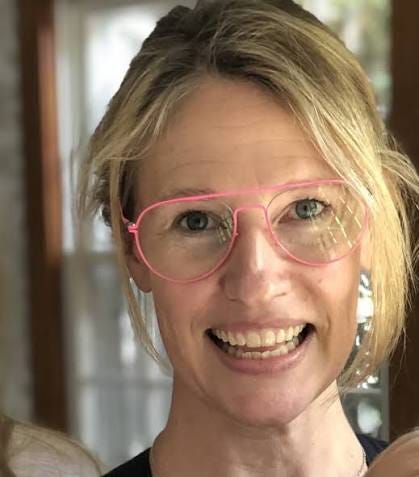
LOOK AT HER, ISN’T SHE BEAUTIFUL. I wonder how she keeps her bottom teeth so straight.
Our paths first crossed when she was editing The Women’s Review of Books. Then I became a columnist in Liber, the feminist literary journal Jennifer publishes. Then, in 2022, as the founding editor of Dottir Press, she published my book Streaming Now. It’s a physically beautiful book. I mean, would this woman make something that isn’t beautiful.
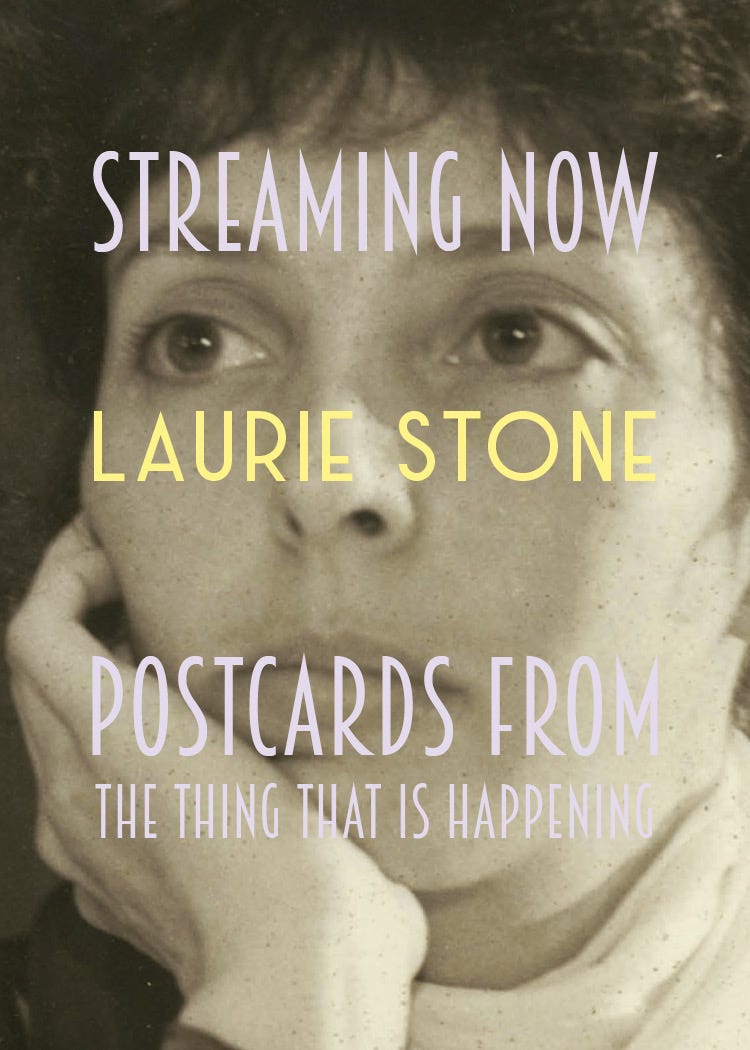
She was very smart about suggesting it not come off as a Covid memoir. She said, “That will date it.” It’s not a Covid memoir. Jennifer was thinking readers here might like a copy of the book with a special 30% DISCOUNT for you. The money goes to supporting feminist publishing and here is the link to order it:
https://www.dottirpress.com/streaming-now
When she was growing up in Fargo, North Dakota, she knew she had to get to New York City. How? After college, she applied for an unpaid internship at Ms. magazine and on January 2, 1993, she got the call. At 2 AM, she boarded a train to NYC. It took two full days. How to make herself indispensable? Become the person who can clear paper jams from Xerox machines. She soon graduated from intern, to assistant, to editor. After Ms., she became Executive Director of the Feminist Press and in 2018 she created her own publishing company, Dottir Press.
Everything she’s done in her career amplifies the art and ideas of feminists. Few people can match her focus and capacity to move her projects in the world.
Her own books include Manifesta, Look Both Ways, Grassroots, F’em, and Abortion & Life. She’s made two documentary films. She’s taught at the New School, and in 2024, she became the Lakes writer-in-residence at Smith College. Most of the time, she lives in the city with her kids Skuli and Magnus. On Tuesdays, she drives to Northampton, Mass and drops into what she calls, “my own private Themyscira—the island where Wonder Woman was born and raised. She’s teaching writing and editing to the students at Smith while preparing her papers for the Sophia Smith Special Collection of Women’s History. This fabulous human is also producing a play she calls “hilarious and dark”: The Body of Mary: A Play in 3 Acts (of God). Look for it to debut this fall in New York City, and here’s a link to learn more:
I’m okay. Another year. We think about it this way. By we I mean me and probably every other female human on the planet. In this way, we share a common experience. Does it unite us? Maybe. Sometimes. In some ways.
All the people I engaged with yesterday were women. The second I see a woman in a setting for breast health, I love her. I fall instantly in love, and I say I’m afraid in the routine way we are all afraid to get bad news. Yesterday, the women were beautiful, all of them. I hugged them because the news was good. They smelled like sun on grass. I always wear perfume but not yesterday. They don’t want you to wear scent at the screenings.
In the past, more than one time, the news was iffy, and I had to have further tests. Oy. You know what I mean, and if you don’t know what I mean, I am thrilled and I hope it never happens to you. One of the questions on the form yesterday was, “Are you an Ashkenazie Jew.” I said to Richard, “I am, right?” He said, “Yes.”
He comes with me to the screenings. He worries about the weather. Seriously, he is a weather hypochondriac. He does not worry about medical tests. He wasn’t supposed to live to be 60, and next week he’ll be 76.
Afterward, we sat outside the Maker Hotel on Warren Street, drinking coffee. A weight the size of my body lifted off me, leaving room for the other weights of the world to resume their seating positions, but not right away.
LAURIE & RICHARD on writing DRAMATIC NARRATIVE in any prose genre: To RSVP: lauriestone@substack.com.
To attend one event or receive one recording, with no future payment obligation, you can buy a “coffee” for $4 at ko-fi.com/lauriestone
The BREAKOUT SESSION following the Zoom conversation about DRAMATIC NARRATIVE is on SUNDAY AUGUST 30, from 3 to 4:15 EST. There is a cap of 10 at each breakout. You are invited to share a piece of your own writing of around 400 words. The SLAM readings are thrilling impovs—we make a work together larger than the parts! The fee is $30. To sign up please email me at: lauriestone@substack.com.
with Steven Dunn, with Margo Jefferson and Elizabeth Kendall, with Francine Prose, with David Cale that includes a reading from his hit solo theater piece Blue Cowboy, with poet David Daniel, with Daisy Alioto, publisher of Dirt, and others, please email me at: lauriestone@substack.com.
If you would like to book time to talk one-on-one about a project you are working on or for guidance in gaining confidence and freedom in your writing practice, please email me at: lauriestone@substack.com.
If you would like to book time to talk one-on-one about STARTING AND GROWING a Substack publication, please email me at: lauriestone@substack.com. I can help you through the software, choosing a title, art design, and ways to gain readers.
Comments
Nothing yet. Say the first thing.
Sign in to join the conversation.