

Hello from Paris, where I’m spending the week with my son, mostly just riding the metro (his favorite thing to do here). We’ve been on every line in the past but because there’s a new RATP jingle (it’s terrible!) he decided the metro had been “reset” and we had to do it all over again. We did not see the eclipse from where we were, and J. did not care, and I took a contrarian pleasure in liberating myself from caring. So much of autism parenting has been about letting go of what I thought parenting was going to be about, what other people are doing as families, and just… doing whatever.
It’s not bad, it’s just different. Is what I tell myself.
So we come to Paris and we ride the metro for hours, and wherever possible I invent a reason to go above ground, to get a takeaway coffee, to get an ice cream, to go to the bathroom, and that is how we see the Seine, or the canal, or the Palais Royal, etc — by accident.
He has a native-born Parisian’s indifference to the city’s monuments. The other day we were on the line 6 which does this beautiful thing of crossing the river between Passy and Bir Hakeim and you get an amazing view of the Seine and the Eiffel Tower and I have always loved it, even when I saw it every day on my commute to work at NYU in Paris which used to be at Passy. I said to J.: I’m going to take a picture for Grandma and Grandpa, they’ll like to see it! and J. said DO NOT TAKE A PICTURE OF THE EIFFEL TOWER MOM DELETE THAT RIGHT AWAY!!!!
Another thing that annoys my son: showing him places in Paris that I have some connection to. I am trying to stop compulsively doing this: ah! that’s the library where I used to study! Ah! that’s where your dad used to live! Oh! This metro station is where you were born! I mean, not in the station, just nearby. Aux Bluets! Sometimes I say these things more than once. The thing is, he mostly doesn’t respond, and it can be hard to tell if it’s because he’s preoccupied with his own thoughts, or is having processing difficulties and can’t understand me (the streets = sensory overload), or if he hears me perfectly well and just finds the things I say deathly boring. It was the latter the other evening walking down the Boulevard de Magenta: Do you remember that this is where we lived when you were born? This is the first place you ever lived!
J.: YES MOM I REMEMBER YOU’VE TOLD ME A MILLION TIMES NOW STOP TALKING!!!!
How did this happen? When did I become someone’s annoying mother? Have I been annoying this whole time? And/or is there something inherently annoying about our parents, always there first, always telling us stuff they think we don’t know? I would never have taken a picture of the Eiffel Tower from the train in my life before J., I have always maintained a façade of being too cool for that, but I don’t know — parenthood makes you do unexpected things.
On this trip, we’re staying in a part of town that’s rife with memories for me, and I’m learning to keep my mouth shut about it. I used to live around the corner on the Rue Rodier, which since 2024 has been the Rue Claude-Rodier, because they’re now trying to name more things after women in Paris (I wrote about the need for more representation of women in urban spaces for Le Monde in 2018) so ye old Jean-Baptiste Rodier (1763-1832), deputy governor of the Banque de France, has had to shove over for Claude Rodier (1903-1944), Resistance fighter. In those days the road we’re staying in now was called the Rue de Rochechouart, but in 2019 it became rue Marguerite-de-Rochechouart, and the nearby Boulevard de Rochechouart was renamed Boulevard Marguerite-de-Rochechouart. Quite a mouthful. I heard some French tourists stumbling over the name the other day as they came out of the metro at Anvers looking for Montmartre. Mar-guer-ite-de-Ro-che-chouart. It’s trochaic tetrameter.
But wait for it: our friend Marguerite was actually Marguerite de Rochechouart de Montpipeau (1665-1727). That’s how you can tell a person is really posh here, they have like 10 names all connected by nobility particles and prepositions. The niece of the abbess of Fontevraud (who was sister to Mme de Montespan, the mistress of Louis XIV) where little Marguerite was raised, she grew up to become the abbess in her own right, of Montmartre, though her abbey no longer stands. From what I can gather, she was a very good manager, paying off the abbey’s debts, enlarging their kitchen gardens, founding an archive, and beautifying the premises. Now she is the only woman in Paris to have a boulevard named after her. (Perhaps even less comprehensible to her, the owners of the flat we’re staying in have also named their wireless network after her, though they have neglected to include the first r.) But no one knows who she is, or even cares. If this major nun can be forgotten, even by those who say her name every day, what hope is there for the rest of us?
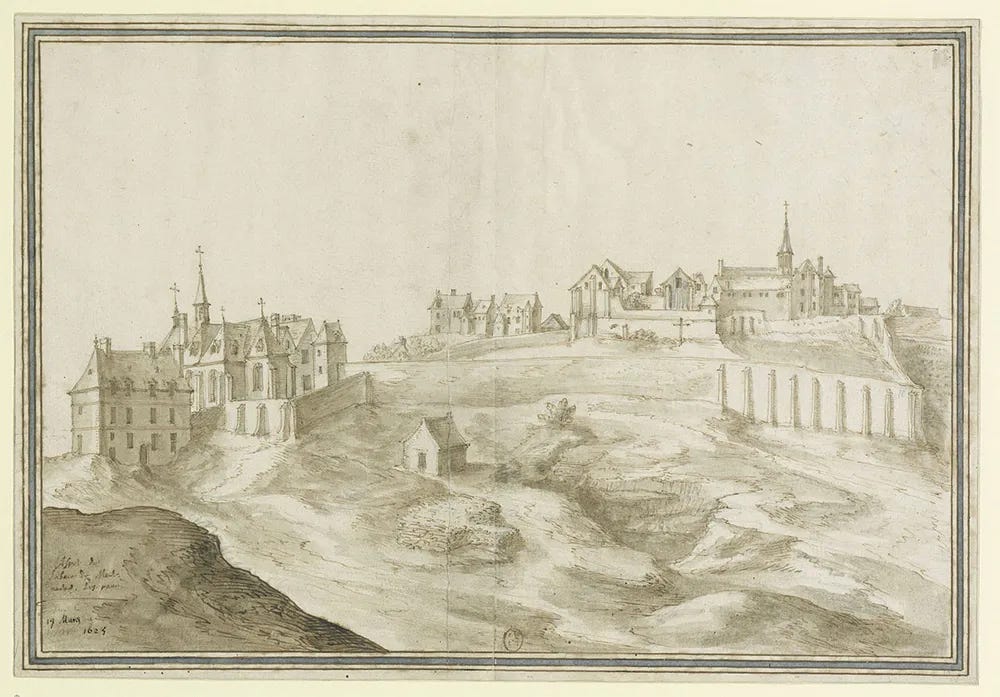
This is a 17th century drawing of her abbey. It’s hard to plot an image like this onto the map in my mind but I suppose the top of the hill is the same, that’s where Sacré-Cœur is now, and the buildings on the left (is that the abbey or the priory?) is where the stairs and the funicular are now?
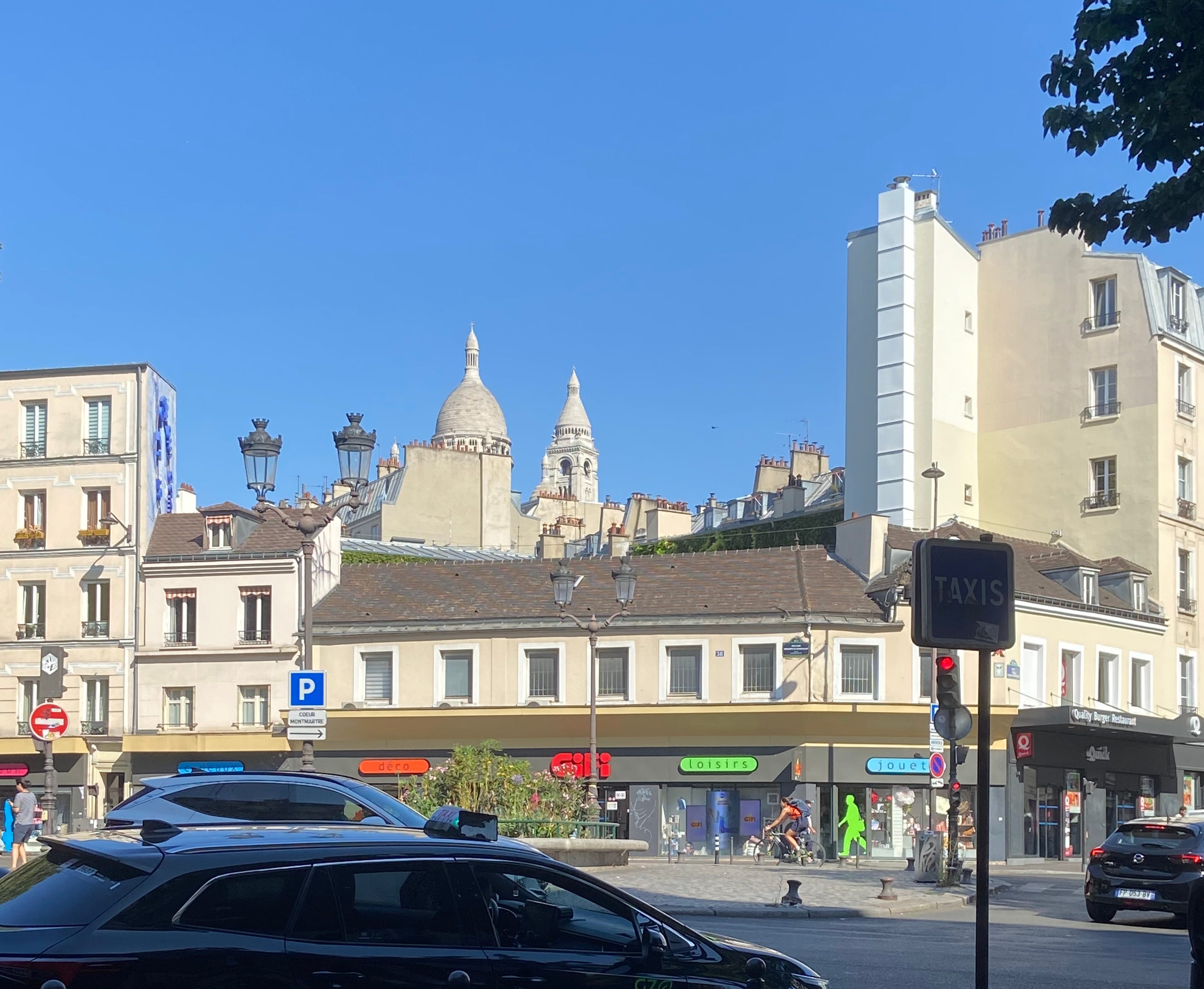
And above the shops at this intersection, you can see Sacré-Cœur atop its hill, still atoning for the bloodshed of the Commune. But as I am with my son, what interested him was not the church but what he took to be the green man from the crossing sign, on the outside of that Gifi shop.
Just off to the bottom right in the drawing of the abbey (and off to the right of my photograph) would one day stand one of the women’s barricades, where Louise Michel fought during the Commune: they called it la barricade des Rochechouartaises. Serious (read: male) historians have suggested that the so-called “women’s barricades” are pure legend, but this feminist historian claps back with eye-witness proof of one at Place Blanche, reported in a Parisian daily newspaper called the Journal Officiel on 23 May 1871. And as for the Rouchechouartaises, there is this illustration by a contemporary illustrator:
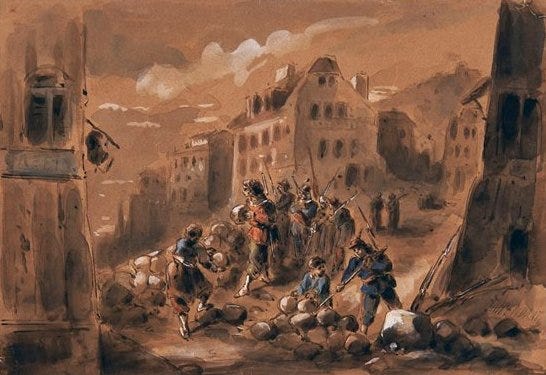
Thank goodness for these newspaper articles, these quickly-done sketches; thank goodness for journalists, for illustrators, for photographers (and in the long run the archivists, the curators), who capture what they see, and record it for posterity, which really does exist, even though it feels like the news cycles go by so quickly and we forget from week to week what we were all het up about.
But I was talking about why I had to tell my son about my link to all of these places in Paris. It’s because I want him to know my Paris. And I want him to understand that this is my city, even though we’re primarily living in London, that Paris is where my history is, because one day we’re going to move back here and I want it to feel normal and natural, but also inevitable: that it’s his city as well.
It’s nostalgia, too, which is also why I dislike the new RATP jingle. It doesn’t sound Parisian, I told J., it sounds like you could be in any metro system in any city in the world.1 Why does the old one sound Parisian? he asked. I tied myself in knots trying to articulate a Parisian aesthetics of the corporate ditty, and I think there’s something to my argument, but really it comes down to the fact that I just like the old one better. The old one says “Paris” because it’s been the soundtrack to my metro rides in Paris for 27 years. It’s why I like the MF67 stock trains with the little handle you turn to open the doors, that you can hold onto as the doors open and the train is still slowing to a stop, and you keep holding onto it as you hop off the train, a Parisian-specific dance step. These are the textures and sounds and movements of my city and I don’t want them taken away, replaced with stupid little songs and frictionless automatic doors that you simply walk out of.
Talking about the past with our children — even something as stupid as I used to go to that café — is born of the same impulse to commemorate as renaming the streets after women, but it is our silly simple lives we want to commemorate. This impulse is why I am drawn to urban history, but it is also why I am a reader and a writer. Who lived here and how did they live? What was it like for them? I think answering these questions is part of what narrative art is for. I just watched the 1996 film adaptation of Jean Giono’s novel Le Hussard sur le toit and now I have an understanding of what it meant to live through the cholera epidemic in France in 1832. How does this serve me, or us, in 2026? I don’t know. It’s more than just entertainment, watching a beautiful film with beautiful actors in bed at night next to my sleeping child. Even trying to put words to it — empathy, testimony — feels like overreach. It’s just a simple act of recognition, I guess.
Ben says it sounds like a health care commercial.
No posts
Comments
Nothing yet. Say the first thing.
Sign in to join the conversation.