
First things first — Vocal Break is out in North America in 2.5 months and I would be an irresponsible author if I didn’t start banging on about it on here. Look at this cover! I had an idea early on that this photograph of Bikini Kill (taken by Tammy Rae Carland) really pulled together so many of the themes and motifs in the book — the Little Mermaid, girlhood, punk, cool, authenticity, feminist activism — and I was so pleased FSG went for it. Thanks to my editors there for their patience with my persnicketiness and Na Kim for the design and Kathleen Hanna and Tammy Rae for saying yes to it.
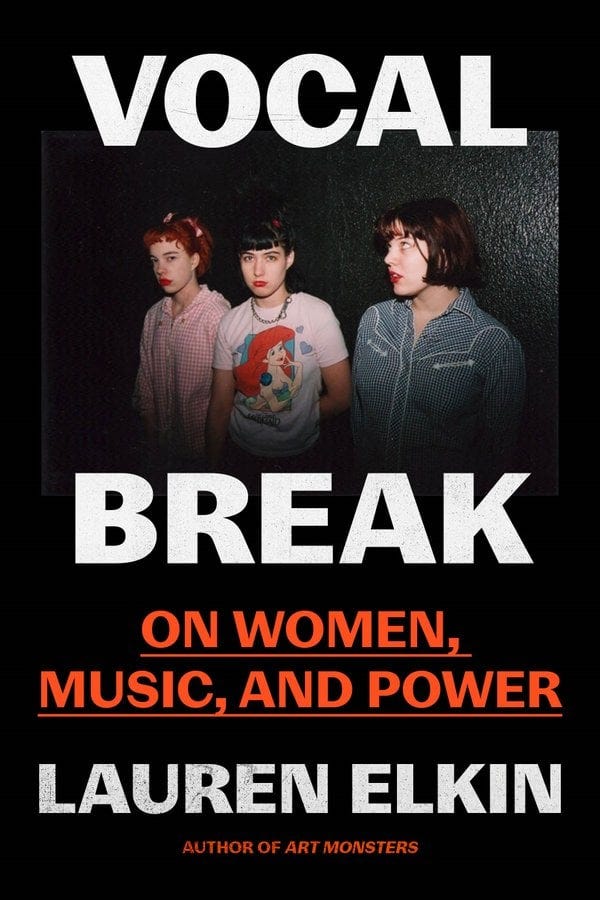
If you are in the US or Canada would you please consider pre-ordering? Pre-orders are one of the nicest things you can do for an author — it signals to bookshops how much support they should give to a book, signals to publishers that there is ongoing demand for a particular author, and — ick — boosts the algorithm so Amaz*n shows your books to more potential buyers. For some people it also helps them make the bestseller list, as early orders end up counting in the first week of sales. (I am in no danger of this, as long as I keep writing niche books about feminism. Seriously: the book has two reviews on UK Amazon. I am clearly not writing into the zeitgeist.)
Order from Bookshop.org or the other place.
With that said — hello! I’m just back from a trip to Glasgow and Edinburgh, where I was in conversation with Claire Biddles at Burning House Books, and at the Edinburgh Book Festival with my friend Sinéad Gleeson and Astrid Jorgensen of Pub Choir fame. Given that I was totally spent from two tiring (but lovely) trips to France with my son, involving multiple hotels and train rides, I had been complaining the whole previous week about having to schlep up to Scotland. “Four and a half hours on the train,” I whined. “Four and a half hours.” But obviously Scotland is always worth the schlep. I forget, between visits, how much I love it there.
I had a religious experience on the journey up. As we left Lancaster station, these enormous hills rolled into view. I was listening to “Pompeii” by Bastille, which is a pretty epic song, it has to be said, and those archaic eh eh oh eh oo, eh eh oh eh ohs seemed to be emanating from the hills themselves. (As a side note, I love that Dan Smith sings in his own London accent instead of doing a fake American one. I know it’s not that rare but I saw Raye talking about this recently, about how she didn’t feel authorized to sing in her own accent, and that made me sad.) But the hills! Absolutely mind-blowing, not at all normal. I believe I was looking at the Howgill Fells, which the naturalist and fellwalker Alfred Wainwright compared to a herd of sleeping elephants. I felt so grateful to be in that landscape. As a city person I have not instinctively understood the mystical attachment of the Brits to their geological formations, but this Saturday on that train to Glasgow I got it, I really got it. O Albion! My borrowed country. Although, as I recently learned, my grandfather’s family can be traced back to 15th century Lancashire, so maybe I was feeling some kind of deep ancestral bond.
In other news, I got extremely emotional looking at a fern leaf earlier that week, so… I don’t know what’s going on with me. Look at its beautiful little leaves, so delicately, minutely textured. Look at this leaf. Look.
What to do with all this beauty, I ask you!
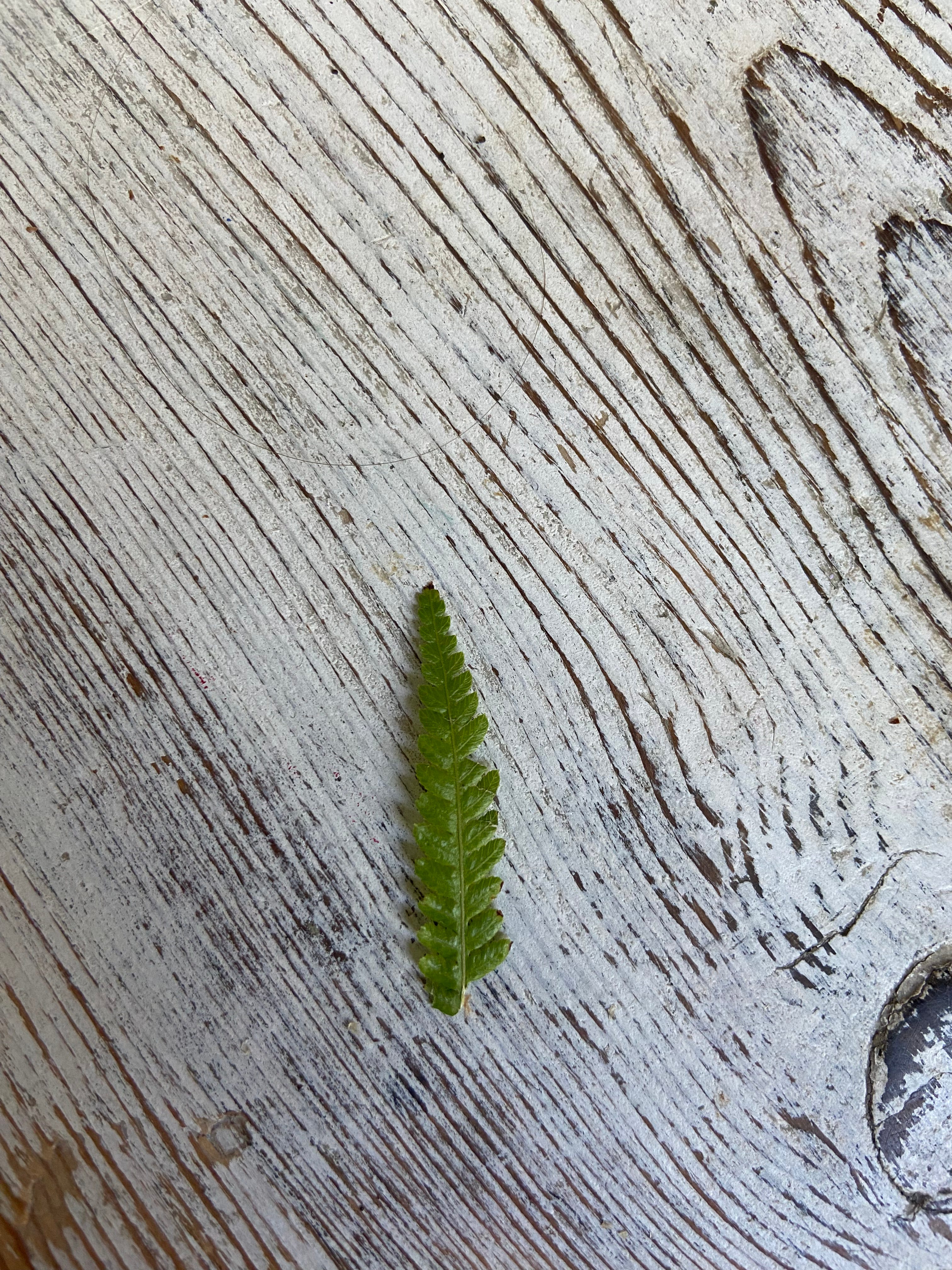
fells
Glasgow was a trip, as usual. My taxi driver looked like Ali Smith. Everywhere I went people were doing karaoke. Aimee got ID’d at the pub afterward despite being in her late thirties and Claire said that for her last big birthday she staged a group performance of the musical Company, so now I have #goals for my 50th, in 2028. ( Shannon Rose Smith is also planning something like this for her 50th. 2028 will be a great year for amateur theatricals.) I will be back, Glasgow, just as soon as I can, and next time I want to go to Supercube.
When I go to Edinburgh I like to play a game with myself: how long until I hear bagpipes. When I go during the festival, it’s usually within five minutes. This time was no exception. I also saw a guide leading a group of tourists, sword held aloft.
The festival was great, as usual. My event was magical — Astrid got the very shy, bookish audience to sing Cyndi Lauper in two-part harmony (I posted a video on Instagram). I missed Rebecca Birrell because I was trying to get work done in the Glasgow hotel that morning and couldn’t get myself together to take an early enough train, and I missed Philippa Snow because I had to take a nap, and I missed Chris Kraus because my event conflicted with hers.
But I did get to see Andrew Hussey and Richard Collett talking about France and Britain and national identity. Collett’s book Along the Borders tracks his travels and conversations along the borderlands of the United Kingdom; that is where, he found, national identity is strongest: “Flags fly, dialects become stronger, and the distance between ‘us’ and ‘them’ grows. But borderlands are also the spaces in between, where centuries of history and culture merge and collide to create complex and shifting identities.” Collett was saying that he doesn’t think we should get rid of borders, because they are meaningful containers to people, but that we should examine them, reach across them, and think about what they bring into contact. It made me think about my writing on the slash in Art Monsters — how it separates and conjoins disparate ideas, brings them into conjunction, activates something, can be a site of the work we have to do. I wrote about this in Flâneuse as well, quoting the theorist Homi Bhabha:
it is at the borders that ‘something begins its presencing’ […] Something happens when we push at them, and cross over them; some ambiguity is sustained, that cannot be absorbed into some kind of homogeneous identity. In my experience those who defend this homogeneity don’t much care for border-crossers, those who don’t or can’t respect boundaries, or, rather, respect them in a different way, by brushing back and forth against them. […] Beware roots. Beware purity. Beware fixity. Beware the creeping feeling that you belong. Embrace flow, impurity, fusion. ‘To be unhomed is not to be homeless,’ writes this wonderful critic named Homi.
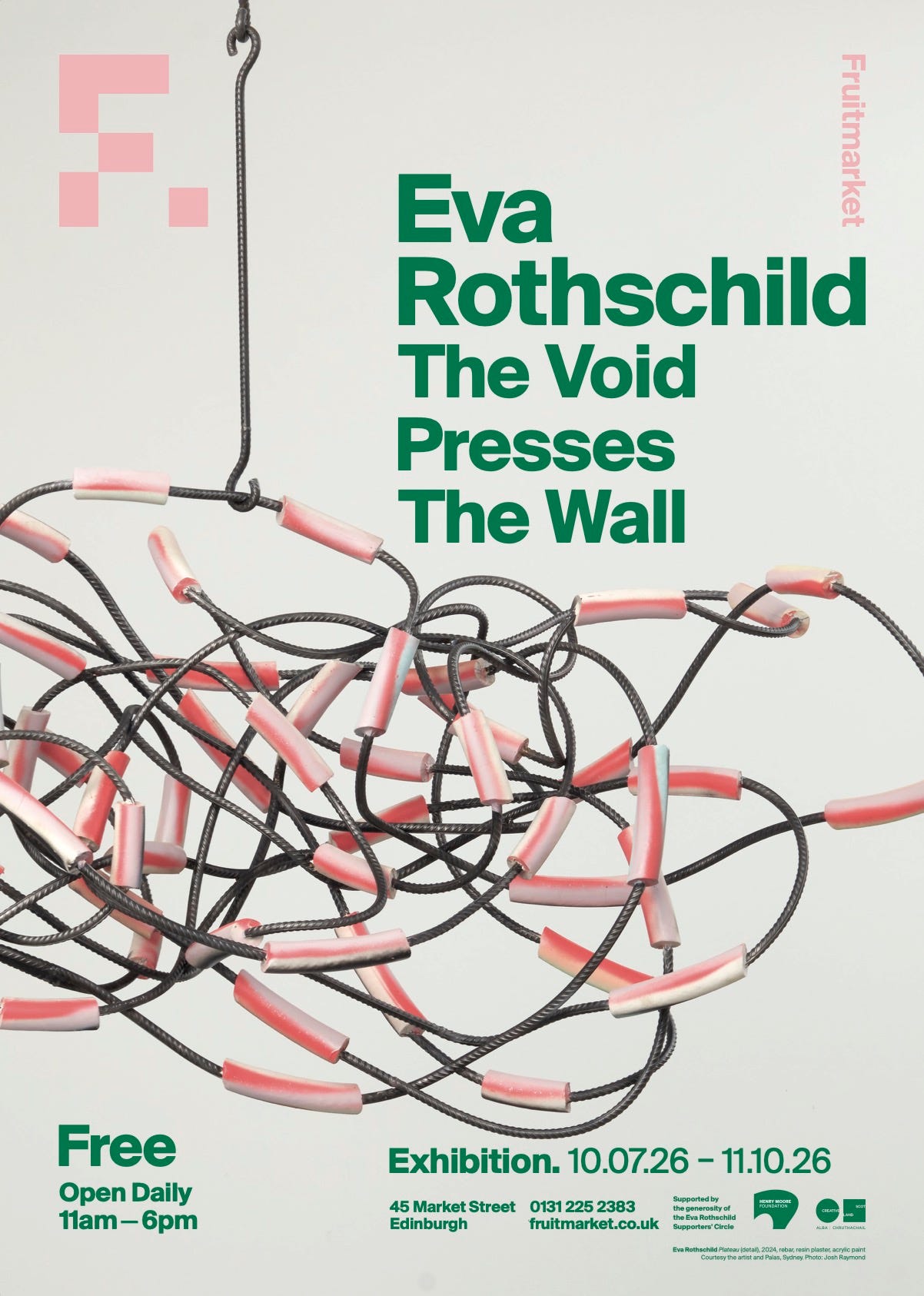
My train home was cancelled Monday morning, and, finding myself with two hours to kill until the next one they could put me on, I took myself to the Fruitmarket Gallery, which is next door to Edinburgh Waverley. Their current show, The Void Presses the Wall, is by the Irish sculptor Eva Rothschild, and it resonated beautifully with all this border thinking — or at least, that’s how I read it. It was, I thought, a show about connection and responsibility and hospitality in the internet age. The first big piece you encounter is a tangle of rebar, connected by spray-painted nodes like pieces of candy, called The Cloud. I thought I took a picture of it but I guess I didn’t, so here it is on the poster:
A piece called Pilgrim gave us squishy stacked spheres, like some Victorian’s home-made football, the title invoking ideas of movement and travel, but also the ecosystems that crop up along a pilgrim route: exchange as being at the heart of the formation of communities and boundaries, commerce as an immediate byproduct of devotion, as evidenced by the enormous boost to Edinburgh’s economy the festival brings (I once made the mistake of booking my own hotel during the festival, rather than staying in the one they put writers up in — yikes), as lovers of theatre, comedy, music, art, and literature flock to the city in their annual pilgrimage — with buying power as the entrance to these observations. Those who can’t afford the pilgrimage have to stay home.
I was thinking of this as we are about to shell out major money to get our British citizenship (or, well, we will as soon as we can figure out how to get a passport photo taken of our little rebellious PDA king, who keeps a neutral expression for every picture ever taken of him UNTIL you want him to be expressionless and then he does this weird smile-grimace which is just not going to fly with the home office). I am miffed, as I did not have to pay to become French, but then I remember the lawyer’s bills I had to pay to challenge the fact that they turned down my naturalization application not once but twice, on the grounds that I did not have a permanent work contract. What writer has a permanent work contract, I paid a lawyer thousands of euros to reply. The cost you pay for being on the margins. But standing behind me, not allowed over the border into French nationality, were those who had neither the permanent work contract, nor the money for a lawyer.
Another piece in this gallery was called Houdini, and it consisted of multicolored hoodies coated in resin with their sleeves knotted together, forming a chain suspended from the ceiling. These jumpers, grasping each other, their wearers vanished, put me in mind of the migrants who try, every day, to cross the Channel in small boats, becoming bogeymen to the British Right, who try to get their followers to blame all their misfortunes on these refugees, rather than ten years of Tory austerity, dehumanizing them, reducing them to empty rags instead of actual people with lives and souls and people who love them. Or perhaps there’s a suggestion of the way extreme trauma makes you disassociate, leaving your body and its predicament behind.
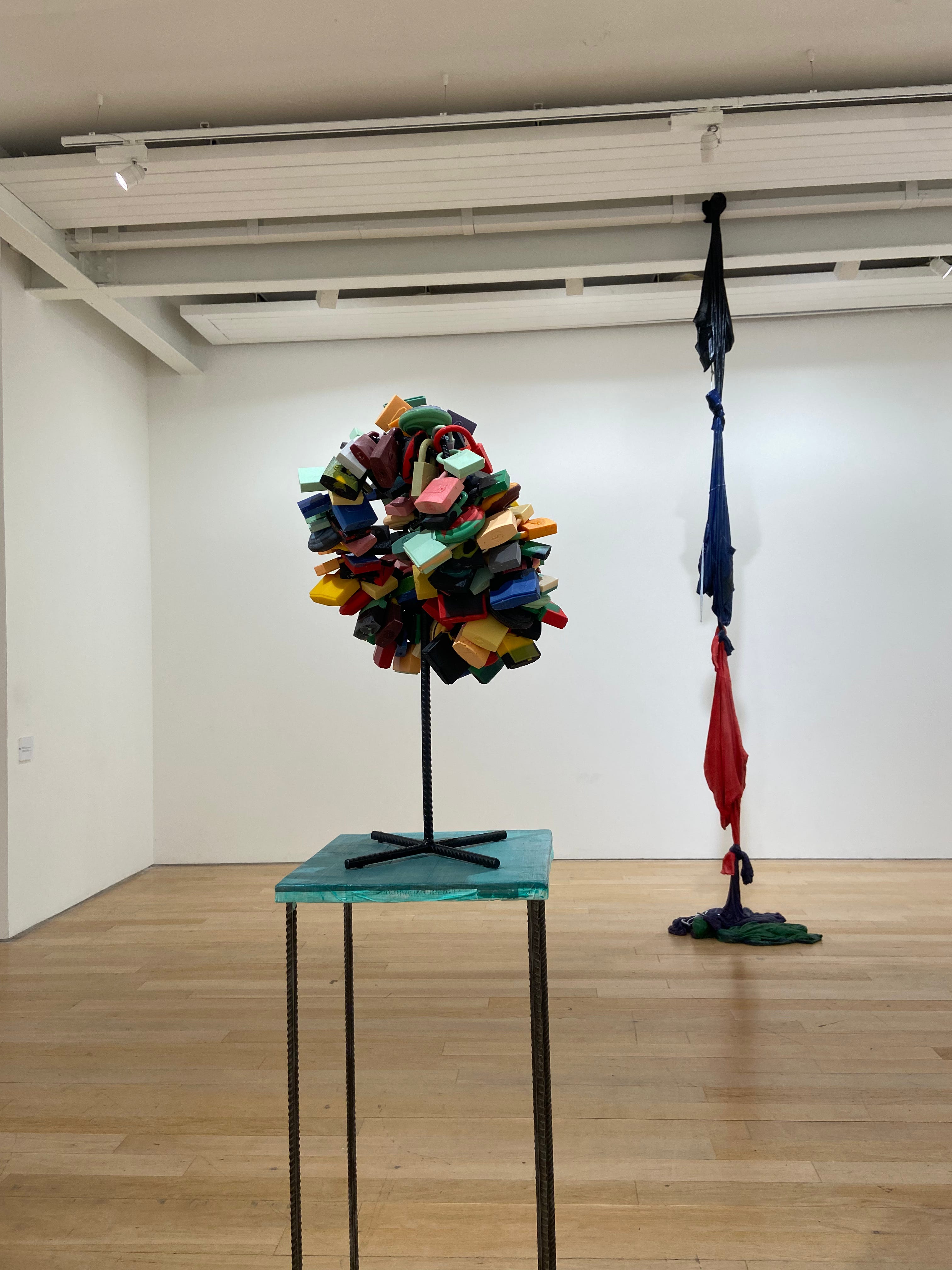
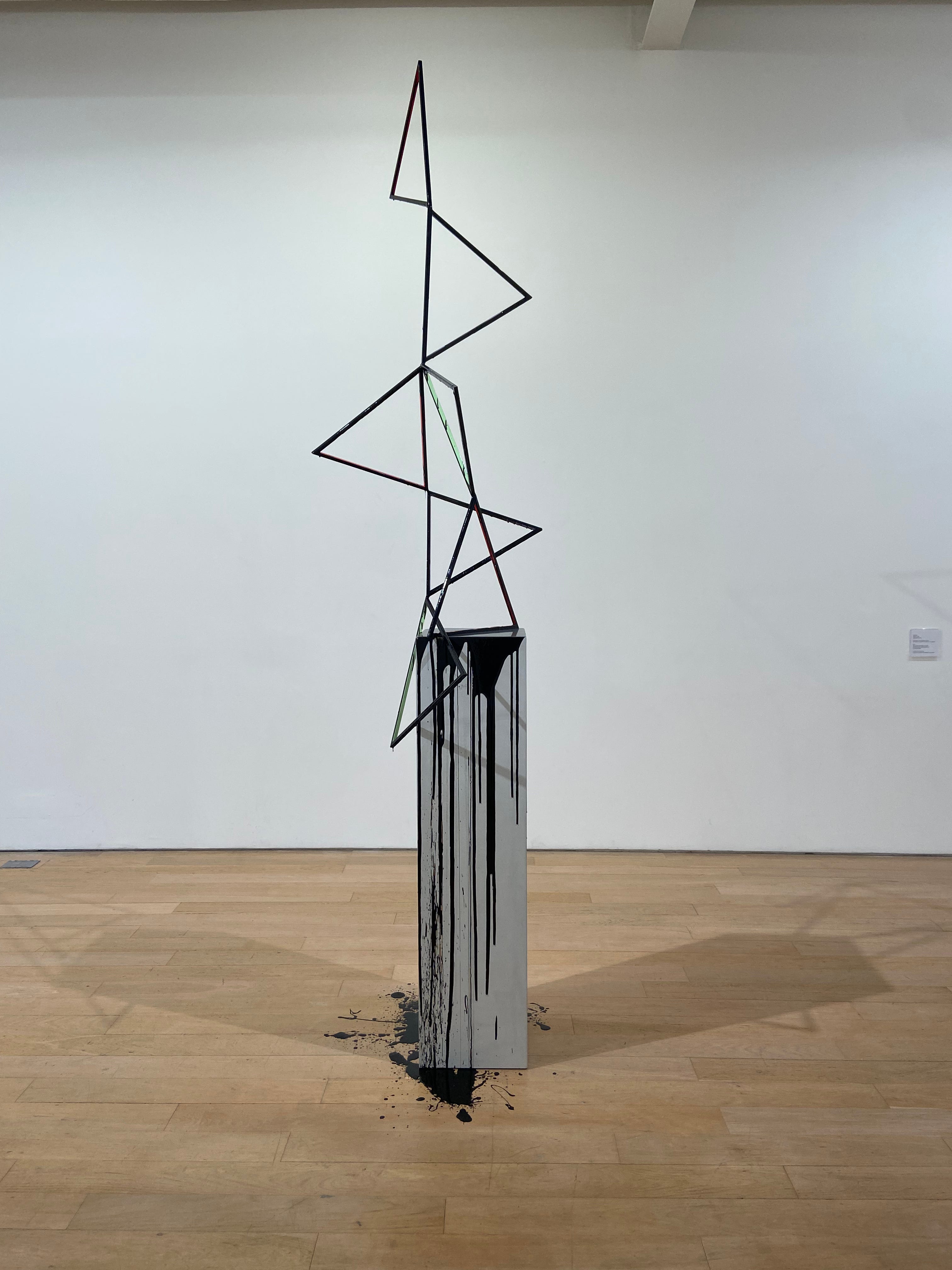
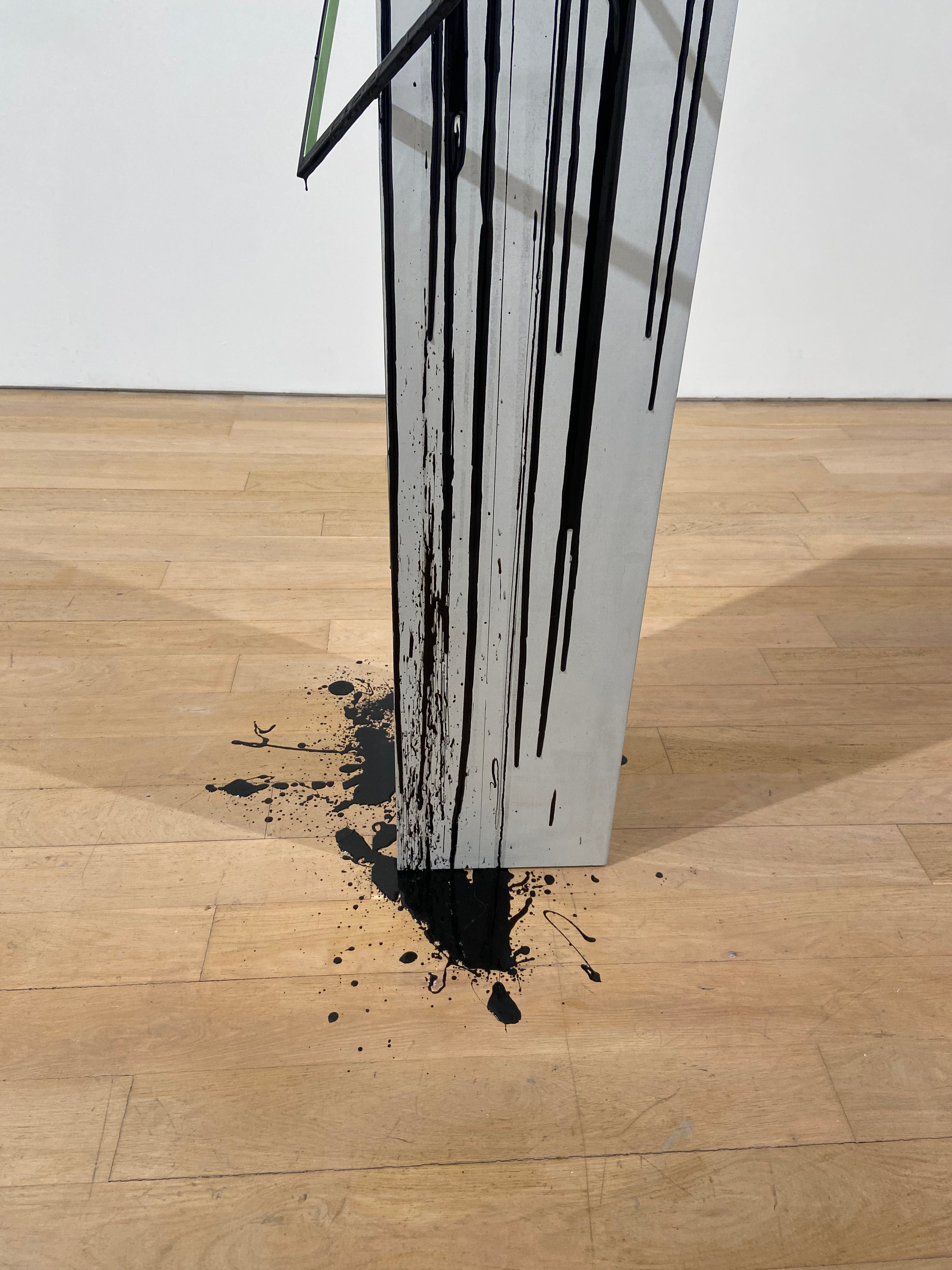
Not every piece aligned with this reading, though; there was a lot of really interesting work upstairs and in the warehouse that dealt with cursive writing, absent presence, balance. But it was in this first room that I spent the most time, just gorging myself on Rothschild’s imagery. I’ll end with a piece from that room, Tranquility Now (2020), a series of steel triangles coated in poured rubber which drips down the sides of the plinth, forming a puddle on the floor (much like the bottom hoodie in Houdini). I thought of something Lisa Robertson wrote about Eva Hesse, which I also quoted in Art Monsters: “Form – it’s because there are consequences.” I like the idea that the consequence might predate the form, that form is a consequence of consequence. The show is very Hesse-inspired, and there’s a lot of Louise Bourgeois in there as well, but instead of trying to cover that up Rothschild has let it be, informing her forms.
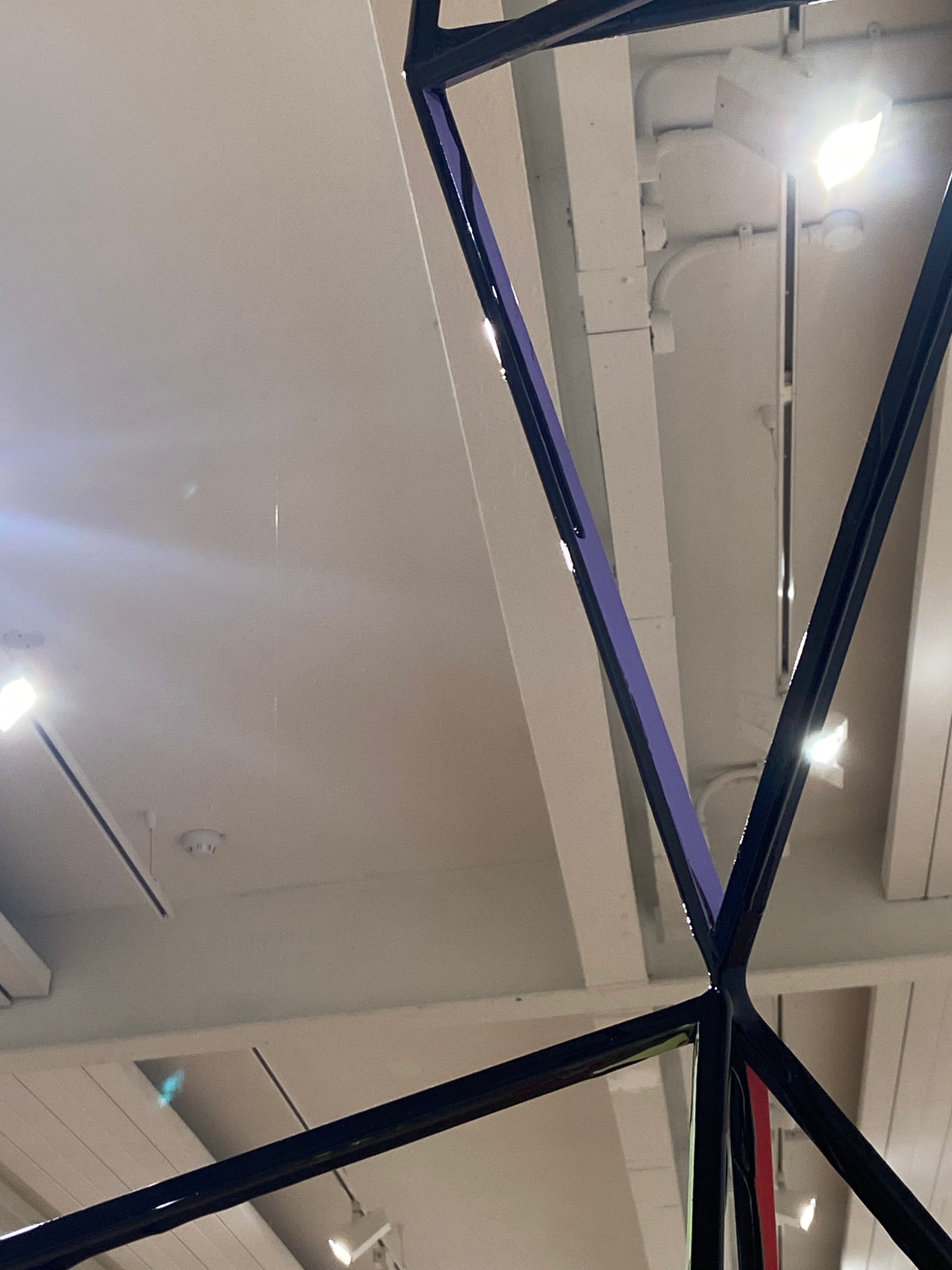
There was a nearly-invisible thread of spider silk connecting this one to the ceiling. Has the ghost of Louise Bourgeois been through the gallery? The light glints on it and I manage to capture it, before heading back to the station.
No posts
Comments
Nothing yet. Say the first thing.
Sign in to join the conversation.