
I have been a Christian for as long as I can remember, and a writer for nearly just as long. But it was only a few years ago that I slipped into the deep waters of poetry. What started as “melodic microblogs” on Instagram soon became full-blown poems that I swam through to process my experiences, feelings, and faith.
I thought I didn’t like poetry. I had no formal teaching in the craft, nor was I much of a poetry reader, which is why I didn’t recognize it as poetry.
Today, much to my surprise, I’m often asked for my top tips for writing poetry. At first, I had no robust answer, only what you will read as the first tip on the list below: Feel deeply. Let yourself go as you write.
That’s basically all I did at first.

But as I’ve been asked more and more, and consider what I did in my forthcoming debut poetry book, This Side of the Sky, there are a few things I would offer. Even if you don’t think you like reading or writing poetry, I encourage you to try. You might find, like I did, a new love.
Here’s another readon I want you to try: The majority of popular modern poetry is written by non-believing authors. While many people can write poems that are smart, complex, and beautiful, I’ve noticed there’s more to be captured in the human experience. As image bearers, we cannot fully know ourselves apart from God. The gospel is what gives us and the ordinary moments of our lives meaning, significance, purpose—and perhaps most essential for the human heart—hope.
And so as Christians who are poets, we write with that in mind—it should set our work apart.
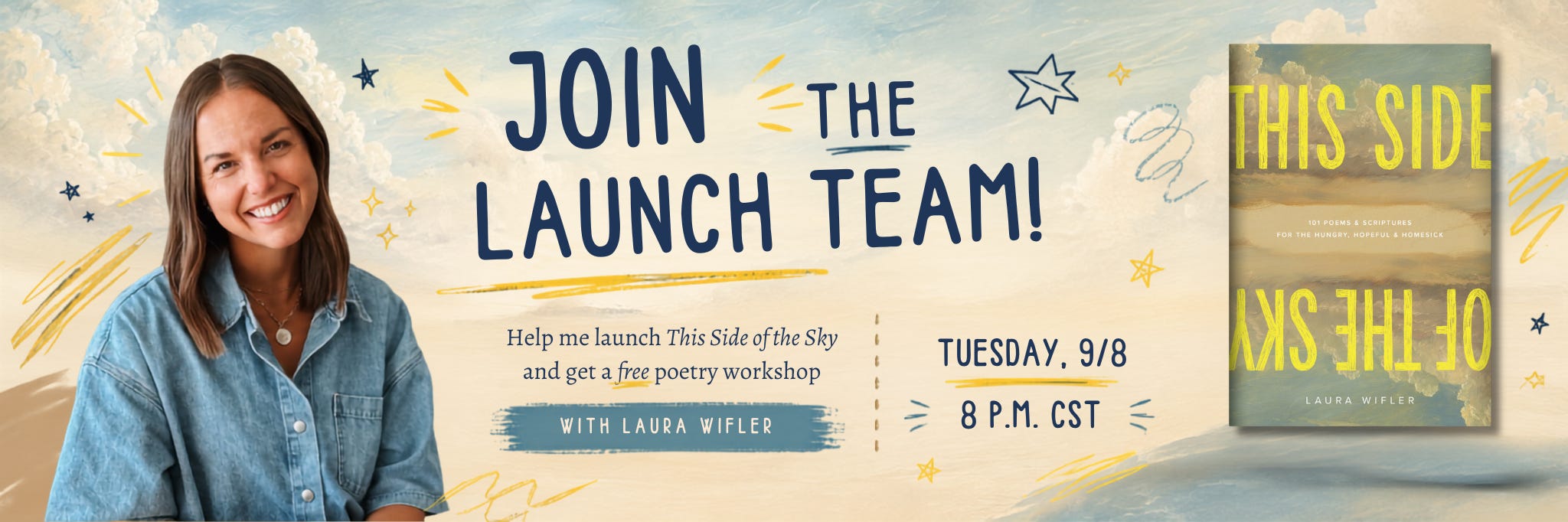
Before we get to the list, if you want to dive even deeper into this, I’m offering a free poetry workshop for anyone who serves on the launch team for This Side of the Sky starting on 8/26. If you can’t make to the workshop there will be a recording sent out after. Sign up below to help me launch the book, and to get your free, live poetry class!
Okay, let’s get to the tips. No matter if you call yourself a writer or poet or not, I pray something in here will be of value to you.
Here’s me, putting on my “poet voice,” which is absolutely different from my casual newsletter voice. Let’s go.
Feel deeply. First, you must understand that if you do not feel anything when you write poetry, it is not poetry. It’s okay if you don’t feel anything at first, but as you write on, you must. Remember Frost? “No tears in the writer, no tears in the reader.” If you bawl as you write, your reader might feel sad. If you cackle, your reader may grin. Collapse into your feelings as you put your whole self into the work. You can remove things later, but to start you must be hunted by your feelings. You must ache with their weight.
Add gristle. Your first pass at the poem will be plain and tired. You will use cliches and prefab language around the sands of time and an ocean of emotion. So keep a word bank on your notes app. When you hear a sticky word, write it down. Then take your original poem, edit out all your pre-chewed language, and replace it with sinewy, fibrous words. Give people something to chew on late at night, the next morning, in five years.
Don’t be afraid to be misunderstood. Poetry has long been known to be a conversation between the writer and the reader, with much of the meaning left up to interpretation, but this still doesn’t stop people from wondering what you as the author, “tried to say.” When the readers ask (in person or on the internet) take a slow blink, a deep breath, and let them. Let them hypothesize. Let them ask. Let them push back on what they think you said. Conversations mean people are reading your work, and isn’t that what we want? For the same reason someone loves a piece, another loathes it. For each creative choice, there will be those that resonate with it and those that reject it. The goal is not to worry about taste or interpretation, but instead write what you love. Write what you can stand up for.
Pull a string. Perhaps the greatest delight for a reader is when a poem pulls a thread all the way through but you never notice until the end. Write down two seemingly unrelated topics or anecdotes or just … things, and weave them into a couple.
Be weird. After you write down everything you feel you want to say, go back through and make it weirder. No one wants to read a reheated message. Delight yourself with an unmoored line. Free-float a fresh analogy. Don’t be afraid of adding a spike.
Go where the words are. Every writer knows that ideas come and go, and if you do not capture them, they will always go. So when the words come, strike! Run to the notebook while boiling pasta on the stove. Roll over and scribble a title under the moon. Write down the hot words, the words that itch and buzz in your brain. Scribble them while they feel urgent and make sense of them later.
Add the hope: The Celts had a phrase, “Thin Place.” They often said that Heaven and Earth are only three feet apart, but in a Thin Place, the distance softens like a veil parted. It’s there we sense the sacred, gaining an awareness of another world. As you write, find the collision of Heaven and Earth. Speak to the holy mystery that haunts every surface of your life. Offer the knowledge that every beat of your mortal human heart is sustained by the God of the universe.
Write the specific, insignificant-seeming details. Write about the small bump on your mother’s collarbone or the way your daughter’s floral quilt feels velvet against your cheek. Somehow—and I don’t know how this works—but your grandmother’s paisley couch where you ate a slice of casserole will become the reader’s memory of being lonely. The opal egg your son brought you after the miscarriage for comfort will become the reader’s comfort in their grief. It is a wonder, isn’t it?
Get your butt in the chair. This, my friend, is the oldest writing advice you’ll ever receive. Perhaps it was once said as, “Place thy personage upon the seat,” or “Affix thyself to thy writing desk,” but the message remains: Sit down and write because you’ll always find a reason not to. Postpartum, a new job, new marriage, new grief. You will put it off for later every day that you do not believe that your words are worth writing. So believe that this work has value. Believe that it is doing something. That might be just for you, or perhaps, somewhere down the line, for someone else. Either way, trust that the words are worthy of writing and sit down and write.
Worship. The best poetry is an overflow of worship. Whether the poem breaks your heart or mends it back together, your writing, your art, is an offering to God. So write to know. Write to understand. Write to say. But above all, write to worship the God who has given you life. Write with the hope you have both today and eternally.
No matter if you’re brand-new to poetry or you’ve been writing this way your entire life, I hope you take some time today to sit down and worship through writing.
—
Don’t forget! I’d love to have you join my launch team for This Side of the Sky—and as a thank you for helping me, I’ll help YOU learn to write poetry, even if you’ve never done it before (or don’t think you’d like it). AND you get the chance to win these awesome prizes!

Comments
Nothing yet. Say the first thing.
Sign in to join the conversation.