
Niche ID is about the choices we make when we build for creative life. It explores non-linear journeys, cross-category concepts and the lore of the modern niche.
“Our intention is to affirm this life, not to bring order out of chaos, nor to suggest improvements in creation, but simply to wake up to the very life we’re living…”
John Cage
Hello friends and lovely new subscribers, welcome!
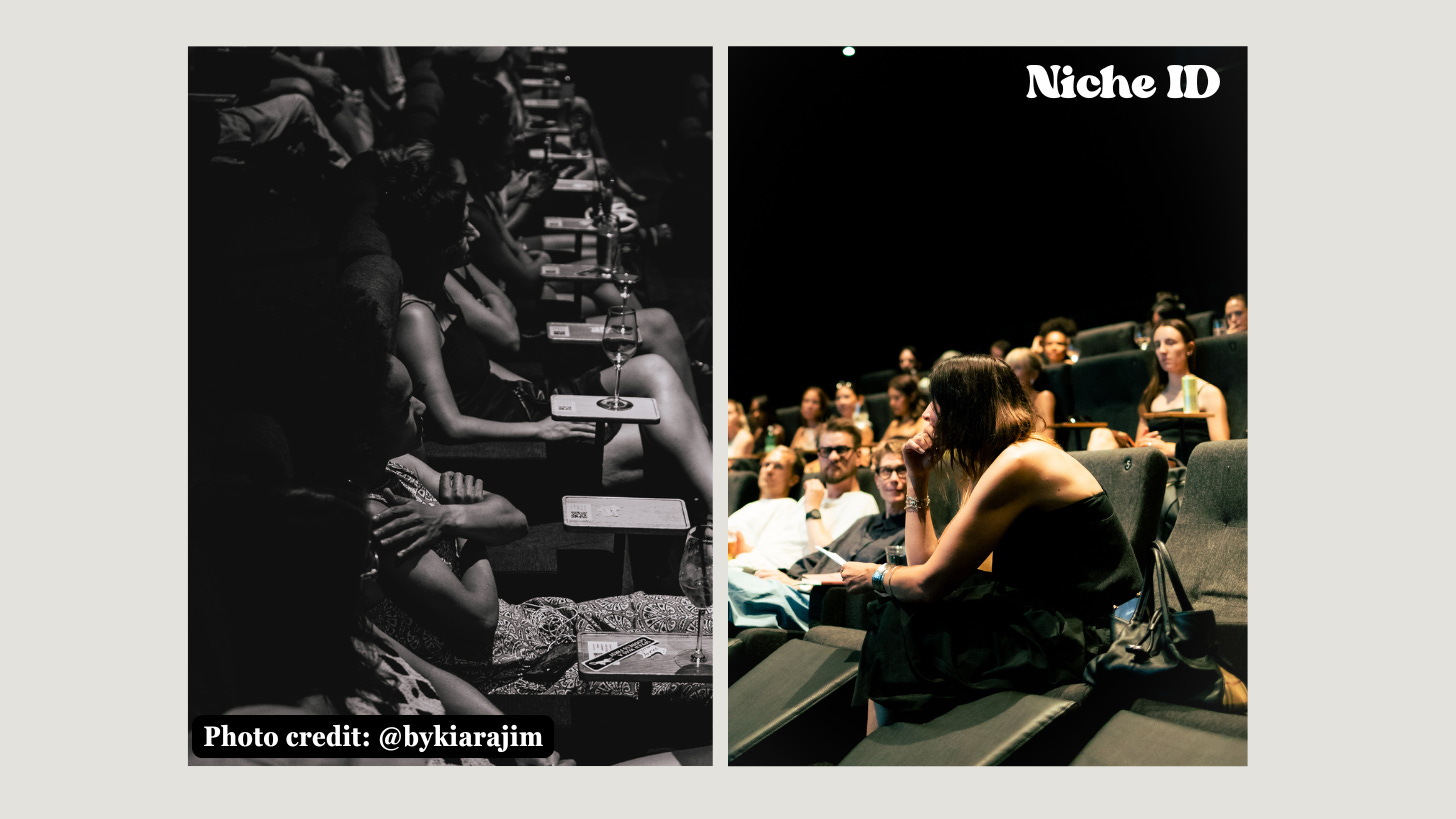
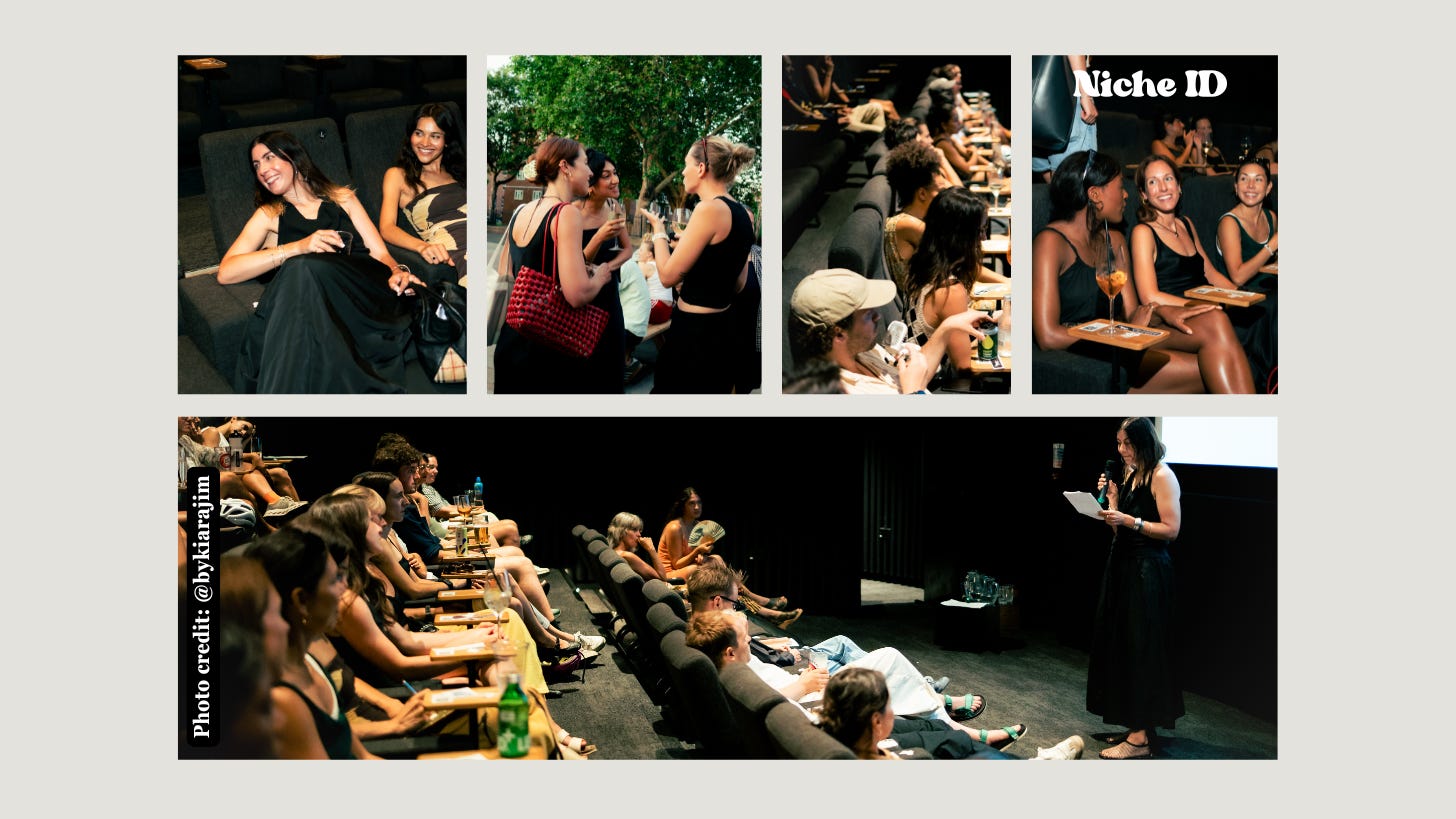
I was invited to speak at Moving Words held at the Curzon in Hoxton last week.
It was an evening of live readings hosted by Pruzan x Taking Space, bringing together authors, researchers and storytellers to share their work on movement and women’s experience in its broadest sense.
I’m sharing a few highlights from my piece but more importantly, the thinking behind it.
I’m always interested in how other writers approach and answer an open-ish brief. Sharing’s a catalyst for new creative avenues, and I’m hoping this could be useful for anyone staring down a blank page.
If it sparks anything in you, as always, let me know. ♥
I start with the classic ‘running tap’ ideation theory: ‘run the water’ a while to get all the cloudy thinking out before the crystal-clear flow of clarity kicks in (Lee Glandorf of The Sweat Lookbook and I also touched on the method in our conversation here.)
An obvious focus for me (the first glass of drinkable water) would be the link between movement and the flow state.
There’s already a huge canon of poets and writers (Wordsworth, Woolf, Murakami etc.) who’ve spoken about how motion is the kindling for their own creativity, and you’ll read about it in pieces like this.
My guests on the podcast often make the movement → creativity connection too:
Here’s Lee again:
“Running just helps get the juices going, it’s a good way to work through a phrase. It’s how I usually figure out the start or the end of something.”
Philosopher and label owner Jozef White, also told me:
“You have to attend to the finite minutiae of life in order to unlock infinite beauty and creativity. It doesn’t really matter how. For me, it’s by running, but different types of movement do it as well. In these moments of deep focus or flow state, just touching that each day is what opens up the possibility for everything.”
Now, while a movement-adjacent writing routine is a vital practice, it’s a saturated topic. So rather than shoehorning my segments into some sort of manifesto, I keep the tap running.
Many creatives will tell you that making something interesting is about doing something interesting. But when deadlines loom, finding beauty or profundity in the everyday is also a useful Jedi move.
I switched to sense-checking the lineage of poets and creators who’ve made out-of-the-box compelling work from the place where they stand. Prolific artists like experimental composer and writer, John Cage, who expressed his ideas through avant-garde sound and form.1
“If something is boring after two minutes, try it for four. If it’s still boring, then eight. Then sixteen. Then thirty-two. Eventually one discovers that it is not boring at all.”
John Cage
My point is that once you start mining techniques and material that already exist (and all the ways these can be reinterpreted) your ideation tap begins to more closely resemble a river after the rain. Look outward.
Your outputs rely on diverse, high quality (and of increasing importance, atypical) inputs. Think: conversations, books, interviews, archival references and a healthy balance of offline living for a more holistic understanding of real people’s voices, and their infinite expressions.
Youtube’s full of old BBC recordings and vintage footage that reminds us of the gift of the collective human story. I’m not just referring to the Jungian heroes but regular, rich characters2 with an endearing enthusiasm for the task in hand, whatever that thing is. Everything is research and nothing is wasted (my only exception being if, like me, you had to endure Toy Story 5 this weekend).
Let’s bring John Cage back to the front of this orchestra and talk about Fluxus.
Fluxus was a 1960s movement named after a magazine founded by the artist, George Maciunas. It featured a bunch of interdisciplinary artists centred around the work of Cage himself. Maciunas said his goal was to promote a flood of “anti-art,” but what interests me is that Fluxus had a real ‘do-it-yourself’ attitude. Inherently democratic and uncommercial, creative cross-pollination, elements of chance and an off-beat sense of humour were encouraged.
“I have nothing to say
and I am saying it
and that is poetry
as I need it.”
John Cage
Closely related to Dadism: not total nonsense (most of the time) but staunchly nonsensical in nature, listening to the Nymphet Alumni podcast got me thinking more about experimental poetry within this framing.
#SwagDadasim unpacks the spirit of ‘salad dressing’ (bear with me) which the hosts loosely define as the tension between intention vs. randomness to express your own unique style.
The new wave of (net-native) #SwagDadasim is about layering universal pop culture visuals alongside IYKYK obscure references that may (or may not) be sending signals the observer is yet to decode. The fact this is all only half decipherable is kinda the point.
They quote a suggestion on how to make a Dadaist poem:
“Take a newspaper, scissors and choose a page from the paper you want to make your poem. Next carefully cut out each of the words and mix them all in a bag. Shake gently.
Next, take out each cutting one after the other. Copy conscientiously in the order in which they left the bag. The poem will resemble you.
And there you are: an infinitely original author of charming sensibility, though unappreciated by the vulgar herd.”
Excellent stuff. So, with literary collage in mind, that’s where I look next.
Now I appreciate that the Curzon isn’t Cabaret Voltaire. So in the spirit of the avant-garde, but with a form that’s more likely to engage an audience coming in from 36 degree heat, I land on the form of Found Poetry.
Found Poetry’s about creative editing of existing texts to sharpen or change a narrative and experiment with rhythm.
Your unique style of curation dials up the volume where you want it, and so I decide to share real stories of other women, with an emphasis that’s mine. Specifically the words of women who ran the first London Marathon in 1981, the year I was born.
Madge Sharples, 69, speaking from the Marathon starting pen (0:52 secs in, here) is one of the heroes of my piece.
Before 1975, women were banned from competing in road races longer than 6K and a self-confessed, “little girl playing at marathons,” Sharples represents not just enthusiasm and capability, but the very real barriers women faced (and continue to face) when it comes to age and athletic opportunity.
In an extract from my reading, here’s her corresponding Found Poem:
I worked up to 76-miles last week Of course I’ve been running Nowhere to go but out I’m a little girl
14 on Saturday
21 on Sunday
to work, home again
So I’ve earned my salt
Nothing to do but run
playing at marathons
but my training
absolutely serious
The creative takeaway is that you don’t have to be personally introspective when you consider an open brief like this. Take the opportunity to raise the voices of others.
Great artists steal, and as Dalí once said, “Those who do not want to imitate anything, produce nothing.”
There are infinite stories, just waiting to be told in a way that’s unique to you. Often creative constraints can be useful, but never fear the open brief.
Seek one out. Or make your own.
With thanks to Sarah Ackland at Taking Space and Jessie Hyman at Pruzan.
Photos by Kiara Jim.
─── ⋆⋅☆⋅⋆ ───
Thoughts, shares and suggestions always welcome. There’s no paywall and hearts are free 🖤 Follow Niche ID on Spotify [Apple here], and get to know when new episodes drop. Season 3 is currently in conversation and edit.
This “boring” Cage quote is a useful rubric for open-minded research, but perhaps not for pacing your style of presentation.
I’ve heard a certain podcast demographic call smart, interesting characters ‘full stack humans’ but for the purposes of not being sociopaths, we can just call them ‘people.’
No posts
Comments
Nothing yet. Say the first thing.
Sign in to join the conversation.