
You could simply say that I’m late to the party. In a way, that would be a fair appraisal.
But it’s not the whole truth.
The whole truth is much more important.
“Grief, when it comes, is nothing like we expect it to be.”
— Joan Didion
I’ve been moved to tears — in public, by art — before. It doesn’t happen often, but it does happen. This time was different. I had to bridle myself from openly weeping, from collapsing in the museum like an abandoned marionette. I had to leave the exhibition before I wanted to because it felt like the cellular seams of my skin were slicing open; that years of pent up grief and longing were seeping out of my pores. I had to leave before the deluge.
What did it? What made me feel this way? It was The Visitors.
The artwork was made in 2012. A lifetime ago.
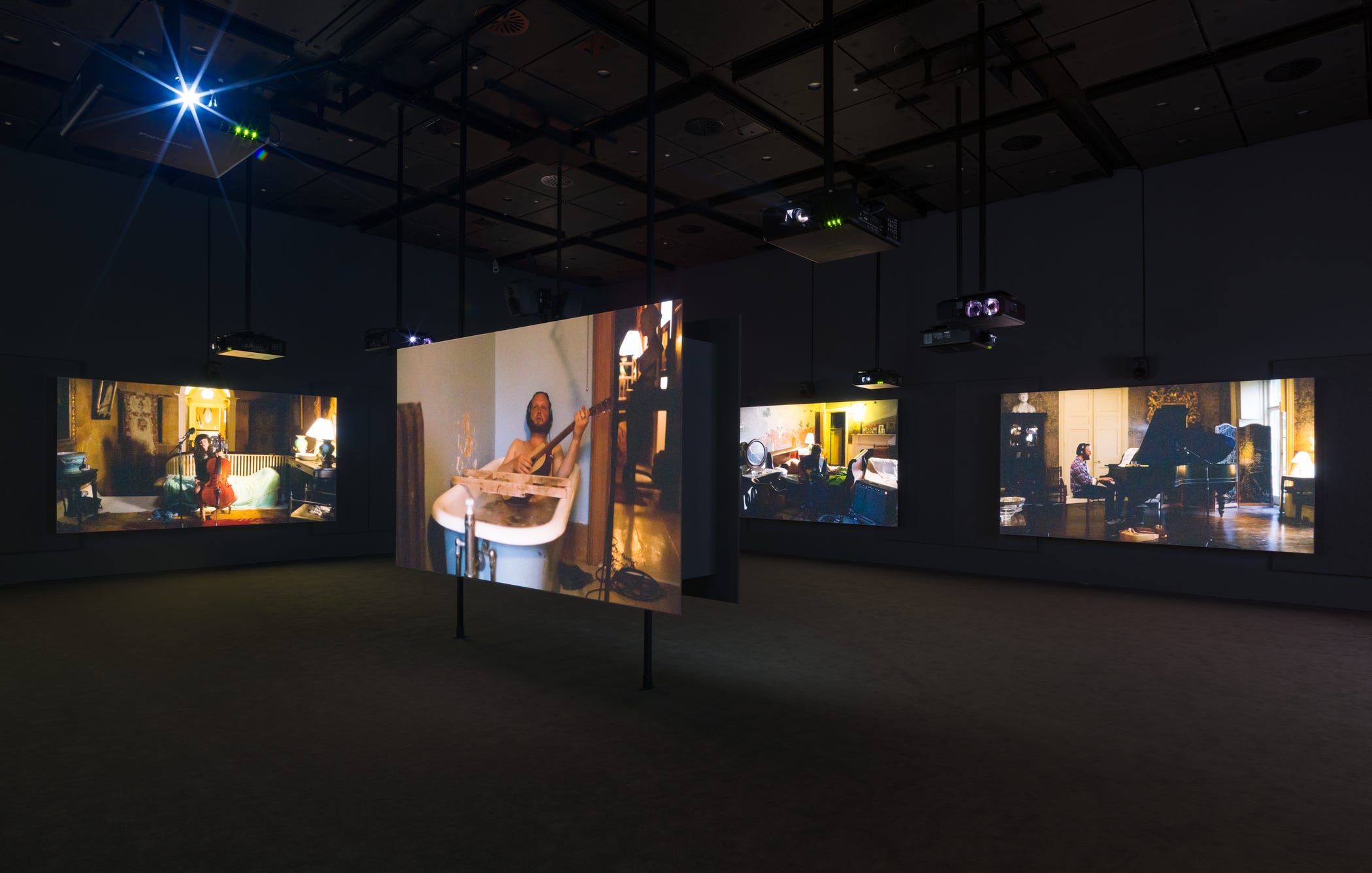
The Visitors is a nine-channel video installation by Ragnar Kjartansson, an Icelandic artist. A group of musicians gathered at the historic Rokeby estate in New York and performers, with their instruments, took up residence in various rooms. Kjartansson, for one, plays a guitar while soaking in a bathtub. Each performance was filmed simultaneously and in a single take. The disparate views are all projected individually like a deconstructed dollhouse. Nine audio channels are paired with their video counterpart, creating a matching auditory landscape. The result is a cinematic concert, both fragmented and complete.
Kjartansson’s lyrics are economical. Just 14 lines are layered and repeated throughout the hour-long performance. They’re from a poem, “Feminine Ways,” by Ásdís Sif Gunnarsdóttir, his ex-wife. The Visitors was shot shortly after their divorce. The lyrical minimalism is offset by a rich and full musicality. It’s beautifully melancholic, in that the aliveness of pain can be pleasurable.
I am not the first person to weep because of The Visitors. In fact, I’m at the back of the line. Many, many people talk about their experience with reverence. Others return to watch it again and again. Some go so far as to follow its exhibitions around the globe.
I first saw it pre-pandemic. I have only the vaguest memory of that experience. It slid off of me. I felt nothing that I can recall.
And then I saw it again this month. What happened? How did it become this transcendent experience?
The complete answer contains more nuance, but the first part is COVID.
Our entire world changed in 2020. Later, we were collectively told to move on without any real guidance. The effects from living under sustained, existential threat and, in many cases, profound isolation were swept under a capitalistic rug. GDP took priority over actual support or communal reflection.
So when I walked into a darkened room and was surrounded by these screens — people separated physically, but united in their harmonies — I saw myself, my own life, and the world around me. The artwork not only embodied an experience I’m still processing, it afforded me a space in which to do that processing, a vehicle through which I could reflect.
For years we’ve been ushered along by all sorts of entities. We’ve been instructed that the pandemic is “over.” Not only were we left to manage the pain on our own, we were told there was no more pain, no more suffering, no more grief. And when my emotions crested to the surface, I was overwhelmed. The sensations were so unbearable that I couldn’t fully receive the catharsis The Visitors offered.
Within this story there’s a broader lesson about offboarding and aftercare in experience design. The pandemic tenders a real-life example on an unprecedented scale of what happens when a processing phase isn’t included or addressed.
Scientific studies have shown that reflection is an essential part of making memories, but far too often experiential productions aren’t designing for what comes after the finale. Offboarding and aftercare can be holistically applied in numerous ways and don’t necessarily require complex solutions or intricate additions.
They’re also not isolated to somber-leaning experiences. For productions on the delightful end of the spectrum, the processing phase looks different. With those we want to share our joy and to revel in the sensations of imagination, play, wonder, and awe. Design considerations become how to amplify and extend that shared, joyful reflection.
One of the most comprehensive and thoughtful examples of offboarding is Dreamachine.
Created by Jennifer Crook and based on the work of Brion Gysin and Ian Sommerville, Dreamachine invites participants to recline in a circular structure. Spatial audio transmits an instrumental soundtrack while strobes overhead deliver the experience’s visual catalyst. Participants close their eyes and the strobes induce a form of self-hallucination without any pharmaceuticals or altering substances. The effects can be intense: energizing, restorative, and emotionally heightened.
A trained staff guides all phases, including thorough onboarding and offboarding. The latter offers options for discussion, writing, and drawing. The version I experienced also had a secondary room for silent decompression. It’s a singular example of anticipating and providing for the spectrum of emotions audiences may feel as the result of an experience.
Another, less structured example is The Unfair Advantage (currently playing in London). It’s a brilliant and intimate show by magician Harry Milas. From card cheat to stage performer, he openly dissects card tricks for the show’s duration. It’s surreal to watch him describe what he’s doing, how he’s doing it, even slowing down the mechanics, and still not be able to fully parse out the illusions.
Audiences are welcome to linger after the show to ask questions. The night I attended everyone stayed, eager to further investigate the tricks and Harry himself. It was an electrifying evening and this was a gentle way to allow that electricity to dissipate slowly and communally.
There’s also a lesson here about transformation. The experiential industry continues to ruminate on transformation and the design of transformative experiences — how we design for that… Can we design for that?
With The Visitors, nothing about the art itself changed. It was exhibited as intended by one of the co-owning institutions. Nothing about my first encounter was transformative, which is not to say that the artwork failed in any way. It simply didn’t resonate with me at that time in my life, based on the world around me and how I fit into it. It's an acute reminder that our relationship to art is fluid. An artwork may not change in form, but it can change with us as we traverse the pathways of life.
However, that transformational outcome is unpredictable; we cannot reverse engineer it. No one could have designed a route that brought me here. No one could have crafted this experience for me. It unfolded through the creases of a million different variables.
This doesn’t mean we shouldn’t create or design with care and intentionality. It does mean we need to leave room for people to grow and mature and become more fully themselves in response to the world’s evolution alongside them.
The takeaway: Experience design needs to prioritize opportunities for self-assessment. Self-assessment, and how we cultivate it, is the connective tissue between these two themes of reflection and transformation.
While working on my REMARKABLE report, Kimberly Beaune, an experiential consultant and fellow WXO member, asked if my threshold for transformation had increased; if the high volume of experiences I was attending had raised my individual bar. It was a wonderful question and one I hadn’t considered.
I was surprised to come to the opposite conclusion: My threshold for transformation has lowered.
I realized a virtuous cycle had developed. As I participated in more and more experiences, my own sense of self-assessment grew stronger. I could more readily and with greater precision identify and articulate my feelings and emotional responses. And as that fluency manifested I found more and more moments, however brief, where I was impacted within an experience. Those moments don’t necessarily add up to major behavioral shifts, but they have a compounding, net-positive effect on my life overall.
Which points to an interesting hypothesis: If our ability to self-assess is increased, then our ability to be transformed could also be increased.
I’m keen to shift the conversation around transformation. We can prioritize human-centered design and its vast unknowns, full of unassailable and sublime magic. One way is to consider more opportunities for reflection and self-assessment. I propose that if we focus on those, a degree of transformation will occur in tandem.
I hope to experience The Visitors again someday. I wonder how I will have changed by then, how the world will have changed. Will I still feel like weeping? Or will I feel something else?
Even if that day never comes, I’ve preserved this particular experience like a tree ring in my life. It’s a marker that will live with me forever.
***
Have you seen The Visitors? What’s one of your “tree ring” experiences?
Comments
Nothing yet. Say the first thing.
Sign in to join the conversation.