
Hey, welcome back. I’m Laura. Just a regular human and marketer trying to make sense of the AI era without losing my mind.
This week I want to talk about something that has been bothering me for a while: we spend hours crafting the perfect CV, tailoring it for every application, and somehow still feel invisible. I built something to change that.
Job hunting has started to feel exhausting on both sides. This article shares a practical idea: how to build a “SuperMe” bot, trained on your real experience, so recruiters get real answers before they ever schedule a call.
For candidates
How to go beyond the CV and actually stand out in a crowded market
Two ways to build your own SuperMe GPT this weekend, no technical skills needed
For recruiters
How to run a full behavioral round on your own schedule, before ever picking up the phone.
Have you ever received something like this from a candidate? I want your honest opinion. Your opinion matters and helps me!
Every minute, 9,000 job applications go out on LinkedIn. That is 12 million per day. And yet most candidates never even get a “seen.”
If you have ever felt invisible during a job search, it is not personal. It is math.
What does that actually look like in practice?
Source: nytimes (2025 data)
Working in tech startups comes with a lot of pros and some real cons. Instability is one of them, and last year, I spent four months actively searching. Competitive sector, hundreds of applications. I developed a nervous twitch every time I saw the word “upload” and was genuinely close to joining a traveling circus before tailoring my CV one more time.
But I have also built marketing teams twice. I know what it feels like to open 100 CVs. It is like reading dating profiles where everyone says they love “traveling and good food.” You learn nothing real.
What the recruiter is actually thinking
30 CVs opened. Tuesday afternoon.
“Increased engagement by 40%. Sure, but how? Led cross-functional teams. Doing what exactly? The keywords are there, but I can’t yet determine whether this person can do the job. I need to schedule a call just to get basic answers. And I have 29 more of these to go.”
That call is not a conversation. It is the same five questions, repeated all day long.
What the candidate is actually doing
“Paste job description. Paste CV. Done. Fast. The keywords match, the bullets are reworded. Wait, does this sound like me? Not really. But it has the right words in the right places. On to the next one.”
Ten minutes of work, zero personality transferred, and a recruiter who still cannot tell the difference
Both sides are exhausted.
Now imagine this instead.
A candidate does not just send a CV. They send a CV plus a link to their own SuperMe GPT, trained on their real achievements, projects, and way of thinking.
A recruiter clicks the link and asks:
“Walk me through a growth experiment you ran.”
“How did you coordinate your last GTM launch?”
“What measurable impact did you drive in your last role?”
They get clear, specific, honest answers. At 9 pm on a Wednesday, if that is when they have time.
It is not a better CV. It is a conversation before the conversation. A recruiter can run a full behavioral round before the first call and move forward only with the people who genuinely stand out.
Candidates show depth, recruiters save time, and both sides get more signals in less time.
Super Me is your professional brain in a bot. Your experience, on demand, before you ever get on a call.
This is exactly what I built during my own job search. Here is how to do it.
I know what you are thinking. You are already exhausted. The last thing you need is another thing to build. But this is the one thing you build once and use everywhere.
Step 1: Build your career encyclopedia
Write your best professional experiences using the STAR format: Situation, Task, Action, Result. Recruiters love this format because, after years of listening to candidates open with “so, I started my career back in 2009...”, a concise, structured answer lands like a cold glass of water in the desert. They will not cry, but they will want to.
Put everything in a document using markdown format.
Take a look at an example for inspiration
Case: Boosting Qualified Leads at Qredo (BTB)
Situation: When I joined Qredo, a Web3 SaaS platform serving institutional clients, our sales team was receiving too few qualified leads.
Task: My goal was to design and execute a multi-channel strategy to boost qualified demo leads by 20% within six months, using a combination of paid and organic efforts.
Action: I designed and executed a multi-layered strategy focused on capturing high-value leads:
Established Metrics: I started by setting up a performance dashboard to measure our current efforts, operating under the principle that you can only improve what you measure.
Quick Wins (Inbound): I implemented Leadfeeder to identify and capture leads from our existing website traffic, syncing them directly with our HubSpot CRM. This delivered a quick win, increasing new sales opportunities by 20% in the very first month.
Unique Organic Channel: I built a dedicated, high-value prospec process. We implemented a weekly routine to scrape Web3 investment news and identify newly funded companies (our ideal clients). We then proactively sent these targeted leads personalized case studies via email and LinkedIn.
Data-Driven Paid Tests: I launched data-driven paid campaigns, starting with five targeted LinkedIn campaigns to test different industries and use cases. This A/B testing quickly showed us which industries performed best, allowing us to refine our ad spend and messaging.
Result: Drove a 30% increase in new joiner sales performance within 8 months of implementing the playbook.
This is the hardest part. It takes a few hours the first time. But once you have it, you never start from scratch again. Think of it as a small encyclopedia of your professional life: your best work, your real impact, and the range of problems you have solved.
Step 2: Upload it as context
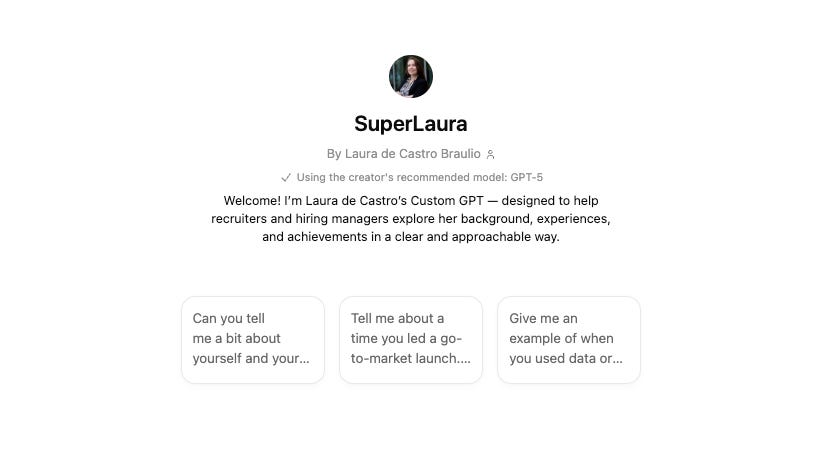
Go to ChatGPT or Gemini and create a custom GPT. Upload your document as the knowledge source.
FYI (Just in case), a custom GPT is simply a version of ChatGPT that you train with your own documents, so instead of answering general questions. In this case, it answers based on your experience, your words, and your way of thinking. A chatbot that actually knows your laboral career.
Step 3: Write the instructions
Tell the model how to behave, what tone to use, when to ask for clarification, and what to prioritize. I will share my own prompt below as a starting point, but treat it as inspiration, not a template. Experiment with it and make it yours.
If you want something more visual or interactive, Claude’s artifacts are worth exploring.
Have a look at the prompt I use and feel free to copy it.
Step 4: Add the link to your CV or share it directly with a recruiter when you apply.
Time to test yourself! Ask a simple question, like…. Tell me about yourself, Laura.
This is the option I would choose today if I had to search for a job again.
Step 1: Create a profile on SuperMe.
SuperMe is a great project, community, and AI-native professional network where top profiles share their thinking and knowledge so others can learn directly from them. I discovered it through Elena Verna . The project is led by Casey Winters , a serious entrepreneur and one of my favorite authors on Substack. I recommend following him 100%
The platform has a lot of potential beyond its original use case, and using it as a hiring tool feels like a natural extension. A way to let your real experience speak before you ever get on a call.
I may not be the first to use it this way … so Casey Winters maybe here is your next use case.
Step 2: Upload your career encyclopedia as a private source.
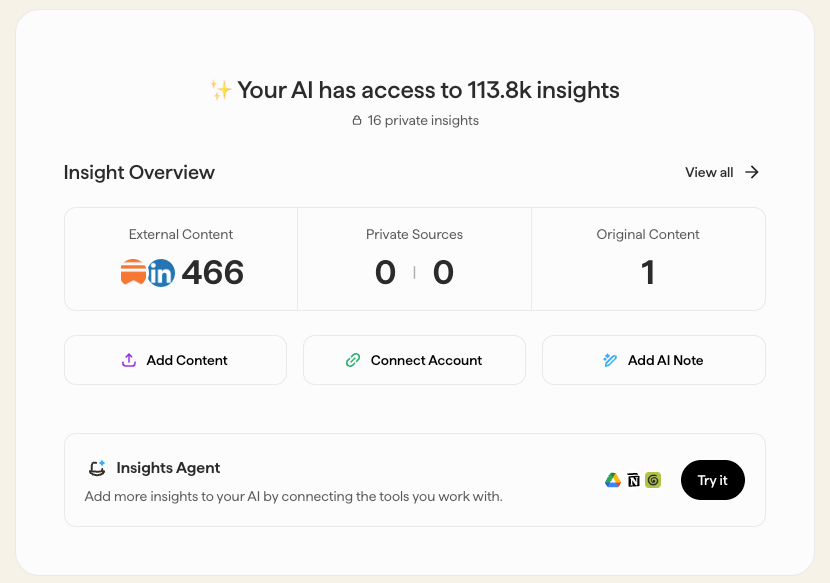
Step 3: Connect it to your LinkedIn or blog, and it stays current without extra effort.
Step 4: Add the link to your CV or share it directly with a recruiter when you apply.
Time to test yourself!
https://www.superme.ai/lbraulio
Ask a simple question… like what did you work on? Or tell about a great GTM plan you led.
We are moving into a world where AI agents do the visiting for us. Book the flight. Choose the dentist. Order the flowers.
In that world, the question is no longer “how do I present myself?” It becomes “how do I make sure the right information about me is ready when something, or someone, comes looking?”
A SuperMe GPT is a small, practical answer to that. The things that actually matter about you, the things that never fit in a CV, finally have somewhere to live.
Maybe someday we will read a headline about the first person who got a job offer without a single intro call, because an AI recruiter spoke with their SuperMe, liked what it found, and made the offer. That day is probably closer than it sounds.
But before we get there, I need to know if the humans doing the hiring today would even open the link.
I genuinely believe this can save recruiters hours of unnecessary intro calls while giving candidates a real way to stand out. But I also tend to fall in love with my own ideas, which makes me the worst possible person to evaluate this objectively.
That is exactly why I need you.
You have seen hundreds of CVs and sat through thousands of intro calls. You know within thirty seconds whether something is worth your time. That trained eye is exactly what this needs.
Six recruiters tested it last year. Three loved it, three had no interest in changing their process. Both reactions are valid, but six people is not enough to draw any real conclusions.
What to do
Open my CV doc as you would any other candidate’s. Click and access the SuperMe link inside. Ask it 2-3 questions you would normally ask in an intro call. Examples:
Tell me about yourself. A quick Intro
Tell about a great GTM plan you led.
Walk me through a campaign you launch and optimize
Or whatever you find useful in your intro call.
And then answer these questions. You can take the form here.
Thanks so much in advance for your honest opinion as a recruiter!
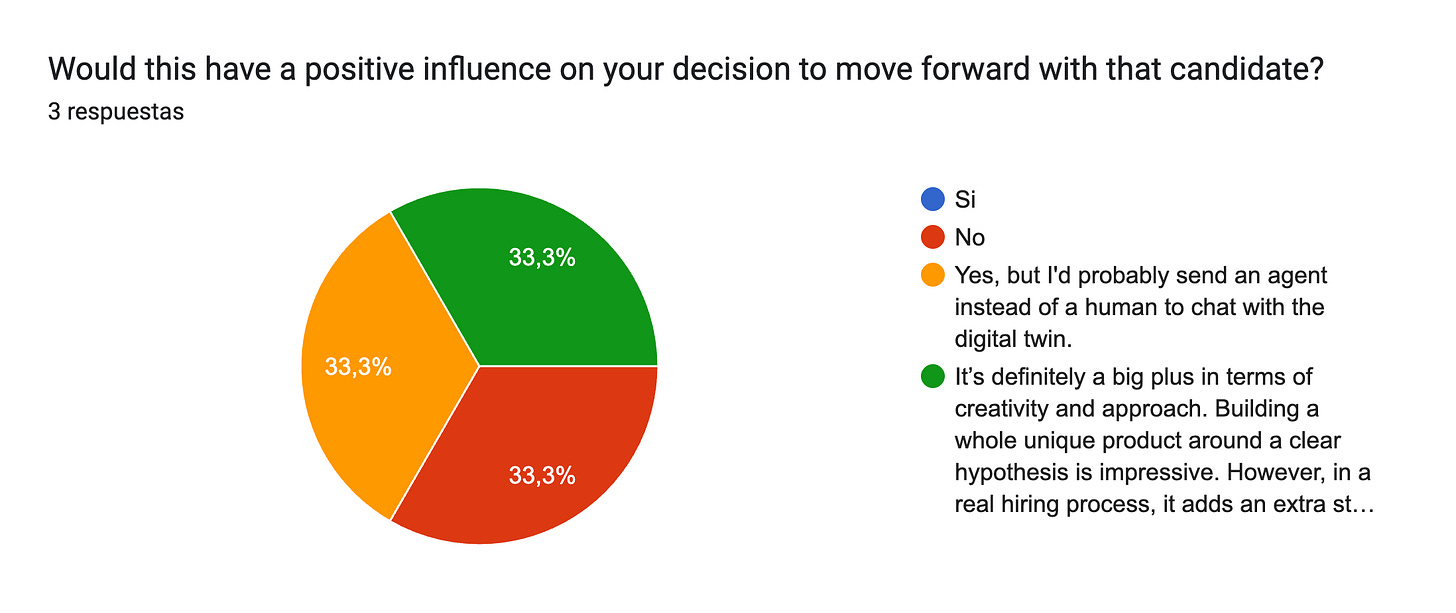
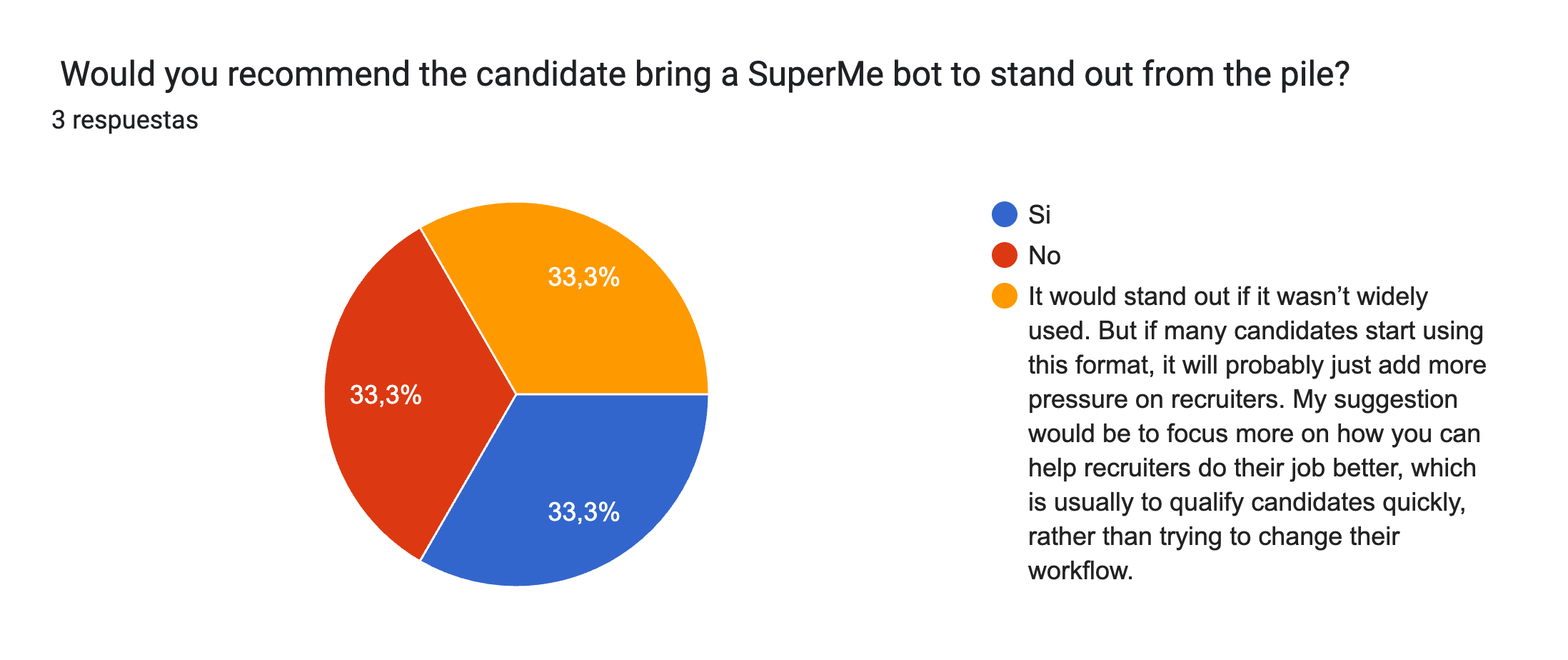
Some Recruiter responses
Big Thanks!
Yana Senina. / Pablo Tonittu. / Aleks Vernikov
Please click on it and tell me what your first reaction was when you opened it.
Well-organized template with basic template. SupeeMe GPT looks cool but also seems like if I’m a recruiter, it will take me a while to talk with the digital twin to assess the candidate fit.
“This is unusual”
First reaction as a recruiter: if I am after unicorn candidates (AI engineers, researchers from AI firms), I’d definitely use it.
If I am reviewing an application among 100+ other applications, I would not use it because
it’s an extra time commitment from my side.
If I shortlist a candidate and want to give them a call, it could be a good tool to use to save time, especially to ask questions about interests, availability, and salary.
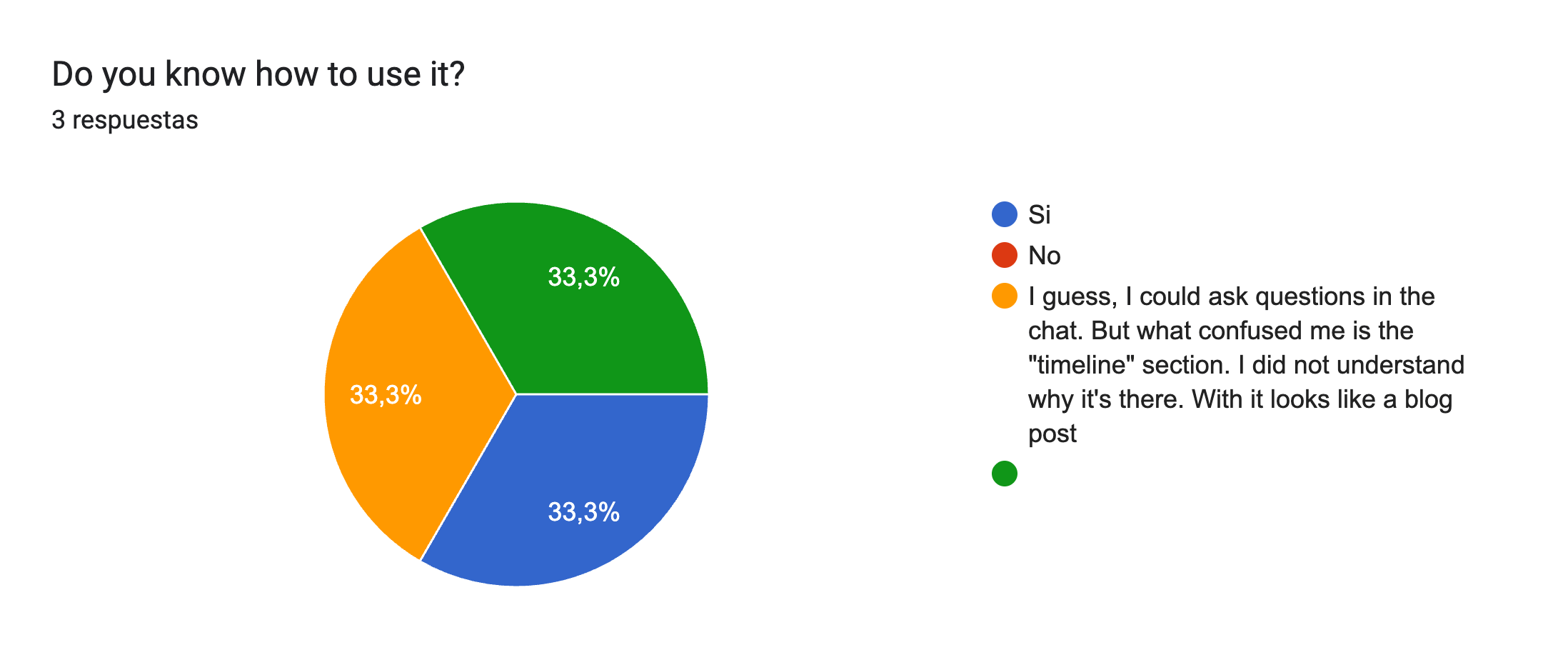
Was there anything it told you that a CV never would?
More depth, more information.
In a way, yes.
It definitely adds a personal touch, but it did not add extra information for my 1st step - screening (i.e. deciding whom to invite to an interview).
If this article gave you one useful idea, one thing worth trying, or even just the feeling that someone else has been through the same frustrating process, then it was worth writing.
If this resonated with you, share it with someone who is job hunting right now or with a recruiter brave enough to have an honest opinion.
The more people test this idea, the closer we get to knowing if it actually works, or at least knowing who to blame if it does not.
Be Happy
Laura
Comments
Nothing yet. Say the first thing.
Sign in to join the conversation.