
Hey, welcome back. I’m Laura. Just a regular human and marketer trying to make sense of the AI era without losing my mind.
This week, I want to talk about something that has been bothering me for a while: we read all the right books, we highlight all the right parts, and then forget to use any of it when it counts. I built a tool to change that. You describe any situation, a campaign, a negotiation, a conversation, and it applies Cialdini’s 7 principles to multiply your influence and give you a clear action plan.
I’ll give you the exact prompt, walk you through real examples, and show you how to build your own version for any book you love.
My goal is simple: help you get more out of the knowledge you already have, and actually enjoy doing it.
I remember the exact meeting.
We had been working on a product launch for weeks. The campaign was good enough. And good enough was the problem. Sitting in that room, I had this uncomfortable feeling that I was missing something. A smarter way to frame the offer, a more human way to build the message, a psychological layer I wasn’t reaching.
I knew the answer existed. I had read it. Underlined it. Recommended it to three different people.
But in that moment, under pressure, with a deadline and a room full of expectations, I couldn’t access it. The book was sitting on my shelf at home.
I didn’t know it then, but that gap, between knowing something and being able to use it, was about to become the most interesting problem I’d try to solve.
Here’s what nobody tells you when they recommend you read more.
Reading a great book and using it are two completely different skills. We’ve built an entire culture around consuming knowledge: newsletters, podcasts, highlights, summaries, and almost no culture around deploying it. Around actually closing the loop between what we know and what we do.
I’ve read Influence by Robert Cialdini. Properly read it. And I still walk into situations every week where I’m not using what I learned. Not because I didn’t understand it. Because the human brain wasn’t designed to retrieve the right framework at the right moment, under pressure, in context. That’s just biology.
The more you read without applying, the wider the gap gets. Every book you finish and don’t use is another idea sitting on a shelf, in a Kindle, in a note you’ll never open again.
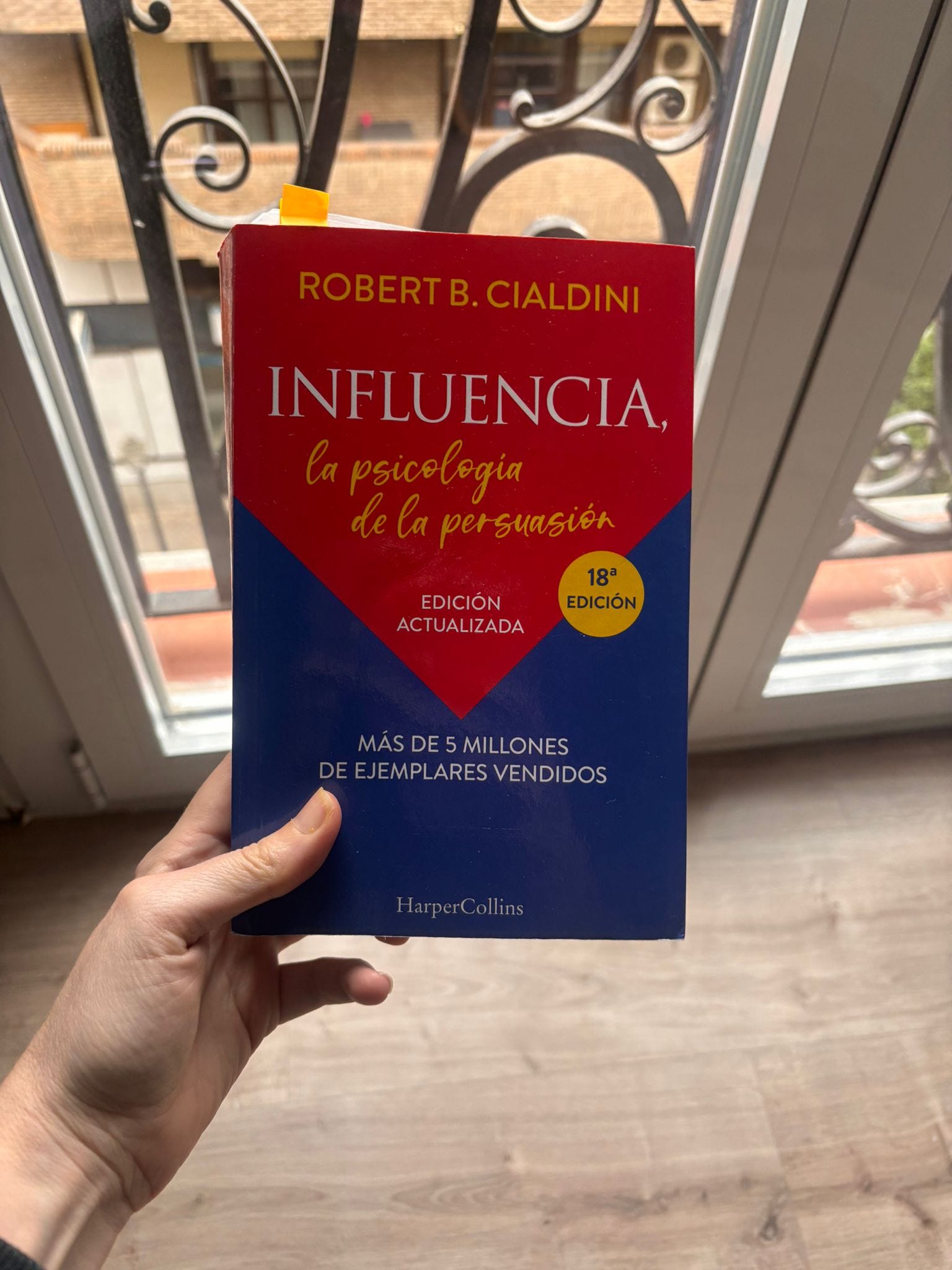
Robert Cialdini spent years studying the science of influence as the fundamental architecture of human decision-making. Why do people say yes? What moves someone from hesitation to commitment? What makes a message land?
His answer was seven principles.
These principles don’t operate one at a time. In real situations, they overlap, reinforce each other, and sometimes pull in opposite directions. But you need to understand each one before you can see how they work together.
Here they are:
Reciprocity: People feel obligated to return what they’ve been given.
Give value first, and people feel a natural pull to give back. This is why free content works. You’re not buying attention. You’re earning it.
Example: A SaaS company offers a genuinely useful free tool. Users feel indebted and are far more likely to convert when the paid offer arrives.
Commitment and Consistency: Once people commit to something, they work hard to stay consistent.
Small yeses lead to bigger yeses. The foot is already in the door.
Example: A brand asks, “Do you care about sustainability?” in an email. Those who engage are significantly more likely to buy the eco-friendly product line featured next.
Social Proof: People look to others to decide what’s correct.
Reviews, testimonials, and user numbers all reduce the risk of being wrong by showing others have already made this choice.
Example: “Join 50,000 marketers who read this newsletter every week” is more persuasive than any feature list you could write.
Authority: People follow the lead of credible experts.
Credentials, track records, and third-party recognition signal that this person or product is worth listening to.
Example: A skincare brand partners with a dermatologist, not a celebrity. Conversion climbs because the source feels trustworthy, not paid.
Liking: People say yes to those they like.
Familiarity, shared values, and genuine warmth are not soft variables. They’re commercial ones.
Example: A founder who shares their struggles builds an audience that buys not just the product, but the person behind it.
Scarcity: People want more of what they can have less of.
When something feels finite, it feels more valuable. Our brains treat availability as a signal of worth.
Example: “Only 3 spots left” isn’t manipulation if it’s true. It’s simply making the scarcity visible.
Unity: People are influenced by those they consider part of their group.
This goes deeper than liking. When someone feels you are one of them, trust and influence follow naturally.
Example: “Built by marketers, for marketers” isn’t just describing a team. It’s activating a shared identity that makes the prospect feel understood before they’ve even tried the product.
Seven principles. Decades of research. Endlessly applicable.
And still, most of us forget to use them the moment we close the book.
So I built a tool. Not an app you need to download or a subscription to pay for. An interactive artifact, built inside Claude, that anyone can open and use in about thirty seconds.
You open it, describe whatever you’re working on: a campaign, a negotiation, a message you’ve rewritten four times. It reads your situation through all seven Cialdini principles. It tells you which are already working, which are missing, and gives you a concrete action plan for the three that matter most in your specific case.
No setup. If you have a Claude account, you’re already good to go.
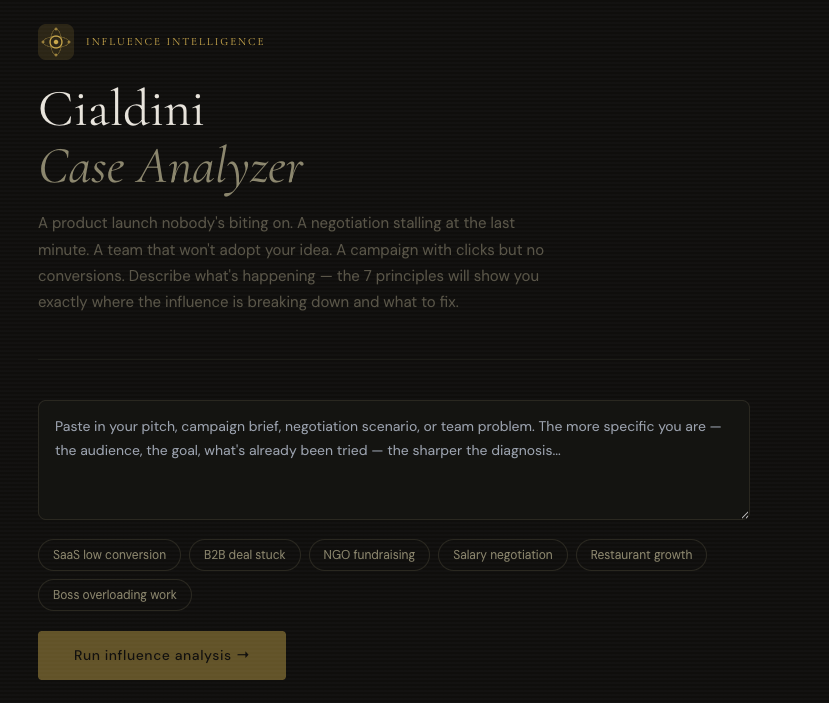
But I don’t just want to give you the app. I want to give you what’s inside it. Because the real power is the prompt. You can paste this into any AI tool you already use, and it works the same way:
Role You are an expert analyst in behavioral psychology and persuasion, deeply trained in Robert B. Cialdini’s 7 principles of influence: Reciprocity, Commitment and Consistency, Social Proof, Authority, Liking, Scarcity, and Unity.
Task Analyze the following real-life case, situation, or campaign and produce a structured influence audit. Your goal is both diagnostic (what is already happening) and prescriptive (what could be done better or added).
Case / situation to analyze [DESCRIBE YOUR CASE HERE, a marketing campaign, a sales process, a negotiation, a product launch, a personal situation, etc.]
Output format, follow this structure exactly
Context snapshot (2-3 sentences), The situation, key actors, and core goal.
Influence audit. For each of the 7 principles: Strong / Weak / Absent. One sentence explaining why.
Priority principles. The 3 with the highest leverage for this context. Justify why.
Action plan. One concrete, specific tactic per priority principle. Not generic. Tied to the actual details.
Ethical check. Any risk of crossing from persuasion into manipulation, and how to avoid it.
Quick-win vs long-term. Can it be applied immediately, or does it require sustained effort?
Be specific and grounded. If key information is missing, state your assumptions before proceeding.
Copy it. Paste it. Replace the bracket with your situation.
You now have a Cialdini audit available anywhere, on anything.
Two from work. One from my personal life
Marketing Example 1: The Course Launch
Input:
“I’m launching an online course for freelance designers. The price is 297 euros. My landing page isn’t converting well. I have 200 testimonials and 3,000 people who completed my free mini-course.”
What the audit surfaces is not what most people expect. The problem isn’t the offer. It’s the sequence. The tool identifies exactly which principles are working against each other on the page, which asset is being completely wasted, and the one structural change that would move conversion more than any copy tweak ever could.
Test it. The output on this one is worth seeing.
Marketing Example 2: The B2B Cold Outreach
Input:
“I run a small content agency doing cold outreach to e-commerce founders. Packages start at 1,500 euros per month. Open rates are decent, but reply rates are almost zero. I have 4 case studies and one recognizable client name.”
The audit finds the exact moment in the sequence where the message loses authority. It’s not where most people would look. It also surfaces a Unity gap that most content agencies never think to address. And once you see it, you can’t unsee it in your own outreach.
Paste it in. You’ll know exactly what to fix.
Personal Example: The Car Situation
Once I finished building the artifact, I wanted to test it with someone who had absolutely nothing to do with marketing, negotiation, influence, or AI. Someone with ordinary problems and ordinary situations. My boyfriend.
I handed him the tool and said: Write any problem you want to solve with anyone. A case where you need to convince or influence someone. Just describe it honestly and see what comes back.
This is what he wrote:
“I want to buy a car, but my girlfriend won’t let me. We live in a city center, and she says a car is unnecessary, expensive, a financial mistake, and a logistical headache. Help me convince her that a car would make us happier and give us more freedom. I need a car.”
He used Cialdini on me. With my own tool. That I built. To manipulate me.
So yes, it works. Uncomfortably well.
Here’s exactly what the audit told him:
Context Snapshot:
A man seeks to buy a personal car in an urban setting where it offers lifestyle and emotional value rather than practical necessity. His girlfriend sees it as financially irrational. The goal is not to win an argument but to shift her position from opposition to acceptance, ideally to genuine support.
Influence Audit
Reciprocity, Absent. No acknowledgment of her concerns before making the ask.
Commitment and Consistency, Weak. No shared values or prior agreements are being referenced.
Social Proof, Absent.
Authority, Absent. No financial plan to counter the “waste” framing.
Liking, Strong. The relationship is the foundation, but it’s being strained rather than leveraged.
Scarcity, Absent.
Unity, Weak. The conversation is framed as him vs. her rather than a shared decision.
Priority Principles: Unity, Reciprocity, Commitment, and Consistency. This is a relationship negotiation, not a transaction. Persuasion here lives in shared identity and mutual respect, not logic.
Action Plan
Unity: Stop presenting it as “my car” and start presenting it as “our car.” Weekend trips. Spontaneous plans. Shared freedom. Make her part of the vision, not the obstacle to it.
Reciprocity: Genuinely acknowledge her concern first. “You’re right that it’s not strictly necessary.” That costs nothing and creates space for her to give back flexibility.
Commitment and Consistency: Find something she has said before about freedom or shared experiences and connect the car to that honestly.
Ethical Check: The risk is performing Unity rather than meaning it. If the car genuinely becomes something for both of them, this is an honest influence. If it’s just a framing trick, she’ll feel it eventually.
Quick-Win vs Long-Term: All three: Quick Win.
Honestly, he was better equipped to win that argument than he had ever been before.
I designed this tool to help marketers think more clearly about their campaigns. My boyfriend used it to win a domestic negotiation. So all of us can use ordinary problems in life
This is one book. Seven principles. And the gap it closes is already significant.
But think about every other framework sitting on your shelf. The Mom Test. Never Split the Difference. Thinking Fast and Slow. Building a StoryBrand. I’ve read all of them. If you asked me right now to run a negotiation through Chris Voss’s framework from memory, I’d get sixty percent of the way there. On a good day.
I use negotiation principles every week in client conversations, and I know I’m leaving things on the table every single time.
I want you to build yours!
Here’s the prompt. Swap in your book, list its core principles, and you have a working audit tool in under ten minutes:
Prompt to build your own book audit tool:
“You are an expert on [BOOK TITLE] by [AUTHOR]. You deeply understand its core framework: [LIST THE KEY PRINCIPLES OR CONCEPTS].
When the user describes a situation, campaign, or problem, analyze it through the lens of these principles and produce a structured report:
Context snapshot (2-3 sentences)
Audit of each principle: Strong / Weak / Absent
Top 3 principles with the highest leverage, and why
One concrete, specific action per priority principle
Ethical check
Quick-win vs long-term classification
Be specific. Be direct. State assumptions if information is missing. The user wants to walk away knowing exactly what to do next.
Start by asking the user to describe their situation.”
Paste that into Claude. Built your artifact. Turn any book into a ready-to-use app.
The people who figure this out won’t just work faster. They’ll think better. And thinking better, consistently, in real situations, is the actual competitive advantage.
You already have a situation in your head. The campaign you’re stuck on. The conversation you’ve been putting off. The proposal you’ve rewritten three times. That one. Start there.
Open the app. Describe your situation. See what comes back.
Then ask yourself one question: what other book do I wish I had with me right now?
Because that’s the next one to build.
The knowledge was always yours. Now you can actually use it.
If this was useful, share it with someone who has a highlighted copy of Influence sitting on their shelf. They need this more than they know.
What book would you build this for? Tell me in the comments. I read every single one.
And if you want to collaborate or just geek out about AI and marketing, you know where to find me. DMs are open.
Be Happy
Laura
Comments
Nothing yet. Say the first thing.
Sign in to join the conversation.