
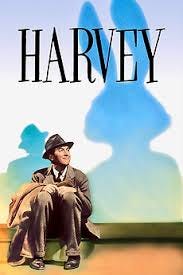
Harvey is a classic 1950 film starring James Stewart as Elwood P. Dowd and a six foot, three-and-a-half-inch tall white rabbit named Harvey, whom most nobody else but Elwood can see or acknowledge. The film is based on a 1944 play of the same title written by Mary Chase (also a screenwriter for the film adaptation). While James Stewart was nominated for his performance in the Best Actor category for both the Academy Awards and the Golden Globe Awards, it was Josephine Hull, who plays Elwood’s older sister Veta, who took the wins for Best Supporting Actress.
Spoiler Warning: All sorts of spoilers ahead for Harvey
If you’ve never seen this film, the original play, or any of its subsequent adaptations, I urge you first to go and watch it! Harvey is the sort of film that I wish we got to watch in my film analysis classes in undergraduate school instead of the many, many terrible “films” we were subjected to, including hours of scratches and coloring on film and a “short” film of a lemon which I have never stopped ranting about for over twenty years. Harvey is delightful and magical and really demonstrates the power of stories.
The entire film is of a single day in the life of Elwood P. Dowd, his invisible friend Harvey, his older sister Veta, his niece Myrtle Mae, Judge Gaffney, receptionist Miss Kelly, patient handler Mister Wilson, Dr. Sanderson, and Dr. Chumley. Everywhere Elwood goes, he is happy to talk to and meet new people and is pleasant and sweet enough to invite people, old acquaintances and new, for drinks or dinner at his home as he cheerfully moves through the day. When Veta and Myrtle Mae try to hold a social event at the house, however, they fear that Elwood will return “with Harvey” before the event ends and frighten everyone off by introducing them to an invisible person. Veta calls Judge Gaffney and unfortunately Judge Gaffney’s plan to deter Elwood goes awry and Elwood returns home and quickly clears the event by showing off his friend Harvey to everyone. Veta and Myrtle Mae are deeply embarrassed by this behavior and Veta finally becomes determined to enact the plan she and the Judge had been discussing previously. Veta takes Elwood to a sanitarium. There, Dr. Sanderson misunderstands Veta’s grief and distress about Harvey’s appearance in Elwood’s life affecting her own life and decides that Veta must be committed and Elwood must be let go. After the misunderstanding is cleared up, Dr. Chumley gets involved and everyone is searching for Elwood, who is also searching for Harvey. During the course of these events, Harvey is described as a “pooka,” which has several alternate spellings. Pookas are Celtic mythical animal spirits, which can be overall benign but can be quite mischievous. Eventually, everyone is enchanted by Elwood in spite of their doubts regarding his sanity, Dr. Chumley also can see Harvey, Veta has admitted that occasionally she is horrified that she does see him, and we, the audience, have seen Harvey’s invisible presence move the world through doors opening on their own. Ultimately, Veta hears the cab driver describe Elwood as very sweet, but he won’t be any longer after any treatment given at the sanitarium, and she changes her mind and stops Elwood from receiving a treatment that she had just insisted Elwood receive so that he would stop seeing Harvey.
The film both explains the magic of Harvey and provides doubt about the magic of Harvey simultaneously. As the audience, the film ends while we still have some conflicting emotions. We have, of course, fallen in love with Elwood and the idea of Harvey by now, but watching Dr. Chumley believe in and somewhat fear Harvey has also shaken our resolve to fully believe that Harvey is magic or a haunting. In the end, though we see Harvey invisibly open the gate and rejoin Elwood as he leaves the sanitarium along with his sister and niece, we still aren’t sure whether Harvey is really there or whether Elwood has had a break with reality that he is just very good at charming others into going along with.
In the end, it doesn’t matter very much whether Elwood is delusional or mentally ill or not, because his experiences are very real and he is very distinctly treated as such. Veta is understandably very upset about Elwood’s behavior, yet when she is seeking professional help, even the professionals are quick to judge her reasonable mixed emotions as her own delusion. The professionals also rush to release Elwood, the gentle-mannered man who repeatedly attempts to introduce them to his friend Harvey who would certainly not appear to be there to them if they just listened carefully, and commit Veta without confirming or making any specific plans for treatment. Veta being committed is part of the comedy of this story, but it also clearly portrays something that does happen frequently in reality: describing a problem or seeking help for it too desperately can be a trigger for others to other and jump to conclusions much too quickly. Disabled people frequently encounter judgements like this, especially those with mental and emotional conditions and those with invisible disabilities. These judgements can so easily lead to poor outcomes, because we, as a society, almost always prefer to view such scenarios as being “personal” problems or failures. Somehow, it is easier for us to see the world as fairer and more within our control than it really is, because it feels safer and less upsetting than confronting the reality within ourselves.
Elwood is pleasant, generous, and kind throughout the film. His enthusiasm and charm are reminiscent of Mister Rogers interacting with others. Elwood has a gentle charisma that is difficult to dislike, though usually (and on some occasions throughout this film), people find his happiness (along with talking to someone they do not believe is there) undesirable. Grumpier and more rigid characters tend to be dismissive and rude to Elwood, presumably simply because they don’t like Elwood being happy and comfortable in his own skin and life while they perhaps aren’t.
As Elwood describes Harvey to others, but especially Dr. Chumley near the end of the film, Harvey’s magic and mischief begin to seem more and more appealing. He tells Dr. Chumley that Harvey can stop time and bring you anywhere for as long as you like and back without a minute having really passed. He says, “You see, science has overcome time and space. Well, Harvey has overcome not only time and space, but any objections.” Dr. Chumley is enchanted by this idea and asks Elwood if Harvey has done this for him. Elwood says that Harvey could and probably would, “But so far, I haven’t been able to think of anyplace I’d rather be. I always have a wonderful time, wherever I am, whomever I’m with.”
Harvey might truly be a pooka and might really be there walking along with Elwood and such spirits may be real. Or Harvey might be a very beautiful delusion that Elwood manages to share with others in his community. The film is titled Harvey but it is Elwood who produces this magic, this delusion, and this identity. Whenever Elwood introduces Harvey to someone, he is introducing himself to the world in a way that feels safe to him and ought to simply be beautiful to others. Like Veta does by the end of the movie, we should all want to help and care for each other as our own brothers, but we also should accept someone as they are without judgement. Elwood ultimately may need help, because he may have broken with reality in some way, but working to know and understand him before judging him is certainly the better path that everyone should take.
References
https://en.wikipedia.org/wiki/Harvey_(1950_film)
https://en.wikipedia.org/wiki/P%C3%BAca
No posts
Comments
Nothing yet. Say the first thing.
Sign in to join the conversation.