
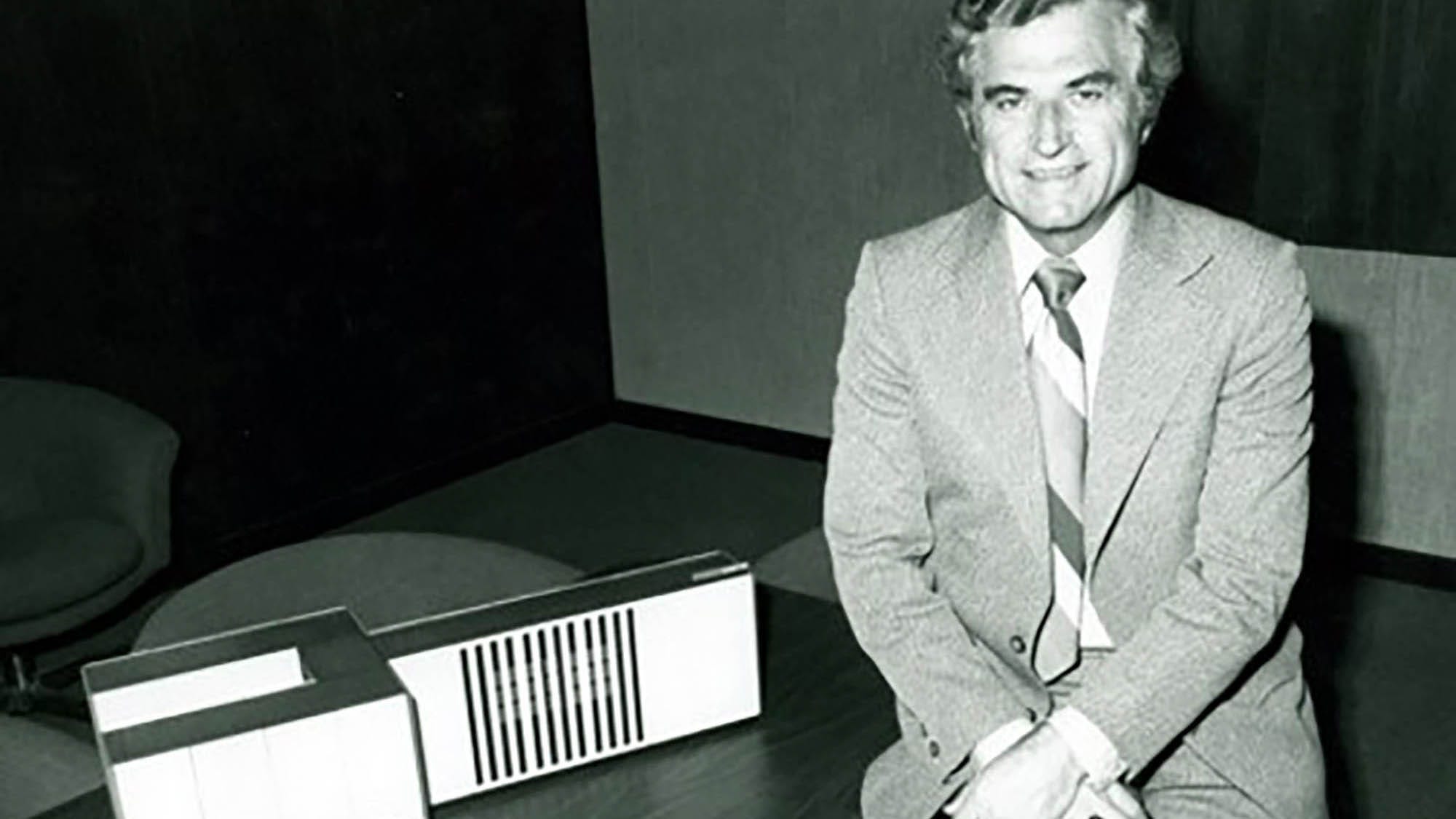
When we think about Norwegian-Americans who changed the world, names like Ole Evinrude, Earl Bakken and Norman Borlaug often come to mind.
Yet one of the most influential may be a man most people have never heard of.
Without Gene Amdahl, modern computing might have looked very different.
He designed some of IBM’s most important computers, created a mathematical principle that still shapes every supercomputer and cloud service today, and later became the first person to seriously challenge IBM’s dominance in the computer industry.
Few Norwegian-Americans have had a greater impact on the technology that powers our daily lives.
Gene Myron Amdahl was born on November 16, 1922, near Flandreau, South Dakota.
His parents were immigrants of Norwegian and Swedish descent who had settled on the prairie, like thousands of Scandinavian families before them. They were part of the great migration that transformed the Upper Midwest into one of the most distinctly Norwegian regions outside Norway.
Growing up on a farm during the Great Depression meant hard work, but it also fostered curiosity and self-reliance. Those qualities would define Amdahl throughout his life.
After serving in the U.S. Navy during the Second World War as a radar instructor, he attended South Dakota State University, earning a degree in engineering physics in 1948. He later completed graduate studies at the University of Wisconsin.
By then, electronic computers were still in their infancy.
Amdahl entered the field just as it was beginning.
In the early 1950s, IBM was transforming from a company known for punch-card machines into the world’s computer giant.
Gene Amdahl quickly became one of its brightest engineers.
He worked on several landmark systems, including the IBM 704 and IBM 7030 Stretch, one of the world’s fastest computers at the time.
His greatest achievement, however, came during the 1960s.
Amdahl became the chief architect behind IBM System/360.
It is difficult to overstate the importance of this project.
Before System/360, nearly every computer was unique. Programs written for one machine often had to be rewritten from scratch to work on another.
Amdahl helped create a family of compatible computers that could run the same software across multiple models.
Today that sounds obvious.
In 1964, it was revolutionary.
Many historians consider IBM System/360 one of the most important engineering achievements of the twentieth century.
In 1967, Amdahl published what became known simply as Amdahl’s Law.
It sounds technical, but the idea is surprisingly simple.
Imagine assigning ten people to paint a house.
If everyone can paint at the same time, the work finishes much faster.
But if only one person can unlock the door, prepare the paint and inspect the final result, adding more painters eventually stops helping.
Some parts of a task simply cannot be divided.
That insight became one of computer science’s most important principles.
No matter how many processors a computer has, the portion of the work that cannot be parallelized limits the maximum possible speed.
Today, Amdahl’s Law influences everything from artificial intelligence and supercomputers to cloud computing and the processors inside your smartphone.
Nearly sixty years later, engineers still use it.
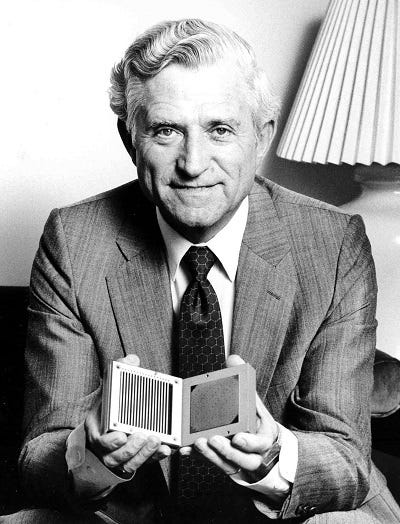
Most people would have been satisfied after helping build IBM.
Gene Amdahl was not.
In 1970, he founded Amdahl Corporation with a bold ambition: to build computers compatible with IBM’s systems—but faster and less expensive.
At the time, IBM dominated the industry so completely that many believed no competitor could survive.
Amdahl proved them wrong.
His company became the first truly successful manufacturer of IBM-compatible mainframe computers.
For years, Amdahl Corporation forced IBM to innovate faster and compete harder.
It was one of Silicon Valley’s earliest success stories and demonstrated that even the largest technology company in the world could be challenged by better engineering.
Unlike many technology pioneers, Gene Amdahl rarely sought publicity.
He preferred solving problems over giving speeches.
One of his most famous observations captures his philosophy perfectly:
“Architecting is a very creative activity. It is applying imagination to reality.”
Colleagues described him as brilliant, humble and intensely curious.
His legacy lives on in nearly every modern computer.
Whether you use a laptop, stream movies, train AI models or store photos in the cloud, many of the architectural principles behind those technologies trace directly back to Amdahl’s work.

Gene Amdahl died on November 10, 2015, just days before his ninety-third birthday.
Despite his enormous influence, he remains relatively unknown outside the computing world.
That is perhaps surprising.
Among Norwegian-Americans, he belongs in the same conversation as Earl Bakken, Ole Evinrude and Norman Borlaug—individuals whose ideas permanently changed how the world works.
The difference is that Amdahl’s inventions are largely invisible.
We cannot see them.
We simply rely on them every day.
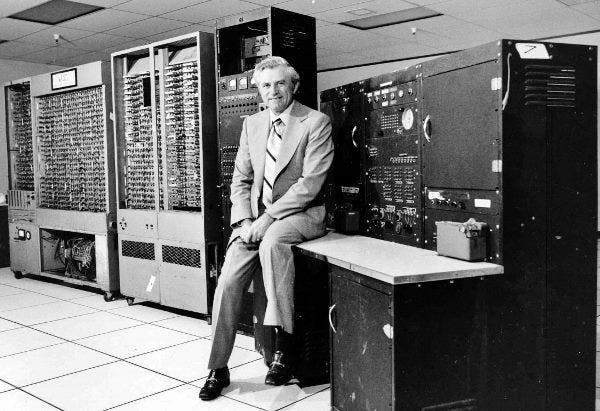
When Norwegian emigrants crossed the Atlantic during the nineteenth century, few could have imagined that one of their descendants would help design the digital age.
Gene Amdahl never became a household name.
He didn’t invent a consumer gadget or build a social media empire.
Instead, he built the foundations that countless others would stand upon.
Sometimes the people who change the world most are the ones working quietly behind the scenes.
Gene Amdahl was one of them.
National Academy of Engineering – Memorial Tribute to Gene M. Amdahl
South Dakota State University Archives – Gene Amdahl Biography
Did you know Gene Amdahl before reading this article?
If you enjoy discovering remarkable Norwegian-Americans whose stories deserve a wider audience, consider subscribing. This series explores the people who left Norway—or whose families did—and helped shape America in unexpected ways.
Comments
Nothing yet. Say the first thing.
Sign in to join the conversation.