
Darling,
Attending university is delightful: dark academia hookups, depressive professors, drinking on the library roof, trying to compose a sestina by 8 AM.
But not all budding novelists can drop everything and rush off to uni. Nor is it mandatory for success. Not at all!
Want to write novels? Read great novels.
To help in your quest, noble autodidact, I’ve compiled a list of novels I found supremely helpful in learning to write romance.
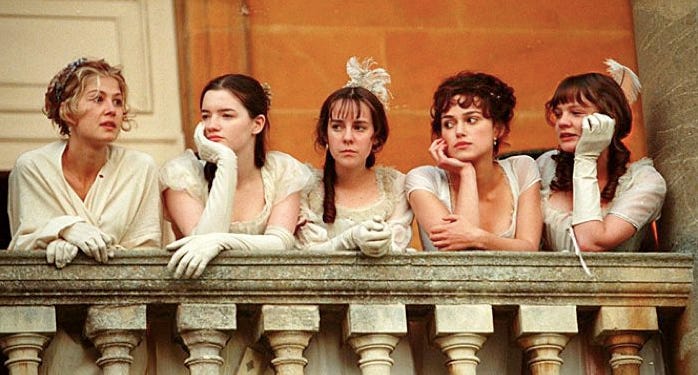
Jane Austen - Pride and Prejudice. We must begin with Mother. The attention to subtleties of gender, class, family loyalty, ignorance and experience. . . What is the truth of the heroine’s everyday life? A crucial question to ask as one begins writing.
Evie Dunmore - Bringing Down the Duke. Her work weaves in fascinating historical detail without indulging in “pause for lecture about railways” nonsense. The stakes are sharp: the heroine is fighting laws that render a wife the property of her husband; thus, giving in to love means giving away autonomy and betraying the Cause. The trickier the obstacle, the better the story.
Daphne de Maurier - Rebecca. Gothic: a color one wants in one’s paintbox. This too is among our foremothers—a classic to know if one leans into the shadowy, skin-prickling, imbalanced power dynamics of romance. (I also love the classic film with Laurence Olivier—he’s obscenely dashing.)
VE Schwab - The Invisible Life of Addie LaRue. Arguably romance-adjacent, depending upon how one reads the ending, this is a lovely example of using supernatural devices to deepen a relationship story. Exposition is famously nightmarish to execute well, and this book brings its rules to life not by explaining at length but by pummeling the heroine with the consequences.
Laura Kinsale - Flowers from the Storm. A classic published in the 1990s, worth reading for its rigorous specificity of character, approach to emotion, and the elegance of the mismatched-lovers relationship. A must-read for historical romance writers.
Sierra Simone - Saint. The story feels personal—using one’s own idiosyncratic fascinations as a guide can make a story sing. And I recommend her oeuvre for those who find themselves holding back once breeches pop open; her spicy spice might grant permission to set down euphemisms and write from the id.
Yulin Kuang - How to End a Love Story. The setup is light—a job forces together high school enemies. But the reason she hates him is so tragic that it’s genuinely difficult to imagine how the author will pull them together. Worth studying for any writer tempted to defang their premise and back away from its darkness. High risk, high reward, darling.
Emma Cline - The Guest. One way to understand romance is to read something it absolutely isn’t. This story begins with the dissolution of a woman’s relationship and tracks the rocky week that follows. She has intimate encounters, but is never driven by love and connection—it’s instructive to track Cline’s discipline in guarding against the merest whisper of romance.
Which other novels have taught you to be a better writer? Do share!
LMxx
PS You can order my newest addition to the genre here. And if you’re extra-keen to dive in you can apply to join my ARC team here!
Comments
Nothing yet. Say the first thing.
Sign in to join the conversation.