
The year was 1854. America was growing fast - millions of immigrants arriving from Europe, railroads transforming travel, the frontier continuing its Westward expansion. And at the same time, the country was hurtling towards the crisis of ideology and economics that would erupt into civil war just seven years later.
But Stephen Foster was concerned less with the trials and troubles of the nation than with the wreckage of his personal life. The consecutive deaths of both his parents and his closest friend, the collapse of his marriage, financial hardship and spiraling alcoholism gave him all the inspiration he needed to write his song Hard Times Come Again No More, a fervent plea for an end to sadness and suffering.
‘Tis the song, the sigh of the weary;
Hard Times, Hard Times, come again no more:
Many days you have lingered around my cabin door;
Oh! Hard Times, come again no more.
By the mid-1800’s, Foster was one of America’s most famous songwriters, probably our first actual pop music celebrity. He’d already written the enduring hits that made him a household name, including Oh! Susanna, Camptown Races, Old Folks at Home (Swanee River), and My Old Kentucky Home. So when Hard Times came along, it was eagerly welcomed by his fans across the country. The song moved among American parlors, music halls, taverns and riverboats as the decade progressed, the times got harder, and war finally tore the nation violently apart.
During the Civil War years, the capacity of this song to express and hold collective grief came into sharp relief, and it became an essential emotional lifeline for weary front-line soldiers on both sides of the conflict - a quiet anthem amid the unimaginable brutality of the battlefield.
‘Tis a sigh that is wafted across the troubled wave,
‘ Tis a wail that is heard upon the shore,
‘ Tis a dirge that is murmured around the lowly grave, –
Oh! Hard Times, come again no more.
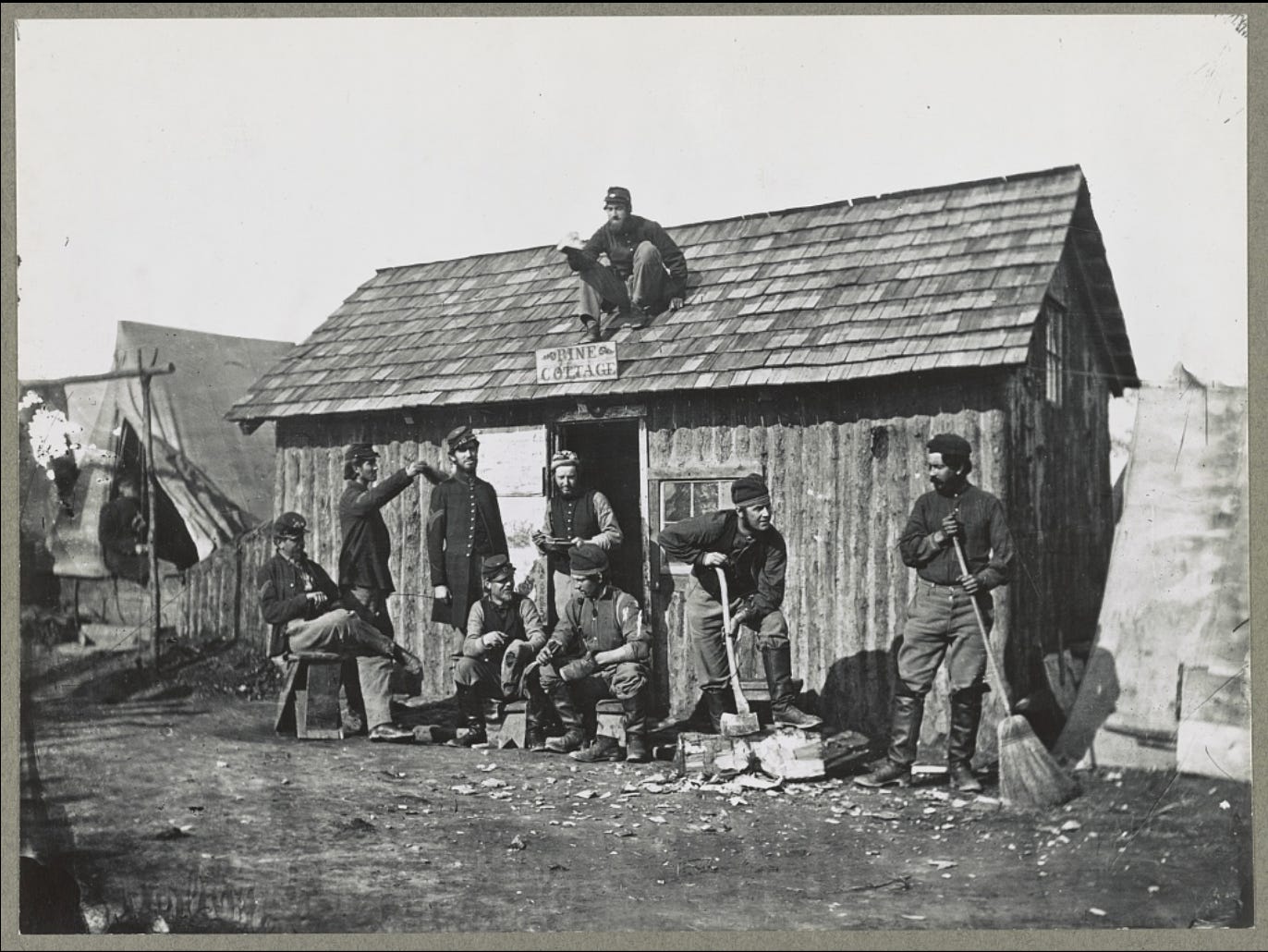
“Pine Cottage”, Civil War soldiers winter quarters - photograph by Mathew B. Brady, c. 1863
Library Of Congress Prints And Photographs Division
These days, hard times have come again, and with a vengeance. We live in a time of such stark division that it elicits frequent comparison to those years leading up to the Civil War. As the daily headlines scream crisis and chaos, and grief and loss loiter around my cabin door, I look back into the archives of our music to find powerful resonance and solace in old American songs from hard times past.
Foster’s legacy, of course, is complicated. Those iconic songs that made him famous were written for the booming industry of blackface minstrelsy. He was one of the most successful contributors to that genre, invented in 1830’s New York by white performers who used burnt cork or shoe polish to blacken their faces, dressed in tattered rags, and sang in an invented dialect that mocked and distorted African American speech.
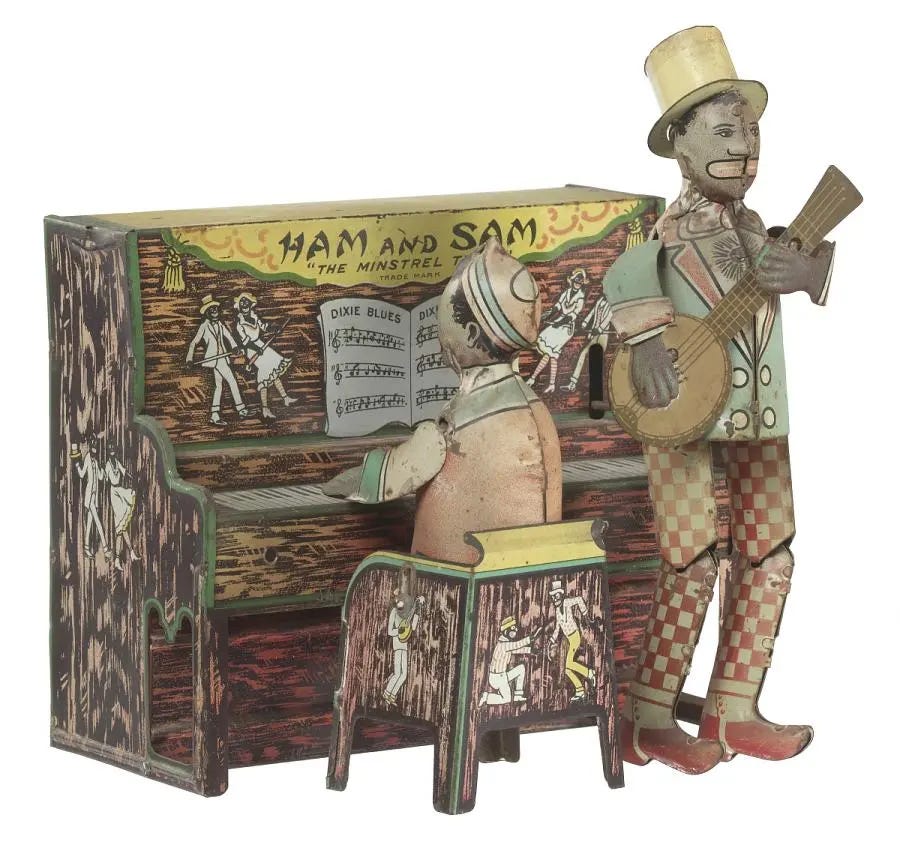
Tin windup toy of “Ham and Sam The Minstrel Team.”
Collection of the Smithsonian National Museum of African American History and Culture
Minstrel shows portrayed enslaved Africans on Southern plantations as lazy, foolish, superstitious, untrustworthy characters, encouraging racist stereotypes both at home and abroad as European tours made minstrelsy the first internationally-exported form of American popular entertainment. Foster’s lovely melodies graced the American musical tradition even as they amplified a culture that exploited and distorted Black lives for mass entertainment and commercial gain.
For more on the contradictions and complexities of minstrelsy’s legacy, listen to these words and music from my friend Rhiannon Giddens:
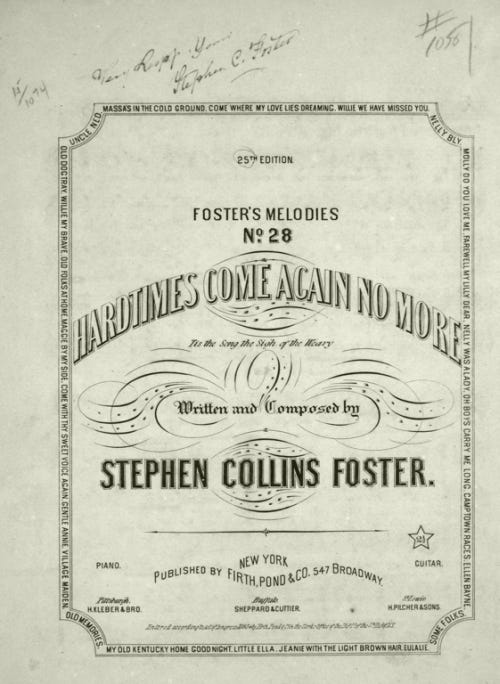
1854 seems to have marked a turning point for Foster. The two classic songs he wrote that year, Hard Times and Jeanie with the Light Brown Hair (written as a peace offering to his wife during their above-mentioned marital struggles) follow the melodic style and verse-and-refrain formula of his minstrel songs, but their themes move away from plantation life, their lyrics are free of pseudo-Black dialect, and they are titled, on the cover pages of their first editions, simply as “Foster’s Melodies.” The thing that most connects Hard Times Come Again No More to any version of the Black American experience is that the tune may have been based on a melody Foster heard as a child, visiting an African-American church in his hometown of Lawrenceville, Pennsylvania.
Is it possible that, as explosive political and social tensions led the divided country to the brink of war, Foster was inspired to write songs focused on the universality of human experience? In that climate of fear and danger, did he feel moved to prioritize uplift over entertainment? And did the American audiences of the time receive these songs with an instinctive need for solace and quiet, refuge from all the noise and chaos? If so, I can relate. The music I need now speaks to shared humanity, reflects the cycles of history, reminds me that in every time and every place, hard times come and go, tragedy strikes and sometimes justice prevails, progress is made and lost, and there is always music to accompany our lives.
I recently made a recording of Hard Times Come Again No More - a collaboration with the New York-based 9 Horses trio: composer and mandolinist Joseph Brent, violinist Sara Caswell, and bassist Andrew Ryan.
Joe made this arrangement, and we recorded it at Abehouse Studios in South Salem, NY last October. The track has just been released on my album Hold These Truths.
What I remember about this recording session is the raw honesty and vulnerability that defined our music-making that day. You can hear it - a weariness and melancholy cut through with some deep store of resilient energy. One week after we made this recording, 5 to 7 million people across the country joined the second wave of No Kings demonstrations, one of the largest single-day protests in American history. We the People were weary AF, but we found the energy to flood the streets and show the kind of unity that has triumphed in the past, to march for justice and peace and truth and even joy.
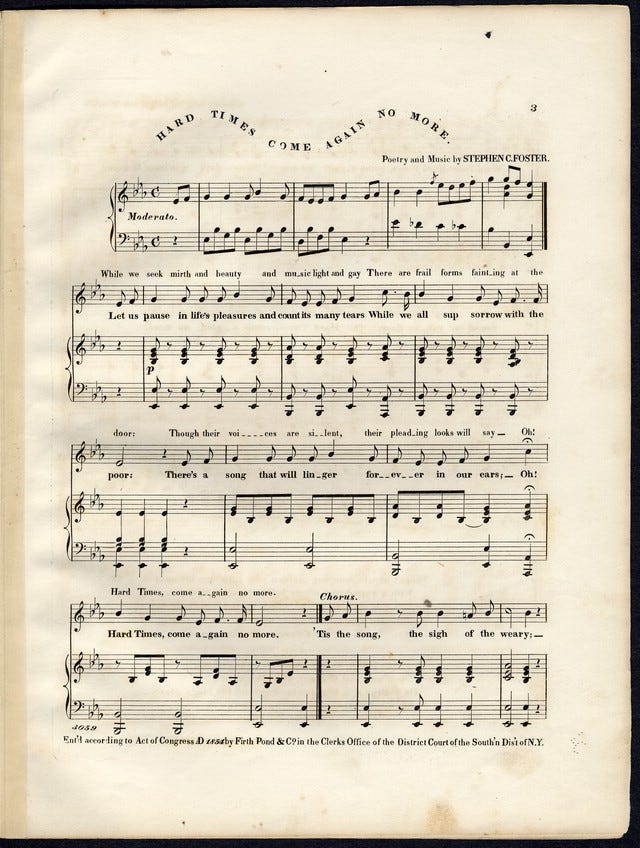
While we seek mirth and beauty and music light and gay
There are frail forms fainting at the door:
Though their voices are silent, their pleading looks will say
Oh! Hard times, come again no more.
Here’s something from the archives - the very first recording of Hard Times , captured in 1905 on one of Edison’s earliest wax cylinders by the Edison Male Quartet. Listen through the scratches and hiss to hear the nostalgic sentimentality that pervaded the early years of that new century and the innovations of its new technology.
Hard Times is one of Stephen Foster’s most enduring songs - it comforted Americans through labor strikes, the Great Depression, and the Civil Rights Movement, and it surfaces now in our own age of anxiety. Its message is timeless: our survival depends on our ability to feel and care for one another. Johnny Cash sang this song, and Emmylou Harris, and Springsteen, and many others. But this version by Mavis Staples is my favorite. Mavis dives right into the American contradictions of this song. She confronts its origins and considers its long journey. She invokes all the ancestors who survived their own hard times, she honors their strength and resilience, and she reminds us that our own courage and conviction can guard the cabin door.
No posts
Comments
Nothing yet. Say the first thing.
Sign in to join the conversation.