
Back in 2021, my husband and I co-wrote an article on general histories of Taiwan in English. I read more than half, he read more than the other half, and we overlapped on a few.
At the time, we both hoped a more contemporary general history would be published soon, as the most recent one dated from 2014 (A New Illustrated History of Taiwan) and thus didn’t cover the seminal Sunflower Movement and what followed it. While a very good book, and one of our recommendations, it’s a bit dry in places, and covers Taiwanese history by topic rather than chronology, diving into what makes Taiwan the country it is today on a cultural level rather than following the Great Men of History in All Caps. That’s fantastic for people who already know the chronology and fundamental beats of Taiwanese history, but might be unclear in places to readers who don’t even know who, for instance, Zheng Chenggong (Koxinga) was.
We also hoped for something more engagingly written, as other, older works could also be somewhat dry or academic (Forbidden Nation and Taiwan: A New History, respectively).
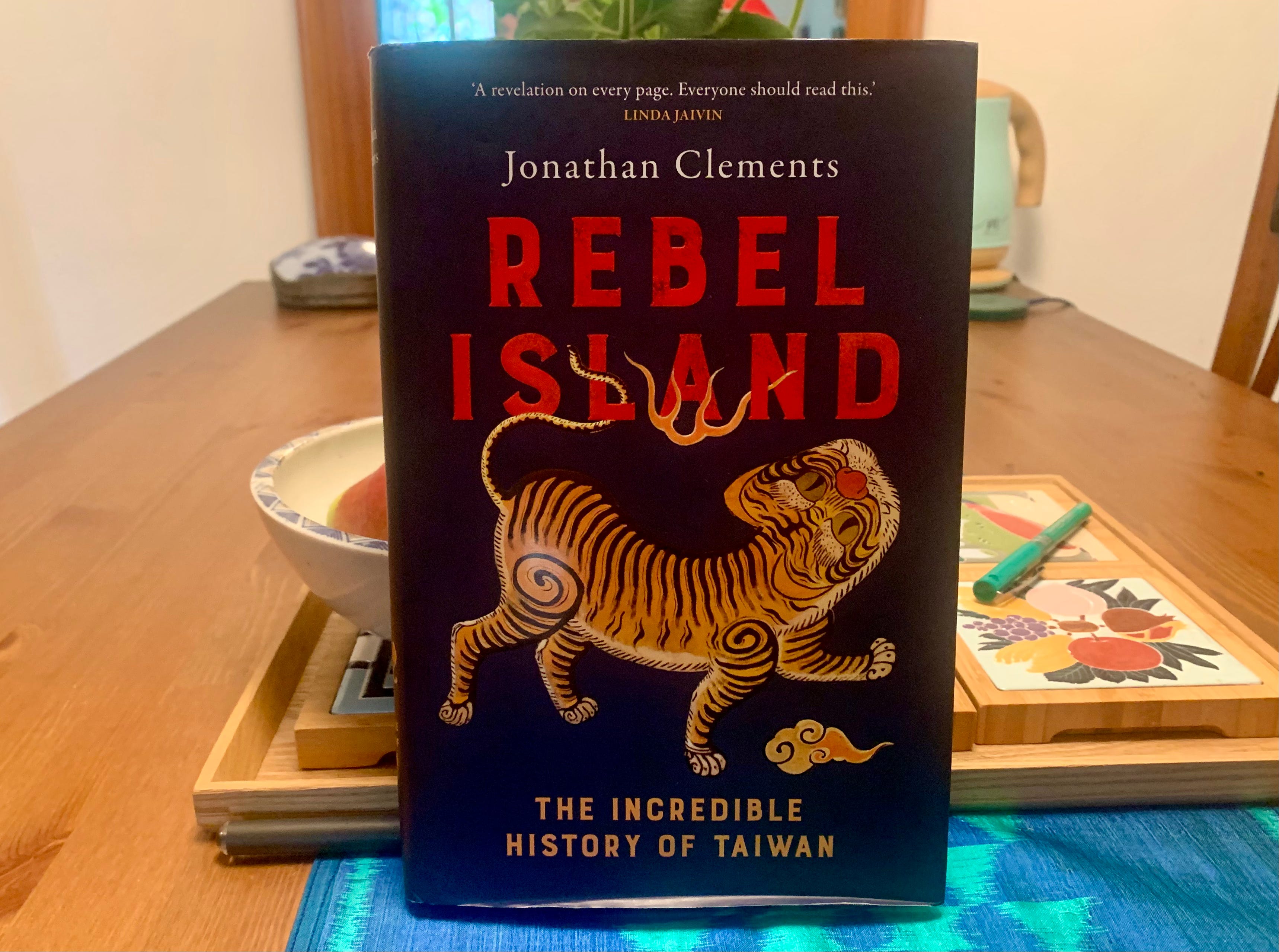
Enter Rebel Island: The Incredible HIstory of Taiwan, a 2024 general history by Jonathan Clements that provides some, but perhaps not all, of what Brendan and I were looking for when we wrote that article five years ago.
This book has many positives. It starts out with a more in-depth accounting of Indigenous prehistory than most other works. Like A New Illustrated History of Taiwan, it then weaves that Indigenous History into the narrative wherever possible, something other histories tend not to do. To read Forbidden Nation, you might not even realize that most of Taiwanese history was Indigenous history, and A History of Agonies treats Indigenous people and culture downright offensively.
Rebel Island is also engagingly written, to the point that one actually wants to pick it back up again, rather than feeling like they have to (a problem I’ve encountered with many a general history; I never even finished a particular book on Armenian history, it was so bad). It is especially good right up until the Japanese era, providing a clear overview that is easy to follow for the Taiwan history novice, and provides interesting details that the well-versed might not know.
For instance, I hadn’t known that the Indigenous leader Toketok, who agreed to talk to Charles LeGendre after the Rover Incident, had sent his daughters to tell Chinese emissaries that “they were not worthy of an audience”. Awesome. Love that.
It also lays a strong foundation for refuting the premise that China has a historical claim to Taiwan, pointing out again and again the amount of time China did not control Taiwan, did not control all of Taiwan, or treated Taiwan like a colony it didn’t even want.
There are a few factual errors, however, which I’ll let you read about in Steven Crook’s review.
The battles between the 1895 Republic of Formosa forces under Black Flag Liu (Liu Yong-fu) and the Japanese are also well-handled; Clements provides more detail than I recall in any other general history I’ve read, including some interesting points about the stamps they issued. To quote the book, I love a little philatelic skullduggery.
When Clements gets to the Japanese era, I felt it skipped over quite a bit. I had been hoping for at least a few paragraphs on the nascent home rule movement under cultural icons such as Chiang Wei-shui, which might be considered among the first Taiwanese identity movements after the 1895 rebellion. I read a lot about education under the Japanese for my Master’s thesis, and felt this warranted a paragraph or two as well, as it was the first introduction of universal education to Taiwan.
After the Japanese era and World War II, the narrative gets a little more questionable. Again I’ll let you read Crook for the details. I want to focus my discussion of Rebel Island’s flaws on the last few chapters. They’re problematic enough that when I’ve lent my copy out to others, I’ve told them that everything up to Chen Shui-bian’s presidency is fine, or where there are factual errors, it’s close enough or the mistake is minor. After that, the editorializing really starts to bother me.
I don’t have an overarching problem with editorialization in history books, especially if the author is forthright about it. However, Clements tends to save his personal comments for criticisms of the DPP, and almost never criticizes the post-democratization KMT.
For instance, he states former president Ma Ying-jeou’s dismantling of the White Terror exhibition at Dead Dictator (Chiang Kai-shek) Memorial Hall as fact, which is fine. But then he calls former vice president Annette Lu’s criticism of the KMT as having their bags packed and foreign citizenship ready to flee “ungracious”.
It wasn’t a kind remark on Lu’s part, but she also wasn’t completely wrong. As for actions that are “ungracious”, I think Ma’s removal of a White Terror exhibit far better fits the adjective, but Clements saves his criticism almost wholly for DPP figures.
That’s just one example. Let’s look at another, a few pages later. Clements’ summary of the Sunflower Movement is almost farcical:
But the actions of the Orchid Islanders were a sideshow compared to the youth movement in mid-2010s Taiwan.
Perhaps, though “sideshow” is an ungracious thing to say, and the youth movements included anti-nuclear protests that represented similar interests to the Orchid Island protests.
The movement defined itself as pro-democracy, thereby implying that all claims for Taiwan as a democracy already were worth nothing to the island’s younger voters.
Wrong. Painfully, insultingly, dead-ass wrong.
I actually sent a photo of this paragraph to a friend who was a Sunflower occupier. He immediately called me and we spent more than an hour on the phone complaining about this one paragraph. He was very clear that the mid-2010s youth movements cherished and recognized Taiwan’s democracy, they did not think it was “worth nothing” or didn’t exist. They felt that Ma Ying-jeou’s actions were abrogating that democracy, and they wanted to save it, not criticize it.
Again appropriating floral imagery in imitation of the Wild Lilies, the ‘Sunflowers’ occupied the Taiwanese parliament to protest at the Cross-Strait Service Trade Agreement…
Two minor points, but also wrong. They became the Sunflowers because a florist donated some Sunflowers to the cause, and the name stuck. They didn’t ‘appropriate’ anything, they just didn’t stop people from using that symbol after it happened. It wasn’t intended, by the occupiers, to call back to the Wild Lilies in any intentional way.
They also, as my friend pointed out, were not technically protesting the CSSTA (though most were probably against it). They were protesting the black box politics that caused the CSSTA to be passed against standard parliamentary procedure.
If you know a lot about Taiwan and were in Taiwan during that time, you know this. This is the sort of basic thing a person with sufficient expert knowledge to write a history of Taiwan ought to know.
…a treaty that many believed would expose Taiwanese infrastructure to mainland interference and control.
First, I’m not sure it was a ‘treaty’, that’s a specific thing, and second, we don’t need to be calling China ‘the mainland’, as Clements does repeatedly. It’s just China. Taiwan doesn’t have a mainland.
They were evicted by riot police…
They were not.
In fact, this is a major problem with the narrative, although the error might seem minor to some. In fact, the police cannot enter the legislature without the consent of the actual legislators, and they did not give that consent. The occupiers stayed in the legislative chamber peacefully for about three weeks and were at no point evicted; they chose to leave when they felt they had done what they could with their protest after KMT legislative speaker and Ma Ying-jeou rival Wang Jin-pyng talked to them and gave them a few assurances.
Some Sunflowers were evicted from an attempt to also occupy the Executive Yuan, but this was not a main Sunflower event. Clements really needed to distinguish between the legislative occupation and the aborted executive occupation, but didn’t.
…but were supported by a large crowd marching on the government offices outside.
Huh?
There was a large encampment outside that saw a rotation of supporters, day and night, for those weeks. I would know, I was part of it most evenings. There was never a ‘march’, though there was a large sit-down protest — one of the largest in Taiwan’s history, if not the largest, but don’t quote me on that — on March 30th, which I also attended.
At any rate, they were not evicted from the legislature at all, and were not supported by a “marching crowd” when their eviction didn’t happen.
There are other issues, such as calling Freddy Lim a “key figure in the Sunflower Movement” (he supported it and had many friends in the movement, but was not actually a leader or occupier), but this paragraph alone should give one pause. If this is how Clements treats the Sunflowers, can he be trusted on more recent history?
I’ll also correct one mistake Crook points out: on the next page, he states that Wang Ju-hsuan was Tsai Ing-wen’s KMT opponent in 2016. This is wrong. Eric Chu was the candidate after the KMT replaced Hung Hsiu-chu due to her miserable poll numbers. Wang was Chu’s running mate. Again, someone with the expert capacity to write a history of Taiwan really ought to know, or at least have the forethought to check, this sort of thing.
A few pages later, Clements repeatedly quotes Xi Jinping’s absolute nonsense about “national sovereignty and integrity” (for China, not Taiwan). This is acceptable, as China’s threats are very real, but he never quotes Tsai Ing-wen in opposition to this, and to some extent paints the independence movement as “anti-KMT”, which is not exactly the case (many people who support Taiwan independence still vote for their local KMT pork-barrel clown because of, well, pork). l
Only Xi’s words get any air. This is a problem. This has been a problem in Taiwan-focused journalism for years, and has only fairly recently started to improve. Clements’ treatment of this topic feels like an article written in 2015.
In the end, those last few chapters soured what was initially a very pleasant and engaging reading experience. I can only hope that a future edition of this book will be a bit more balanced in its editorial critiques, include something — anything — from the pro-Taiwan side in rebuttal to Xi Jinping’s claims, fixes all the factual errors, and completely revamps its treatment of the 2010s youth movements.
The overall sensation of reading the book was a wonderful, scenic Sunday drive down a well-mapped road, and then suddenly coming through a thicket to careen off a cliff. Everything was fine, fine, fine — then suddenly you’re free-falling and don’t know quite how you got there.
Or it’s like watching a student get A-minuses (minus for the few factual errors) on every paper and quiz, only to bomb the final because they didn’t do the reading. I mean it: those last chapters get even the fundamentals wrong.
All of Clements’ build-up to the ridiculousness of Chinese claims, and the horror that the KMT inflicted on Taiwan during the White Terror, come to nothing as he seems to pivot toward painting the KMT as the more reasonable of the two parties in democratic Taiwan. Which, of course, is an opinion I don’t agree with at all.
Worse, it’s an opinion. Editorializing is acceptable, but you have to distribute those comments evenly, or not at all.
Until then, I’m still waiting for a more recent general history of Taiwan to be published that not only includes 21st century developments, but handles them well.
No posts
Comments
Nothing yet. Say the first thing.
Sign in to join the conversation.