
When I became a mother in the mid-1980s, breastfeeding was regaining popularity, and I viewed breastfeeding as a remarkable way for healthy mothers to support their babies. In 1980, Dr. Ruth Lawrence, a heroine in the field, published Breastfeeding: A Guide for the Medical Profession. Then in 1991, the La Leche League encouraged mothers to breastfeed by publishing its ground-breaking book, The Womanly Art of Breastfeeding.
As a pediatrician and neonatologist, I knew that the medical benefits of breastfeeding were substantial, so I naturally chose to breastfeed my own children. Mothers of premature infants had even greater incentive to express milk as research increasingly identified even more medical benefits of breastmilk feedings for preemies.
But working full-time and breastfeeding is extremely problematic, to say the least, and there were many barriers and challenges for me to overcome along the way.
Nursing David, my first born, was easy. He was a slow-moving, big preemie, and, surprisingly, he nursed well and consistently - every three hours. My milk supply was good, and I fell in love with the process of him latching on, sucking, and swallowing my milk while I gazed at this face, hands, and feet. This lovely postpartum scene persisted for us for eight weeks while I was on maternity leave.
However, my returning to work full-time and using a hand-held, battery-operated breast pump became a recipe for failure. At the time, I didn’t understand the true nature of the feedback cycle of demand and supply. I got busy with sick babies in the NICU and didn’t sit down often enough to pump (every four to five hours is not enough). Other times I would wait until my breasts felt full (also a bad idea, since this signals a decrease in milk production). As you might imagine, my milk supply dwindled. It was especially disappointing that I nursed David exclusively for only three months.
With my second child, Anne, I returned to work again at eight weeks but used an electric, hospital-grade breast pump with a double pumping feature. Twice daily, I sat in the NICU pumping room with all the other NICU breastfeeding moms. Visiting with the preemie moms while pumping in the quiet, comfortable pumping room adjacent to the NICU was pleasant. The walls were adorned with posters of angelic young moms, snuggled comfortably in rocking chairs, gazing lovingly at their nursing preemies. The atmosphere was serene and soothing as we sat in soft recliners listening to our pumps whirring and pulsating.
It was fun to hear the younger moms’ stories, and I offered encouragement for them along the way. This charming setting allowed me to not only to maintain my own milk supply, but also to get to know some of these dedicated mothers. Exclusive pumping for a sick baby is no easy feat for some moms, and I think they enjoyed seeing their baby’s doctor focusing on pumping like any other busy. working mom.
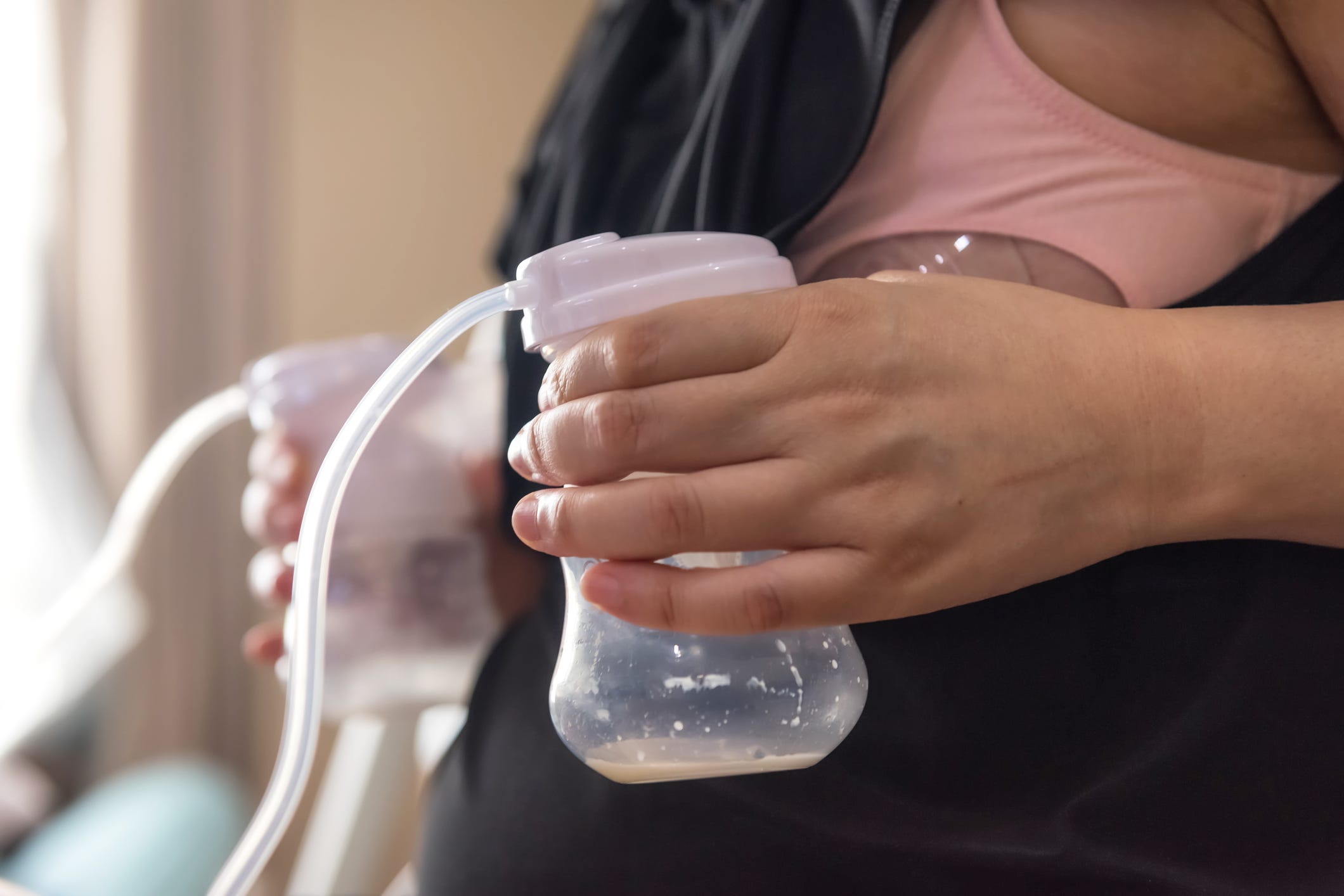
And so, with Anne, my adequate breastmilk supply lasted several months longer until the stresses of busy NICU workdays took a toll, and (again) I carved out insufficient time for pumping. I was happy to nurse her exclusively for five months, and then I reluctantly weaned her over to formula.
Actually, my nursing-Anne-story was much more complicated. From the beginning of nursing her, I had tremendous trouble with engorgement and sore nipples. She nursed like a shark, and my nipples were raw, cracked, and extremely painful for the first three weeks. Sometimes they bled. My husband was helpful during this stressful period by massaging my sore, engorged breasts while I pumped milk after nursing her.
One time, Anne threw up some swallowed blood. I freaked out and called my husband to come home and check on her. I thought she had a GI bleed! While nursing Anne, I also struggled through a horrible bout of mastitis when she was six weeks old. Somehow, we made it over that high hurdle of painful breastfeeding and sore nipples, and everything healed.
During those challenging early days, my “pediatrician brain” didn’t remember to put my finger into her mouth and assess her suck, and my “mother brain” never considered it. Much later, I figured out that she probably had ankyloglossia, or tongue-tie. In retrospect I was astonished that I missed that. When a baby has ankyloglossia, the frenulum, or anchoring tissue under the tongue, is so tight or thick that it prevents their tongue from extending properly. A tongue thus tethered to the bottom of the mouth creates an abnormal and harmful suck, and it generally makes breastfeeding too painful to continue.
Several years later, at age 40, I found myself nursing my third child – in a new city and state, with a new job (which is a whole other story). Laura was an easy baby, a pleasure to nurse for twelve months. She was a ten-pound baby who slept through the night at two weeks of age! And finally, I enjoyed a longer maternity leave. I returned to work when she was four months old, and continued nursing and pumping my breastmilk for another eight months.
The pumping situation at my new hospital was entirely different, however. I pumped in the nurses’ supply closet inside the NICU. There was no mothers’ pumping room in this NICU (until I had one set up later). The nurses had few breastfeeding role models. Sure, a few of them had breastfed their own babies, but it was not talked about much on rounds. Not only did they know that I was nursing and pumping my milk, but they observed me recruit and cheerlead other NICU moms who were attempting to breastfeed or provide milk for their sick infants.

Finally, with this third baby, breastfeeding was a truly pleasant experience. She took my milk from a bottle easily, and she nursed when I was home. It was the perfect breastfeeding experience. Once when Laura was about eight months old and he saw me carrying a small cooler full of expressed breastmilk (after a night on call), one of my partners quipped, “Aren’t you through with all that baby stuff yet?” I just drew in a deep breath, sighed, and replied, “No, not yet.” Nursing Laura was easy and enjoyable. It was the best thing in my life at the time. Only once did we have any sort of mishap. At nine months of age, while cuddled together in a rocker nursing, she bit me – hard, right on the nipple – it hurt badly and I screamed at her, “No biting!” She burst into tears, and we both cried and cried. After that incident, though, I experienced no further biting.
After nursing my three through all these ups and downs, I became a forever breastfeeding advocate for NICU moms and for other moms as well. For instance, I always went out of my way to compliment moms who nursed in public, even women I did not know.
In addition to providing NICU care to my patients, breastfeeding became my passion. I trained to be a Fellow in the Academy of Breastfeeding Medicine and volunteered to be the Medical Director of the Mothers’ Milk Bank at Austin during their early years. For six years, I served on the Committee on Breastfeeding of the American Academy of Pediatrics, a group that wrote policy for pediatric practices. This was a prestigious, national position that presented me with opportunities for teaching and research. For the remainder of my neonatology career, within my practice and the hospital system in which I worked, I was known as the chief breastfeeding expert and advocate, and I valued that distinction.
Fast forward thirty years to my older daughter having her first child, Katherine. My husband and I were invited to the delivery, which we happily attended. Her birth was awesome, much better than the thousands of other deliveries I had attended over the years. However, Anne was never comfortable nursing Katherine. She had nipple pain right from the start. The lactation consultant (LC) diagnosed her with ankyloglossia, or tongue-tie, and my heart sunk.
I dreaded seeing my daughter go through with her baby what I had endured with her. The LC helped her with a nipple shield and a good hospital-grade pump. I arranged to take mom and baby to see a pediatric dentist who did laser cutting of the tight frenulum, a procedure called frenotomy. This was accomplished, and Anne worked with an LC, but she was never comfortable nursing her daughter. She had a great milk supply and happily pumped and bottle-fed Katherine for twelve months. Hers was a herculean effort once she was back at work in the pediatric ICU. In my mind, around-the-clock pumping is much more challenging than breastfeeding itself.
Earlier this year, my daughter-in-law (my son’s wife) delivered a baby girl and Alissa also had difficulty nursing her baby. Like so many others, these new parents supplemented their baby with formula early on, which resulted in low breastmilk production the first few weeks. A skilled LC helped mom with her milk supply, but for some reason (unknown to me) the baby would never latch on well or comfortably. As a result, my daughter-in-law also became an exclusive pumping and bottle-feeding mom.
When my daughter was texting with her sister-in-law about the situation, she described herself as having been “miserable” while trying to breastfeed. She gave her sister-in-law tremendous encouragement with the exclusive pumping route. I was surprised at my daughter’s use of the word miserable, because I never knew that she was that unhappy.
As I have thought long and hard about these two recent, more personal situations, I have decided that some mothers just cannot breastfeed easily or well. To me, that is a tragedy, because breastfeeding – real nursing at the breast- is so wonderful when it works. I had to really struggle at nursing my second, but I was highly motivated and tolerant of the initial pain. I saw the pain as a challenge to overcome. But now, each of these two young women is quite happy and content with their choice. Each one is comfortable with this method of feeding breastmilk to their babies.
The bottom line is that every mother has to find her own way to feed her baby. Breastfeeding - actual nursing at the breast - can be difficult, as my own family’s story exemplifies. Even with valuable emotional support from family members and help from experienced LCs, nursing at the breast cannot be accomplished, and that is okay. My old mentor, Dr. Richard Schanler, used to tell me that the most important thing was to get breastmilk into the babies, and he was probably correct.
Breastfeeding can be beautiful - and still be extremely difficult.
A mother can value breastfeeding deeply while acknowledging the pain, exhaustion, medical complications, and emotional strain it may cause.
Knowledge does not eliminate breastfeeding problems.
Even a pediatrician and neonatologist can experience engorgement, cracked nipples, mastitis, declining milk production, and an unrecognized tongue-tie.
Returning to work can undermine milk production.
Maintaining supply requires adequate pumping frequency, time, privacy, effective equipment, and workplace support—not simply determination.
The right equipment and environment matter.
A hospital-grade double pump and a comfortable pumping space helped make breastfeeding more sustainable, while a handheld pump and an unpredictable schedule did not.
Exclusive pumping is breastfeeding, too.
Pumping around the clock, storing milk, washing equipment, and bottle-feeding can require even more time and effort than nursing directly at the breast.
Tongue-tie can make nursing painful or ineffective - and treatment does not guarantee successful nursing.
Lactation support and frenotomy may help, but some babies and mothers still cannot establish comfortable breastfeeding.
Every mother experiences breastfeeding differently.
One mother may see early pain as a challenge she wants to overcome; another may experience the same struggle as intolerable or harmful. Neither response is wrong.
A mother’s mental health matters.
Breastfeeding should not be pursued at the expense of severe distress, anxiety, exhaustion, or a mother’s emotional well-being.

Thanks for reading Moms Matter! This post is public, so feel free to share it with a mother you know who needs some encouragement.
Comments
Nothing yet. Say the first thing.
Sign in to join the conversation.