
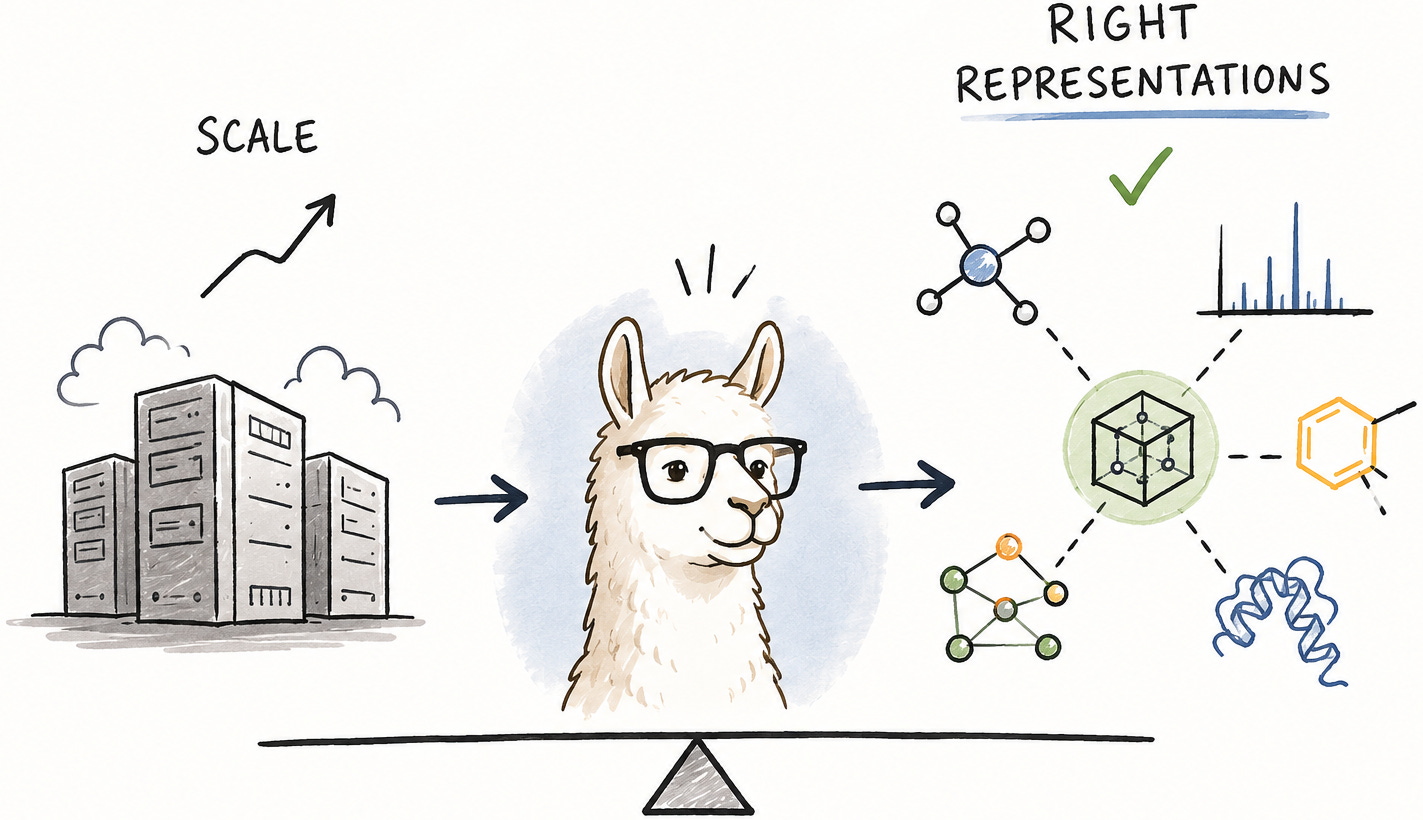
Over the past few years, the dominant narrative in Deep Learning has been simple: larger models, more data, and more compute lead to better performance. While scaling has undeniably transformed the field, many of this month's papers point toward a different trend in chemical AI. Rather than relying on ever-larger models, they achieve progress by learning better representations of molecules, reactions, spectra, and scientific knowledge itself. Whether through multimodal fusion, specialized architectures, domain-specific inductive biases, or improved reasoning trajectories, these works suggest that understanding the right structure of the problem can matter more than simply increasing model size. The next advances in chemical AI may not come from scaling alone, but from learning the right representations.
This might not be a very recent paper, but it is a very impressive example of how cheminformatics can enable new chemistry. DNA-encoded libraries (DELs) allow very fast screening of large compound collections. They rely on parallel combinatorial chemistry (rather than synthesizing compounds one at a time) and on a single binding experiment: the whole library is screened at once by affinity selection, separating binders from non-binders. Each hit is then decoded using a trick — every molecule generated in the combinatorial synthesis carries a DNA barcode that encodes its identity. The PNAS article by Brenner and Lerner gives a good explanation of the background of this technique. The approach comes with a drawback: the “marker tag” is often much larger than the ligand itself (the DNA tag is typically more than 50 times the mass of the small molecule), so it can modify the interactions with the target. The barcode also restricts which chemistry can be used to build the ligands, since every reaction has to be DNA-compatible.
Thus, van der Nol et al. set out to remove the need for barcodes, using instead the compounds’ own MS/MS fragmentation “fingerprints.” Tandem MS is necessary here because such large combinatorial libraries contain many isobaric compounds (same mass, different structure), so the MS1 mass alone cannot tell them apart. The libraries were built by solid-phase synthesis, reaching almost half a million compounds.
The “decoding” used the latest advances from the Böcker lab: SIRIUS 6 and CSI:FingerID. The pipeline determines the molecular formula from the isotope/fragmentation data, and its CSI:FingerID component predicts a molecular fingerprint from the spectrum and scores that fingerprint against candidate structures in a database. Here, they can load the fully enumerated library — all compounds that could result from the combinatorial chemistry — into SIRIUS as this database. It is important to realize that SIRIUS will always predict a fingerprint and produce a ranking of candidates: it is a ranker, not a presence/absence detector, and thus has no real way of declaring that a spectrum corresponds to no library compound at all.
Doing this, however, leads to many false positives: most experimental MS/MS scans are just background, and against such a large library something will almost always match. They therefore add a filtering step they call COMET. COMET is a library-aware filter that uses predicted combinatorial fragmentation patterns to keep only the scans that plausibly correspond to real library members, dramatically reducing SIRIUS’s false-positive annotations rather than just stripping background noise.
The fragmentation patterns behind COMET are derived from data. The authors first synthesized small, fully defined sub-libraries (a few hundred known compounds per scaffold, the “mini-SELs”) and measured their MS/MS. Since every compound here is known, they could check by hand which bonds actually break (these mini-SELs also served as the ground-truth set for estimating recall and false-positive rates in the first place). Because the molecules are modular, with building blocks joined by defined bonds, fragmentation happens mostly at these junctions, so they could simply count how often each connecting bond breaks (the “fragmentation frequencies”) and keep the most prominent recurring patterns — separately for each scaffold, since the three library architectures fragment differently. These empirical patterns are then fed into a combinatorial “fragmenter” that predicts the expected fragments for every member of the full library.
On this basis, COMET applies two conditions: first, a scan is discarded unless its precursor mass matches a compound in the library (i.e. unless a library candidate of that mass exists at all); second, its MS2 must contain at least one of the fragment peaks one would expect for such a candidate. Only scans passing both are kept for full annotation.
I like this paper as it is introducing a new method that can enable new research by combining strong cheminformatics and strong synthetic chemistry. It is sometimes surprisingly difficult to find examples of cheminformatics/AI in chemistry to be relevant in practice — this paper is a nice counterexample.
Pick: Contemporary AI lacks the imagination to diverge or negate in science
Despite recent progress, current AI systems remain limited in their capacity to generate meaningful scientific hypotheses. We previously discussed this in our review of General Purpose Models, arguing that although several promising initial studies evaluating LLM-based hypothesis generation have emerged, the field remains young.
Previous works have relied on just over 100 researchers to evaluate LLM hypothesis-generation capabilities or compare them with human experts (arXiv:2409.04109v1 and arXiv:2506.20803v1). While these represent substantial human-subject efforts, Evans et al. take it to the next level in their recent work (arXiv:2606.08251v2). They gathered 121,640 recent preprints across biology, medicine, chemistry, and social sciences. For each paper, they extracted the research context and open questions, prompted 26 LLMs to generate corresponding hypotheses, and solicited evaluations from the original authors. In total, 6,749 scientists contributed 25,139 rating sets, assessing hypotheses across dimensions including novelty, empirical feasibility, and estimated probability of being true. Their main finding is that LLMs can generate plausible scientific ideas, but their “imagination” remains constrained: non-reasoning models converge on a narrow set of similar hypotheses, whereas reasoning models explore more diverse directions, yet they still rarely produce null hypotheses. This result could suggest that reasoning models, likely through reinforcement-learning exploration mechanisms, yield greater response diversity than their non-reasoning counterparts.
The study further demonstrates that standard automatic evaluators such as LLM-as-a-judge, novelty metrics, retrieval-augmented judging, and existing reward models, correlate only weakly with expert ratings, often at near-chance levels. Overall, the paper concludes that current AI is better characterized as a grounded assistant than as an autonomous scientific imagination engine: it can recombine and evaluate patterns from the literature, but it struggles with handling negative results, unexpected findings, and the tacit knowledge that comes from failed experiments and everyday scientific practice. These limitations remind findings from our recent evaluation of AI Scientists (arXiv:2604.18805v1): although AI scientists can generate initial hypotheses, they frequently fail to update or abandon them in response to new evidence or shifting experimental outcomes. This underscores the need to still use them as tools to assist human researchers, rather than as independent end-to-end scientists.
Pick: MarkushGrapher-2: End-to-end Multimodal Recognition of Chemical Structures
Extracting chemical structures from documents, specifically Markush structures, is challenging because these are representations that describe entire families of related molecules, and they combine two parts. The first part is an image showing the molecular backbone with variable regions, and the second is text specifying which chemical groups can fill those variable regions. They are important in patent analysis, prior-art searches, etc. Existing automated tools handle either images or text, and the few multimodal methods that exist lack the precision needed for large-scale processing.
Three core difficulties make this hard: image conventions vary across patent offices and eras, textual definitions are unstandardized and often recursive, and there is a shortage of well-annotated real-world training data.
To address that, the authors developed MarkushGrapher-2, an end-to-end model that takes a raw input image and outputs a structured text sequence representing the chemical structure, split into a graph backbone and a table of substituents. End-to-end refers to processing raw images at inference time without requiring pre-annotated text inputs, which is a key limitation of MarkushGrapher-1.
The architecture uses two parallel encoding pipelines: a vision encoder (from MolScribe, Swin-B backbone) pre-trained for standard chemical structure recognition, and a vision-text-layout (VTL) encoder (T5-based) that fuses image patches with text and bounding boxes extracted by a dedicated optical character recognition (OCR) module. A standout component is ChemicalOCR, a compact 256M-parameter model fine-tuned specifically for reading text in chemical images, since general OCR tools perform poorly.
The model is trained in two phases. First, an adaptation phase aligns the decoder to the frozen vision encoder’s features using simple molecule recognition. Then, a fusion phase introduces the VTL encoder and trains for the harder Markush task. The full model has 831M parameters, of which 744M are trainable.
To address the data scarcity, the authors built an automatic pipeline converting USPTO MOL files into image-CXSMILES pairs (the USPTO-MOL-M dataset has 54k samples). They also released IP5-M, a benchmark of 1,000 manually annotated Markush structures from major patents (USPTO, JPO, KIPO, CNIPA, EPO), which together handle 90% of the world’s patents.
The model substantially outperforms others on Markush recognition. On the M2S benchmark, MarkushGrapher-2 reached a CXSMILES accuracy of 56, compared to MolParser at 39 and MarkushGrapher-1 at 38. On the IP5-M benchmark, it achieved 53.7 compared to MolParser’s 47.7, and on WildMol-M, it reached 48.0 versus MolParser’s 38.1.
Meanwhile, it stays competitive on standard molecule recognition (e.g., 96.6 on UOB), beating general-purpose models (GPMs) like GPT-5 and DeepSeek-OCR, which performed very poorly on Markush images, often producing chemically invalid output or hallucinations.
Ablations confirm the design choices mattered. OCR input is critical: M2S accuracy jumped from 4 to 56 when OCR predictions were included, since the text supplies the brackets and indices needed for Markush-specific features. Two-phase training beats single-phase training across benchmarks. The two pipelines are complementary: vision-only excels at molecules, OCR+VTL excels at Markush features, and combining them captures both.
MarkushGrapher-2 is a unified, end-to-end solution that bridges molecular and Markush structure recognition, making large-scale automated extraction from patent literature feasible.
Picks: From Entropy to Epiplexity: Rethinking Information for Computationally Bounded Intelligence
To best illustrate the questions posed by Finzi, Qiu, Jiang et al., it is useful to look at one example they mention: AlphaZero, a game-playing model developed by DeepMind. Trained from zero human data, learning only from the deterministic rules of the game and a self-play RL algorithm—both of which are simple to describe—AlphaZero nonetheless reaches superhuman performance with megabytes of information stored in its weights. According to traditional frameworks such as Shannon or algorithmic information theory, the information content of these weights is bounded by the short program that generated them, which seems to imply that little to no genuinely new information was created in the process. Yet asserting that AlphaZero learned nothing clearly misses the mark.
The authors resolve this tension by replacing the assumption of an observer with unlimited computation from classic information theory. Once the observer is restricted to programs that run within a time budget, a short description of e.g., AlphaZero and the network trained for thousands of GPU hours are no longer the same thing. To capture this, they decompose information into two parts: time-bounded entropy, the truly random content that no efficient observer can predict, and epiplexity, the structural, learnable content a bounded observer can distill into a model’s weights.
Two models can reach the same final loss yet be very different: one memorized surface statistics, the other learned deep reusable structure. Final loss alone can’t tell them apart. Epiplexity is meant to capture how much reusable structure a model pulled out — which is what lets it transfer to new tasks. That’s why they argue text data teaches models more transferable skills than image data, even though images carry more raw bits: text has more epiplexity, images are mostly entropy (the exact pixels are unpredictable but not meaningful to learn).
I liked this paper because it formalizes something practitioners typically cannot express in words: not all bits are equal, and data’s value isn’t its size or even how well a model fits it. However, the applicability seems limited, because it’s only tested on one architecture, which they also acknowledge in the Appendix. This means, that the epiplexity which is supposed to be a measure of the data turns out it’s also measuring the model indirectly.
Metal Organic Frameworks (MOFs) have been notoriously challenging to model computationally. As MOFs contain hundreds of atoms per unit cell, getting accurate picture of the system at atomic level with first-principle Density Functional Theory (DFT) calculations are computationally expensive. Molecular Dynamics (MD) simulations do address this issue but qualitive and quantitive accuracies are heavily dependent on the limited choice of available force fields. While machine learning has streamlined target property prediction, achieving inverse design is bottlenecked by scarcity of high-quality datasets. Efforts have been made towards large scale computational repositories such as QMOF, hMOF, ODAC dataset etc., that are property labelled along with the structures. However, models trained exclusively on these can lack compatibility to experimental MOFs.
Unlike training end-to-end models for target specific prediction or inverse design, the authors of this paper address the mentioned challenges by a modular model architecture called Efficient Generation of MOF (EGMOF). It is a harmony of a diffusion based Prop2Desc model and encoder decoder transformer (Desc2MOF). The former model predicts chemical descriptors from target properties while the latter predicts the building blocks and the structure of MOFs from descriptor. This model is modular since it needs to pretrain Desc2MOF only once and train Prop2Desc for desired properties. Training Prop2Desc with descriptors as low dimensional vectors is highly efficient and stable for a diffusion model which are generally bottlenecked by huge dataset and optimization requirement for tasks typically such as direct prediction of the spatial coordinates of atoms. The authors observe that similar descriptors exhibit similar properties ensuring that the descriptor space captures the underlying structure-property relationships. This becomes useful and efficient especially to train the model on different properties for descriptors rather than to predict full structures.
The model outperforms generative models like MOF-Diff or MOFFusion which required massive training dataset with 94 % structural validity and 91% hit rate (this metric ensures that the models are evaluated on a consistent criterion across different properties) while training only on 1,000 samples. For H2 uptake at 77K and 5 bar, which is in accordance with the standard guidelines of working-capacity, EGMOF could unconditionally generate with training set like distribution and best performed in the low range targets (10 - 15 g/L). Apart from outperforming other models, the model showed unprecedented generalizability as the authors could apply model for conditional generation of about 29 distinctive and diverse property datasets. Despite the high validity and hit rate, EGMOF shows a lower performance when benchmarked on experimental datasets such as CoRE MOF, QMOF and text-mined sources. As the authors note, this is likely due to the misalignment with the Desc2MOF training dataset, as EGMOF tries to map experimental data to hypothetical structures.
I found the paper interesting because it tries bridges the gap between experimental and computational chemists; it demonstrates how generative models can remain accurate even in a low-data regime especially relevant to a real laboratory setting. The authors contradict a common notion that generative models are data hungry, or inverse design models require enormous datasets. Because EGMOF can train effectively on just 1,000 samples, it means that it can be trained on actual lab data. Where other models require retraining end to end for MOF structures on different properties, EGMOF only requires Prop2Desc retraining while the MOF generator remains intact. This makes it flexible, practical as well as computationally inexpensive to optimize for different tasks as the descriptors are just 1D vectors to be trained.
Picks: Collective intelligence for AI-assisted chemical synthesis
With chemical literature growing exponentially, it becomes increasingly harder for chemists to explore unknown chemical reaction pathways. MOSAIC (Multiple Optimized Specialists for AI-assisted Chemical Prediction) is a framework that addresses this by predicting full instructions for wet-lab experiments, including relevant reaction components and expected yield, although it may not always provide exact conditions. This information is scored against a confidence score derived from how closely the query matches the model’s training (the centroid distance). Built on the Llama-3.1-8B-Instruct model, it does this by separating the chemical reaction space into Voronoi-clustered regions and fine-tunes a dedicated expert for each, yielding 2,498 specialized models that span the reaction space. Each chemical reaction is encoded as the difference between the product fingerprint (PFP) and the reactant fingerprint (RFP) of the RDKit and Morgan fingerprint, respectively. Through the Kernel Metric Network (KMN), a reaction-specific fingerprint (RSFP) vector is generated, as shown in Fig. 1a-b.
The key result is an overall 71% experimental success rate, while the success rate appears to be the fraction of attempted wet-lab reactions yielding the desired product. But there is no clear definition on the success rate in the paper. For each result, its confidence depends on the centroid distance. Reactions within the expert knowledge domain (distance <100) succeeded more than 75% of the time, while distant ones dropped to around 50%. Separately, the much smaller MOSAIC model outperformed much larger general-purpose models (including ChatGPT o1 Pro and Claude 3.5 Sonnet) on a benchmark using a fixed prompt template with one example. The authors therefore conclude, that fine-tuning and chemistry-specific optimization can beat general purpose models with higher parameter count. A potential reason for the much better performance is the nature of the scoring. The benchmark was scored against a rubric, rewarding MOSAIC’s own output format (atom mapping, sectioned operations, reaction classification). Since MOSAIC was fine-tuned to output that format, higher scores could also reflect format-conformance rather than higher chemical correctness, whereas the general models were prompted one-shot, never adapted to the task.
Overall, more than 35 new compounds were discovered and validated through real wet-lab experiments. Still, while MOSAIC was able to discover routes to previously unreported compounds, it achieved this by adapting existing reaction patterns rather than unfolding new reaction mechanisms. The authors themselves also acknowledge that it cannot generate transformations involving unprecedented reagents and pathways. A further caveat is that predicted and experimental yields often diverge (Fig. 3 and Fig. 4), leading to modest yields. For example, the new azaindole synthesis (compound 13a), still required standard human-led optimization to reach a usable yield. This reflects both the crude tokenization-based yield prediction and the fact that one-shot conditions establish feasibility rather than optimized efficiency. The validation, optimization and method development of the instructions to reach high yields still fall back to the chemist, which makes MOSAIC feel less like an autonomous synthesis tool and more like a search engine for inspiration within the large, already-known chemical space.
In conclusion, the authors’ choice of using real wet-lab validation of the MOSAIC-supported discoveries makes potential future use cases of the framework more tangible. It also shows that initial one-shot results and reaction parameters should be taken with a grain of salt and will require more wet-lab testing on the researchers side. Although the authors claim the framework to be more capable than the evidence supports, MOSAIC can still improve wet-lab research: it speeds up the literature-search for existing novel synthesis and can lead to potentially higher-yield variations.
Picks: Towards Diverse Scientific Hypothesis Search with Large Language Models
Introduction and motivation. I picked this paper because of a problem I worked on in the past. I had built an automated loop that used an LLM to improve prompts step by step: the model proposed new prompts, each was scored, the best ones were kept, and the loop repeated. Looking back, I built this in the standard evolutionary way without thinking much about it, and it had exactly the weakness this paper describes. By always keeping only the best candidates, the loop quickly settled on a small group of very similar prompts and stopped exploring. The methods in this paper could have helped me keep a wider set of good options, which is why the topic caught my attention.
LLMs are increasingly used to search for scientific hypotheses, usually inside an evolutionary algorithm: the model proposes candidates, an objective function scores them, the best are kept, and the loop repeats. The authors point out a structural weakness in this recipe. Keeping only the top candidates each round creates strong pressure that pushes the search into one narrow area and removes diversity. This matters because checking a hypothesis in the lab or by simulation is slow and uncertain, so it is safer to end with several different good hypotheses than with many copies of one.
Technical foundations. Their idea is to treat the search as a sampling problem. Instead of cutting a fixed number of candidates each round, every hypothesis is given a survival probability based on the Boltzmann distribution, p(x) ∝ exp(−βh(x)). Here h(x) is the “energy” of a hypothesis, where low energy means a good hypothesis, and β is the inverse temperature that controls how strongly selection favours good candidates: a large β gives a sharp distribution (exploitation), a small β a flat one (exploration). Because the exponential never reaches zero, even weak candidates keep a small chance to survive, which is what protects diversity. On top of this, the authors use parallel tempering, a method from physics. Their method EvoDiverse runs two pools at the same time: a hot pool of hypotheses with a flat distribution that explores widely, and a cold pool with a sharp distribution that refines the best candidates. The two share information through a Metropolis–Hastings swap, where a candidate from the hot pool is compared with a random one from the cold pool. If the hot candidate is better, the swap is always accepted and the discovery moves into the cold pool for refinement; if it is worse, the swap is still accepted sometimes, with a probability that becomes smaller as the difference grows. This keeps some mixing between the pools while still protecting the quality of the cold pool.
Results. The authors test the method on three tasks under equal budgets: molecular discovery, equation discovery, and algorithm discovery. Across all three, EvoDiverse reaches higher diversity than the single-pool and ensemble baselines while staying competitive or better on quality. In molecular discovery it keeps about twice as many distinct candidates as the MOLLEO baseline and converges faster to good scores, as measured by the Top-10 AUC. Final average scores are more mixed: EvoDiverse leads clearly on JNK3, but on GSK3β it ties MOLLEO and the Ensemble baseline reaches a slightly higher Top-10 average. The molecules also keep good drug-likeness and synthesis scores even though these were not optimised directly, which suggests that the extra diversity is useful and not just random noise. Their ablations show that the swap rule itself, and not only the presence of a second pool, is responsible for the gains.
Discussion. The framing is clear and the physics analogy is used in a careful way rather than only for decoration. I would have liked stronger statistical support, since the molecular experiments use only three random seeds and some comparisons stay inconclusive. The method also adds several settings that need tuning for each task, such as the number of pools, the temperature gap, and the swap frequency. For equation discovery the authors even had to change the energy to a log scale so that the swap would work well, which shows that the method can be sensitive to the scale of the objective. It is also worth noting that this is only an approximate version of parallel tempering, because the population produced by the LLM does not follow a known distribution, so the guarantees of the original physics method do not fully apply here. Still, none of these points remove the value of the main idea: a simple and well-motivated way to keep hypothesis search diverse without losing the ability to converge.
Pick: Weight-Space Geometry of Offline Reasoning Training
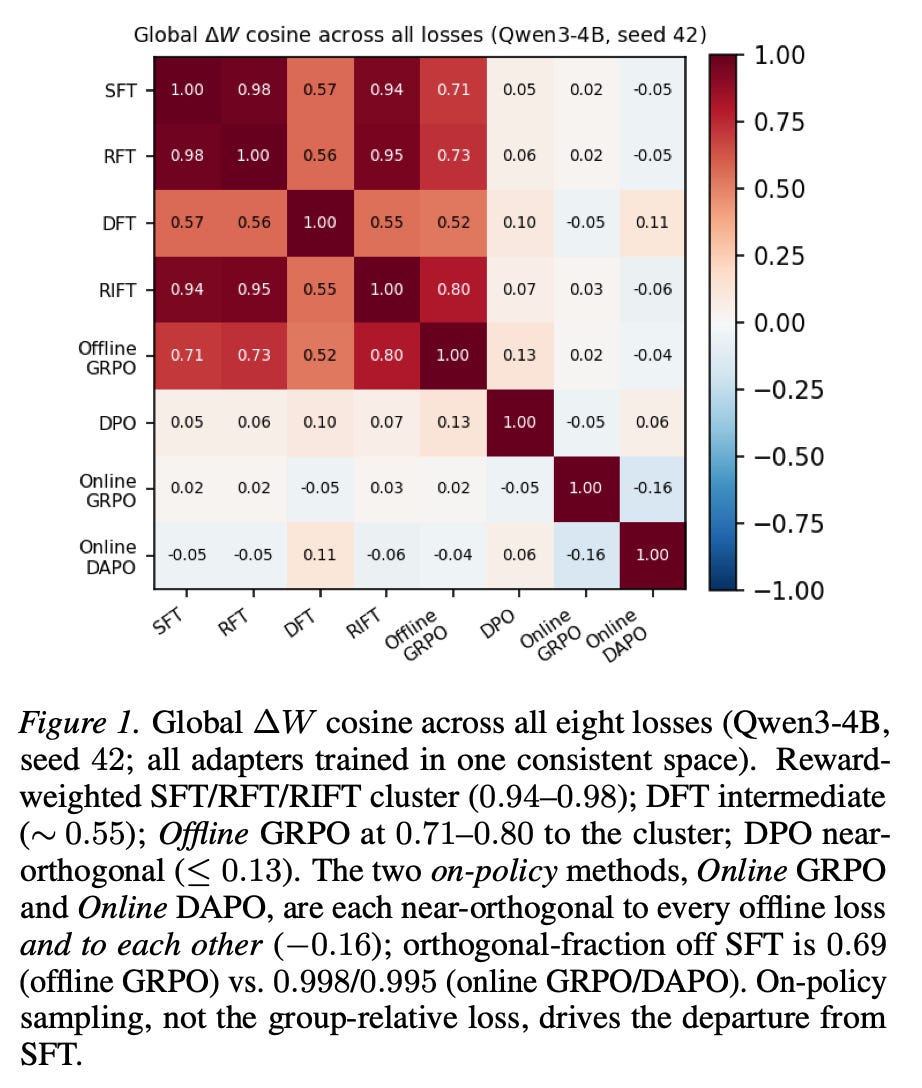
This paper studies whether common training objectives, such as SFT, RFT, RIFT, DFT, Offline GRPO, and DPO, produce different model updates. Using identical teacher-generated math rollouts, a shared Qwen3-4B base model, and attention-only LoRA adapters, the authors compare the resulting weight-space deltas with cosine similarity, subspace angles, linear mode connectivity, and representational similarity. The main finding is that SFT, RFT, and RIFT are almost colinear in weight space and achieve similar GSM8K accuracy, suggesting that reward filtering or reward weighting often behaves like rescaling supervised fine-tuning rather than introducing a distinct learning mechanism. DFT is unexpectedly more directionally distinct despite being a small modification of SFT, while Offline GRPO adds a substantial orthogonal component but remains in the same broad loss basin. DPO is the clearest outlier, it occupies a near-orthogonal, higher-rank subspace, induces a mode-connectivity barrier and late-layer representational divergence, and obtains the strongest benchmark performance in this protocol. It’s important to note that DPO was trained with a 10-fold smaller learning rate and fewer examples. Interestingly. online GRPO is far more orthogonal than offline GRPO.
Pick: Atomic-level protein–ligand recognition with PBCNet2.0 for probe discovery
This is a follow-up work on the original PBCNet (Pairwise Binding Comparison Network): The original paper tried to address a known failure mode in protein-ligand binding affinity prediction. The standard approach is to train models to predict the absolute affinity for a single protein-ligand complex. There are two main issues with this approach: first of all, the absolute binding affinities are very noisy as they depend on the assay used among other things. Secondly, the model could simply memorize the ligands and not actually learn to predict the interactions between the ligand and the protein pocket. To address this, PBCNet 1.0 uses a Siamese Network architecture and learns to predict relative affinity of of pair of ligands to the same target pocket. The same encoder is used to generate embeddings for the reference protein-ligand complex (x_ref) and the query protein-ligand complex (x_query), the results are concatenated as [x_ref, x_query, ∆x] —where ∆x is the difference of reference and query embeddings— and are subsequently fed into a prediction head to predict relative affinity. The relies heavily on hand-tuned priors such as atom-pairwise statistical potentials (APSPs): you take a large dataset of protein-ligand structures and create histograms of the observed distances between the ligand atom-types and the protein atom-types, then turn those frequencies into energy-like scores via the Boltzmann relation. The issue with APSPs is that it is limited to the types of and prevalence of interactions it sees in the dataset.
PBCNet 2.0 keeps the Siamese Network idea but trains on ~14 times more data using a different architecture. Instead of using APSPs and fixed angle bins, the atoms are represented by a Cartesian rank-2 tensors that are decomposable into scalar/vector/tensor components and they use an equivariant architecture based on TensorNet. They also ditch the concatenation and only ∆x is fed to the prediction head. Furthermore, they require the prediction to respect anti-symmetry: the predicted relative affinity of (ref, query) must be exactly the negative predicted relative affinity of (query, ref). To achieve this, both ∆x and -∆x are passed separately through the prediction head, and the final loss is the average of each loss.
The results show an 18% improvement over PBCNet 1.0. They also train the new model with concatenation[x_ref, x_query, ∆x] and they observe that difference-only performs better (0.67 vs 0.59 Spearman correlation). This shows that including the absolute embeddings can result in the model “memorizing” the ligands and not the interactions. To further investigate if the model is learning the interactions or not, they perform an ablation test where they keep the internal bonds of the ligand and the pocket, but remove the edges between them (removing the interaction information), and they compare the training curve with the training including interactions. In the early stages of training the curves are similar, which the authors claim is the models learning the raw molecular structures. Then the curves start to diverge: graphs with interaction edges keep increasing in performance while the incomplete-graph performance starts to decline. The authors reason that a memorizing model wouldn’t care about the missing edges and this shows that the model is actually using the interaction information.
An impressive result is that PBCNet 2.0 can also predict affinity changes that are induced by mutations of the protein pocket despite being only trained on pairs of different ligands in the same pocket.
The authors claim that this is an “emergent” property of the model but I don’t fully agree with this claim. It is true that the model was not explicitly trained on this task but this task is extremely similar to the training task.
Pick: Trajectory-Refined Distillation
On-policy distillation (OPD) for large language models has the tendency for student rollouts to enter incorrect reasoning trajectories that subsequently receive noisy or fragmented supervision. The authors of “Trajectory-Refined Distillation” formalize this phenomenon as prefix failure, arguing that many existing OPD improvements focus on token-level loss adjustments while leaving the underlying faulty trajectory unchanged. Therefore, they introduce Trajectory-Refined Distillation (TRD), which firstly refines student-generated trajectories under teacher guidance and then performs distillation on the corrected trajectories. Across mathematical reasoning and coding benchmarks, TRD consistently improves upon standard OPD and on-policy self-distillation baselines.
Once a student model deviates from a correct reasoning trajectory, traditional token-level distillation objectives provide increasingly weak supervision. TRD focuses on correcting the trajectory itself before distillation, directly trying to tackle the problem instead of reweighting or clipping. While the experimental results are strong, it remains unclear whether prefix failure is the primary bottleneck across all on-policy distillation settings. While I feel like it’s almost a cliche to ask for more comparisons/benchmarks, it would be great to see more models (other than Qwen3) as well as benchmarks other than the math and coding to strengthen the claims.
Although I am still learning about distillation for large language models, I found this work quite interesting. Apart from the apparent gains showcased in the paper, the shift of perspective and identification of a problem and its apparent solution always make for an interesting read.
About this newsletter: The paragraphs about the papers are written by group members individually and reflect their own opinions. The newsletter has been reviewed by other group members for factual correctness and edited by Gordan Prastalo and Kevin Jablonka. The editorial is written by Gordan Prastalo.
No posts
Comments
Nothing yet. Say the first thing.
Sign in to join the conversation.