
Article Summary: Beckstoffer Vineyards has removed more than 800 acres of vines in Lake County and will farm about 140 acres going forward, ending nearly three decades of expansion in the Red Hills. The retreat follows a year in which the county's cabernet crop lost 48.9% of its value and the districtwide weighted average grape price fell 38% over two years. An acre of Lake County cabernet returned roughly $3,800 in gross crop value in 2025, down from about $12,300 in 2023, before any farming cost is subtracted. Sauvignon blanc has passed cabernet as the county's largest variety by volume.

LAKEPORT, Calif. — Beckstoffer Vineyards has removed more than 800 acres of vines in Lake County and will farm about 140 acres here going forward, ending nearly three decades of expansion in the Red Hills by one of the county’s largest and most prominent growers. The state’s grape crush data explains the decision in plain arithmetic.
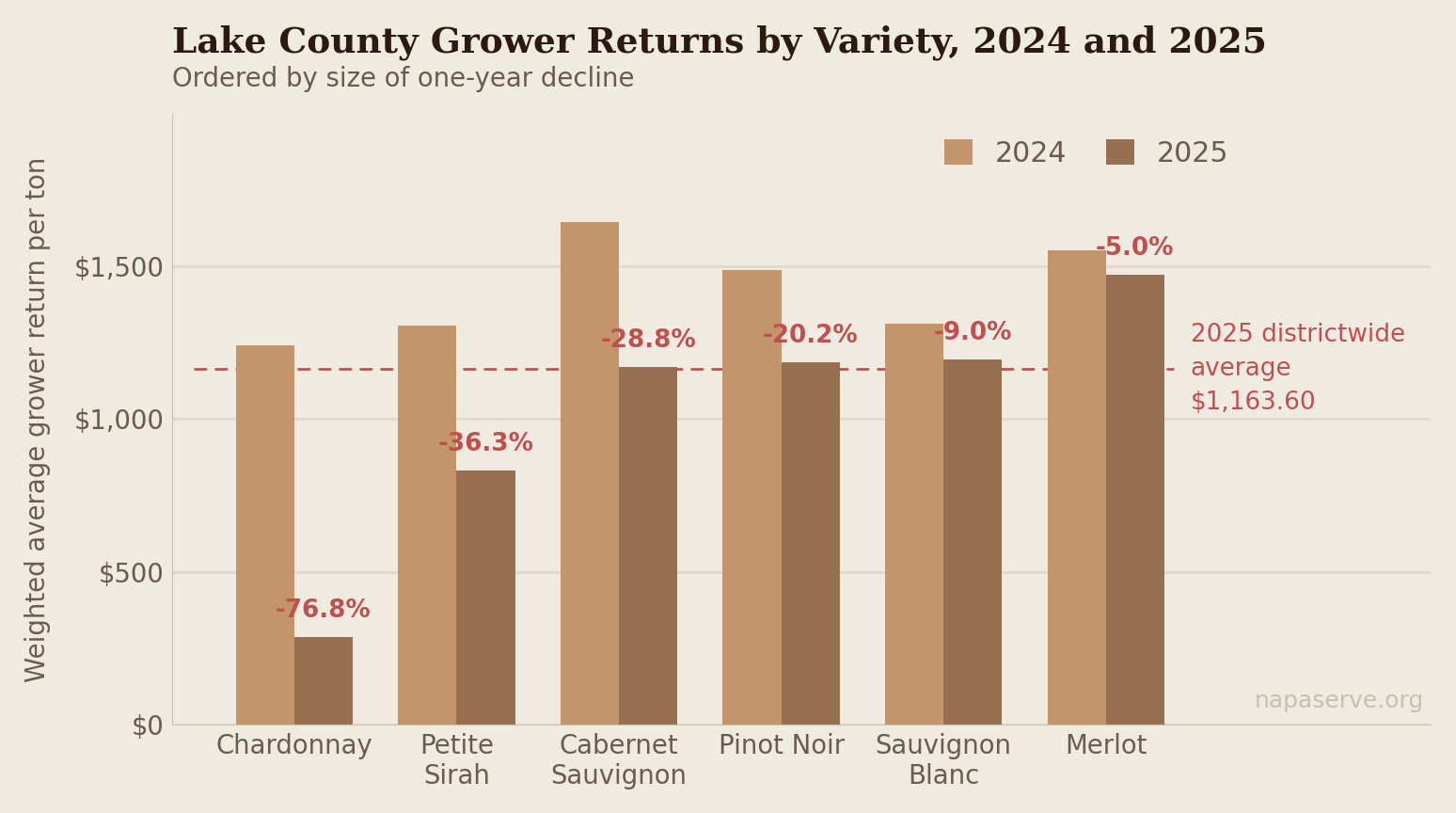
Lake County is California Grape Pricing District 2 in its entirety, which makes that data an unusually clean read on the county’s dominant industry. The final 2025 Grape Crush Report, published April 30 by the California Department of Food and Agriculture and the USDA’s National Agricultural Statistics Service, puts the districtwide weighted average grower return at $1,163.60 a ton. In 2024 it was $1,467.76. In 2023 it was $1,877.76. That is a 38% decline in two years, and it extends the trajectory this series documented in March.
Cabernet sauvignon, the variety the county spent two decades marketing, fell farther and faster. The weighted average was $2,322.04 a ton in 2023, $1,644.21 in 2024 and $1,171.26 in 2025 — down 49.6% across the two years. Chardonnay fell from $1,241.12 in 2024 to $287.65 in 2025, a 76.8% collapse in 12 months. Pinot noir fell from $2,230.73 in 2023 to $1,187.29, down 46.8%.
Beckstoffer bought its first Red Hills parcel in 1997 and with a group of area growers petitioned successfully for the Red Hills Lake County appellation, approved in 2004. By 2012 the company described a Lake County portfolio of about 1,200 acres and was still adding.
Announcing a 2019 purchase from Treasury Wine Estates, Andy Beckstoffer said the Red Hills had the promise to be the “best non-Napa cabernet sauvignon in California.”
The Sacramento Bee reported July 29 that the company has since removed those 800-plus Lake County acres along with roughly 400 acres in Mendocino County and laid off 50 of its 65 employees companywide. Executive Vice President of Farming Brandon Axell said Beckstoffer will farm about 140 acres in Lake County and 800 in Mendocino going forward while maintaining roughly 1,000 acres in Napa Valley, down from a peak nearly 4,000 acres across the three counties. Axell said the company had planned to farm several hundred additional Lake County acres this year but stopped midseason and that it is pulling vines carrying uncontracted fruit.
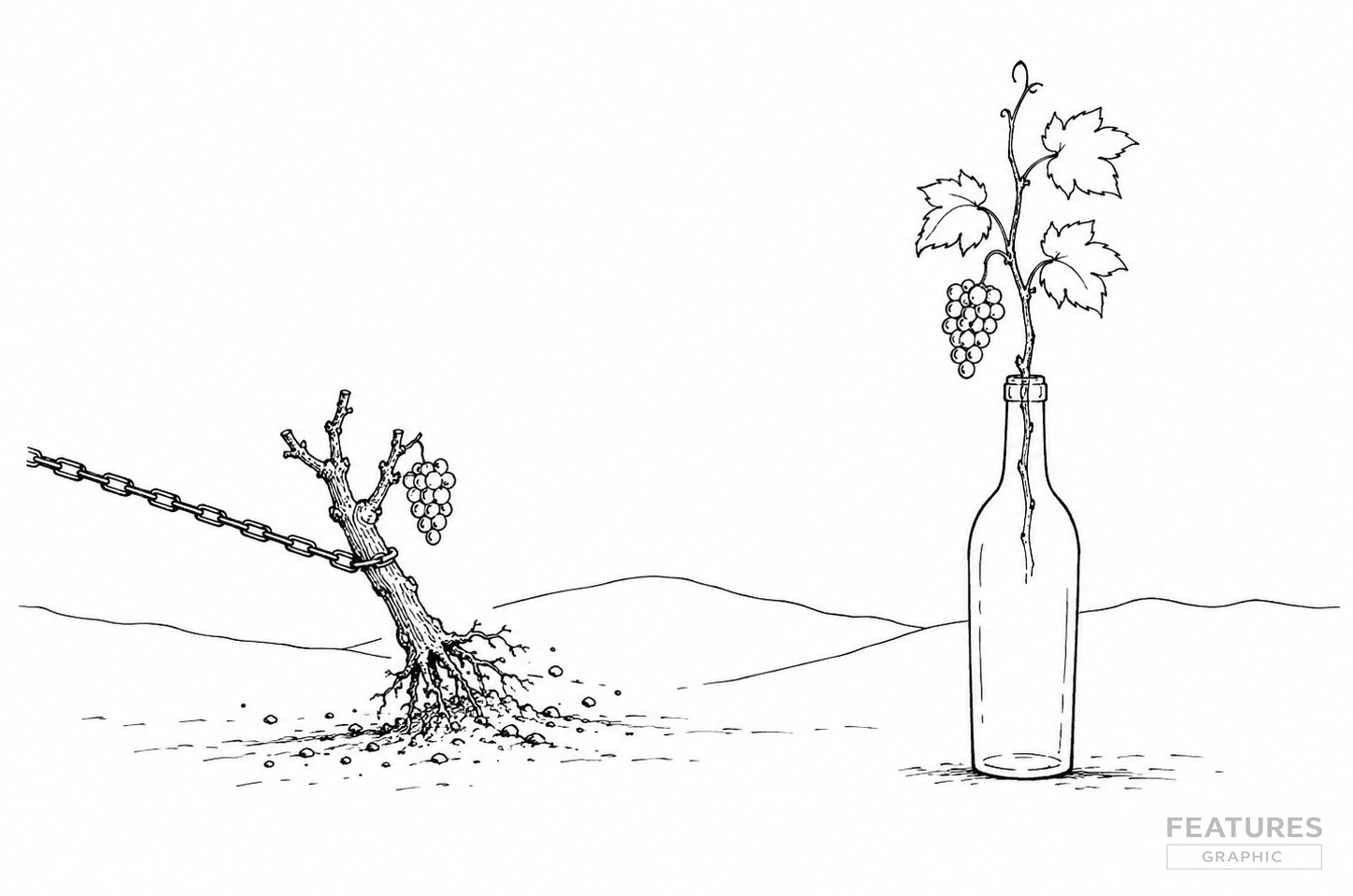
Against the 10,516 acres of winegrapes standing in Lake County in 2025, an 800-acre removal by a single grower amounts to roughly 8% of the county’s vineyard footprint. Because the reduction happened at a private grower rather than a winery facility, it never entered the state’s WARN layoff dataset, and the county has no public accounting of how many of those jobs were local.
The state acreage survey recorded a smaller countywide decline than the company’s own figure — 759 acres, of which 757 were cabernet — but the survey excludes blocks harvested in 2025 before being pulled, so it understates the year’s removals. The Press Democrat reported July 2 that Christian Klier of Turrentine Brokerage estimated growers took out another 1,500 to 1,800 acres of Red Hills cabernet this year, a broker’s estimate rather than a recorded figure. If it holds, county cabernet acreage would fall nearly 3,000 to 3,300 acres, down from 5,634 in 2023.
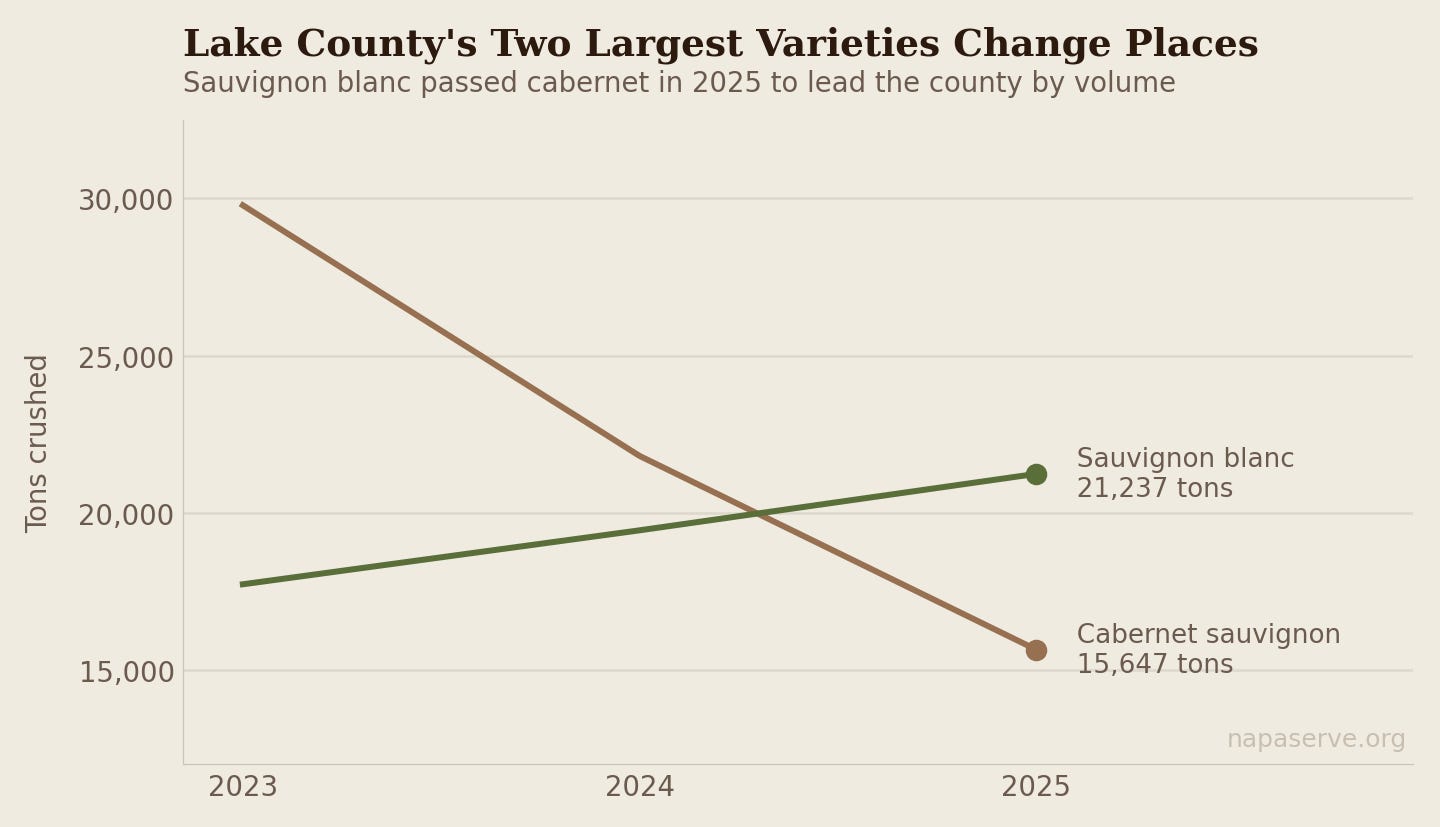
Axell described the removals as an economic decision, and the crush data puts a number on it. Price alone understates what happened because tonnage moved in the same direction at the same time. District 2 crushed 15,646.8 tons of cabernet in 2025, down from 21,809.4 tons in 2024 and 29,780 tons in 2023.
Set that production against the county’s bearing cabernet acreage — 5,634 acres in 2023 and 5,587 in 2024 per the agricultural commissioner’s crop reports, and 4,830 acres in 2025 per the state acreage survey — and the arithmetic a Lake County grower actually faces comes into view. Gross return per bearing acre was roughly $12,300 in 2023, roughly $6,400 in 2024 and roughly $3,800 in 2025.
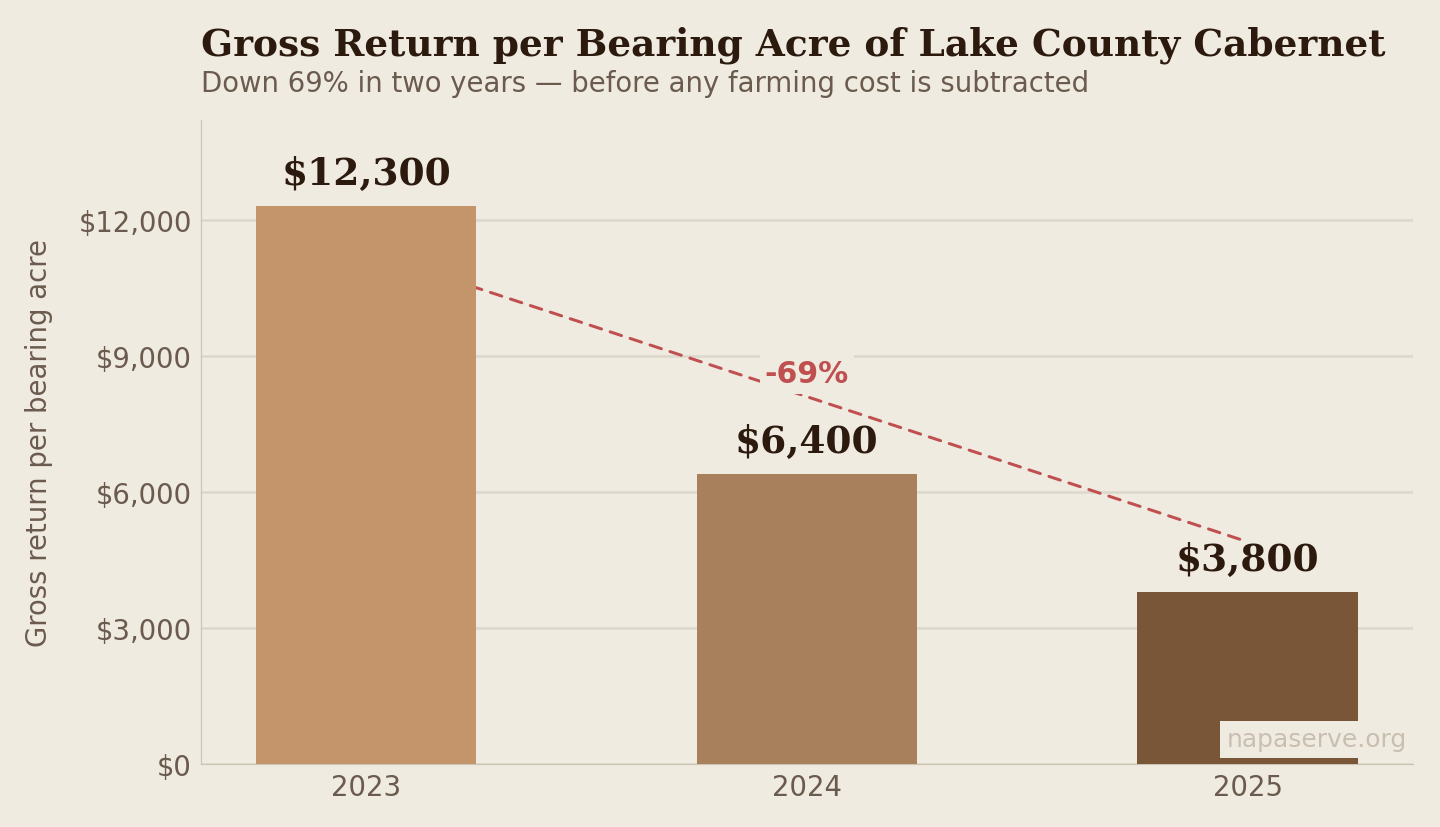
That is a 69% decline in two years, and it is a gross figure. Nothing has been subtracted for labor, water, fuel, equipment, custom operations, replant debt or land. Vines come out when that number falls below what it costs to farm them, and in the Red Hills it has.
District 2 crushed 42,874.8 tons of wine grapes in 2025, down 15.7% from 50,869.9 tons in 2024. Multiplied by the districtwide weighted average, the 2025 crop was worth roughly $49.9 million against about $74.7 million a year earlier — a loss of nearly $25 million — or about a third — in a single vintage.
Cabernet accounted for roughly $17.5 million of that decline on its own, falling from about $35.9 million to about $18.3 million. The variety that carried the county’s reputation lost nearly half its value in one year.
That money does not leave in the abstract. It leaves as pruning crews not hired, custom operations not contracted, equipment not replaced and property taxes assessed against land that no longer pencils at its planted use. It arrives on top of a set of stress indicators this series has documented across the past year: an 8.2% unemployment rate in January and a population of 66,793 on Jan. 1, down 209 residents, with every jurisdiction in the county losing people.
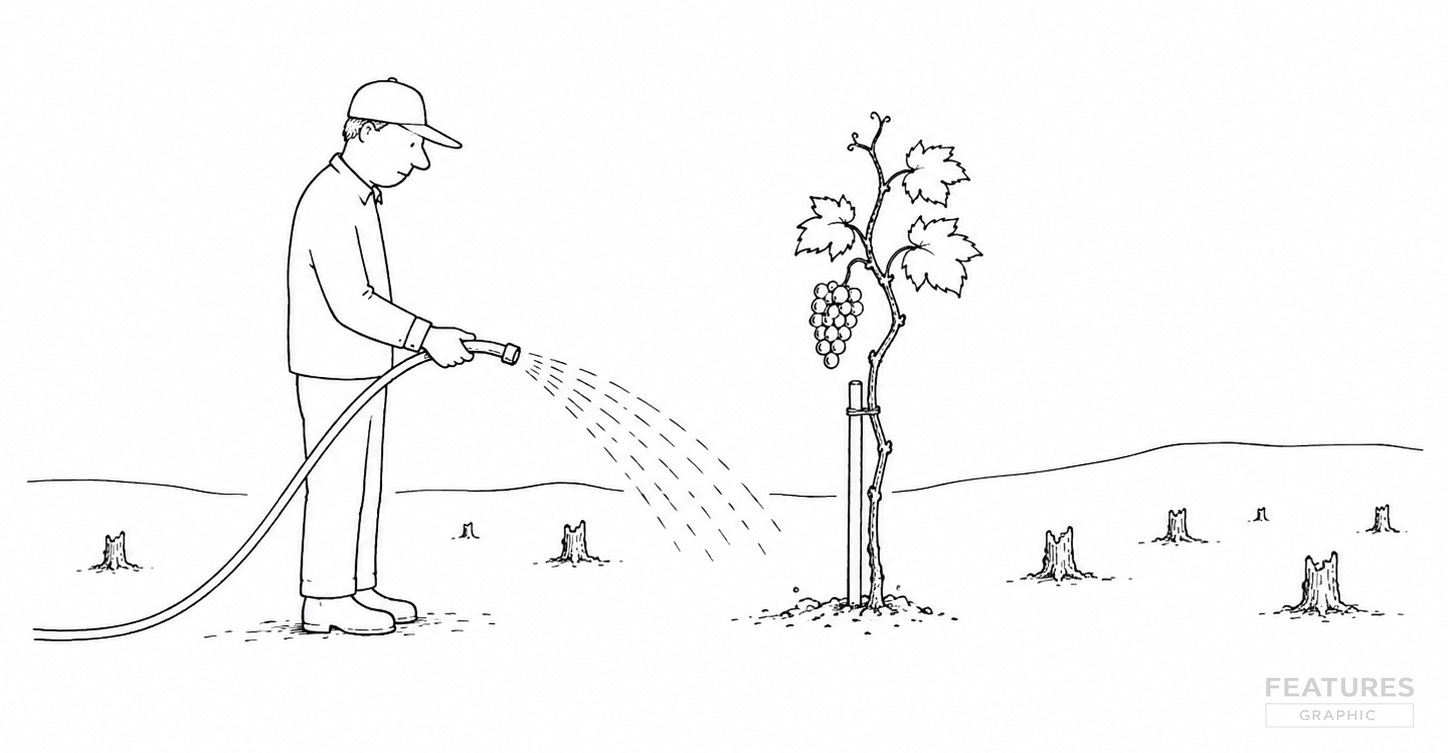
Napa County is District 4 in its entirety, which allows a direct comparison on the same measure. Napa crushed about 144,000 tons in 2025 against roughly 147,000 the year before, a decline of about 2.1%, and its all-varieties weighted average slipped 2.6% to $6,767.53 a ton.
Lake County lost a fifth of its price and a sixth of its volume over the same 12 months. Napa cabernet was worth about 5.6 times Lake County cabernet per ton in 2024. In 2025 it was worth about 7.6 times as much.
The gap widened because the two counties sell into different markets. Appellations that sell on scarcity held their pricing. Fruit that competes on cost has no floor when the discount buyer stops bidding, and Lake County built its modern reputation on being the affordable alternative.
The contraction is not uniform, and one line in the final report is worth the attention of anyone farming red grapes here. In District 2, white wine grapes averaged $1,173.91 a ton in 2025 and reds averaged $1,149.19. Whites now out-earn reds in Lake County.
Sauvignon blanc rose to 21,237.2 tons crushed from 19,440.6 a year earlier and passed cabernet to become the county’s largest variety by volume, at $1,195.73 a ton. Together the two varieties made up about 86% of the county’s crush.
Neither carried the county’s highest price. Cabernet franc averaged $1,807.31 a ton on 51.3 purchased tons and sangiovese $2,178.42 on 27.8 tons — small, specialized buyer pools sitting above a much broader and weaker market for everything grown at scale.
Beckstoffer’s remaining Lake County acreage will be primarily cabernet, drawn from the sites the company considers its strongest, and Axell continued to describe the county as a quality cabernet region while explaining the retrenchment. That distinction matters locally. The company is not repudiating Red Hills fruit. It is reducing exposure to acreage for which no buyer has committed, which suggests the operative divide is no longer good vineyard against bad vineyard but contracted fruit against uncontracted fruit.
Statewide, the California Association of Winegrape Growers and Land IQ counted 38,134 acres removed between October 2024 and August 2025, against 477,475 acres still standing. Lake County did not rank among the 10 counties with the largest removals — which is the uncomfortable part of the number. What happened here is not the extreme case.
Fewer acres eventually mean less fruit. They do not automatically mean better prices because the other half of the equation — how much wine buyers want — has not turned. The open question for Lake County is whether the acreage that remains is small enough to be contracted and whether the county’s next chapter is written in sauvignon blanc.
-
Tim Carl is a Northern California-based photojournalist.

—
The views, opinions and data presented in this article are those of the author and do not necessarily reflect the official policy, position or perspective of Lake County Features or its editorial team. Any content provided by our authors is their own and is not intended to malign any group, organization, company or individual.
Our illustrations are produced through a multistep process of generative tools, digital sketching and photo editing, often starting from our own images or sketches.

No posts
Comments
Nothing yet. Say the first thing.
Sign in to join the conversation.