
Have you noticed your child suddenly finishing homework very quickly? Or perhaps they’ve become unusually reactive, throwing a full-blown meltdown over a minor misunderstanding?
As parents, our first instinct is to audit their screens. We look at their apps, we worry about the toxic pipelines of the algorithms, and we fret over the sheer velocity of their group chats. We panic over the peer pressure of synchronous messaging and wonder what they are absorbing.
But what if the greatest digital disruption in our homes isn’t coming from their devices?
What if it’s coming from ours?
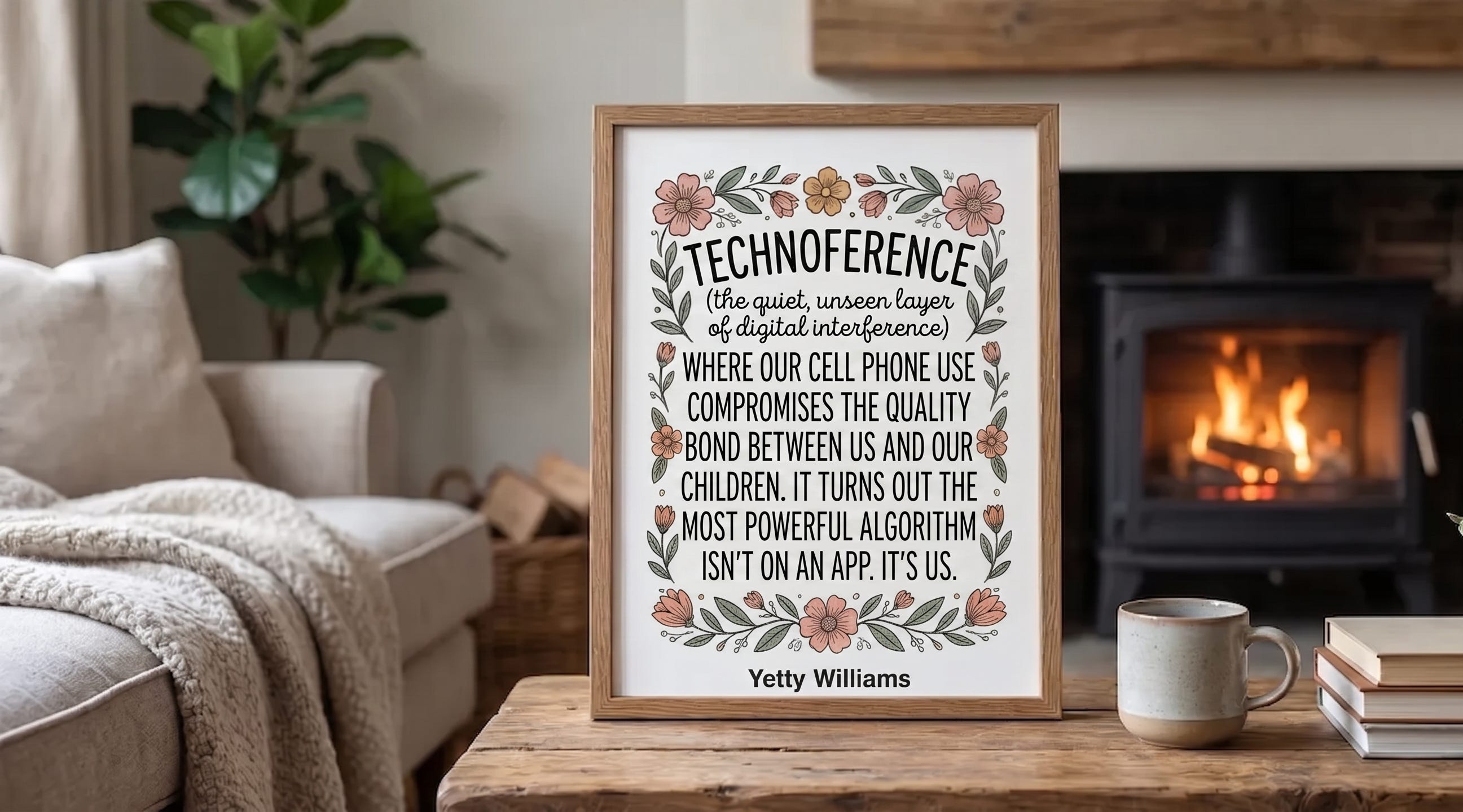
Welcome to the era of technoference. The quiet, unseen layer of digital interference in which our own cell phone use compromises the quality of the bond between our children and us. It turns out that the most powerful algorithm in our children’s lives isn’t on an app. It’s us. And right now, too many of us are unknowingly slipping into a dangerous habit that is tanking our children’s Emotional Intelligence (EQ).
In my training in cyberpsychology, what consistently stands out is how today’s digital landscape offers a real-time, unfiltered look at human behavior. We do not need a controlled lab setting to see the effects of screens; we just need to look around our own living rooms.
Recent studies have brought to light a sobering truth: parental use of mobile devices in the presence of children is the strongest predictor of lower child emotional intelligence.
To understand why this happens, we have to look back at a classic psychological concept known as the “Still Face Experiment.” In the original developmental psychology studies, a mother would interact with her infant joyfully, then suddenly turn away and return with a completely blank, expressionless face. Within seconds, the child would become highly distressed, trying desperately to win back her attention before collapsing into tears and emotional withdrawal.
When we check a notification mid-conversation, or scroll through a feed while our children are trying to tell us about their day, we are delivering a modern, high-tech version of the Still Face. - Yetty Williams
Our faces go blank. Our pupils freeze. Our responsiveness drops to zero. To a developing child or a vulnerable teenager navigating a complex world, that micro-moment of unresponsiveness feels like a silent exclusion. It signals that the digital world behind our screens is more valuable than the human soul standing right in front of us.
The divide between analog-minded parents and digital-native children already creates immense tension, often leaving children to navigate their digital lives independently. When technoference cuts off the emotional valve at home, we risk creating “digital orphans,” children who are effectively raising themselves on the streets of social media.
Many parents reach out to me, saying, “But Yetty, I am an authoritative parent! I set boundaries, I talk to my kids often when we are together.” As I share in Chapter 9 of my book, Digital Savvy Parenting: What the World Urgently Needs, Parenting styles in the physical world don’t always translate to the digital world. You may be a perfectly balanced, authoritative parent in traditional contexts, but completely disconnected when it comes to technology.
The digital age has shifted the monopoly on knowledge. In the “good ol’ days,” perhaps our parents could say, “Because I said so,” and remain the ultimate authority. Today, with “Uncle Google” and “Cousin ChatGPT” moving into our homes, our children have instant answers 24/7. They don’t need us for content; they need us for context.
If your child cannot communicate openly with you because your face is buried in a screen, or if they feel shut down by your digital unavailability, they will find an alternative reality online. One of the only ways to stay relevant in their lives is to build the right relationship while you can, ensuring that your voice is the loudest voice in your child’s head.
To bridge this gap and help parents realign their physical strengths with the digital landscape, I developed a framework consisting of four distinct Digital Parenting Archetypes:
The Avoidant Digital Parent: Shies away from technology out of fear or intimidation, leaving children to navigate risks entirely on their own.
The Dependent Digital Parent: Relies heavily on devices for entertainment or work, accidentally modeling chronic “doom scrolling” and triggering the digital “Still Face.”
The Complacent Digital Parent: Takes a hands-off approach, assuming children can self-regulate without rules, leaving them exposed to unfiltered algorithms.
The Innovative Digital Parent: The ideal we should all strive for—approaching technology with balance, empathy, and intentionality.
The transition from a traditional style to an innovative digital style involves recognizing that the online and offline worlds are no longer separate. Our children live a completely blended reality. If we are stuck in an “analog mindset” or caught in a cycle of digital dependence, we leave our front door wide open to external algorithms programming our children’s values.
To find out exactly where you stand on this spectrum, you can take my quick assessment right now: 👉 Take the Digital Parenting Type Quiz Here
To counter technoference and actively shift your archetype toward the Innovative ideal, implement these four steps tonight:
Apply a Traffic Light System to device use within the home.
🔴 Red Zones: The dinner table, car rides, and the first 20 minutes after arriving home are non-negotiable, device-free times. No phones on the table—even face down.
🟡 Amber Zones: Spaces where devices are allowed, but with full transparency. If you must answer a work message, state it explicitly: “I am responding to an urgent work email for 5 minutes, then I am putting my phone away to focus on you.”
🟢 Green Zones: Dedicated spaces for family connection, shared tech exploration, or watching educational content together.
We have been sold a massive parenting myth: the idea that as children get older, they need us less. In reality, the teenage years are a second maternity leave, a phase I call Teenternity. While toddlers require hands-on physical care, teenagers require deep, “on-call” emotional presence.
Teens rarely open up during scheduled “quality time.” They open up at random, inconvenient intervals; often late at night when you are just there. If your face is hidden by a smartphone during those rare windows, the door slams shut. Put the phone down and simply remain available in the room.
Children learn emotional regulation by watching how we handle digital pressure. When your phone buzzes or rings, model the exact behavior you want to see from them. Instead of impulsively snatching the device, let it ring out, or explicitly say, “I hear the notification, but what you are saying to me right now is much more important.”
A mother in our community recently shared a painful but beautiful wake-up call that perfectly illustrates the shift from a Dependent to an Innovative archetype.
Her 12-year-old son had suddenly stopped sharing details about his school day. When she gently sat down with him to ask why he had grown so distant, he looked at her and said:
“Mom, whenever I try to talk to you, you’re looking down at your phone. I’m tired of talking to the top of your head.”
She realized that what she viewed as “harmless multi-tasking,” such as answering quick client emails while sitting on the couch, looked like a permanent, cold “Still Face” to her son. Instead of getting defensive, she moved to a collaborative approach.
She shared that while she is at home with him, she is still working, but can still hear him. He insisted that he didn’t like it and felt dismissed. Together they created a new family rule: “Eyes First, Screens Second.” She also became more intentional with being clear when she needed to fully focus on work, and when it was time to focus on him, she was fully with him.
Within weeks, the emotional distance closed, and their vibrant conversations returned. That is the power of stepping into your child’s shoes with true empathy.
“Our children do not need us for digital content; they look to us for human context. We must ensure they aren’t raising themselves on the streets of social media while we stare at our own screens.”
Recognizing your digital archetype is only the first step. To truly unlearn analog biases, understand the profound effects of online disinhibition, and get the step-by-step roadmap to becoming a truly Innovative Digital Parent, you need the complete strategy.
In my book, Digital Savvy Parenting: What the World Urgently Needs, I provide the tools, engaging coaching questions, cyberpsychology insights, and neuro-hacking tips required to raise resilient, emotionally intelligent children in a hyperconnected world. Do not leave your child’s digital footprint to chance.
📖 Get Your Copy of Digital Savvy Parenting Here
Did someone share this with you? Subscribe to the newsletter https://substack.com/@parentinginthedigitalage
Want More? Connect with Me
Want to book a coaching or training session on Digital Resilience, Family Digital Wellbeing, and Online Safety for your family or school? Visit here to book and here for One-on-One Coaching
Till next time,
Stay Digitally Savvy,
Yetty Williams,
Digital Parenting Coach | Cyberpsychology-Trained
Founder, LagosMums
Author, Digital Savvy Parenting: What the World Urgently Needs
No posts
Comments
Nothing yet. Say the first thing.
Sign in to join the conversation.