
Consider this the sister post to a podcast I’ll be releasing publicly next week, which is also embedded at the end of this article for early subscriber access. The point of this article is to further elaborate on thoughts shared in the podcast and to offer more of an in-depth analysis of the communication styles people (predominantly women) adopt when this topic gets discussed.
These communication styles and the thought patterns driving them expand far beyond the topic of gender and sex; thus, I will be dedicating more time in the future to examining how they show up in the broader culture.
Before unpacking the hot-button issue of gender ideology with you, it feels appropriate to share more of why this topic matters so much to me. I dedicate a few lines to this in the early segment of the podcast episode, but the episode was already very long, and there’s only so much that can be included with the kind of detail I tend to prefer.
As a women's nutritionist and somatic coach focusing on complex trauma, I spend my days helping women reconnect to safety within their bodies and minds as we work toward recognizing difficult patterns, such as dissociation, splitting, and disorganization. There are three main goals we work toward together:
To increase their overall sense of agency and well-being, despite the oftentimes real limitations and challenges getting in their way.
To develop a growing awareness of their patterns, why these patterns exist, and a growing capacity to witness and stay present with these patterns (the first step to changing them).
And lastly, to create changes for themselves—in neuroception, metabolic health, relationships, self-concept, mood, daily behaviors, and overall quality of life.
One big component of this work is to create and reinforce the core needs that often go unmet for women with trauma during developmental years: connection, attunement, trust, healthy autonomy, and remaining connected to our hearts while developing, exploring, and expressing ourselves sexually. The sessions may contain a lot of different forms of content, but addressing these core needs forms the container that makes this work so special and sacred.
It’s relational work, what I do, which means that we’re in relationship, and this is a big part of what elicits change and healing. Because complex trauma is relational, recognizing and shifting patterns often requires someone else be with us, someone whom we feel safe with, reflecting our experience back to us.
Another key component of my work is to help women develop healthy relationships with themselves. So when I see a movement that predominantly targets young women—80% of those identifying as trans are now biological females between ages 11-21—telling them their bodies are wrong and need to be medically altered, I pay attention.
This could have been me.
Growing up in the '90s and early 2000s, I struggled with severe body dysmorphia and an eating disorder that lasted a decade. I was deeply dissociated, traumatized (I have a high ACE score), and lived profoundly disconnected from my body. I remember spending hours on our dial-up AOL connection researching plastic surgeries to get once I could afford them—nose jobs, breast implants, liposuction—anything to fix what felt fundamentally wrong with my physical appearance.
This body dysmorphia—something I’ll be dedicating a full post to soon—began very early in life for me, and I have memories of being 7 or 8 years old and experiencing a lot of distress over my body shape, functions, and appearance. How I viewed and felt about myself depended heavily on how stressed I felt at any given time, within the context of my chaotic childhood environment.
If social media and gender influencers had been telling me back then that my discomfort meant I was actually male, that hormones and surgery could solve my problems, that my distress was proof I was "born in the wrong body"—I might have believed them. The vulnerable teenage girl I was at 13, 14, 15… might have latched onto any explanation that promised relief from the pain of feeling so alien in my own skin.
I weighted the world on my back to try and figure out why I felt so shitty all the time, strived to control every little thing about my appearance, developed unhealthy attractions to boys that were disrespectful and unkind to me, and developed confusing attractions to girls that I had no words for or confidence in to pursue.
I hated everything about myself, and no one around me knew this or could offer me a way out. My way out took years. It wasn’t linear, and it left legitimate scars and regrets, but I didn’t do anything permanent to my body that I will have to live with for the rest of my life. The first leg of my journey did involve medicalization— diagnosis for ADHD, OCD, depression, anxiety, bulimia, insomnia, and medications for all of these conditions. But I was lucky enough to reroute when these medications seemed to be exacerbating the trauma patterns I wasn’t even aware I had yet.
Today, thousands of detransitioners share eerily similar stories: trauma, dissociation, neurodivergence, latent homosexuality, body dysmorphia, and misunderstood neurosomatic patterns driving the disconnection they feel with their bodies.
Unlike myself, sitting alone on AOL dial-up, these women weren’t alone online; they share stories of finding online communities promising answers via abstract gender theories and irreversible medical decisions to be made during their most vulnerable years. As someone who works with women healing from trauma, I can't ignore these patterns. Especially not when they’re at the scale that the gender trends have taken!
But this post isn't just about protecting vulnerable young women (though that matters deeply to me). This post is also about our collective ability to think critically about topics that have been declared off-limits by political activists and internet influencers. It's about what happens when we're not allowed to examine certain beliefs without being labeled— publicly by strangers, but also perhaps even in the minds of those we know well— as hateful bigots. It's about the difference between having compassion for people and accepting every claim made by these activists and influencers.
And it's about biological reality.
As someone who helps women understand their bodies and nutritional needs, I can't pretend that biological sex doesn't matter. I can't ignore the misinformation being spread about something as fundamental to child and adolescent development, women’s safety, societal boundaries, laws and regulations, and the nature of the reality we all share, as biology. And this misinformation is being spread by people with massive platforms and devoted followings.
On a whim recently, I decided to critique the trans-fem, queer influencer, Alok Menon, in my Intstagram stories.
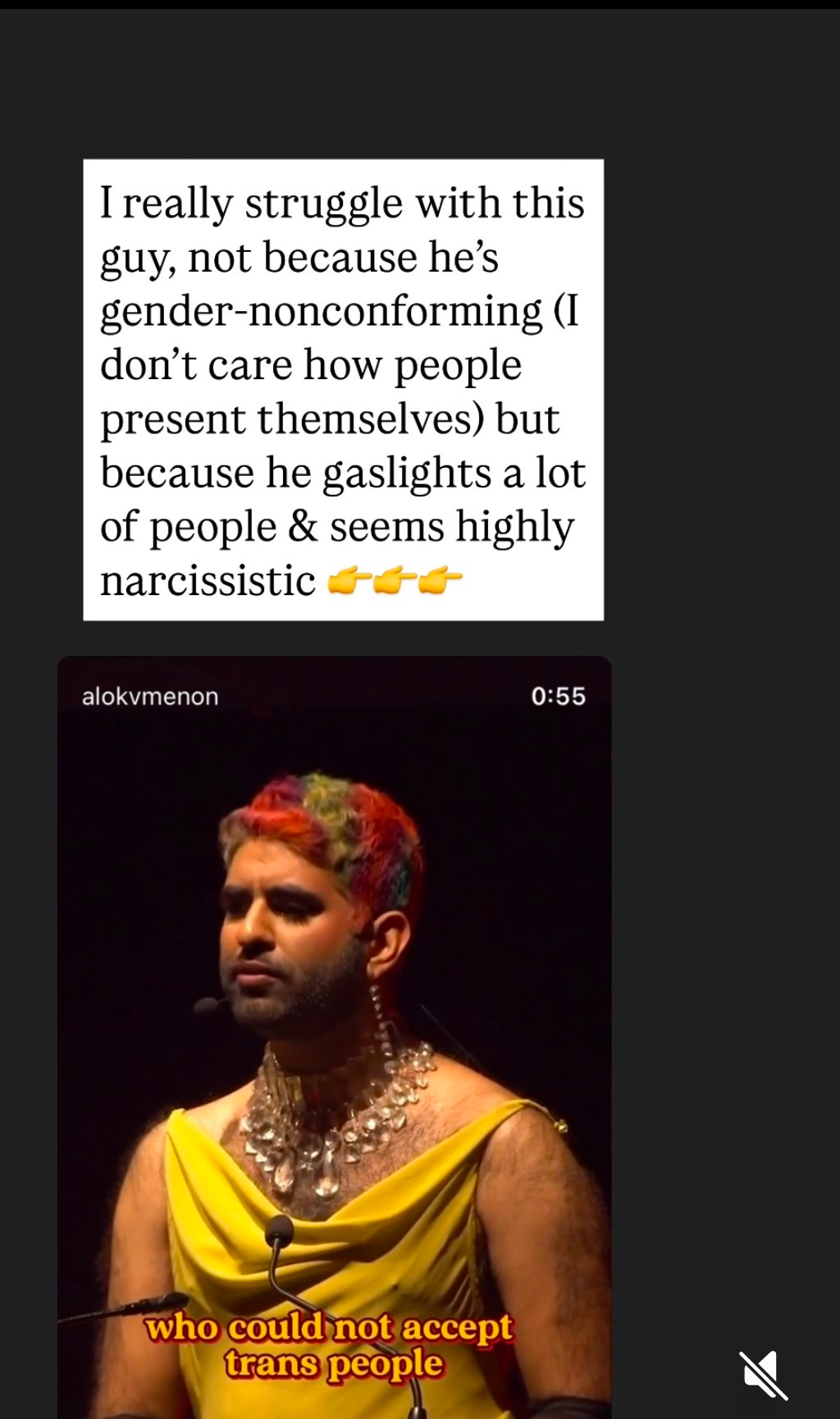
I became familiar with Alok’s work, ideas, and overall presence years ago and found them to be pretty triggering. When something or someone triggers me, I tend to lean into this with curiosity, assuming it might uncover something for me to address internally, which is what I did with them. I dedicated time to understanding the thesis of their work and the driving principles of their ideas. I listened to and watched countless videos of them.
And I became deeply aware of WHY I found them triggering: they display narcissistic traits, they’re distorting reality for their own purposes, and they use emotional manipulation to spread queer ideology. Alok’s built a large audience and brand around their gender nonconformity, which drives the confirmation bias in much of their “research” and the public performance art they create. And above all, they make patently false statements about biological sex and about gender as well.
As I emphasize in the podcast, my window of tolerance for gender nonconformity is large, and I don’t focus much on gender at all since it’s not scientifically verifiable. Deep down, I’d probably even call myself a “gender atheist” in the sense that I don’t really believe in gender, outside of acknowledging the roles it’s played in shaping culture. Having grown up liberal, along the California coasts, and falling outside of gender normative expression myself at various points, I’ve never felt uncomfortable with gender nonconformity of any kind.
I know and interact with countless people regularly who identify as queer and trans and I have positive human experiences within these interactions and connections. My desire as a humanist is to see the common humanity in everyone before I apply their identity labels to my views or emphasize their differences.
AND, as an independently-minded humanist, it falls against my nature and value system to adopt a perception, belief, or assessment about another human being because that human being, or some particular tribal or cultural meme, demands that I do so. Which, as I’ll illustrate below with the screenshot communications, is exactly what gender ideology does to people—it demands compliance.
Needless to say, the simple critique of Alok (and my misgendering them as “him",” which is honestly much more intuitive for me than using “they/them pronouns ") set my stories on fire. I had more engagement in my Instagram stories for a few days over this critique than I’ve had in a long time. Knowing that my story may feel jarring to women who subscribe to this sacred cow (as a matter of unconscious propriety), and that I may be misunderstood, I immediately followed up with explanations and disclaimers:
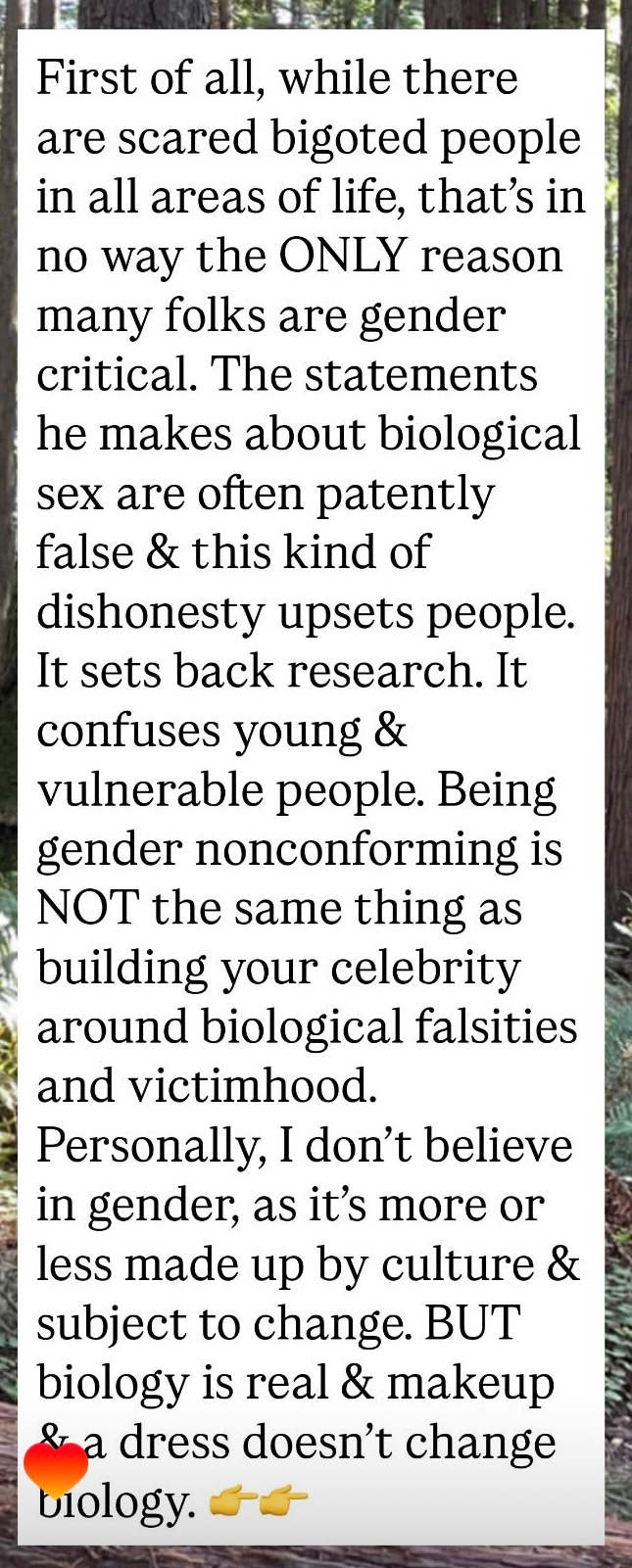
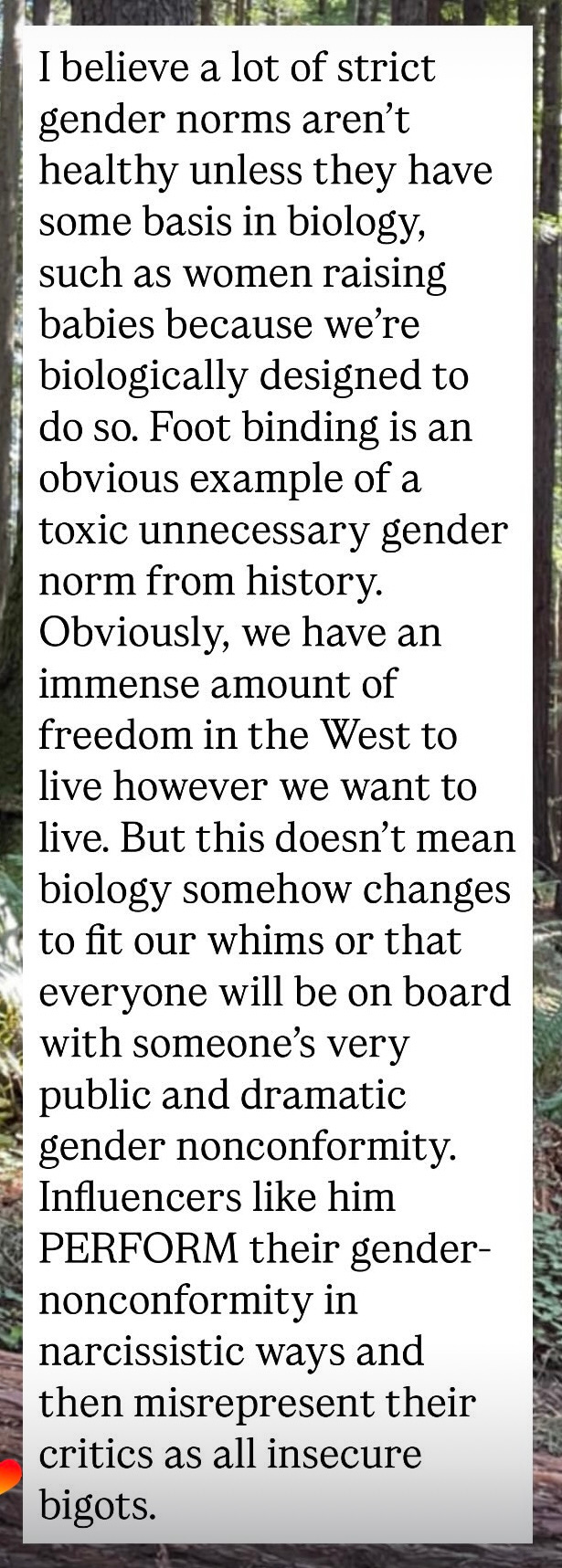
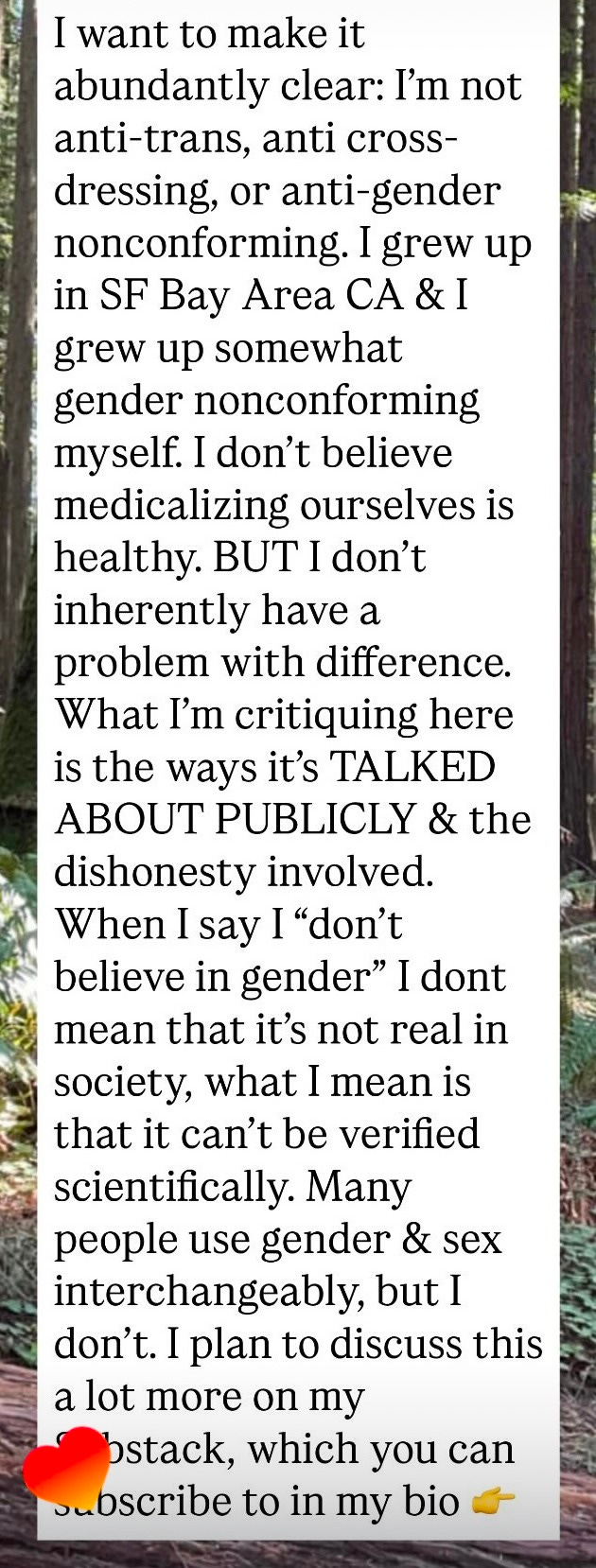
These explanations and disclaimers were loved and responded to by over 1k women—the most responses I’ve had in years from a single story! I had a lot of women DM me to share that they feel similarly and are grateful for my public stance. I wasn’t planning to share any of these in this article, since female alliances around this topic aren’t the point of this post. However, I think it might be helpful for women to know they aren’t alone if they have thoughts and feelings like this woman:
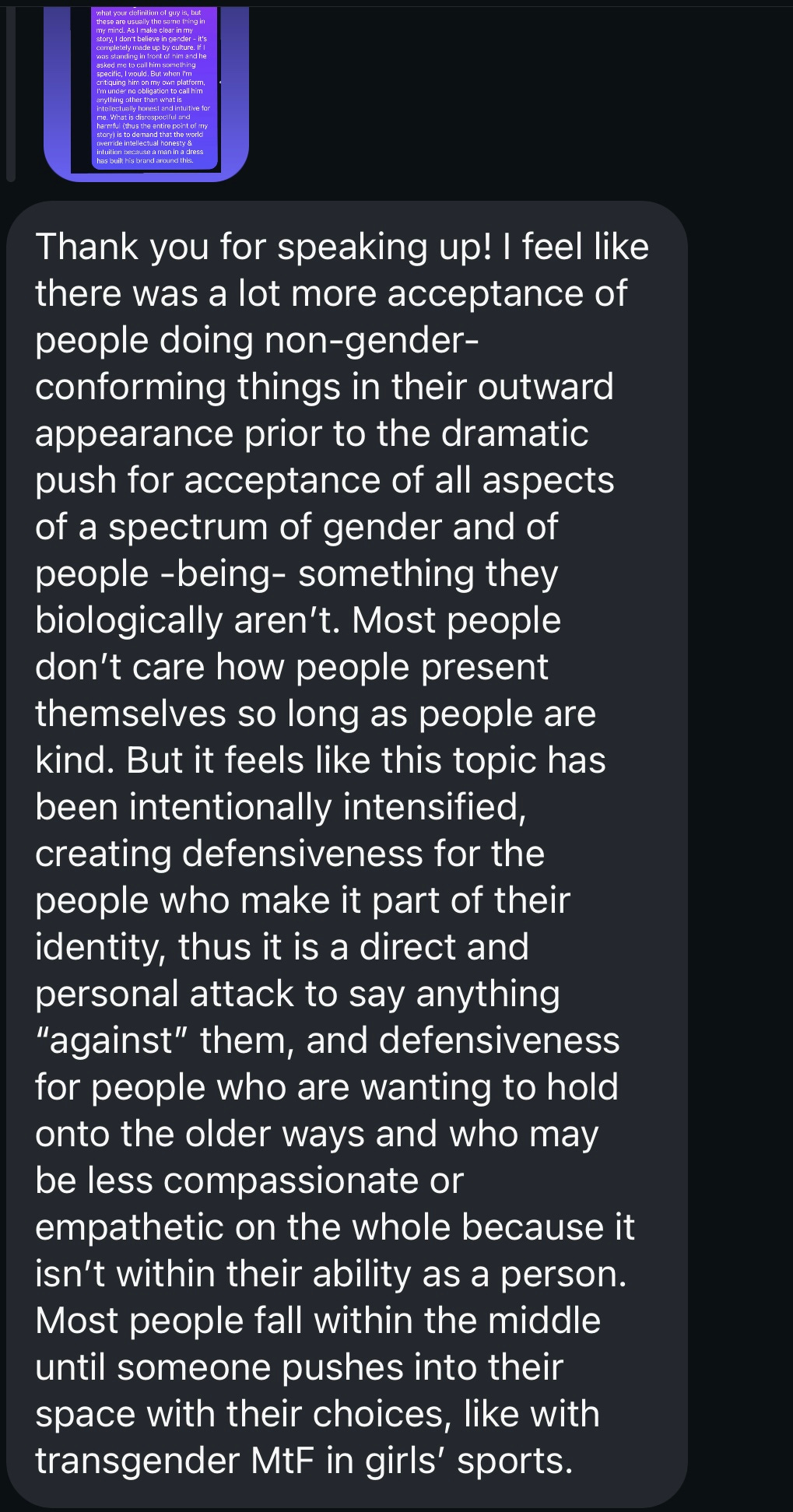
…or this woman:
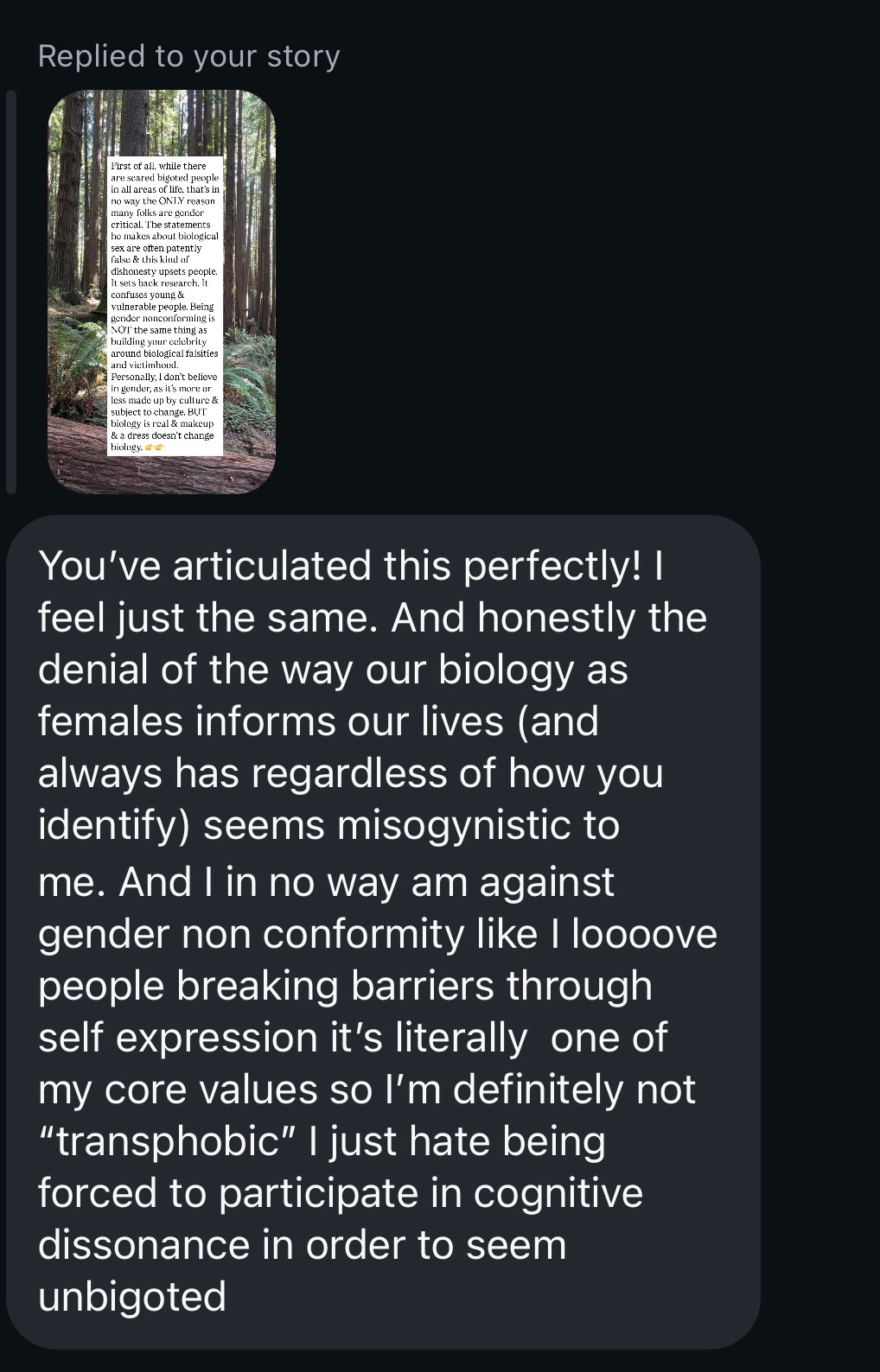
…or this woman:
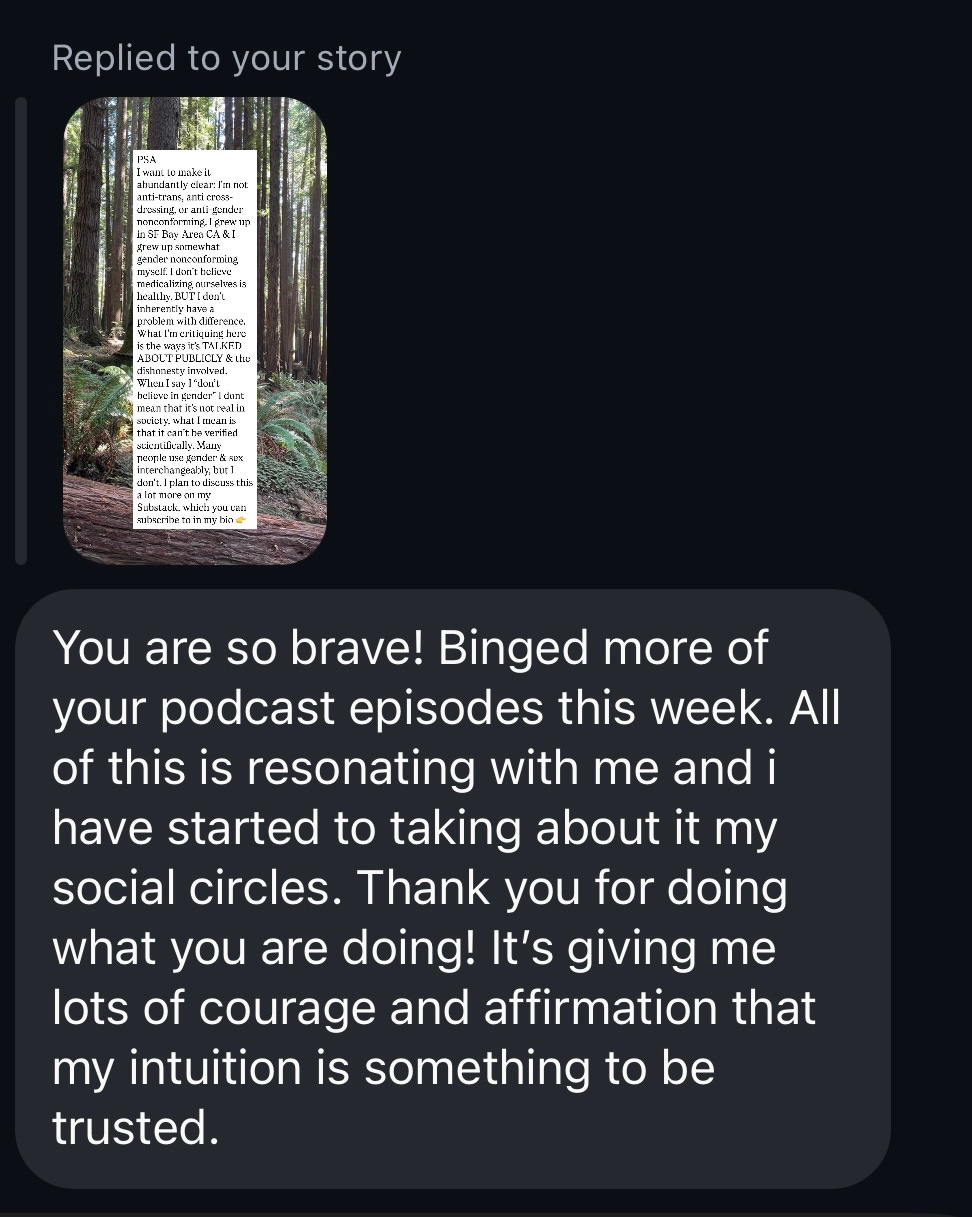
And that you’re not a bigot simply for feeling uncomfortable, gaslit, or lied to by trans influencers and activists. These experiences are shared by women all over the political spectrum, regardless of how accepting we might be toward nonconformity. I no longer believe that concern or dissent toward gender ideology is directly tied to a woman’s comfort levels, but is more tied to the access she has to her bodily signals, rational mind, and independent voice.
Most of the women who aggressed on me in my DMs in direct response to these story critiques, themselves came across as dysregulated, disconnected, unreasonable, and unable or unwilling to think critically about the very topic that they were defending so vehemently.
What happens when you express any of these concerns publicly without anonymity? Well, I found out this week what happens.
The responses revealed everything I was trying to articulate about why this topic has become a "sacred cow"—something so sacred that it cannot be questioned, examined, or critiqued without moral condemnation or hostility from strangers.
Let me break down what these messages reveal about how sacred cow thinking shuts down discourse.
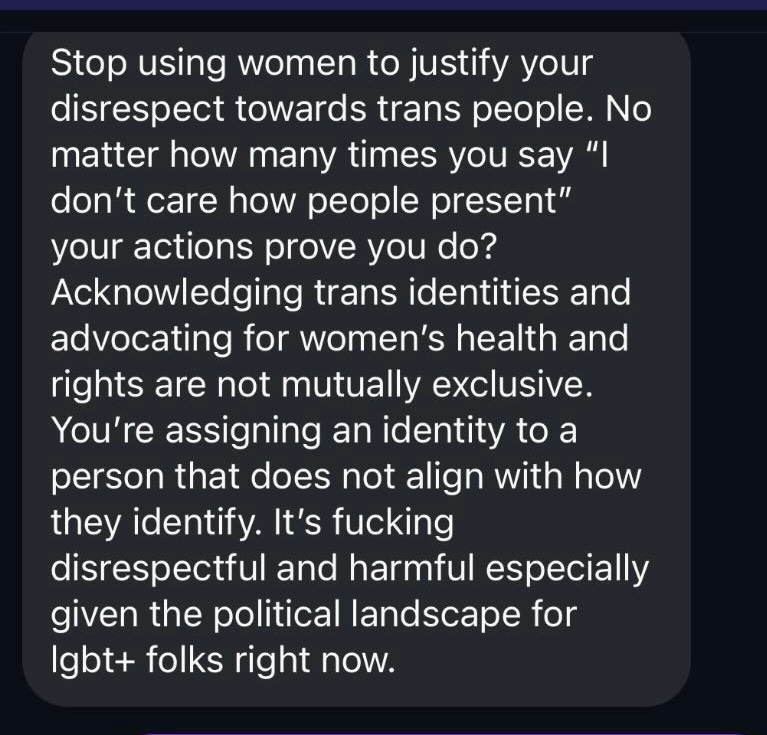
Message 1: Complete Disclaimer Blindness
"Stop using women to justify your disrespect towards trans people. No matter how many times you say 'I don't care how people present', your actions prove you do?"
This respondent completely ignored every disclaimer I made and instead accused me of "disrespect" for simply critiquing communication patterns. Notice the false binary: any criticism = disrespect. This person couldn't conceive that someone might support women's rights AND acknowledge trans identities while still questioning the activist messaging itself. There were no clarifying questions asked of me here because she already knew my intentions and my points, but they weren’t the ones I stated publicly.
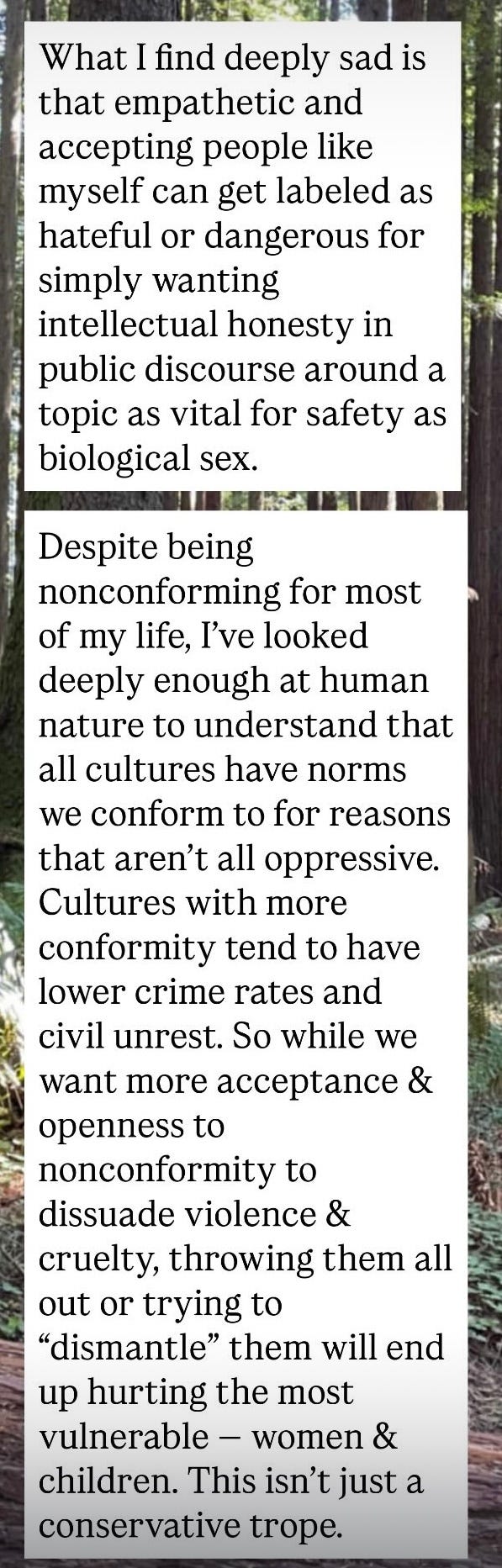
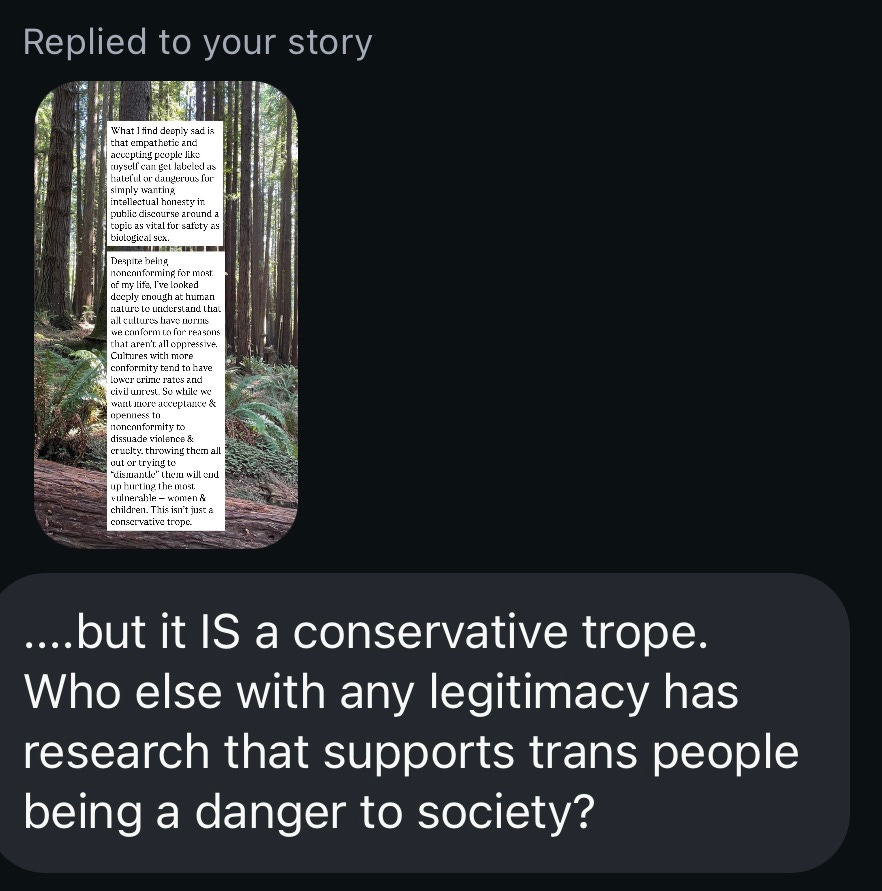
Message 2: The "Conservative Trope" Dismissal
"...but it IS a conservative trope. Who else, with any legitimacy, has research that supports trans people being a danger to society?"
This is a classic guilt-by-association fallacy, used in response to my story above. Instead of addressing my actual concerns about biological misinformation, she dismissed my position by labeling it "conservative." The implication: if conservatives say something, it must be wrong. This shuts down critical thinking by making the source more important than the substance. I also never stated that trans people, as individuals, are dangerous to society—I was pointing to the misinformation & theories that trans and queer activists base their ideas upon. So she demanded evidence from me to back up a strawman that only existed in her own mind.
Message 3: Redefining Good Faith
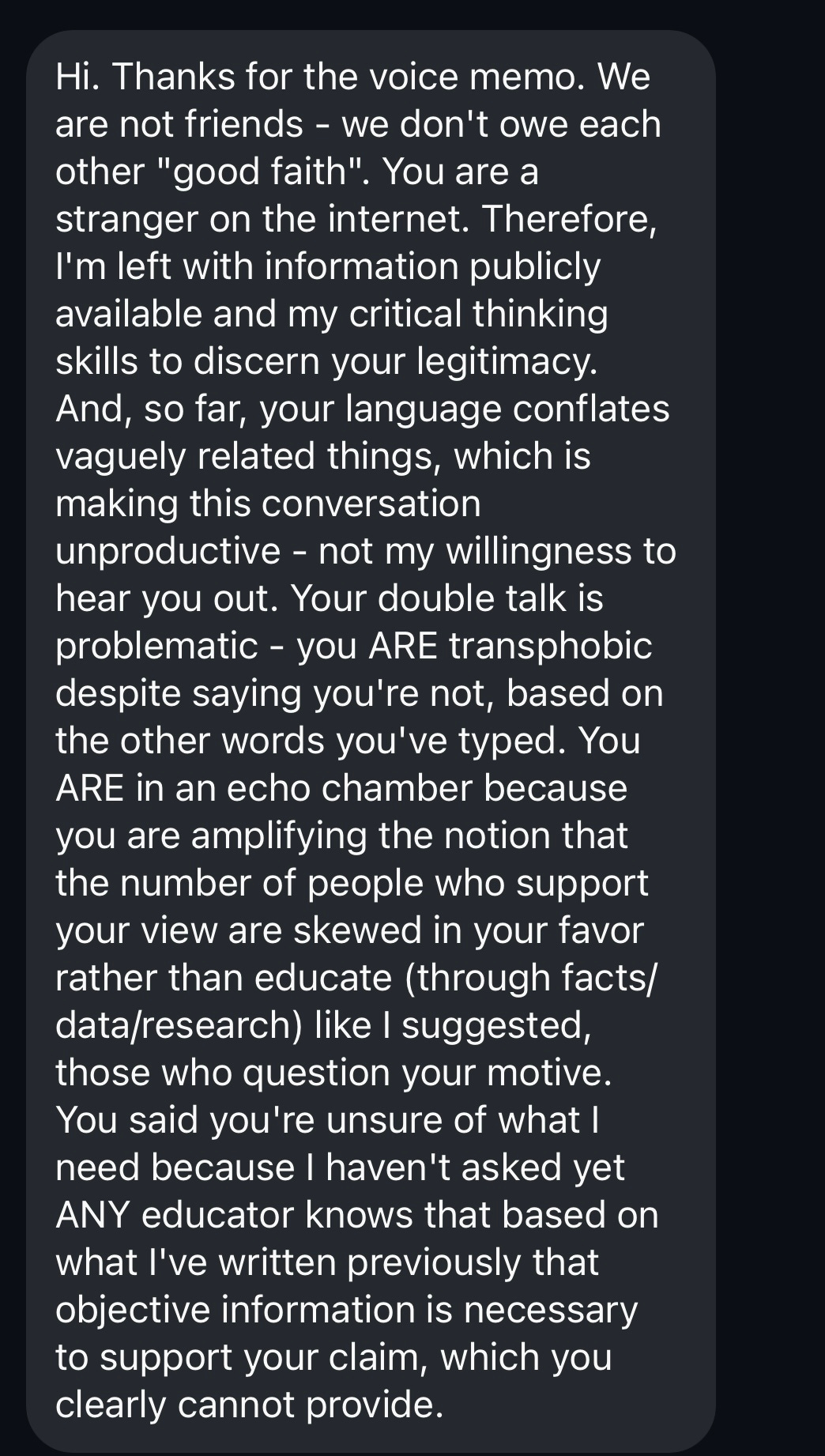
"We are not friends - we don't owe each other 'good faith'. You are a stranger on the internet."
After receiving a few hostile messages from this woman, I sent her a voice memo expressing that I cannot communicate with her if she’s going to continue engaging with me in bad faith. I also asked her for specific points that I’ve made in my stories that she disagreed with. And this was her response. She seems to fundamentally misunderstand what good faith communication means. Good faith isn't something you only give friends—it's the basic principle of engaging with someone's actual arguments rather than strawman versions. By rejecting good faith discourse with strangers, she's (and women like her) essentially saying, "I have the right to misrepresent your position."
So, it didn’t matter what I said because these kinds of communicators are mind-readers who know my deeper intentions more than I do, and therefore made it their job to call me out on intentions and ideas I didn’t even possess.
They then proceeded to label me as "transphobic, despite saying you're not,” while simultaneously accusing me of being unproductive by not providing proof for the claims that I made. This is what classic projection looks like.
Message 4: The Intuition Confusion
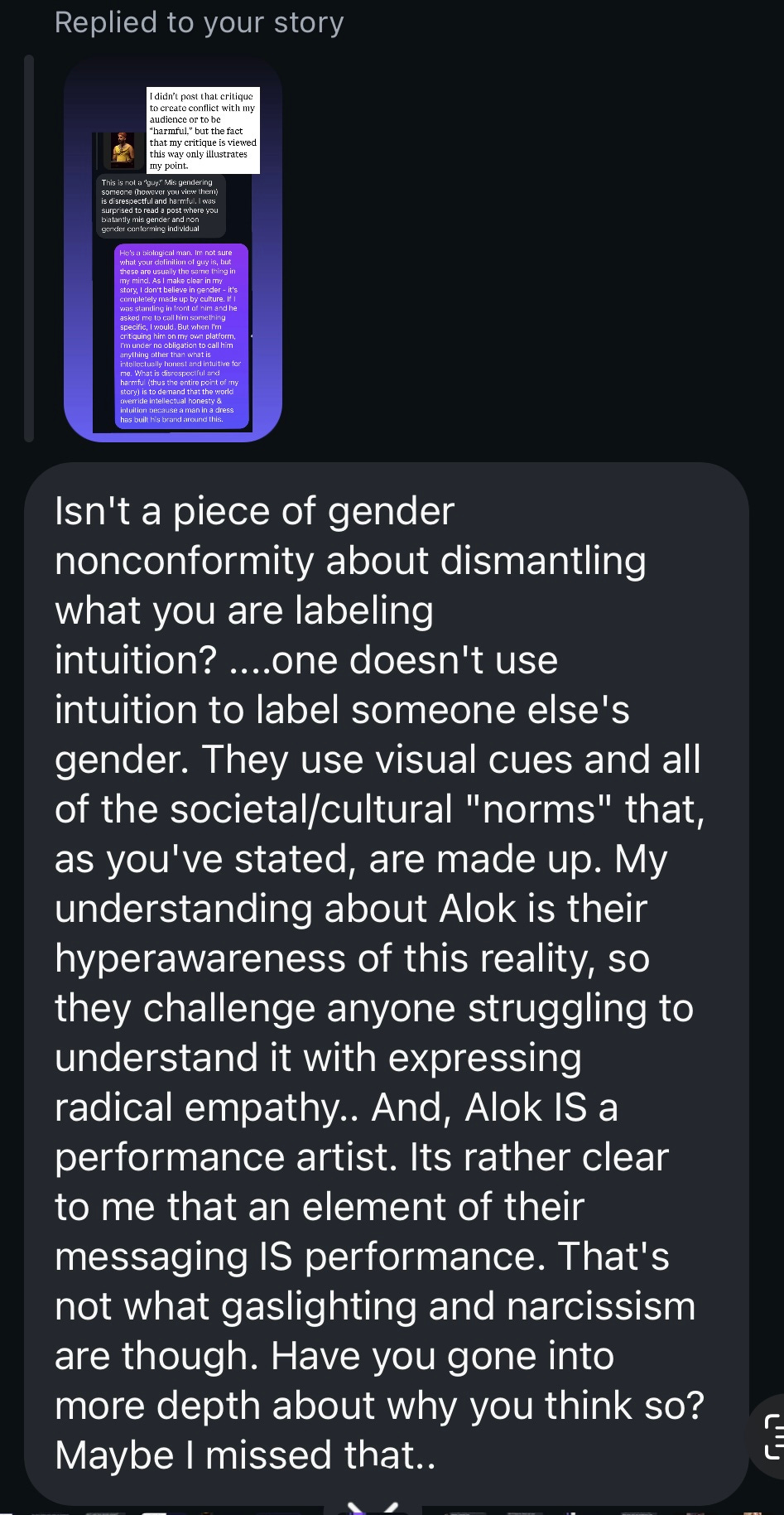
"Isn't a piece of gender nonconformity about dismantling what you are labeling intuition? ....one doesn't use intuition to label someone else's gender. They use visual cues and all of the societal/cultural 'norms' that, as you've stated, are made up."
This reveals a complete misunderstanding of what intuition actually is. This person thinks sex recognition is just "societal norms" rather than millions of years of evolutionary pattern recognition. They've confused social gender performance with biological sex recognition—exactly the kind of conceptual confusion that comes from not thinking critically about these topics in the first place. She then claims that Alok’s behaviors aren’t gaslighting or narcissistic, while making it clear that she doesn’t understand the very topics that I’m pointing to him as gaslighting us on.
Message 5: The Kafkatrap is Key here
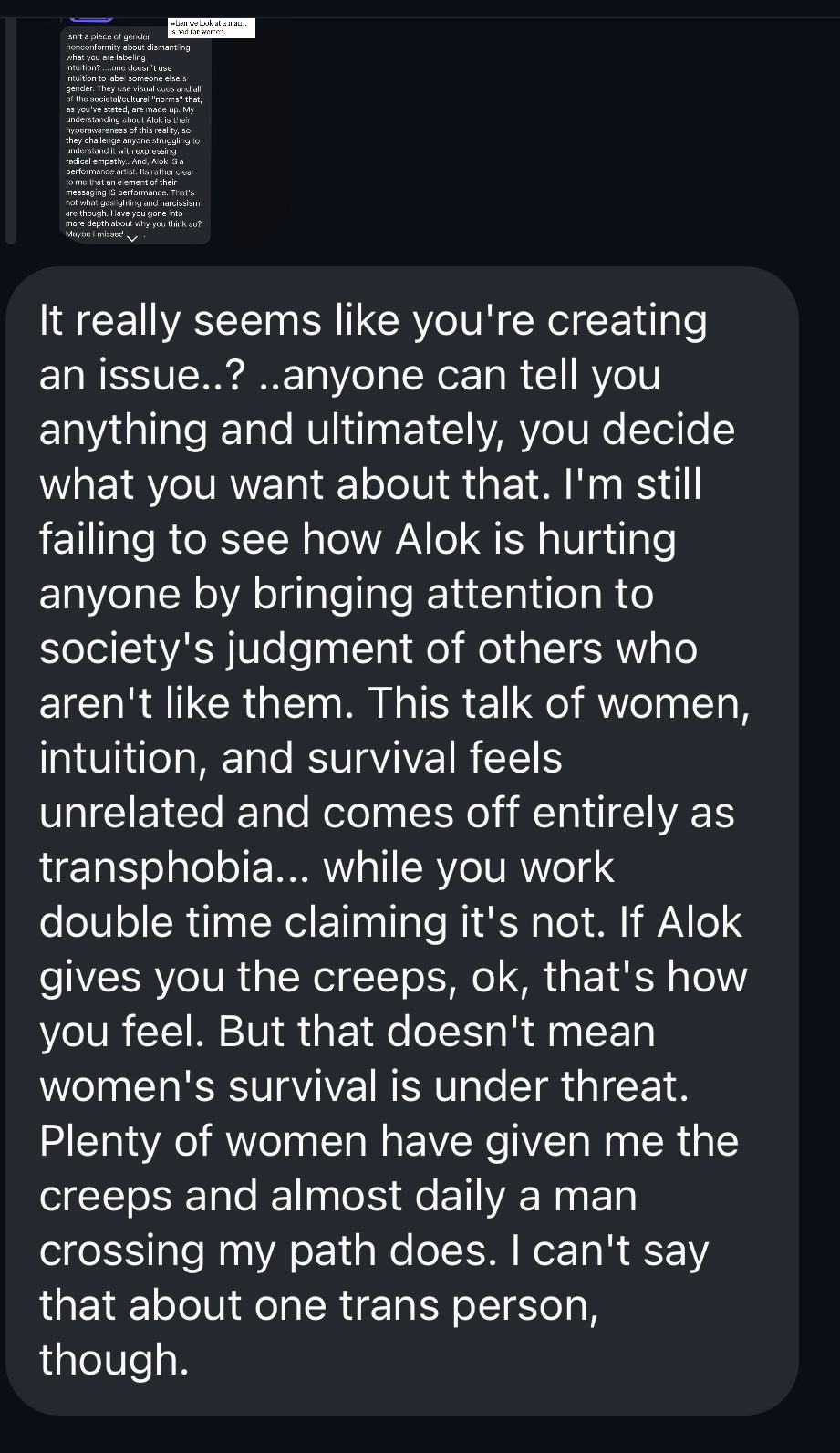
"It really seems like you’re creating an issue..?"
This woman’s message created a situation where any response I give her can be used as evidence against me, from the outset. If I defend my views with further disclaimers or explanations, I’m “working double time” to hide my true nature (transphobic). If I don’t defend myself, I’m guilty by not further defending my original statements made publicly.
There’s also an internal contradiction here, where she denies that women’s survival instincts have anything to do with sex assessment or intuition—that these are unrelated issues I bring up as a result of my transphobia…but then she states that “almost daily a man crossing my path (gives her the creeps).” What she doesn’t seem to understand is that the experience of getting the creeps from someone is itself a survival adaptation.
She has, essentially, created a conversation with me (she private messaged me of her own volition) where:
My concerns don’t exist (gaslighting)
The topics I bring up are irrelevant (dismissal)
My defenses prove my guilt (Kafkatrapping)
My position is evil regardless of my words (moral categorization)
It’s a solid example of how sacred cow thinking makes rational discourse impossible, and it also exemplifies the points I make in the podcast about the narcissistic and authoritarian patterns that often show up in activist communication styles. She’s denying my critique of Alok is real, while simultaneously acting as a literal example of it herself while defending them.
Message 6: The Mind-Reading Fallacy
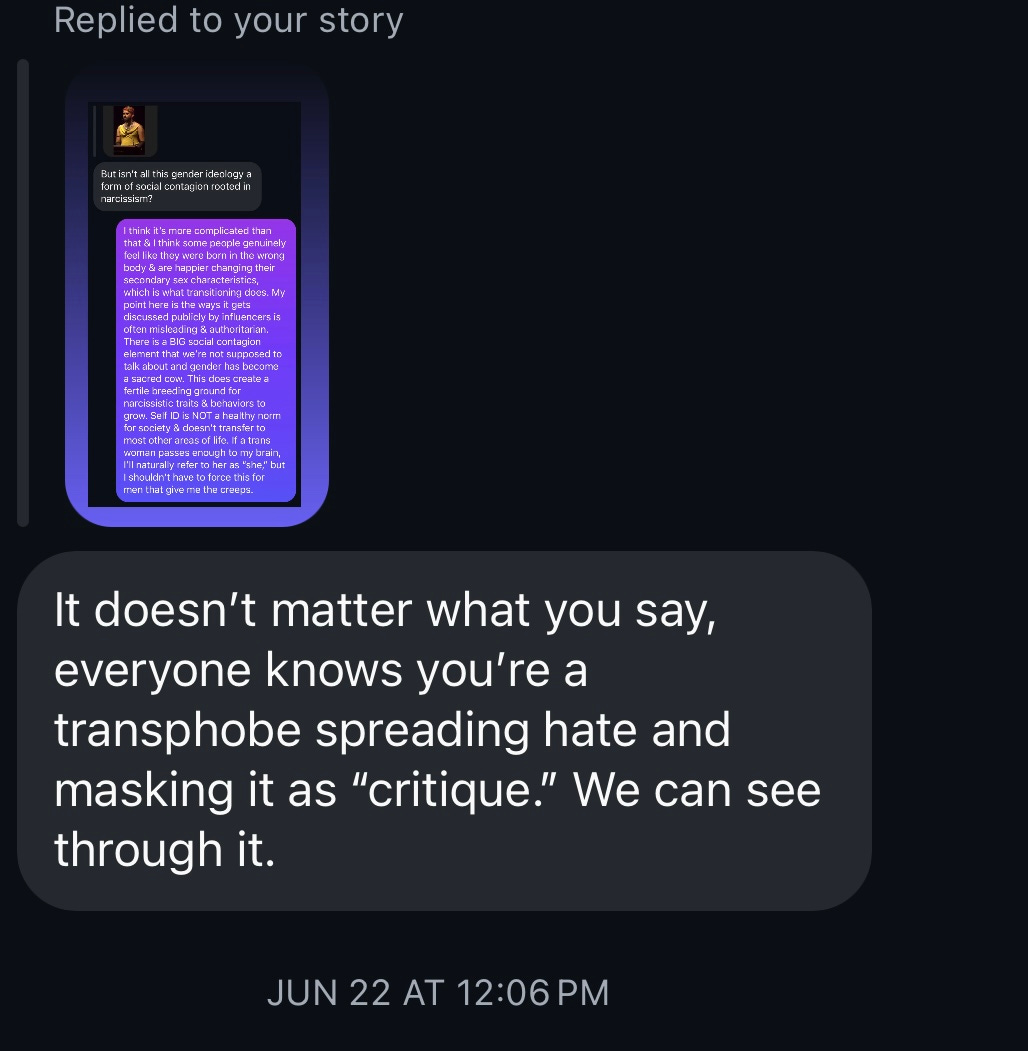
"It doesn't matter what you say, everyone knows you're a transphobe spreading hate and masking it as 'critique.' We can see through it."
This is perhaps the most revealing response of all. This person explicitly states that my actual words don't matter - they claim to know my "real" intentions regardless of what I say. This is classic sacred cow thinking: when something becomes holy, questioning it is inherently evil, and questioners must have evil motives regardless of their stated positions.
Notice the grandiose claim to speak for "everyone" and the assertion that they can "see through" my words to my true motivations. This is magical thinking - the belief that they possess special insight into my psyche that transcends my actual statements.
This response also demonstrates the fundamental unfalsifiability of accusations against sacred cows. If disclaimers don't matter, if clarifications are dismissed, if actual words are irrelevant, then how could anyone ever defend themselves against accusations of transphobia? The likely answer is: they can't. That's the point. It's a Kafka trap designed to shut down all criticism.
In the podcast episode, I dedicate significantly more time to unpacking gender ideology and its influence on the broader culture. I break down its links to queer theory and what queer theory is, myths around violence against trans people, myths about trans’ existence in pre-colonial times, and statistics about trans growth over the past decade. I also introduce concepts such as first-principles thinking and intuitive reasoning that we can utilize to help us recognize and flesh out bad ideas in individual thinking and larger memetics. The focus of the podcast is more broad than this article, in which I’m mainly focusing on the communication patterns of those swept up in this ideolgy.
Here are some overarching patterns that I’ve grown to recognize in my interactions with women who identify with gender ideology:
Complete Inability to Steelman: Not one woman in my Instagram exchanges who was critical of my posts attempted to understand my actual position. I offered disclaimers and even followed up with DM responses, but steelmanning didn’t seem possible. It was like I was speaking another language.
Sacred Cow Protection: Any questioning gets treated as an attack, regardless of how carefully I frame my positions or views.
Conceptual Confusion: Mixing up sex recognition, gender norms, intuition, and conflating intellectual critique with harm and violence
Moral Categorization: I was labeled "transphobic,” “disrespectful,” and “hateful” despite explicit disclaimers that I felt none of these things
Intellectual Dishonesty: Women claimed to want "facts and research" while ignoring the biological claims I was actually making. What they truly seemed to want was submission and compliance.
Self-Contradiction: Often claiming to be "deeply intuitive" while arguing intuition doesn't exist for sex recognition (something that’s been studied extensively by criminologists for decades), demanding acceptance for nonconforming people, while remaining intolerant of differing viewpoints on what nonconformity means
Mind-Reading: Claiming to know my "real" motivations, intentions, and feelings, regardless of my actual words
Unfalsifiable Accusations: Creating a framework where no defense against accusations is possible
But here's what's even more concerning for me: for every woman who sent a hostile message, I received three or more private messages from women thanking me for speaking up and sharing their own concerns—concerns they feel they can't express publicly.
This is how sacred cow thinking works, and it’s a breeding ground for self-censorship and authoritarianism. It creates a climate where people become so unsafe expressing their individual opinions and thoughts that they can lose track of what those opinions and thoughts are, even when they’re alone! It shuts down the development and practice of critical thought, and this gets translated into how we communicate. We create cultural norms and expectations where only one perspective feels safe to express, where women police other women for having "incorrect" thoughts. We stop asking important questions.
The women messaging me privately weren't transphobes or bigots—most of them included disclaimers in their messages about their liberal values and broad overall tolerance. These women were concerned mothers, therapists seeing concerning patterns in their clients, and women who'd experienced trauma, wondering why their sex-based concerns were being dismissed. These women were normal human beings who simply feel uncomfortable being consistently gaslit by strangers about how their own bodies work and what it means to be a woman.
But they felt they couldn't say any of the things that I said in front of others. That's the real danger here—not that people disagree, which is an important component to a free society, but that disagreement has been made unsafe.
So what do we do? How do we navigate a topic that's been declared beyond criticism or examination? Especially when it’s a topic that’s so deeply tied in with our development, survival, safety, reproductive capacities and mating behaviors, family planning, laws, research, and the design of our important institutions?
Obviously, I’m not claiming to be an expert on this topic, but more of a concerned individual. But here are my suggestions:
First, we need to trust our intuition again. Real intuition—what Nobel Prize-winning psychologist Daniel Kahneman showed us—is based on pattern recognition from extensive experience. Your ability to assess biological sex isn't prejudice; it's millions of years of evolutionary pattern recognition that women, in particular, have needed to rely on to remain safe, to protect their babies, and to navigate an at-times harsh existence. When something feels off about being told to override these instincts, that feeling matters—please don’t discount this.
Second, think from first principles. Strip away the ideological layers and start with what we know: humans are sexually dimorphic mammals, sex serves reproductive functions, and biology is a huge driver in a lot of individual and collective behaviors. Build your understanding from these foundations rather than accepting complex theoretical frameworks without examination.
Third, distinguish between compassion and compliance. You can have empathy for people struggling with their relationship with their bodies without accepting every claim made by activists. You can support individuals’ right to nonconformity without endorsing ideologies that make claims about conformity and what it means. You can believe in treating everyone with dignity while still maintaining that objective reality exists and is important.
Fourth, examine the communication patterns. When you're told that asking questions is violence, that disagreement is hatred, that you must adopt specific language or be labeled a bigot—these are red flags. Healthy movements welcome scrutiny; authoritarian ones punish it. And on an individual level, if the person you’re communicating with begins with bad faith and dysregulation, you don’t have to engage with them at all, for your own health and sanity.
Finally, don't let anyone tell you that your thoughts are forbidden. Of course, you don't have to have public conversations if you don't feel safe. But you have every right to think critically, to trust your own observations, to research topics that concern you, and to form your own opinions based on evidence rather than ideology.
Sacred cows make the worst public policies and the worst social norms. The people who suffer most from bad policies and social norms are always going to be the most vulnerable among us. Unfortunately, this is still true even if these vulnerable humans also happen to be the ones pushing the authoritarian policies and norms in the first place.
Living in a free society means we get to choose which memetics we succumb to—gender ideology being one we’re free to opt out of.
Listen to the full podcast episode below, and feel free to share your thoughts—respectfully—in the comments.
0:00
-1:43:56
If you found value in this analysis and want to support independent thinking on complex topics, consider upgrading to a paid subscription. Your support allows me to continue having these difficult but necessary conversations.
No posts
Comments
Nothing yet. Say the first thing.
Sign in to join the conversation.