
Before getting into the essay, I just want to say thank you for all the kind messages I received after posting about finishing my PhD. The support — on Substack, Twitter, and elsewhere — really meant a lot. It also got me thinking about the value of academic titles and why people sometimes react strongly to them. This piece grew out of those thoughts, and I hope you enjoy it :)
There was an interesting discussion on X a couple days ago which was sparked by this tweet:
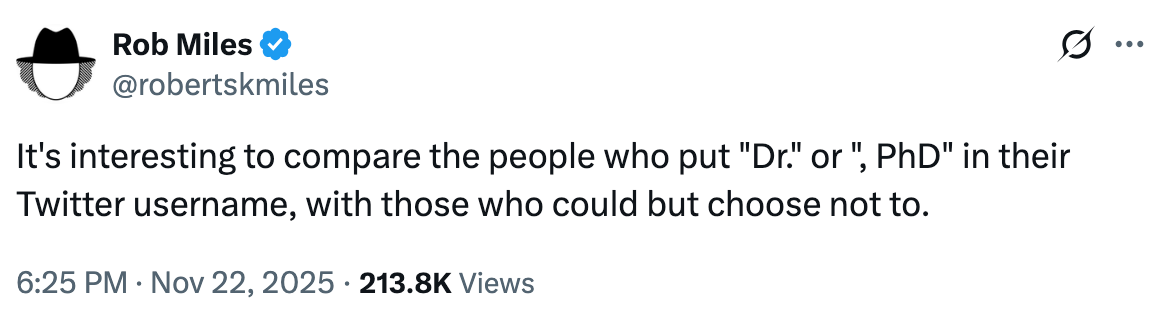
I've wondered myself why some people choose to do this. And it feels particularly apt to think about it now: I’ve just finished my philosophy PhD, which means I’ve technically acquired a new title. So naturally, one might ask whether I’ll be updating my social media usernames any time soon with the ol’ “Dr van Oosterum” (which sounds a bit like a comic-book supervillain, doesn’t it?).
The short answer is that I probably won't. And it seems like a lot of people would prefer if I didn't. Exhibit A:

What struck me here wasn’t the tweet itself but the intensity of the reaction (which many people thought was acceptable). People weren’t just mocking a stylistic choice—they were expressing a kind of resentment toward what the title “Dr” seems to do in public spaces. And to be clear, this isn’t necessarily about jealousy or insecurity; it can be a reasonable discomfort with how recognition earned in one sphere suddenly starts doing work in another.
Why does that bother us so much? That question turns out to sit right at the intersection of two very different theories of equality: John Rawls’s and Michael Walzer’s.

In 1983, Michael Walzer wrote an influential work of political philosophy called Spheres of Justice. To understand his argument, we need to quickly examine what ideas he was responding to. At the time, many philosophers were trying to identify the correct principles of distributive justice: the principles an ideal society would use to fairly divide the benefits and burdens that arise from social cooperation. We ‘cooperate socially’ by educating ourselves, following the rules, having jobs, choosing political leaders, paying taxes, and so on. And we don't need to look long at our societies to notice that people lead very different lives – some going well, some much worse.
But this assumes something important: how do we measure how well our lives are going? In the 1970's, the philosopher John Rawls offered a very influential answer. He proposed a list of primary goods: things any rational person would want because they help us pursue almost any plan of life. His list is intuitive enough: a wide scheme of rights and liberties, income, job opportunities etc. Once we have a metric for advantage, we can return to the question of how these goods should be distributed.
Rawls devised an ingenious thought experiment to figure this out. He imagines people like us choosing the principles of justice, but behind a ‘veil of ignorance’ where they lack information about their class, income, race, sex, natural talents, their social status, and their particular plan of life. Rawls argued that people in this situation would choose principles that would be acceptable, no matter where they end up in life. His own view was that they would select two principles. First, a principle guaranteeing basic liberties (free expression, conscience, religion), and second, a principle allowing inequalities in the primary goods only if they are to the greatest benefit of the least-advantaged members of society.1
But Walzer thought the picture was too simple. He accepted Rawls’s point about inequality, but rejected the idea that all the things we care about can be collapsed into one category of “primary goods” and governed by a single set of distributive principles. For Walzer, goods don’t have abstract, universal value; they have meanings rooted in the social practices they belong to. Different spheres (or domains) call for different principles: political power should be distributed by democratic participation, medical care by need, jobs by merit, and love or friendship by affection rather than money or status.
Income, for example, belongs to the economic sphere, where inequalities based on effort and talent are expected. Inequality becomes unjust not when incomes diverge, but when money is allowed to buy goods from other spheres, for example, political influence, public office, or priority in medical care. Walzer calls this “complex equality”: inequalities are permissible within spheres but become unjust whenever one good crosses into a sphere governed by a different distributive principle.
In short, Rawls is wrong on two counts: he’s wrong that we can treat goods as if they were all “primary,” and he’s wrong that a single pair of principles could govern every sphere. In reality, each good has its own distributive rules.
Why does this bit of intramural philosophy matter to a Twitter flare-up? Because the anger around titles like ‘Dr is, at bottom, a reaction to a perceived case of sphere-crossing: people feel that someone is gaining attention in a space where that credential isn't supposed to matter.
Let's go back to the title of ‘Dr.’ All that is, you might say, is a person who has spent several years trying to understand one idea or investigate one phenomenon. Strictly speaking, that's true. But that's also a very abstract way to describe what is, in practice, an enormous privilege that not everyone gets to have.
I was extremely lucky to be born into a nurturing family that valued education and ambition. Of course, I also worked very hard. As my dad always told me, quoting the American golfer Jerry Barber, “The harder I work, the luckier I get.” Long story short, I was able to get a scholarship where I was paid money to think about political philosophy and echo chambers for four years. I obviously would not have been able to do this without the money. Literally no one can because higher education (at least in the UK) costs money.
So when I bowed and said the Latin words ‘do fidem’ at my graduation ceremony and became a philosophiae doctor (i.e., ‘PhD’), I wasn't just being acknowledged for writing a dissertation. I was being granted recognition. I'm not saying all this to be pompous. The point is that titles give people some measure of
“Honor, respect, esteem, praise, prestige, status, reputation, dignity, rank, regard, admiration, worth, distinction, deference, homage, appreciation, glory, fame, celebrity.” - Michael Walzer, Spheres of Justice, 252.
People who don't have the ‘Dr’ title will not, other things being equal, get that same level of positive regard.
Within academia, this makes sense. When I apply for jobs in academia, the title is extremely important. It signals that I am competent enough to conduct research and teach philosophy. In this sphere, it's legitimate that my degree gives me access to jobs others without it cannot have. And because everyone in academia understands the rules of this sphere, we often don't call one another ‘Dr’ or even ‘Professor.’ As Walzer puts it, “Insofar as there is a title for everyone, everyone is recognized.” Within the academic sphere, we (normally) treat each other like equals.
But that title is also visible outside academia, where it carries a different meaning. It signals a kind of superiority in one domain of life. But Twitter is a very different domain. Twitter and other social media platforms distribute attention, which is not identical to recognition, but is closely related. So we can intelligibly ask: by what principle should attention be distributed?
Right now, the de facto answer is this: attention goes to whatever keeps people on the platform long enough to see ads. But while most of us understand the so-called attention economy, we also have intuitive beliefs about what should attract attention – and, unsurprisingly, these often track offline markers of esteem, including academic credentials.
So, why does someone get more attention simply because they have ‘Dr’ in their username? Why do they get more recognition online than someone else? These questions express a deeply Walzerian complaint. It's perfectly fine that someone receives recognition inside academia. Most people don't begrudge academics being recognized by other academics. What irritates people is when recognition earned in one sphere spills into another. That is, when the title ‘Dr’ is used, intentionally or unintentionally, to gain an advantage in the attention economy.
In that moment, some people might feel ‘dominated’: their newsfeed is taken over by someone whose recognition was earned elsewhere. Their own desire for attention gets crowded out. This is the struggle for recognition.2
And crucially, it can't be fixed by simply giving everyone more attention-worthy credentials. If everyone had a PhD, it would cease to have value and would cease to be recognized and admired.
Where does that leave us? To clarify, I do not think there's anything wrong with putting ‘Dr’ in your username or anywhere else. But I do think there's something wrong with pretending it isn't important – or that it isn’t a privilege many people would love to have but, for all sorts of reasons beyond their control, never get the chance to pursue. At the very least, we should recognize that.
That doesn't mean it's OK to say that everyone who puts ‘Dr’ in their username is ‘insufferable’. For one thing, that's obviously not true. Also, there are tons of reasons why people might do this: they might do it for fun, do it thoughtlessly, or maybe they feel like they have to show it off. Even if you suspect that someone is doing it out of insecurity, pointing that out will either accomplish nothing or simply make them feel worse — which isn’t a very kind thing to do.
In the end, I'm not sure there is an easy solution to flare-ups like this. Recognition and attention are scarce goods, and platforms are engineered to turn that scarcity into conflict. What Walzer helps us see is simply that the discomfort isn't irrational: it's a predictable friction that occurs when recognition earned in one sphere drifts into another where people think it doesn't belong.
None of this is a reason to hide the title. But it is, at the very least, a reason to be thoughtful about what the title does.
I know the second principle is a two-parter, but that's not really important for my purposes.
Side-note: I learnt a lot about this Hegelian idea not from reading Hegel, but from Michael Walzer and Axel Honneth. They express it very clearly. Definitely not hinting at another debate that took place on Substack or anything…
No posts
Comments
Nothing yet. Say the first thing.
Sign in to join the conversation.