
I reached 100 subscribers this week! This is way more than I thought I would have by this point so I just wanted to thank everyone for reading Unchambered and sharing my posts. There’s genuinely no better feeling than seeing something that started in your head resonate with someone else.
In music, an ‘accidental’ is a symbol that temporarily alters the pitch of a note, creating an unexpected shift or tension within the established key or harmony. Paul Simon’s 'Still Crazy After All These Years’ is a perfect display of this. (If you haven’t listened to the song, please go ahead and do that now. I’ll wait.) The song has tons of jazzy harmonies and chromatic chord changes that bend the ear away from predictable progressions and toward unsettling but deeply expressive moments.
The Black musician Daryl Davis is also a fan of accidentals – in music and in human relationships. If you don’t know who he is, he’s known for conversing with and befriending members of the Ku Klux Klan. In the brilliantly-named documentary Accidental Courtesy: Daryl Davis, Race, and America (dir. Matthew Ornstein), we follow Daryl Davis’ life and career as a musician and political activist. Throughout, Davis engages in acts of ‘accidental courtesy’ that disrupt our social expectations about how interactions between certain social groups will go down. He meets hatred with gargantuan civility and an empathetic attitude that momentarily alters the KKK members’ hostility toward him to create something new: a change of heart.
As a philosopher interested in civility as the fragile glue of pluralistic societies, I found his approach fascinating. A few scenes stand out as ‘moral studies’ in how courtesy unsettles cruelty.
Right at the beginning of the film, we see Daryl Davis giving a talk at University of California, Irvine where he starts by referring to his (portly) figure:
“You all see this fine figure right here? I didn’t put this on overnight. I want to lose it. I’m not gonna lose it by tomorrow, but if I work on it, over time, it will--it will shrink down. When you’re ingrained in this stuff, you’re not gonna shut it off overnight.”
The analogy between prejudice and bad physical health works on so many levels. Most obviously, what Davis is trying to say is that hard work is as crucial for changing your beliefs as it is for changing your body. You’ll need to be patient because you won’t see results quickly. But in the same way a personal trainer is good for losing weight, so too is being a civic trainer, gently nudging people to reconsider their morally unreasonable positions.
Even if you don’t like Davis’ own interpretation of the analogy, another one works just as well. I’m not a public health expert, but it seems like there are tons of environmental factors that could make it harder for people to manage their health, e.g., unhealthy food being cheap, not living near fresh grocery stores etc.1 Similarly, a lot of the people Davis speaks to have come from troubled social environments. They’ve had bad experiences that make it harder for them to revise their problematic beliefs.
Interestingly though, I’d bet that the same people who think social environments make it harder to lose weight will be reluctant to say the same thing about bad beliefs. In any case, the truth is probably the boring one: individual choice and one’s social environment both shape one’s physical health as well as one’s beliefs. Davis’ civility can be nicely motivated by either of these interpretations of the analogy.
In one memorable scene, Davis talks with Gary, a former Klan member who hasn’t quite abandoned his racism. Asked about his rank as a “Great Titan,” Gary sheepishly gestures toward Davis:
“Uh, he can explain more of that than I can.”
Davis obliges, explaining the hierarchy — rank-and-file member, “Exalted Cyclops,” then “Great Titan.” He even recounts that Gary once phoned him for help understanding his own position in the Klan, too embarrassed to ask his superiors. Let that sink in: a KKK officer calling a Black man for guidance in “Klan-craft.”
Earlier, Gary recalls first meeting Davis while acting as bodyguard for a Grand Dragon en route to Howard University. “Daryl drove us down. He was our butler,” Gary says, then quickly corrects himself: “Chauffeur, not butler.”
That awkward self-correction is a tiny act of accidental courtesy — a moment when decency slips through racist ideology. Gary’s mind momentarily can’t square his beliefs with the man before him. Davis’s calm curiosity generates a quiet cognitive dissonance that, over time, has led dozens of men to hand over their robes.
When asked why he collects those robes, Davis’s answer is simple:
“Well, you know what? It’s better that I have ’em than they have ’em.”
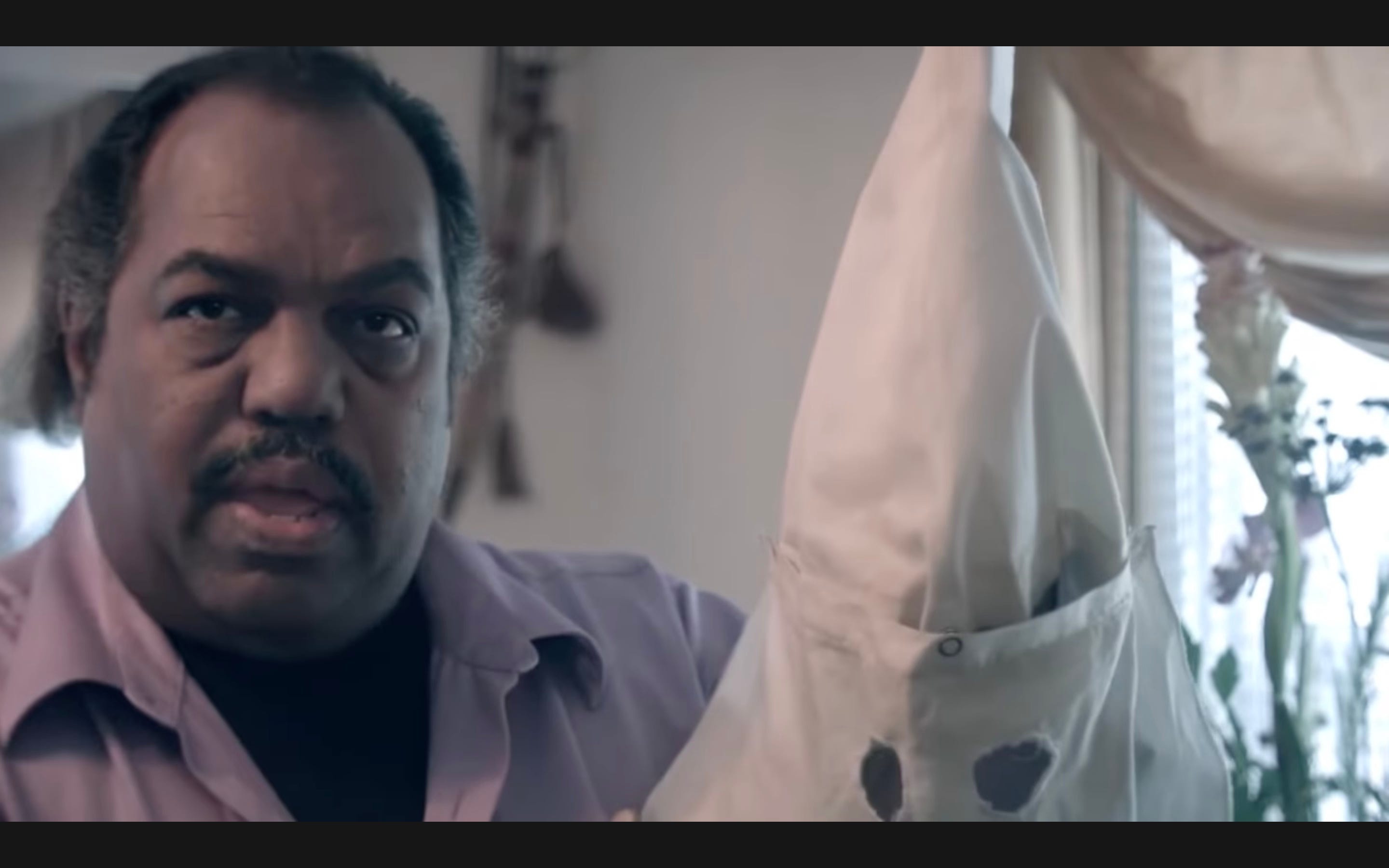
Again and again, Davis disarms hate with humor. A hooded white supremacist tells him,
“I believe in separation. We’ve had integration for 50 years, and nobody seems to realize it don’t work. Don’t you have churches that only cater to blacks?”
Davis replies:
“Yeah, because we couldn’t get into the white churches.”
Laughter ripples through the crowd — the sound of a prejudice cracking?
Another encounter, with neo-Nazi leader Jeff Schoep, is equally compelling:
Schoep: “Who invented rock then? Elvis Presley.”
Davis: “You’re not serious, right? I’m a huge Elvis fan, but even Elvis said he didn’t invent rock-and-roll — he credited Chuck Berry, Fats Domino, and the blues.”
Schoep: “Well… maybe it doesn’t matter who created it. If music’s good, it’s good.”
Davis: “It matters when credit’s due — especially if you’re trying to give it to the white forefathers of this country.”
Schoep, suddenly inconsistent, flounders. In minutes, Davis turns ideology into improvisation — using reason and wit to make hypocrisy audible. The dissonance doesn’t always resolve immediately, but it’s similar to music in that repeated notes eventually change the harmony.
The most heated moments in Accidental Courtesy don’t come from Klansmen but from young Black Lives Matter activists who challenge Davis directly. At first, the conversation is calm. Then, frustration flares.
Tariq Toure: “We talking about the energy that you putting into all them years. That’s a whole lot of years to be doing that. It sound like a fetish.”
Davis replies about the importance of coexistence: “If we’re talking, we’re not fighting.”
Then, another activist says:
Kwame Brown: “Befriending a white person who don’t have to go through what we go through—that’s not an accomplishment. That’s a new friend.”
But then Davis uncharacteristically jabs back—“And this is coming from a college dropout”—the conversation sours.
Tariq Toure: “You’re being disrespectful now.”
(Davis extends his hand; Toure refuses to shake it.)
Kwame Brown: “Stop wasting your time going into people’s houses that don’t love you, a house where they want to throw you under the basement.”
Davis: “So you believe that nobody can change?”
Brown: “I believe you believe the wrong people can change.”
Davis: “What do you mean—the wrong people?”
Brown: “No, white supremacists can’t change. But I can change your mind, ’cause you look like me.”
That line hits incredibly hard. It exposes a despairing but familiar attitude: the sense that dialogue across difference is futile, that persuasion only works within the tribe (if you can even call it ‘persuasion’). To insist that only those who look like us are reachable is to abandon the moral project of sharing the social world together.
A couple moments later, an older activist calls out Davis for his earlier insult:
“Don’t disrespect Black people, man. You got some Black in you, but you sound like you should have a hood on.”
What’s striking is that this is the harshest thing said to Davis in the entire film—harsher even than what he hears from the Klan. But embedded in the tension are genuine philosophical questions: Where should we spend our moral energy? And do we really owe civility to those who refuse to offer it in return?
There are at least two interesting moral challenges that the activists raise for Davis.
Moral Priority
The first is about whether his efforts are best used elsewhere. At several points in the conversation, the activists wonder why he doesn’t march with them or help actively support Black people. Why spend so much of his political energies with the people who despise him instead of lifting his own people out of the injustices they suffer?
Davis does not explicitly answer this question, but I think a good approach appeals to a division of political labor. Some people repair the injuries of injustice; others confront the beliefs that cause them. Both tasks are necessary. Perhaps then, some citizens should take up the burdens of engaging with these individuals to secure liberal peace over time.
Duties to be Civil?
That leads to the second question, do people have a moral duty to be civil? I don’t think Davis ever claims this, but it’s worth addressing. If we say that people have a moral duty, we might mean something like this:
Moral duty: an action for which there is a moral reason sufficient to make it something one ought to do, such that failure to do it would, normally speaking, make one apt for blame.2
In other words, are there reasons strong enough to make it blameworthy not to be civil and engage others respectfully, even members of the KKK? I think we have a duty to be civil to others, but I think that this duty holds under two conditions.
First, it holds when we do not know what others actually believe. Too quickly people assume they know exactly what their conversation partner believes. Davis often says to KKK members “How can you hate me if you don’t even know me?”. I would add that the reverse is true: “How can you hate them if you don’t even know them.”
But when you do know what they believe, I think your duty to be civil can be defeated by others’ unwillingness to engage you civilly. The second condition then is that others must reciprocate some form of civility or courtesy in some way. Davis believes that letting these people talk socially pressures them to let him speak and get his message across. But I’m sure he would say that if he was shouted down, it would be acceptable for him to stop being civil, at least in that conversation.
But what is the reason to be civil, in the cases where you do have a duty? Assuming either of the conditions hold, the reason to be civil is the one Davis himself lays out:
“Because they are our fellow Americans. We all have to live in this country together. Shit. Okay? We--We do. Otherwise, we’re gonna end up self-destructing.”
I actually think Davis lays out two compelling reasons here for being civil. The first is that civility can help us avoid the worst states-of-affairs from occurring (i.e., civic self-destruction). The second reason is subtler. He says that we have to do this because “they are our fellow Americans.”
One thing we do with our fellows is help them when they’ve gone morally astray. Whether it’s becoming addicted to harmful narcotics or to beliefs that destroy the fabric of a pluralistic society, we ought to try to pull them back toward moral health. We can’t all do it. But someone must play the part of the accidental courtesy; it’s the note that can change the social key.
There’s so much more to the film than I could cover. It’s deeply moving and optimistic while not being naive. It’s hard to believe the film only came out in 2016. Its lessons go far beyond navigating racial injustice since we’ve divided ourselves in far more ways now. There’s a real kind of civic courage that is deeply admirable in what Davis does. Watch it, and you might be surprised to see how far a little accidental courtesy goes.
It’s probably not that simple. All I’m doing is building an interpretation of an analogy anyway.
I think this is a pretty ecumenical definition capturing the normative force of morality, the accountability dimension of failing in one’s duty, and leaves room for pluralism about the sources of the duty.
No posts
Comments
Nothing yet. Say the first thing.
Sign in to join the conversation.