
In case you missing it, I wrote a short piece on my experiment to use Zettelkasten to study for my upcoming WSET Diploma D3 exam. I’ll give a tl;dr in this post for context, but still suggest you read the full post:
Applying Zettelkasten to the WSET Diploma
·
January 3, 2024
Long time no see, old friends. I’ve been incredibly busy with game development for my new studio (link because, “always be selling”) and have not paid much attention to this Substack for quite a while. I think I’m going to change that, but also significantly change the content that I write.
In this article, I explained my general process for notetaking. Namely, I read the text, go back to it again and write handwritten notes, then distill those notes into Obsidian in the Zettelkasten format. I have used Zettelkasten for notetaking in other areas for a while now and wanted to try this experiment to see how it might work for exam studies.
The result? It doesn’t. While great for long form bodies of work, research projects, or any more living piece (like writing these articles) I think it’s a solid option. For exam studies, it just doesn’t fit the bill at least for me. Let’s go into that more in this vaguely-wine-related post.
I’ll start off that I did a somewhat poor job at regularly coalescing my handwritten notes into more structured Zettel. Part of this is that I spend nearly all of my time at the computer and piling on yet another reason to be at the desk didn’t sound like a good time. Nevertheless I feel like I did enough to get a feel for how my experiment was going to work out.
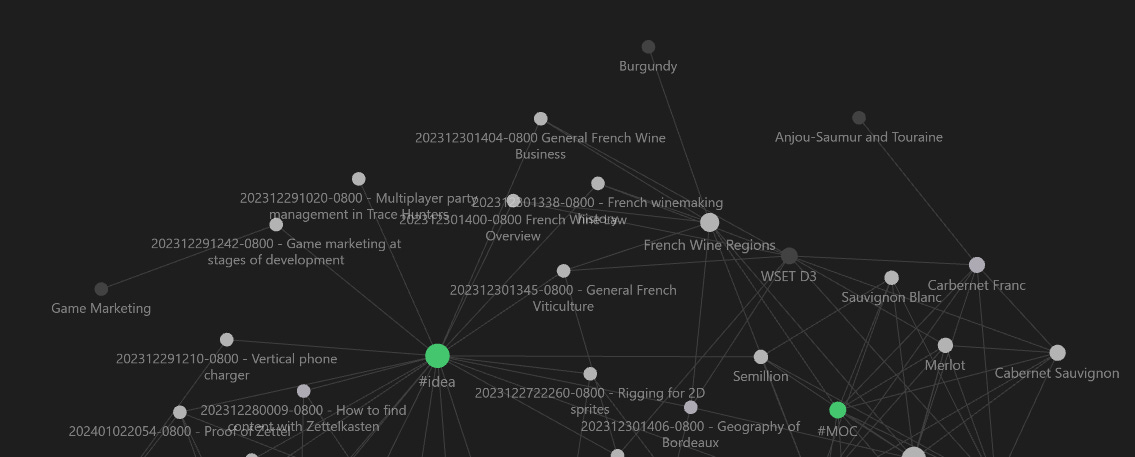
One thing I noticed in Week 1 that became mind-numbingly boring by Week 4 was that the whole “emergence of relationships” method for discovering topics is incredibly redundant when your source material is a single book written as a study guide for an exam. I have plenty of complaints with the presentation of the text itself, but it is still by and large consistent at the topic level. This translated into just putting in a bunch of tags in Obsidian that nearly copied the study text format.
On that point though, I did find that the note-linking was useful for highlighting similarities between regions and grape varieties. That is a major component of the exam and it’s up to you to remember these at test time. I may still continue building these out for at least grape varieties as it proved a nice way to understand the world’s common grape variety usage (according to WSET) at a glance.
The primary reason that Zettelkasten didn’t work for exam studies is namely that this isn’t what it was designed for to begin with. At the core, Zettelkasten is meant to organize knowledge for larger works, originally research papers, rather than the more fact-retention style exam testing. I could see it possibly still working if you took all of your notes first in a tool like Obsidian (not a good idea in my opinion) or you had a massive amount of time on your hands. I think the method in particular would work excellent for the WSET Diploma D6 Research Paper, though I’ve already done mine.
Another reason that I not-so-subtly hinted at is the time investment. Three stages of note taking was simply too much for me to manage on top of building my game studio. Maybe if my full time focus, or even primary focus, was on my Diploma exam studies then I would have a different opinion. For practical reasons, I’ve mostly combined the reading and handwritten notes into the same. That’s not too big of a leap and is a good compromise on time. Needless to say I no longer move that information into Obsidian.
One last thought in this string of random thoughts, I think if instead of Zettelkasten one were to use some of the Anki flashcard plugins then my original read, handwrite, distill method would work quite well. If any of you plan to take WSET Diploma feel free to try that out and tell me how it feels for you.
So these past two posts I’ve rambled on about my study methods way more than I’ve discussed wine. I plan to change that in my next post and have a few ideas, at least one of which I hope to write. Until then, I’ll be studying and making games.
See you in the next one.
If you’re interesting, here are a collection of links (the same ones from my previous post) on these topics.
Artem’s YouTube which I used as an initial model for my format
An overview of Zettelkasten
Anki flashcards (closely related, at least if you write short notes)
WSET Diploma per the WSET
Comments
Nothing yet. Say the first thing.
Sign in to join the conversation.