
I originally posted this story in my family history publication, BJNL’s Genealogy. I am posting it again here because, while it is not about life at the Kyeburn Diggings, it is about someone who grew up there—Emma Veale (later Darcy and then Mumford)—and how, as a young child, she was left behind in Dunedin by her parents.
Emma’s story has been passed down in my husband’s family. Emma is his great grandmother. I was told the story by my husband and by my mother-in-law, Shirley (Emma’s granddaughter). Shirley had heard the story on many occasions both direct from her grandmother, Emma, who is the subject of the story, and from her mother Winnie (Emma’s daughter).
At some point, Shirley typed the story as Winnie told it to her. The typed account is undated but, when Shirley gave the typed page to me, she said it was a version told by Winnie later in Winnie's life and a significant number of years after Winnie had heard the story first hand from Emma. It’s not surprising, therefore, that there are some factual inaccuracies in it when scrutinised in light of documentary evidence. Some of these inaccuracies probably represent misremembered facts on Winnie’s part.
The story originated with Emma herself so it is likely there is some truth to it. She probably was left behind in Dunedin. However, the extent to which all the detail is correct is uncertain. Oral family history tends to get embellished over time and, inevitably, the accuracy of some detail becomes lost with time. The account also raises some questions.
More about inaccuracies and questions later. First a little background about Emma’s life before she was left in Dunedin and then the story as told by Winnie and typed by Shirley.
Emma was born Mary Emma Veale on 26 September 18731 at the Kyeburn Diggings in Central Otago, New Zealand to Isabella Jane [Blythe] and Samuel Jeffery Veale. She was the oldest child in the family and had three younger siblings, Agnes, Elspeth, and Samuel.
Emma's father, Samuel, was a miner. He mined for both gold and coal at the Kyeburn Diggings and, for a while, he also cultivated seven acres of land and grew oats. The family lived in a house made of sod and iron2 in the Middle Kyeburn where most of Samuel's gold mining activity was undertaken.
Life would not have been easy for the family and, after several years at the Diggings, a decision was made to move from Central Otago to the West Coast, and more particularly to Stillwater. Stillwater is not far from Brunner (then Brunnerton) where coal mining was an established activity. Isabella and Samuel were probably in search of new and better opportunities for themselves and their children.
In those days, a move from the Kyeburn Diggings to Stillwater entailed travel overland to Dunedin on the East Coast and then by boat around the bottom of the South Island up to Hokitika on the West Coast and then overland to Stillwater. More about that further on.
A copy of Shirley’s typed account can be located in my family history archive. It’s full of spelling mistakes and grammatical errors. That was unusual for Shirley who was quite particular about such things. However, on this occasion, her predominant focus would have been on typing Winnie’s words as they were spoken in order to faithfully capture what Winnie remembered being told by her mother, Emma.
What follows is Emma’s story in Winnie’s words, as typed by Shirley. For ease of reading, I have made some spelling corrections, added punctuation, and split the account into paragraphs. The words are Winnie’s:
Grandfather married at 21 in 1871. He married Isabella Blythe. Their daughter was born Mary Emma in 1873.
They lived in Naseby for some years. Then moved to Kyeburn and their other children were born named Elspeth, Agnes. George - Elspeth being the second eldest.
Emma Veale went to school. Then they decided to go to Brunnerton where a new mine was. They sold their belongings to buy a horse and cart to go to Dunedin where they were to go to Greymouth. Then they found that they did not have enough money to pay for the tickets for my mother across on the boat. Grandad took her to stay with his cousin Mrs Whale somewhere in Dunedin. Emma was to stay with her until Grandfather could get enough money for her ticket which they would send on later.
The woman that Emma stayed with during this time sent her to do some shopping one day. She was only 5 at the time. On returning she found that the woman had packed up and moved away, Emma sat on the door step for several days waiting for her return but she never did. She later walked to downtown Dunedin and found shelter in a store shed and slept on the sacks of grain. The food she had was the wheat she could pick in the hole in the sack.
Then she went up the street hoping she would meet her parents. A woman and two men found her. She didn't know where she lived. These people took her home, then they found she had nothing to eat they made her milk and bread, lit a big fire and heated big tins of hot water to bathe her. The lady dressed her in her clothes and put her to bed.
In the morning her clothes had been washed and dried also ironed. The lady took her to school and brought her back home for lunch every day. The Sunday teacher took her to Sunday school [and] to live with them. Her under clothes were made into other clothes for her.
The wife of a Head policeman came and said they had her money for her fare. She was taken to Port Chalmers on a boat going to Greymouth. A steward looked after her. I do not know how they knew that her parents were sending the money for her.
Her parents were waiting at the wharf for her. They went to Brunnerton and her father worked in the mine.
In the oral version of the story originally told to my husband, the people who initially found Emma lived in a ‘house of ill-repute’ and that is where they took Emma and looked after her. That too was in the version I was told first time around. I suspect that may be an example of how, in some versions, the story has become embellished? However, this detail has become lost through time and can be neither substantiated nor refuted.
Dunedin was established in 1848 by the Lay Association of the Free Church of Scotland and originally called New Edinburgh until the name Dunedin (the old Celtic form of the capital of Scotland) was chosen3.
By 1858, ten years later, there were just 1,712 people living there but, after the discovery of gold, things changed dramatically. Dunedin was transformed by the Otago gold rushes of the 1860’s. By the end of the 1860’s, Dunedin’s population had increased to nearly 15,000 and, between then and 1881, the population grew exponentially almost tripling4.
Consequently, by the time Emma was left in Dunedin (probably about 1886), it was a sizeable place. In fact, in the mid-1860s, and between 1878 and 1881, Dunedin was New Zealand’s largest urban centre5 6. It was certainly not the place for a young girl to be left alone.
There are a number of factual inaccuracies in Winnie’s account, some of which do not directly impact on the story but are corrected here for the record.
Winifred’s account implies that Emma’s parents lived in Naseby for a while after they married and that is where Emma was born.
Emma’s parents, Samuel and Isabella, married in Naseby. However, as Samuel’s work was at the Kyeburn Diggings, it is likely they started their married life at the Diggings. Naseby is about 16km from the Kyeburn Diggings. When Emma was born in 1873, her birth was registered at Naseby. That was the nearest place to be able to register a birth. However, her place of birth is listed as ‘Kyeburn’7.
The word ‘Kyeburn’ was often used generically on official documents to mean both ‘Kyeburn’, the place, and the ‘Kyeburn Diggings’, a few km away along the Kyeburn and Little Kyeburn rivers.
Winnie's typed version of the story suggests that Elspeth was the second oldest child in the family after Emma and that Agnes came between Elspeth and George. This is incorrect. Agnes was older than Elspeth. Agnes Williams Veale was born on 1 September 18758; Elspeth Sarah Veale was born on 2 June 18789; and Samuel George Veale was born on 7 September 188110; all born at the Kyeburn Diggings:
Contrary to Winnie’s account, Samuel married Isabella in 1872 not 1871. Samuel was 29 years old not 21 when they married11.
The family most likely moved from Central Otago (Kyeburn Diggings) to the West Coast (Stillwater) during 1886. In 1886, Emma's father, Samuel, is listed as working in both places. This suggests 1886 was a transition year. Samuel is listed in the New Zealand City and Area Directories12 at the Kyeburn Diggings in Central Otago and on the 1886 Greymouth Electoral Roll13 at Stillwater on the West Coast.
Emma turned 13 years old in the September of 1886. This suggests that Winnie’s account is incorrect when it says that Emma was about 5 years old when she was left in Dunedin. It is more likely she was about 12 or 13 years old. This may well be a detail in the story that morphed over time in the telling of it.
Winnie’s account refers to them going to Greymouth. I am not sure here whether she was confusing Hokitika with Greymouth or thinking of Stillwater which is relatively close to Greymouth (about 16kms away).
The journey from Central Otago to the West Coast was a challenging one in 1886.
In the first stage of their journey, the family would have had to travel over difficult terrain from the Kyeburn Diggings to Dunedin (about 140km). According to Winnie's account, the family sold their belongings to buy a horse and cart. This would have transported the family, and any belongings they didn't sell, to Dunedin.
The second stage of the journey was by boat. Perhaps they sold their horse and cart on arrival in Dunedin in the hope of having sufficient funds to pay for their passage to Hokitika, retaining a little for their onward journey from Hokitika? Consistent with Winnie’s account, it would have been then that they realised they didn’t have enough money for them all to get to Hokitika, and onwards to Stillwater, and so the decision to leave Emma behind in Dunedin was made.
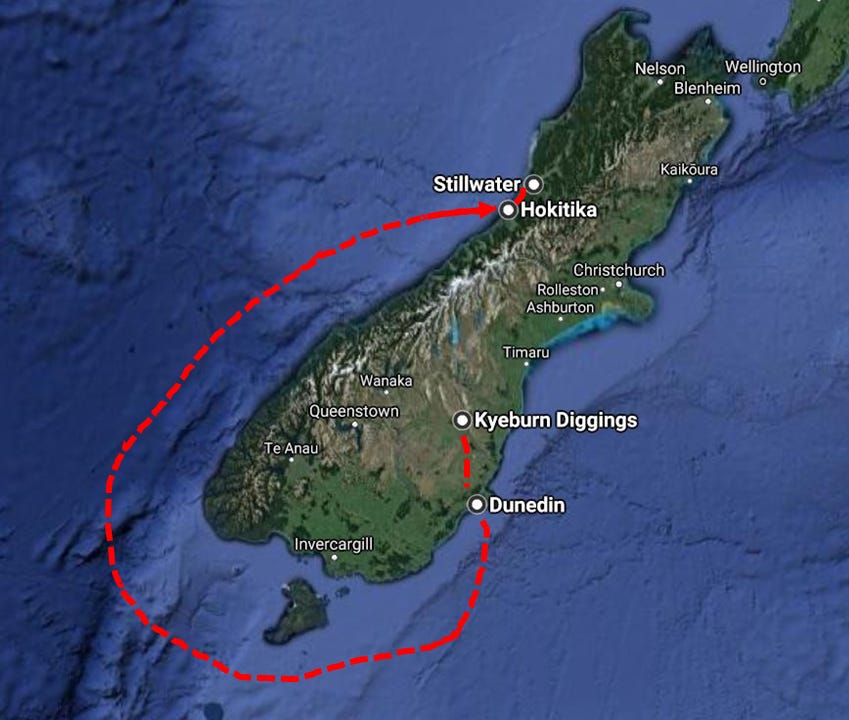
From Dunedin on the east coast, they would have travelled by boat around the south coast of the South Island of New Zealand to Hokitika on the west coast. Greymouth is further up the coast and wouldn’t have been their destination. Hokitika, a river port at the mouth of the Hokitika river, was the main port for the West Coast. Entering the port was a treacherous exercise and many a ship was damaged or lost crossing the bar.
From Hokitika, they would have travelled up the coast by land, through Greymouth, and then a little inland to Stillwater (about 53km).
It is likely Samuel went to Stillwater with the intention of coal mining at Brunnerton (now Brunner), as Winnie’s account of Emma’s story suggests. He is listed in the 1886 and 1887 Greymouth Electoral Rolls as living in Stillwater and working as a miner14. However, contrary to Winnie’s account, the Brunner mine was not a new mine.
Brunner is one of New Zealand’s earliest coal mines. Brunner Mine was established in the 1860’s. This was followed, in the 1870s, by neighbouring Coal-pit Heath on the north side of the Grey river and Tyneside on the south side of the river opposite the Brunner site. By the 1880s and 1890s Brunner and Coal-pit Heath were amongst New Zealand’s most productive coal mines15. By the time, Emma’s family went there in 1886, the mines around Brunner would have been well established.
Emma’s story, as told by Winnie and typed by Shirley, raises a number of questions:
According to the story, when Emma was left in Dunedin by her parents, she was left in the care of her father’s cousin, a Mrs Whale. So …
These days, we understand the term ‘cousin’ to mean the child of a parent’s sibling. Sometimes we use it more generically to mean a more distant cousin. However, in past times, the term cousin has been used more loosely (in British tradition, at least) to refer to any collateral relative more distant than a brother or sister, for example, a niece or nephew—or even to a relative by marriage.
Emma’s Aunt Emma (her father’s sister), married William Morgan Whale16. This Aunt Emma died in London in 186917. Her husband, William, and son William 'Robert' Whale emigrated to New Zealand sometime after Aunt Emma died. They settled in Dunedin. William and Aunt Emma’s son Robert would have been Emma’s cousin. He would have been about 19 years old in 188618. He didn’t marry until 189519 so no Mrs Whale there.
William Morgan Whale married his second wife, Janet Rowan Borthwick in New Zealand in 187820. William was Emma’s Aunt’s husband, so Emma’s Uncle-in-law. His new wife was Emma’s cousin Robert’s step mother. Could she have been the Mrs Whale referred to? If it was William’s wife, where were William and Robert when Mrs Whale allegedly left Emma on her own?
It seems likely that this happened. The only other alternative is that Emma made it up which seems unlikely. Stories like this don’t come out of nowhere but the details about what happened are certainly fuzzy and raise the further question …
Again, I am not sure this is something Emma would have made up? Another detail lost to time! And, if Emma really was abandoned by Mrs Whale and taken in by other people …
If we accept that Emma was left in Dunedin until money could be found for her boat passage to the West Coast, then all we really know for sure about that is that Emma did eventually arrive safely on the West Coast and she was reunited with her family.
While this post was intended to be predominantly about Emma’s ‘left behind in Dunedin’ story, you may like to know what happened to her next.
Initially Emma’s family was based at Stillwater21. Later, in about 1890, the family moved to Cronadun, a few miles away22. At the age of 19, about four months before her 20th birthday, Emma married William Darcy.
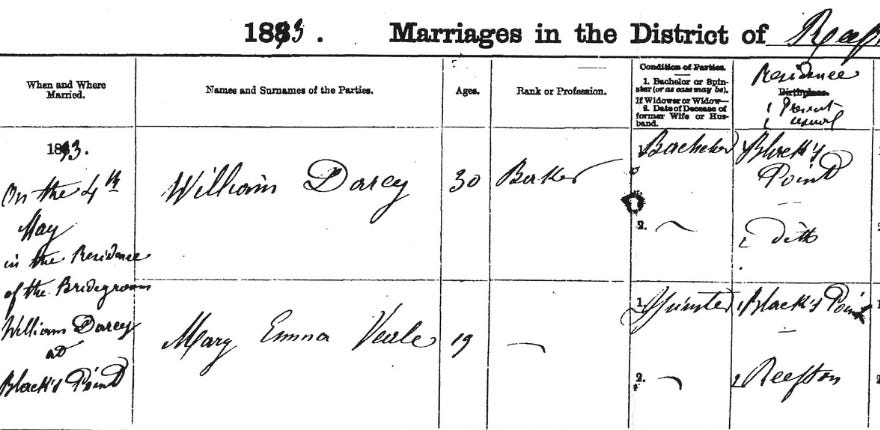
Emma and William’s wedding took place on 4 May 1893 at William’s home at Black's Point, Reefton23. William, who was aged 30 when they married, was as a Baker with premises in Reefton.
Unfortunately, their marriage was to be short. William died on 5 July 189824 at the age of 35 years from cerebral inflammation following measles leaving Emma widowed with two children aged 2½ years and 2½ months old. Winnie (Winifred Alice Darcy), who provided the account of her mother's story, had been born in 189525. Her sister, Margaret Isabel Darcy, known as Isabel, had been born in 189826.
Emma continued living in Reefton as a widow27 until 7 December 1900 when she married Arthur Tregarthen Mumford, a miner28. Emma and Arthur had two children: Arthur Francis 'Frank' Mumford, born 190229 and William Charles Mumford, born 190530. Both were born in Reefton.
To date I haven’t been able to find out very much about Emma’s life with Arthur. Family stories suggest that he didn’t treat Emma well. I have no real evidence of this. However, Arthur doesn't seem to have been living with Emma from 1905 onwards. At some time around 1918, Arthur, moved to Australia. He died in Newcastle, New South Wales, Australia in 192731.
Emma and her children moved to Wellington sometime before 191432 and remained there until about 1946/47 when Emma moved to Nelson with her daughter Winnie, son-in-law, Bill, and grandchildren, Shirley and Douglas.
Emma died at her home in Nelson on 27 May 1954 at the age of 80 years. The cause of death given was intestinal obstruction33. She was buried on 29 May 1954 at Richmond Cemetery in Nelson (Block B, Row 9, Plot 79)34.
If you are already a subscriber to this publication—Kyeburn Diggings One-Place Study—thank you!
If not, and if you would like to receive future posts direct to your email inbox, please subscribe (it’s free!):
The information in this post is drawn from my one-place study website on the weare.xyz platform:
Kyeburn Diggings One-Place Study Website
Birth Registration 1873/42251 Births, Deaths & Marriages Online [Digital Index], New Zealand Department of Internal Affairs [Website]. Accessed 2 June 2022. A copy of the birth entry is held by the Author.
1875/76 Mt Ida Electoral Rolls via Ancestry.com. New Zealand, Electoral Rolls, 1853-1981 [database on-line]. Provo, UT, USA: Ancestry.com Operations, Inc., 2010. Accessed 16 April 2022.
Subsequently, Dunedin has been overtaken by other cities and has grown more slowly.
A copy of the Birth Entry was obtained from the Registry of Births Deaths and Marriage, New Zealand (Registration Number 1873/42251) by the Author (Jane Chapman) in 2001.
Birth Registration Number 1875/12836 - Births, Deaths & Marriages Online, [Digital Index], New Zealand Department of Internal Affairs [Website]. Accessed 2 June 2022.
Birth Registration Number 1878/8175 - Births, Deaths & Marriages Online, [Digital Index], New Zealand Department of Internal Affairs [Website]. Accessed 2 June 2022.
Birth Registration Number 1916/30208 - Births, Deaths & Marriages Online, [Digital Index], New Zealand Department of Internal Affairs [Website]. Accessed 2 June 2022.
Marriages Registration Number 1873/42251 - Births, Deaths & Marriages Online, [Digital Index], New Zealand Department of Internal Affairs [Website]. Accessed 2 June 2022.
New Zealand City & Area Directories, 1866–1955. Microfilm publication, 921 fiche. Anne Bromell Collection, BAB Microfilming. Auckland, New Zealand via Ancestry.com. New Zealand City & Area Directories, 1866-1954 [database on-line]. Lehi, UT, USA: Ancestry.com Operations, Inc., 2010.
1886 Greymouth Electoral Roll via Microfiche, Manukau City Reference Library Microfiche. Viewed by Author (Jane Chapman) in 1993.
1886, 1887 Greymouth Electoral Roll via Microfiche, Manukau City Reference Library Microfiche. Viewed by Author in 1993.
London Metropolitan Archives; London, England; Reference Number: p89/ctc/074 via Ancestry.com. London, England, Church of England Marriages and Banns, 1754-1932 [database on-line]. Provo, UT, USA: Ancestry.com Operations, Inc., 2010.
FreeBMD. England & Wales, Civil Registration Death Index, 1837-1915 [database on-line]. Provo, UT, USA: Ancestry.com Operations Inc, 2006.
His birth was registered Q1, 1867 Registration District Marylebone, London Vol 1a, Page 500 - FreeBMD. England & Wales, Civil Registration Birth Index, 1837-1915 [database on-line]. Provo, UT, USA: Ancestry.com Operations Inc, 2006.
Marriage Registration Number: 1895/1578 Births, Deaths & Marriages Online, [Digital Index], New Zealand Department of Internal Affairs [Website]. Accessed 8 June 2022.
Marriage Registration Number 1878/2237 - Births, Deaths & Marriages Online, [Digital Index], New Zealand Department of Internal Affairs [Website]. Accessed 8 June 2022.
Emma’s father, Samuel, is listed on the 1886, 1887 Greymouth Electoral Roll as a miner at Stillwater – Roll viewed by author (Jane Chapman) via Microfiche, Manukau City Reference Library Microfiche in 1993.
Emma’s father, Samuel, is listed in the 1890 Inangahua Electoral Roll as a miner at Cronadun - Roll viewed by author (Jane Chapman) via Microfiche, Manukau City Reference Library Microfiche in 1993.
Marriage Registration Number 1893/3974 - Births, Deaths & Marriages Online, [Digital Index], New Zealand Department of Internal Affairs [Website]. Accessed 8 June 2022.
Death Registration Number 1898/3769 - Births, Deaths & Marriages Online, [Digital Index], New Zealand Department of Internal Affairs [Website]. Accessed 8 June 2022.
Birth Registration Number: 1895/12109 Births, Deaths & Marriages Online, [Digital Index], New Zealand Department of Internal Affairs [Website]. Accessed 8 June 2022.
Registration Number: 1898/15541 Births, Deaths & Marriages Online, [Digital Index], New Zealand Department of Internal Affairs [Website]. Accessed 8 June 2022.
The 1899 Buller Electoral Roll lists her as: Darcy, Mary Emma - Reefton - Household duties – residential - Roll entry viewed by the Author (Jane Chapman) via Microfiche, Manukau City Reference Library in 1993.
Marriage Registration Number: 1900/926 Births, Deaths & Marriages Online, [Digital Index], New Zealand Department of Internal Affairs [Website]. Accessed 8 June 2022.
Registration Number: 1903/15173 Births, Deaths & Marriages Online, [Digital Index], New Zealand Department of Internal Affairs [Website]. Accessed 8 June 2022.
Registration Number: 1905/11172 Births, Deaths & Marriages Online, [Digital Index], New Zealand Department of Internal Affairs [Website]. Accessed 8 June 2022.
NSW Pioneer Index - Between the Wars Series 1919-1945' via Ancestry.com. 'Australia, Death Index, 1787-1985' Ancestry.com Operations, Inc. 2010 Provo, UT, USA
Emma is listed as being in Wellington on the 1914 Electoral Roll - 1914 Wellington Central Electoral Roll via Ancestry.com. New Zealand, Electoral Rolls, 1853-1981 [database on-line]. Provo, UT, USA: Ancestry.com Operations, Inc., 2010. Accessed 2 June 2022.
Death Registration Number: 1954/22713 Births, Deaths & Marriages Online [Digital Index], New Zealand Department of Internal Affairs [Website]. Accessed 2 June 2021. A copy of the death entry is held by the Author (Jane Chapman). It was obtained from the Registry of Births Deaths and Marriage, New Zealand in 2001.
Cemeteries Search [online database) via Tasman District Council [Website] Accessed 23 December 2021
Comments
Nothing yet. Say the first thing.
Sign in to join the conversation.