
Quick note before we start. If you want one small brain workout in your inbox every morning, a single idea you can use that day, that’s exactly what I built Limitless Daily for. Come grab it.

Kwik Brain,
You’ve probably been told the secret to reading faster is to silence the little voice in your head. Kill the inner narrator, the advice goes, and your speed takes off.
By the end of this you’ll know why that advice is mostly wrong, and why there’s a hard ceiling on how fast anyone can truly read. You’ll also have the few moves that genuinely help.
That voice has a name: subvocalization. It’s the silent speech your brain makes while you read, the reason you can almost hear a word even though you never say it out loud.
It shows up in two forms. The mechanical kind moves your body a little, your lips twitch, your tongue shifts, sometimes you whisper. The mental kind is pure inner voice, no movement, just narration in your head.
Nearly everyone does this. And here’s the part the courses skip: for most readers, that inner voice is how you understand the words. It’s doing the work.

Researchers have tested what happens when you force that voice quiet. In one study, people read long passages while doing a spoken task at the same time, which ties up the same speech system reading depends on. Push that far enough and comprehension drops.
So killing the voice is the wrong target. The move that helps is trimming the slow, mechanical part while keeping the mental part that carries meaning.
One simple way to do that is to run your finger under the line as you read. The tapping keeps your body busy so you stop mouthing words, and it tends to cost less comprehension than tricks like counting out loud, which fights your reading for the same words.
And even the fastest readers never fully silence the voice. Trained speed readers still subvocalize. They just do it faster than the rest of us.

Even if you mastered the inner voice, you would hit a second wall, and this one is physical.
Look at any word on this line. The only part your eye sees in sharp focus is a tiny window, about one or two words wide. Everything to the sides is blurry, which is why your eyes jump along the line in small hops instead of gliding. You can see this in the eye-movement research.
Fast readers take in a slightly wider window than slow readers, but that window has a physical limit no course removes. This is why the big promises fall apart.
The numbers back it up. Most people read for real comprehension at 200 to 300 words a minute. Above roughly 500 to 600, understanding starts to slide for most readers and most material. The most careful review of the research says it’s unlikely you can double or triple your normal speed and keep the same comprehension.
The deepest cap sits one step further back. Your top speed is set by how fast your brain turns words into meaning, and no eye trick speeds up that step.
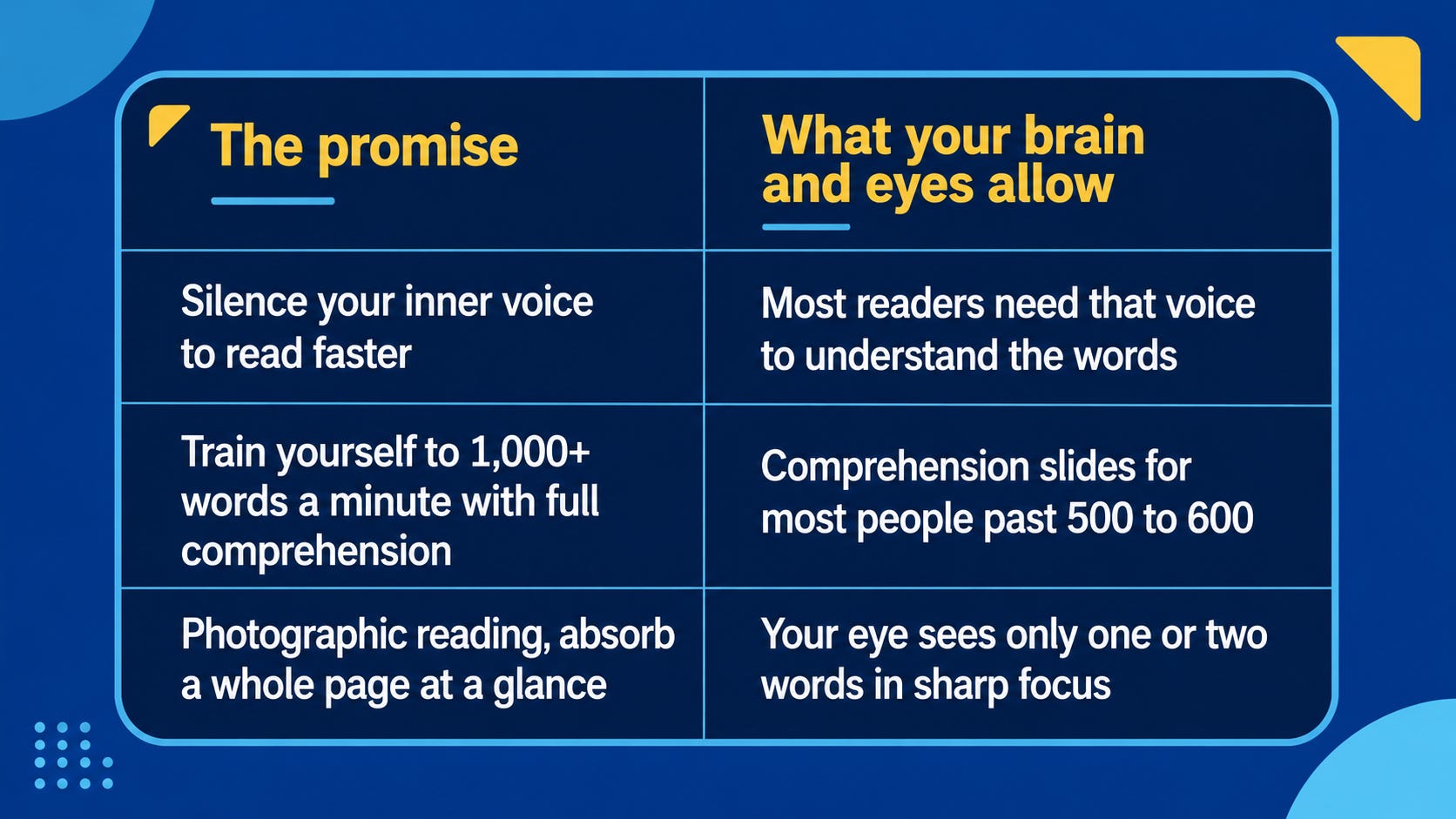
None of this means you’re stuck at your current speed. Real gains are possible, they’re just smaller and less flashy than the ads suggest. Going from around 250 to 350 or 400 words a minute is realistic for most people.
Three habits do the heavy lifting.
Stop re-reading out of habit. Your eyes drift back to words you already understood, which quietly eats your speed. Catch it and keep moving forward.
Use a pacer. Run your finger or a card under the line, or use an app that sets a steady rhythm, so your eyes stop wandering.
Match your speed to the job. Slow down for dense material you need to remember, and open up for light or familiar text. One fixed speed for everything is the real mistake.
The single most reliable upgrade is the least exciting one: build a bigger vocabulary. The more words you know cold, the faster your brain turns text into meaning, which is the exact step that caps your speed in the first place.
So reading faster is real, but it comes from working with your brain and your eyes, not fighting them. The inner voice you were told to kill is carrying the meaning, and the ceiling you keep hitting is built into how you see.
Play inside those limits and you get faster for good. Fight them and you just lose the plot.
Comments
Nothing yet. Say the first thing.
Sign in to join the conversation.