
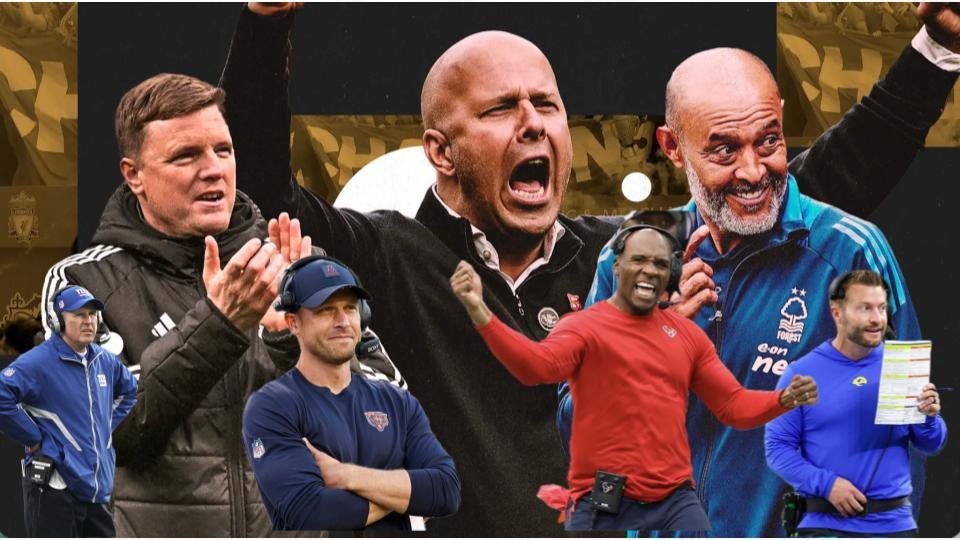
Author’s Note: I began writing the first draft of this article on November 26, 2025. Which is uhhh, before a lot of coaching related things happened this season. I happened to finish it yesterday, May 13th, but wasn’t sure when I was going to send it out. It feels particularly relevant today.
Have you ever watched the broadcast of a UEFA Champions League match? Of course you have. So you know that every broadcast starts off exactly the same way.
It begins with the players lined up in the tunnel. The camera pans to the outside of the tunnel as the players - following the referee - begin walking out. The match ball is on a pedestal just outside the tunnel and the referee, or a mascot, collects it as they walk by.
They walk to the center of the pitch where the two teams line up while the Champions League anthem plays. In the middle of the pitch a banner of the Champions League logo the size of the center circle shakes.
When the anthem is complete the visiting team moves through the line to shake the hands of the referees and the opponents. The camera then pans to a corner view of the ground before a graphic displaying the home team’s starting XI comes up. The players are introduced in line, goalkeeper then defenders and so on.
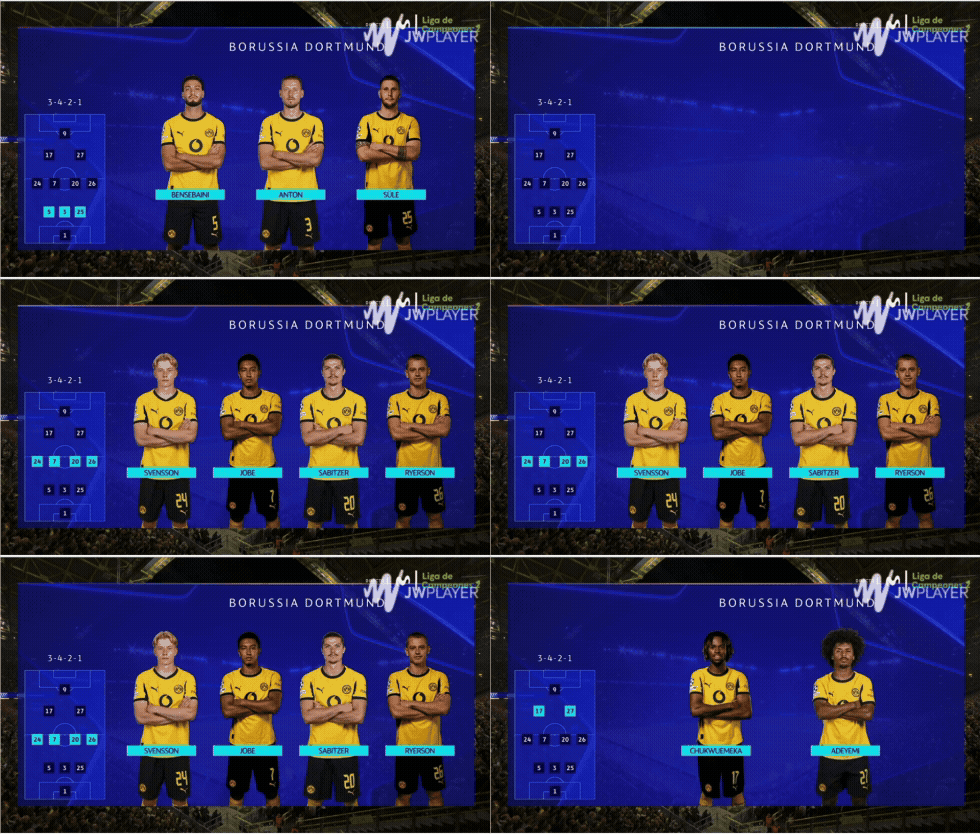
Once every player is shown the graphic switches to a tactical layout of the team’s setup and lists the substitutes. Then we get introduced to the referees as they conduct the coin toss between the two captains. Then they run same graphics for the visiting team’s starting XI. It’s all meticulously branded and controlled. Every Champions League match feels like an event, and when you flip one on, you can immediately tell the football match you’re watching is a Champions League match.1
The Champions League has been doing a version of this since it’s inception in the early 90s. The World Cup and Euros are the same way. These days just about every football match in every league begins like this.
It was only in 2004 that the Premier League started having the teams walk out of the tunnel slowly and lining up at the center of the pitch before the game. Prior to that the referees would lead the teams out of the tunnel, but as soon as they got to the pitch the players would run right by them as they ran out to warm up.
The Premier League implemented the walkout, the anthem, and the handshakes because why should they be any other football match? If the Champions League and World Cup had distinct feels to them that turned them into events then shouldn’t a Premier League match be an event too?
This was the concept that the Premier League was born out of - as detailed by Joshua Robinson and Jonathan Clegg in The Club.
In the late 80s English football was in a bad place. A few young executives from Arsenal, Tottenham, Manchester United, Liverpool, and Everton recognized that the sport was badly in need of modernization. They had a future for what they could make English football as Robinson and Clegg write:
They pictured a modern, marketable, and media-friendly league, with safe, attractive stadiums fit for corporate hospitality that would harness the power of television and transform their teams into billion-dollar businesses.
As it happened, this vision had a name: the National Football League
Arsenal’s David Dein had already been exposed to the NFL in the 70s, That’s where he saw first hand what kind of show the league put on. He saw the pageantry behind each game, the pyrotechnics as players enter the field before the game, the glitz, the glamour. Every game was a spectacle.
And it didn’t end there. The NFL wasn’t just a 60 minute game. Throughout the week they stayed in the news cycle, selling the storylines and narratives of the season making each game at the weekend that much bigger.
Throughout the late 80s these executives made numerous trips across the pond to learn as much as they could about the NFL and see how many ideas they could take back home to revitalize their own game.
If there are two things British football fans hate one is Americans coming in to tell them how to do things and the other is people trying to compare in any way the NFL and American Football with the British game. They’re different games, stop trying to turn one into the other.
Fans (rightfully) may not want to Americanize their sport but as that long winded only slightly relevant introduction was meant to illustrate, football, specifically English football has always been trying to find things they could adapt from their American counter parts.
One of those things is the coaching structure.
The current obsession with football managers2 revolves around the tactical meta. The primary consideration on whether a coach is good or not almost exclusively focuses on how he sets his team up to play. What is their play style, their game model, etc etc?
When it comes to coaching the manager is supposed to do it all. Sure he has assistant coaches but often they’re just nameless bodies. He’s supposed to tactical mastermind, the one who creates the master game plan and does the individual coaching of the players. It’s one level down from The Great Man theory now that we’ve accepted that a sporting director model where the manager is separate from scouting and recruitment is the way to go.3
NFL teams have an army of individual (nameless) coaches for each of the different positions on the field. Those coaches fall under the purview of the offensive and defensive coordinators. Above the coordinators sits the head coach.
The coordinators are the schemers - the tactics guys. They’re the ones who come up with how an offense/defense is going to look and play. Are we going to throw the ball down the field? Are we going to be a team that does quick short passes? Are we going to be a heavy blitzing team? Do we like to play a lot of man to man or zone defense? These are all shaped by the coordinators.
On game day it’s the coordinators who call each of the individual plays.4 The head coach might say let’s dial up a blitz here, but it’s the defensive coordinator who will decide where that blitz is going to come from and where they’re going to attack with the blitz.
The Head Coach is responsible for seeing over the entire team and then some. He’s the one that needs to make sure each of the players are motivated and performing. He has daily media commitments, he regularly meets with the general manager regarding the state of the team and looking at potential draft picks. He needs to watch the tape of the previous game and present the mistakes/things that need to be worked on to the team. He watches the tape of his next opponent so he can come up with game plan for the following week.
But while the head coach will sit with the coordinator to craft the outline of the game plan - this team is weak against the run, let’s run it down their throats or they’ve got a backup at outside linebacker, let’s pick on him - it’s the coordinators who are then tasked with figuring out how they’re going to put that plan into action.
During the game the head coach is responsible for major decisions. Am I going to challenge that call? The coach will decide that we’re going for it on fourth down - he maybe will even say let’s throw the ball or run it here - but after that decision it’s on the offensive coordinator to decide which running play or passing play to dial up.
An NFL head coach delegating responsibilities isn’t a weakness, it’s a necessity.
When NFL teams go looking for a new head coach they dip into the coordinator ranks to find exciting new candidates. It’s the natural place to look as these are the up and comers who have impressed with their exciting new schemes.
The median tenure for an NFL head coach is about two years. Most of these guys fail. When you really think about it, it’s not all that surprising. They’re being hired based on criteria that don’t really apply to the job they’re being hired for.
These guys don’t fail because they don’t know enough about football. The ones that fail do so because they’re not cut out for this specific job. Perhaps they lack the charisma to connect with the players so the players don’t see them as leaders. More often they fail because they don’t do a good job delegating. That promoted offensive coordinator is still overly involved in the offensive schemes, and therefore he’s not devoting enough attention to other aspects of the job. The best and most successful coaches tend to be the best delegators, which allows them to focus on the team as a whole.5
Thanks for reading Kwest Thoughts! This post is public so feel free to share it.
The job of a football manager isn’t much different. There are so many things that fall under his umbrella. Motivation, man-management, media and sponsorship commitments, the actual side of things, scouting your future opponents, overseeing training or scouting future players. It’s far too much for one person to do. Some of those things have to be done by the head coach, therefore it’s best if you delegate everything that you can such as planning out the training sessions or even, gasp, the tactics!
Modern football discourse has greatly overemphasized a coach’s tactics and playstyle. We’re not saying these things aren’t important but by no means should they be the number quality you’re looking for in a potential manager.
When it comes to being a manager your man management skills are much more important for success then your tactical brain. Consider this, an NFL team has 48 active players on their game day roster. Roughly 40 of those guys are going to see the field at some point in the game. There are substitutions made on every play.
A football manager selects 11 players and can make five substitutions for a given match. If you have a squad of 25 players then at most 64 percent of them will be involved in a game. It’s the managers job to keep his entire squad happy - to keep them all feeling like they’re playing a crucial part in the success of the team. That’s especially true of the guys who aren’t playing much.
The actual tactical minutiae of how the squad is going to play, how you’re going to press, all of that can be left to an assistant coach6. The manager meets with the assistant to go over all the details and then he implements it with the players.
That people management is the crucial step here. The best tactics in the world are useless if you can’t get the player to buy in. When you tell a winger that he’s going to spend 90 minutes working his ass off and holding the width - at the expense of him getting chances to score goals himself - you have to have someone that can make him understand why this is such a crucial role.
There have been many great tacticians who have failed as managers. That doesn’t mean they had bad ideas. They may have not had the skills necessary to get the players to buy in to those ideas.
Too often Premier League clubs who are looking for their next coach over focus on the tactical approach a current manager has. It’s the wrong mindset and most of the time it leads to hiring the wrong guy.
Instead teams should be looking at the most successful coaches across many different sports. They’ll find that they all typically have something in common. The ability to manage people and the ability to get people to rally around them. Next on the list is someone who trusts is staff and delegates properly.
Tactics are important but don’t over prioritize them. Find the guy who can connect with your players. The guy who trusts his staff, combines ideas as a unit, using his people skills can merge the two together.
Kwestthoughts is a completely free newsletter and there are no plans to change that. If you’ve ever thought about supporting my work more directly now you can “buy me a drink” or leave a tip as a token of appreciation. Thank you for continuing to support me.
In my opinion this has actually become less so since UEFA started using digital ad boards. Back in the day they just had the MasterCard, Heineken, PlayStation, Nissan boards making Champions League matches look very distinct. These days they can be confused with any other match
We will be using the term managers and coaches interchangeably
Though not everyone has come around on that yet. Some still put this in the purview of the manager
Occasionally you’ll get a head coach who calls the offensive plays. Less often you’ll get one that calls the defensive coverages. Never both
Perhaps it’s notable that, entering the 2025 NFL season, three of the six longest tenured head coaches in the league hadn’t ever been coordinators
Which it typically is. Manchester City’s pressing has become very similar to what Liverpool used to do since Pep Lijnders joined Pep Guardiola’s staff. Lijnders had been an assistant to Jurgen Klopp at Liverpool.
No posts
Comments
Nothing yet. Say the first thing.
Sign in to join the conversation.