
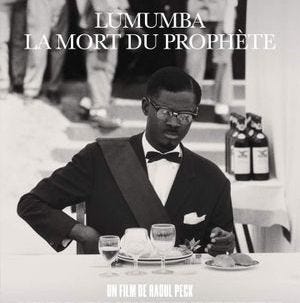
Introduction
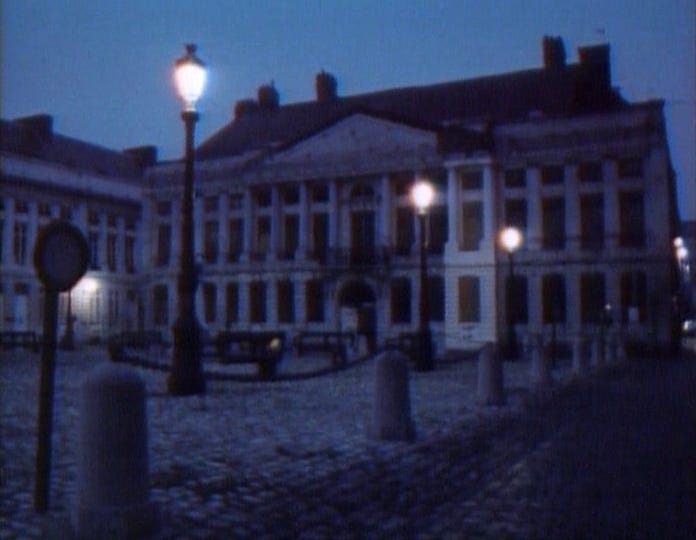
Lumumba: La Mort du Prophète (1990) opens on an empty, silent European courtyard at twilight, streetlights still burning. A succession of photographs follows — a vacant square, a lonely street, an empty fountain, and finally, a building’s façade cutting the sky as a roll of thunder breaks the silence. It is a notably melancholic opening scene, marked in many ways by separation — we don’t know which city we inhabit, have no connection with other inhabitants nor the space’s soundscape, and are positioned as detached observers, shown a series of landscapes and asked to search for something we can’t find.
The subject of our search is introduced by Peck himself, who, heralded by the roll of thunder, begins to read a poem written in honor of Patrice Lumumba, the Congo’s first post-independence leader. As images of the vacant city continue to populate the screen — statues in a square, building facades, darkened windows, a street named ‘place des martyrs’ — Peck reads:
“In Katanga, if one tells you, mother, pointing with the finger: this is the spot where the lost child lies, don’t believe a word, mother, not a word. It was a giant, my mother, a giant who fell that night, that night in Katanga.”
The poem’s dark tone, coupled with the melancholic landscapes, creates an atmosphere of mourning, not only for the figure described as the giant, but also the death of truth. Here, the controversy surrounding Patrice Lumumba is introduced poetically — Western history has defamed the name of the “giant who fell that night,” characterizing him instead as a lost child.
The film’s work and purpose evolves from this root of loyalty and repudiation - could he pull Lumumba back from death to speak one last time? Could Lumumba have the last word? In what becomes Lumumba: La Mort du Prophète, Peck investigates the possibilities that emerge within an alienated environment — through externally imposed circumstances, Peck finds himself without access to the images usually deemed necessary to create a visual timeline of the political life and death of Patrice Lumumba. Instead, Peck must glean from fragments — his own childhood, what little archival footage he can find, transplanted images of Belgium. From this imposed distance, Peck decenters and repudiates the official narrative, opening up the possibility for other narratives to speak in chorus, to create a ‘body’ of Lumumba to circulate and haunt. While the film illuminates the indeterminate, traumatic, and overlooked moments in historical discourse, the lack of images also takes its toll on the filmmaker — confronted with this absence, Peck is haunted by the images that he creates in his own head, and the film becomes as much about the trauma of absence as it is about the redemption of presence.
The Ungraspable Truth // The Accepted Truth That Lies
Peck originally approached Lumumba: La Mort du Prophète as a reconstruction of the life of Patrice Lumumba, Zaire’s first post-independence leader, whose identity was forcibly erased from public consciousness following his murder in 1961. The film confronts the task of recovering and documenting events and memories that have quite literally been expunged, manipulated, and falsified — either completely erased, or filtered through Belgian news media which, as Peck investigates, has been greatly clouded by Western biases, ideology, and supremacy. In effect, Peck positions himself to confront this ‘history’ and challenge the notion of ‘telling the truth’ cinematically, contesting notions that history and media can be free of bias, and highlighting the difficulty of producing history as a Black man who grew up in the colonized Dutch Republic of Congo. In effect, Peck relies on posing more questions than answers, calling attention to the process of history creation itself rather than historical facts, and contesting the historical narrative rather than treating it as a stable record.
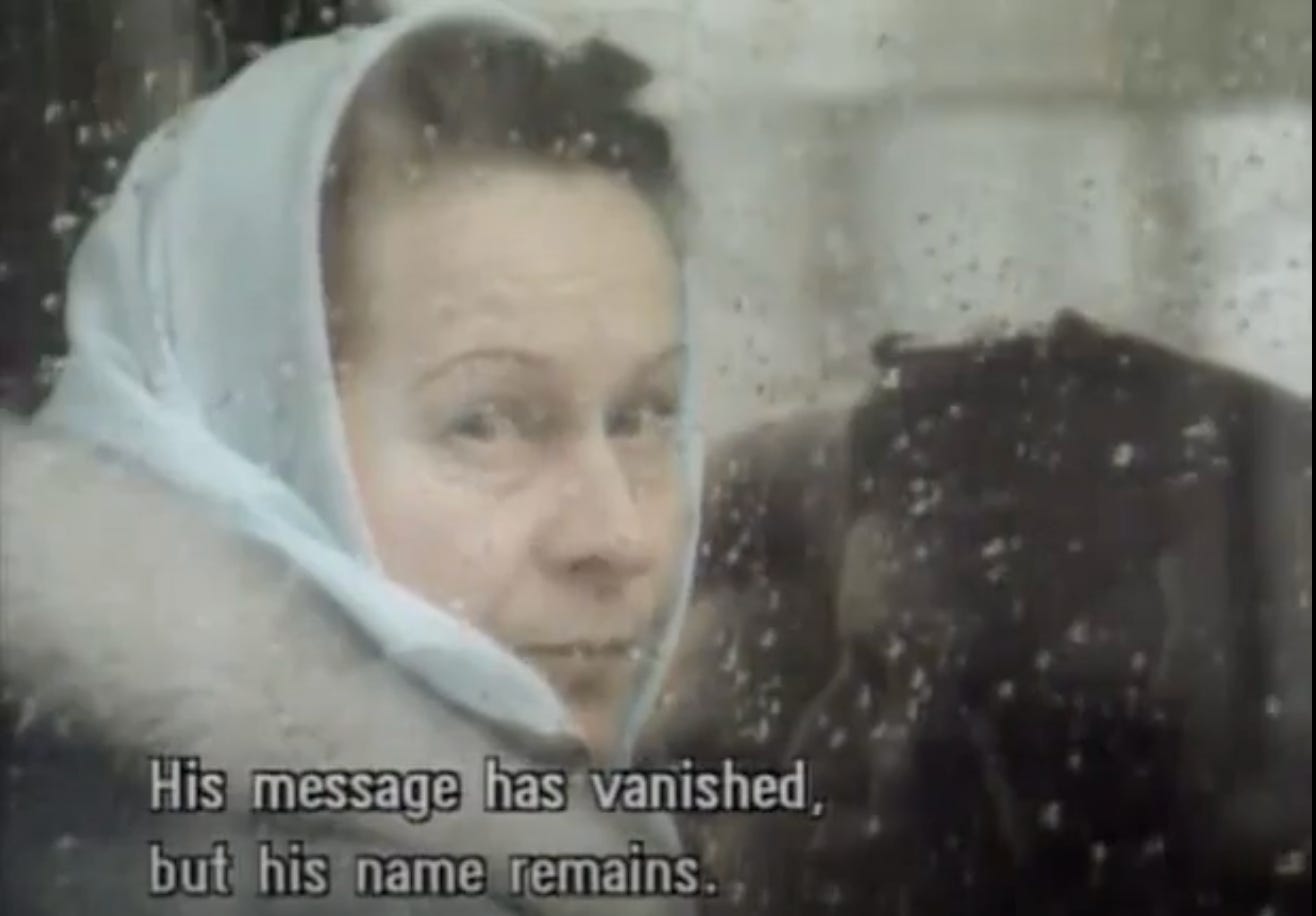
Peck introduces the difficulty of uncovering history in the second sequence of the film — here, he returns to the European landscape of the opening scene, this time populated with life. Situated across the street, the camera films the passengers of a bus, focusing intently on a woman who is looking out the window. The woman feels the camera’s gaze on her and looks into the lens, then looks down, refusing the address. The narrator continues, “A prophet foretells the future. But the future has died with the prophet, whatever is said.” The bus pulls away. “Today, his sons and daughters weep, without ever having known him.” Peck repeats this shot several times — each time, the camera occupies the same removed position, resting on a subject with the intent to study them, only for that subject to be swiftly stolen from view. Here, Peck illustrates the fleeting nature of truth, positioning Belgian citizens as subjects for interrogation only to have them taken away. As he laments, “his message has vanished, but his name remains. Should the prophet be brought back to life again?”
The figure of the prophet, or one who “foretells the future,” functions heavily in Peck’s construction of Lumumba. For Peck, this positions Lumumba’s body and message across time — powerful in the past, silent but felt in the present, and, he hopes, could live again in the future. However, Peck deeply questions the virtues of unearthing this ‘body’. In Lumumba’s case, “the future has died with the prophet, whatever is said.” History has constructed a truth that lies, and in effect the prophecy has been extinguished with the prophet, substituted instead with an official history that does not resemble the ‘message’ that the prophet provided. There is immense pain in this erasure and the present voice that holds the stage. What can be gained by bringing the prophet back to life? What new narratives would emerge if we “gave the prophet the floor, one last time”?
The remainder of the film seeks to answer these questions, as Peck decidedly surges forward in his investigation, only to be spurred and detained by a series of denied images, from archival access to the opportunity to film on location in Congo/Zaire. As Peck explains in voiceover, he sought to shoot the film in the Congo, where much of Lumumba’s political career took place, but after a threatening phone call from the secret service, he and his crew decide to let the plane take off without them. His production becomes stalled in the Brussels airport, and he decides instead to use Brussels as the colonized site for an investigation into Lumumba’s political history.
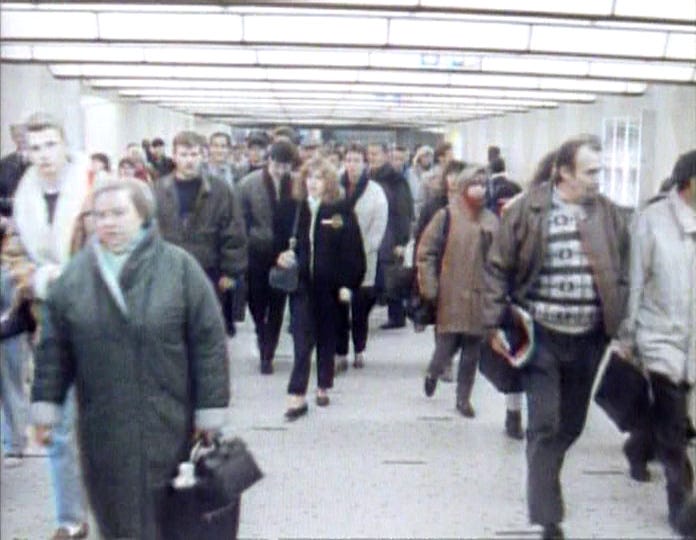
In the first scene in the airport, the camera slowly tracks through a terminal tunnel as a throng of people walk towards us — we are immersed, but moving against the grain of movement. The narrator shares, “I wanted to find the pieces of the puzzle, searching for signs of the prophet… I looked for the soul of the prophet, whose voyage is endless… Up against a wall, lost, and far from home.” As the scene visualizes, Peck wanted to go where the events took place, to return to his and Lumumba’s shared hometown to search for signs of their mutual existence, but instead he finds himself in a similar position to Lumumba, up against a wall and far from home. While the citizens in front of him are also displaced, traveling, and in flux, their situation doesn’t illuminate the soul of Lumumba for Peck — the throng moves toward a common point beyond the camera, while the camera seeks another place, somewhere nobody seems to be going. Here, Peck visually introduces the work of the film itself — to move against the grain and search for narratives that are not institutionalized.
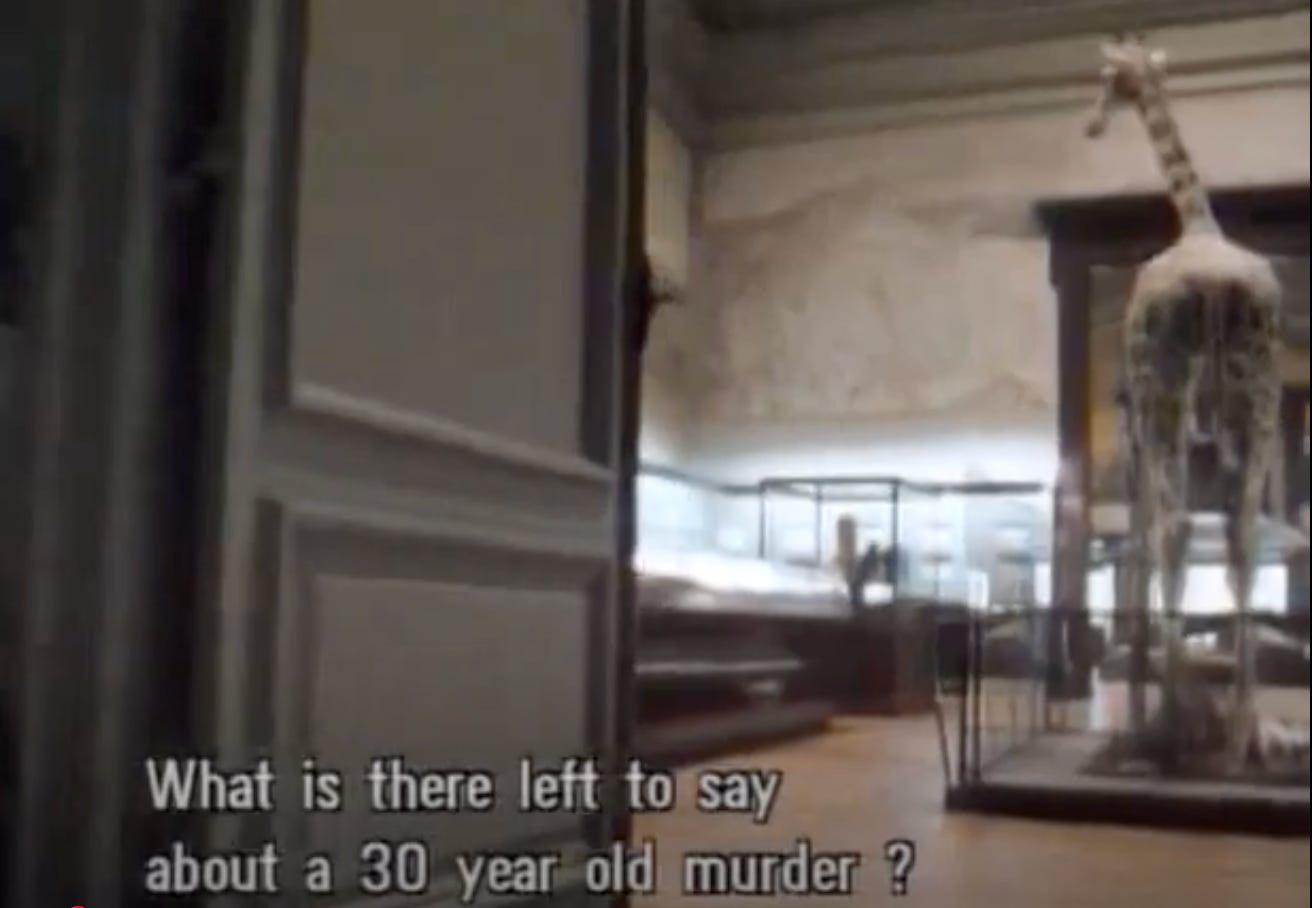
Later, the film moves to the Brussels Natural History Museum, where the African exhibit must serve as a stand in. As we enter the museum, the camera dollies close to the ground, bobbing frantically from side to side, as though searching. From this viewpoint, the numerous glass cases containing relics of official history seem to fly past, unimportant and yet towering above us at all times. “What is there left to say about a 30 year old murder? These are memories that are best forgotten, for the executioner as well as for the victim,” Peck states. Peck draws attention to the ways in which Eurocentric ideas of African history become official narratives — in the eyes of the executioner, the West, what has already been said is sufficient, and for the victim, there is no platform to speak. Peck continues, “there are many ways of killing someone,” as the camera moves at an increasingly frantic pace through the museum halls.
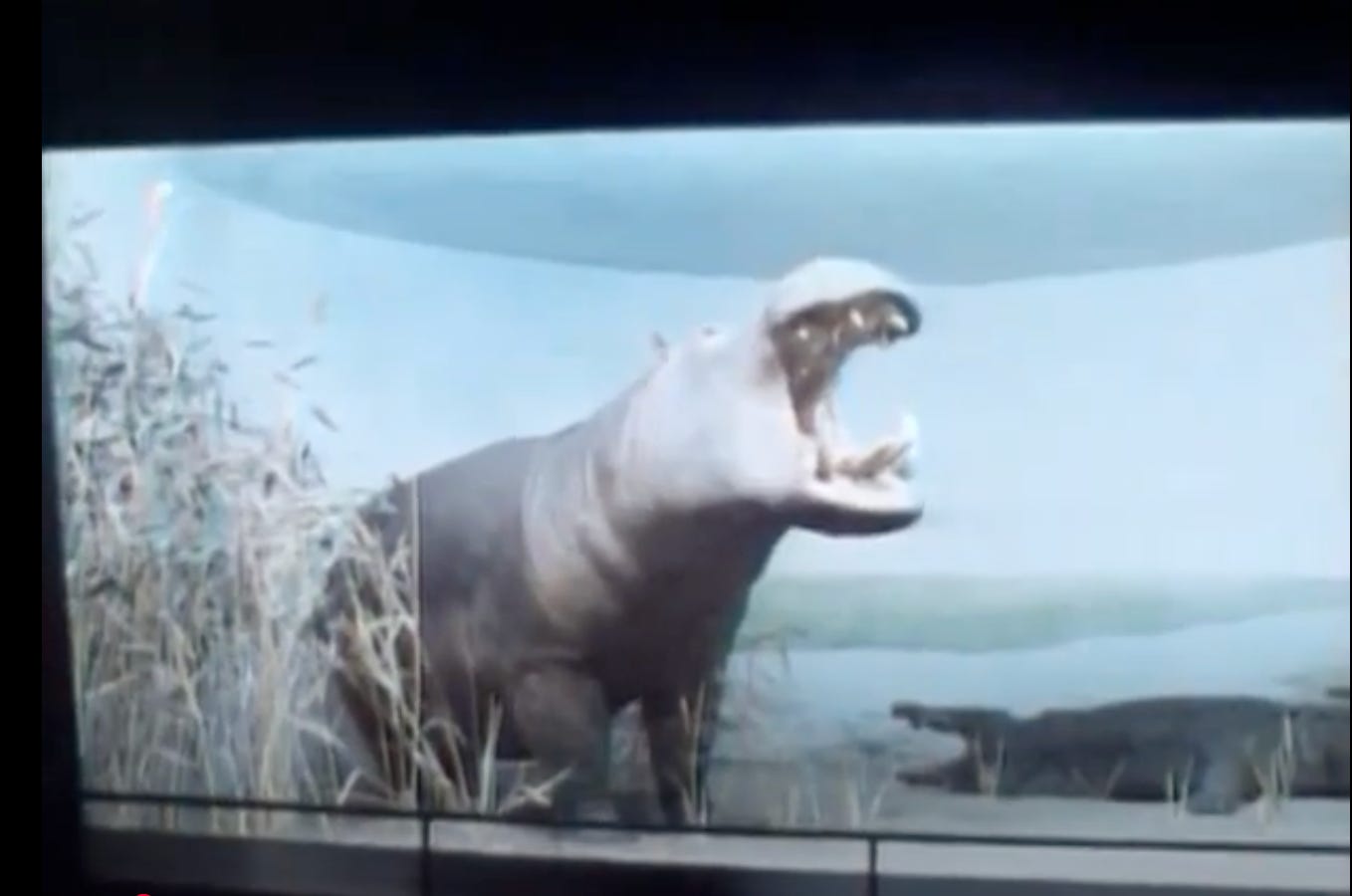
We stop at a series of dioramas — a hippopotamus, teeth bared, a lion lying in the brush, three pelicans. With each of these shots the camera rests before tracking in quickly, and the emphasis shifts from a perfectly framed tableau to an intense desire to investigate further, to get closer. These cliché images of African landscape and wildlife are tidily wrought in narrative scenes, but Peck actively interrupts them.
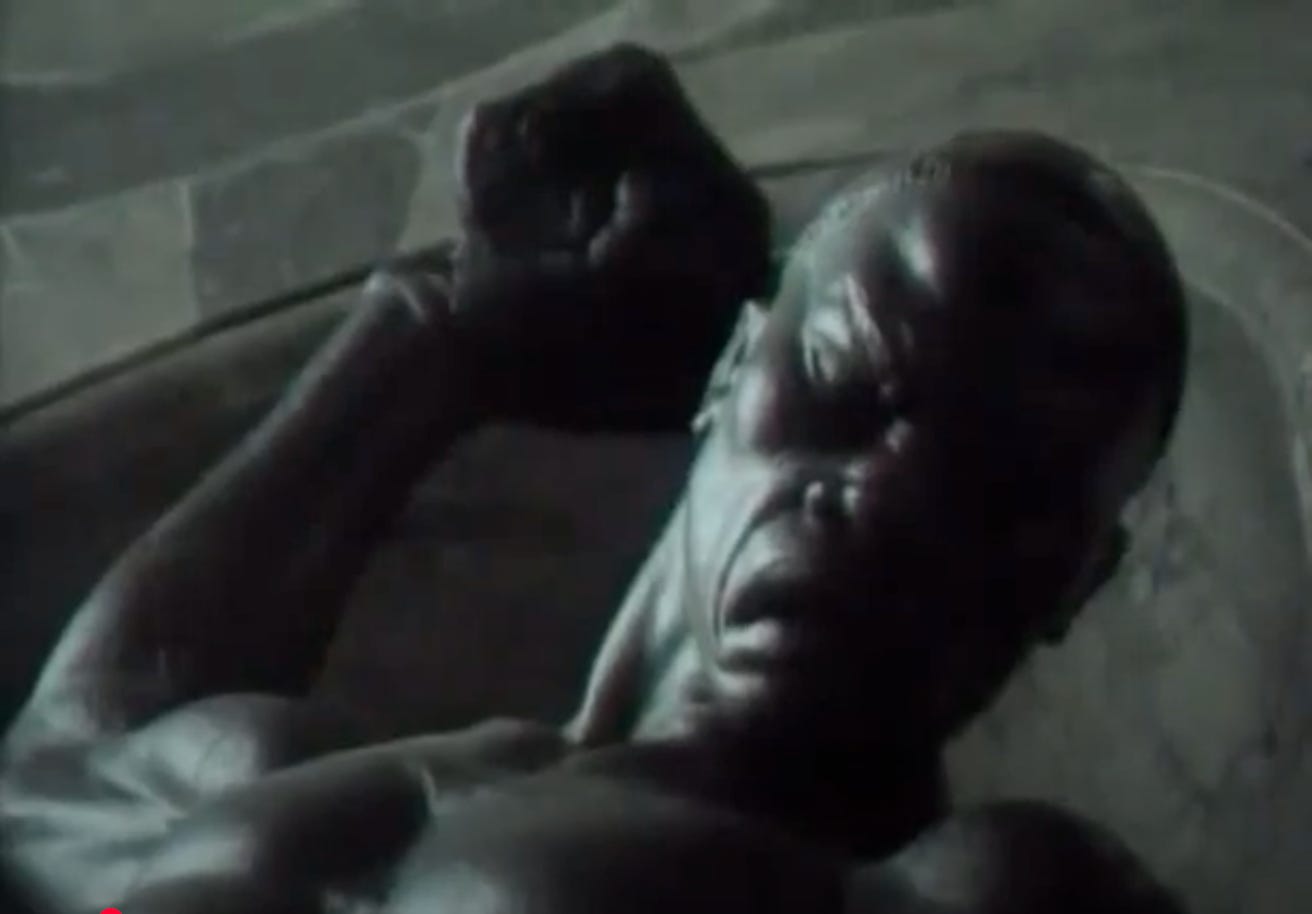
The camera next cuts to a medium close up of a bronze sculpture of a Black man, his face twisted in anger or pain. Then, a Black woman, highly eroticized with breasts exposed. Last, a close up of a Black woman’s face, portrayed with highly exaggerated facial features. The camera films these sculptures from a low angle, emphasizing the grotesqueness of their rendering. The silence that accompanies these images supports the tone, illustrating what is at stake — in the eyes of Belgium, African history is reduced to a narrative that relies on racist stereotype.
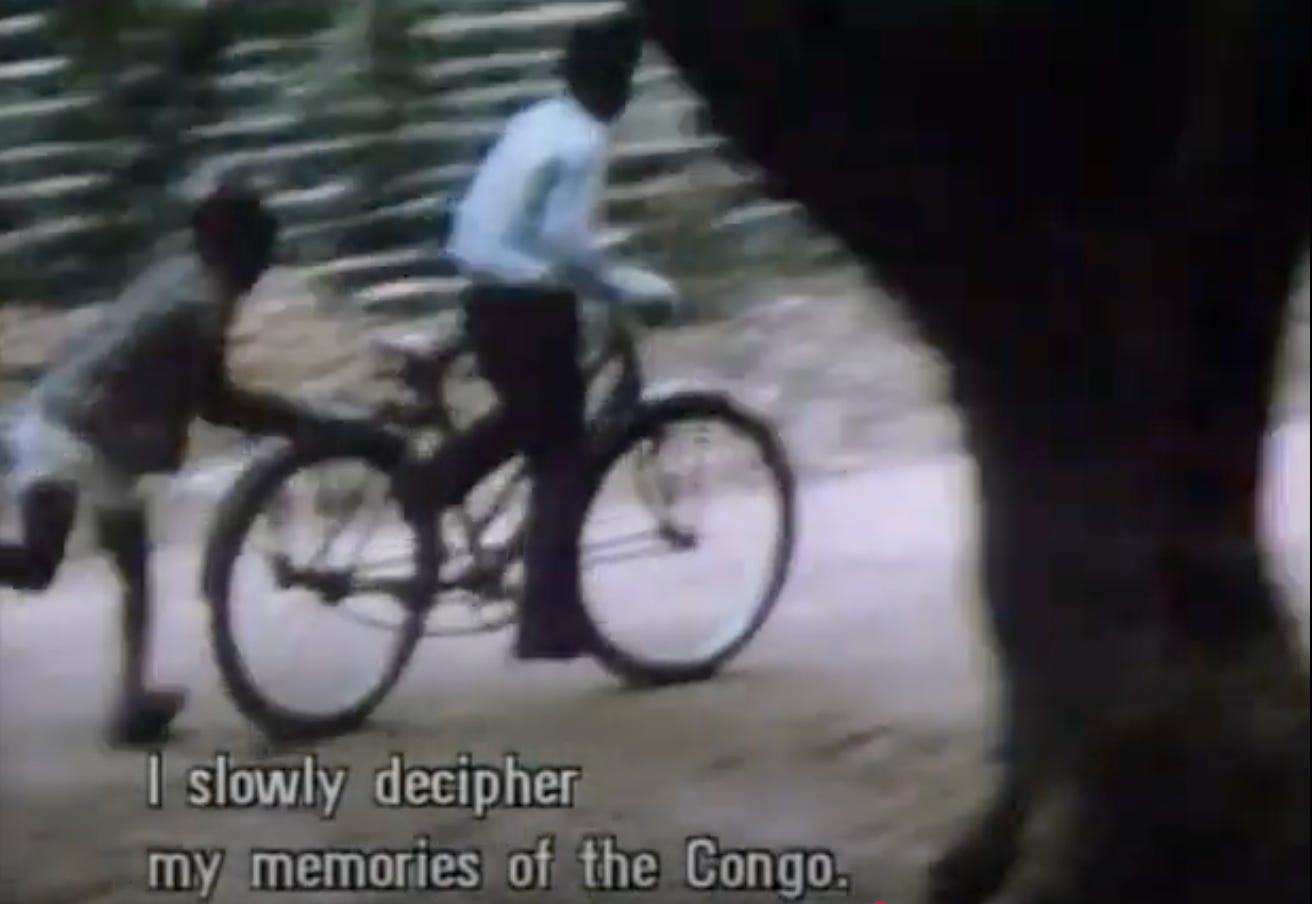
In order to confront this entrenched narrative, Peck draws attention to historical fragmentation, mediating scenes of “official history” with more lyrical sequences composed of images from Peck’s childhood, images of colonization and slavery before and after independence, and quotidian moments in the Congo and Belgium. The voices of Belgian officials, media, and historians are effectively interspersed, for example, with images and vignettes told by Peck’s mother, who worked as a secretary in the government offices in Leopoldville. Often representing a noted departure from the timeline of official history, these vignettes function to interrupt that narrative, pointing to what lay at the periphery — the surrounding war, the Holocaust, and economic interests that greatly effect the life and circumstances of Lumumba. Such sequences illustrate the photographic image’s affinity with historical materiality, as well as its ability to confront audiences with other narratives through collective memory. Always introduced with “ma mère reconte,” Peck’s mother provides vital information to the story of Lumumba, including the acquisition of the Congo at the Berlin Conference, the first photograph of Patrice Lumumba, the nature of Belgian rule, the Ivory slave trade in Nsinga, and the Matadi railroad at Leopoldville. Throughout these scenes, Peck effectively places the Other, a Black woman from the Congo, in the position of historian, maintaining an essential distance from the speaker in the service of truth. Peck’s mother does not occupy the position of the beloved in the film — rather, her text and narratives provide key information, and any notion of subjective narrative is de-emotionalized. Peck practices an intensity of vision, looking deeply into his mother’s stories and the meaning one can glean from them, and deeply respecting the speaker as a critical informant to his historical process. In doing this, Peck repositions the figure of truth in historical discourse, de-centering the colonialist narrative in service of the witness.
Traumatic History // Traumatic Memory
The violence inherent to the colonialist process of manipulating, erasing, and rewriting history leads Peck to rebel in a number of ways. The first, as stated above is Peck’s process of decentering the colonial narrative voice of truth, favoring visual and narrative fragmentation over a stable record. The second, taking this deconstruction a step further, sees Peck reject images all together, a process that, as one sees in the latter half of the film, has traumatic consequences for the director.
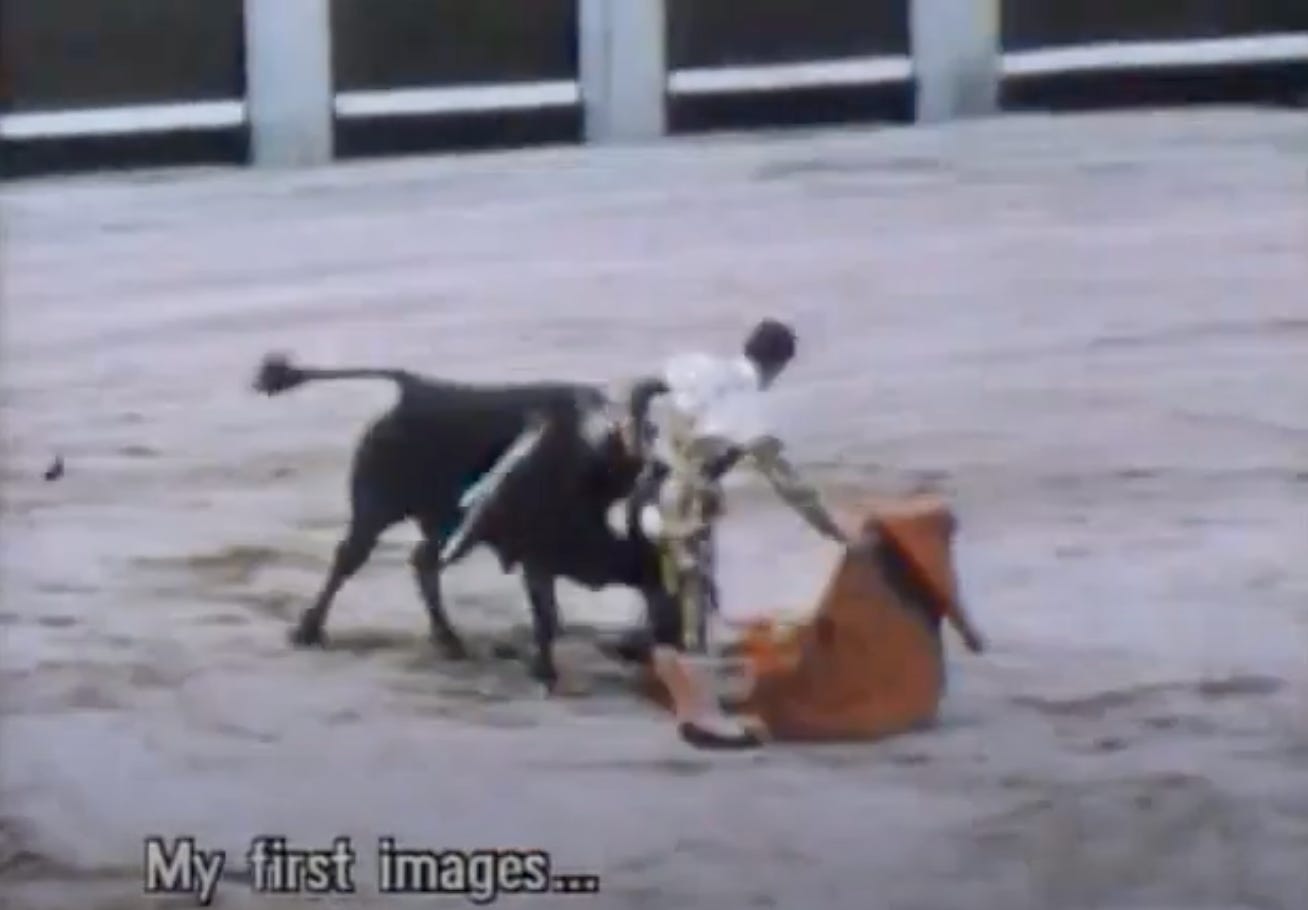
In a flashback to his childhood, Peck recounts the first time his father let him borrow his camera and shares his first images with the audience. A bullfighter and bull fight in a ring, and the camera focuses intently on the action at hand, Peck trying his best to keep the action centered on the screen as well as capture the energy of the ring, cutting back and forth from the stage to the audience as they cheer. Peck recounts a re-visiting of the images, stating, “My daughter and I watch the images, and she asks me what I felt watching this bull being killed. I didn’t dare say my main problem was keeping the camera in focus.” The images now focus on the scene described — the bull is speared by a fighter on a horse, continues to fight, now with five spears in its side, and finally is dragged by the neck out of the arena. The bullfighter bows and waves, holding flowers as celebratory music floods the scene. Then, black leader — the music stops. While Peck’s daughter recognizes the violence of the event, inquiring as to its effect on Peck as a first-person witness, Peck’s position as a filmmaker allows him the necessary distance to view the event, unmarked by the subjective fantasy that produces trauma. Peck focuses on the task at hand, keeping the camera in focus in order to record the moment. As viewers of the recorded event, we too gain the power to confront it, witnessing an event that has the ability to demolish consciousness, the torture and murder of an animal, but that is rendered confrontable through the photographic image.
The tone of this scene, however, does not carry throughout the film — in fact, Peck moves on to illustrate the ways in which history has complicated this process, even rendered it impossible. Lamenting the loss of images at the hand of colonialism, Peck draws attention to this loss through his use of long segments of black leader. At times, the black serves as an acknowledgment that there are no other images for the described events — these not only include moments in Lumumba’s political history, such as speeches or press photos, but also increasingly traumatic moments that deal with Lumumba’s imprisonment, torture, and murder. At first, these accumulated moments of black serve as a political statement. In one sequence, Peck calls this black leader “black holes, images in my head. Forbidden images, but inoffensive.” Here, the black leader cross dissolves to reveal a black road seen from above. Cars pass below us, moving towards a common point off screen, and then back to black leader again. He asks, “are these black holes more corrosive than the images they hide?” Omission here serves as a way for Peck to deny ‘official’ history’s power over the events and crimes that occurred. Instead of going where the official narrative seeks to take us, Peck resists, positing spaces of inquiry, investigation, and subjectivity in their place. Believing in the power of omission, of allowing himself and his audience to create their own images and write their own history, Peck challenges the necessity of images, instead favoring rejection as a form of confrontation.
As the film progresses, however, Peck fights with a nightmare of images in his own head, images that haunt him. These images first emerge as a flash, seen after Peck recounts a telegram his mother received that accounted for supplies used for a series of murders in her office. Peck cuts to the same black street seen from above — a car passes — and black leader. This time, a flash of an image emerged from the black — sepia-toned moving images of soldiers swinging a lifeless body into a truck. Peck cuts immediately to an empty street in the modern day and shares, “no images exist; they are all in my nightmares.” On the soundtrack, a woman’s screams and cries are muffled and a ringing gains volume. We once more cut briefly to the old footage, and this time the camera focuses on the crowd witnessing the previous event — a woman swings her fist and yells. As Peck enunciates, the accumulation of black leader has proven traumatic and has become replaced with images in Peck’s own head, images that he cannot place in order to confront, but only occupy his nightmares. Peck uses the Holocaust as the archetype of trauma — each moment pointing to Lumumba’s murder beckons back to this historical moment, illuminating the status of the modern being as haunted, and effecting all other images that come after. Without access to images, Peck returns to those he was seen, sharing these images with the audience, visualizing them in a series of flashes that evoke collective historical memory. In order to deal with the trauma of Lumumba’s incarceration, torture, and murder, Peck revisits images that allow him the possibility of confrontation — in effect, rather than occupy a positionality of subjective closeness, he is allowed to occupy the place of the spectator, viewing and experiencing their photographic representations and plunging deeply into the heart of the object on the screen.
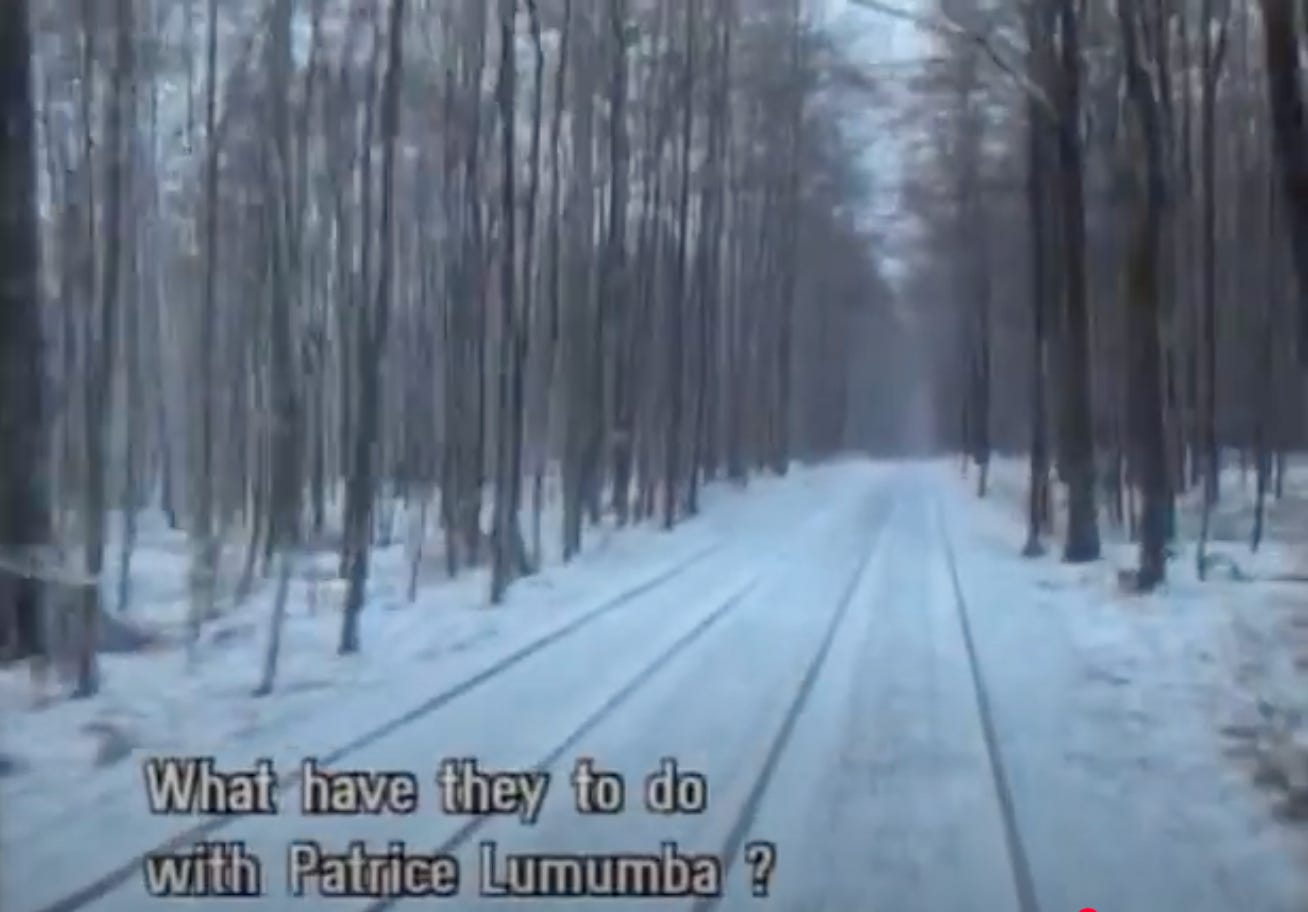
Later in the film, this process comes to a climax, as the camera travels down a railroad track in the snow — dark, thin trees lining each side of the road. Again, Peck refers to these haunting images:
“Why do these images keep coming back to me? What have they to do with Patrice Lumumba? With a few million dead, the uranium of the Congo, with an old greedy king? Is the Holocaust the only unit of measure for the human race? Imagine that there is no heaven, no hell, that there is no explanation for all that. And if there had been no uranium to build the bomb for Hiroshima? There is life, then there is death, after that there is nothing.”
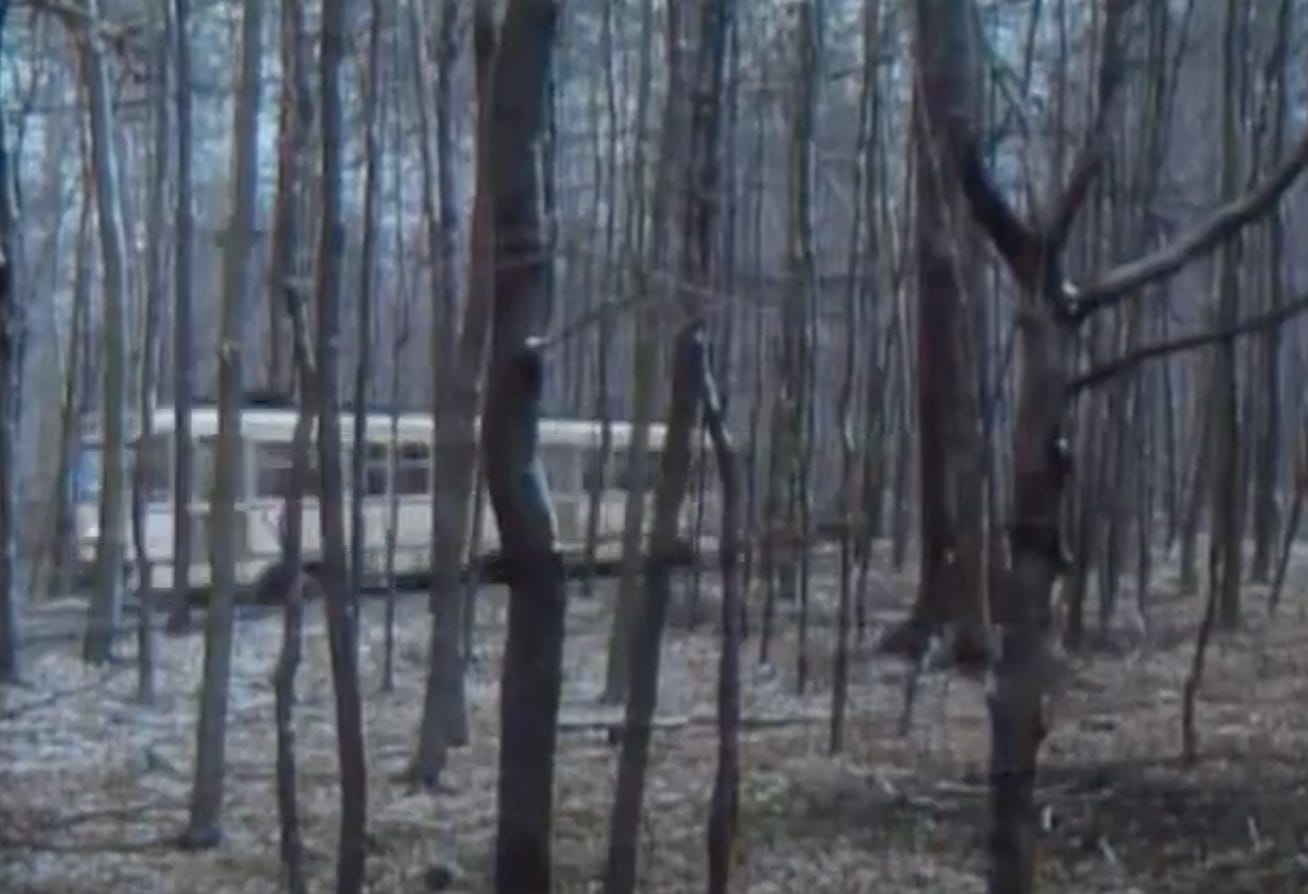
We cut to a close up grove of trees beside the railroad, and a train car passes through the frame. The images embody an intense feeling of melancholy — stark, silent. In this cut, our subjective view is rendered objective, and we become separated from our previous train ride. As this scene attempts to render possible, in order to witness the horrors that occurred, we must be pulled from the movement of the train, estranged, and provided the necessary distance to act as a voyeur. Repeatedly provided images that ‘have [nothing] to do with Lumumba,’ however, Peck illustrates the difficulty of acting as an idealized voyeur figure, or the little boy with the camera, photographing the torture and murder of a bull. In this narration, the work of the film confronts Peck with death in a way that illustrates the fragility of individual human consciousness. Peck deeply embodies the modern subject, traumatized by the horrors of World War II, in existential turmoil — in uncovering Lumumba’s past, Peck has unearthed a number of latent traumas, all of which expose Peck to the ephemeral nature of life, as well as the depth of human evil. These traumas, invisible and yet knowable, are difficult to control, leaving Peck with “no explanation” or comfort. “Is the Holocaust the only unit of measure for the human race?” Are these images the only ones that remain to confront? Again, Peck revisits the idea that “the message has died with the prophet,” illustrating the effect that the absence of images has on his psyche. There is life and death, and then there is nothing. While the human race acknowledges the Holocaust as the unit of measure for trauma, Peck illustrates the danger of ‘seeing’ history, not the official history fed by those in power, but history as it unfolds, infinite and ever repeating. Beckoning to the introductory sequence, Peck questions the value of ‘uncovering the body,’ of reviving Lumumba’s story and traumas, and the subsequent effect it could have on historical consciousness.
La Mort du Prophète
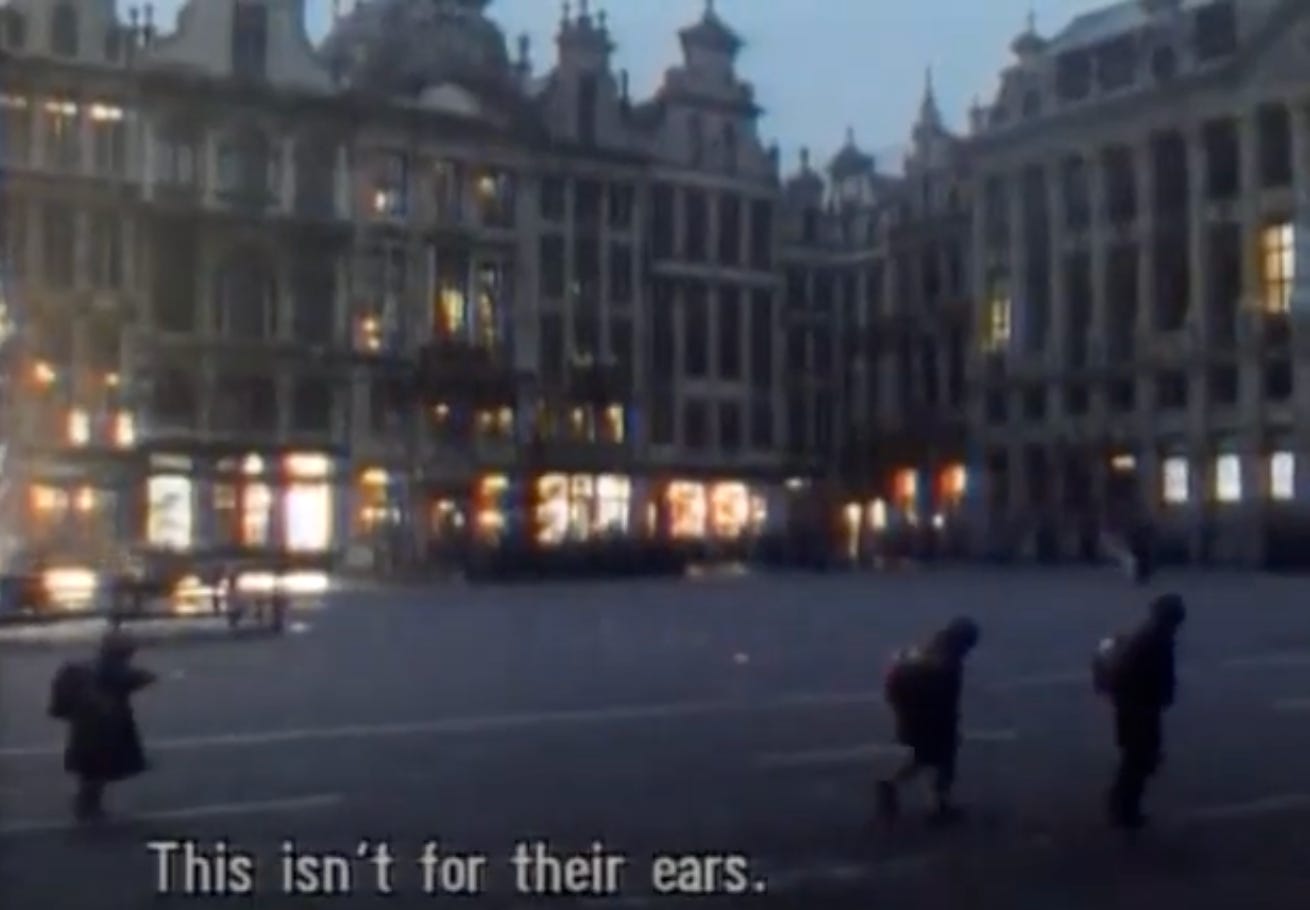
After confronting these nightmare images, anxieties, and doubts, Peck reaches the climax of the film, a recounting of the events directly surrounding Lumumba and his two colleagues’ grisly murders. For this, we return to Brussels, just as Lumumba does, according to Peck, to “tickle the feet of the guilty.” We inhabit an empty city square at twilight, filled with Christmas lights and the sounds of faint caroling echoing around us. “Did I tell you about the prophet’s end?” Peck asks. On the cut, we enter a wealthy bourgeois Belgian party through the door, as a guest. The camera, hand held, enters and roams among the Belgian elite, and guests greet it as it moves through the space. In effect, we circulate as one of them. We watch as men shake hands and socialize with one another, grab drinks from platters and laugh. We walk towards a uniformed man who takes name cards and announces arrivals to a group of diplomats, lined up to shake hands. We join these arrivals, give our card, and move down the line, looking at each diplomat in the face as we go. Peck begins:
“They had to try twice to make the bodies disappear. They say two white men were in the Savannah, dressed as policemen. They say they drove all night. They say that in the public works lorry there was a metal saw…two butcher’s knives, 25 litres of sulphuric acid, petrol, a large empty barrel… and whiskey.”
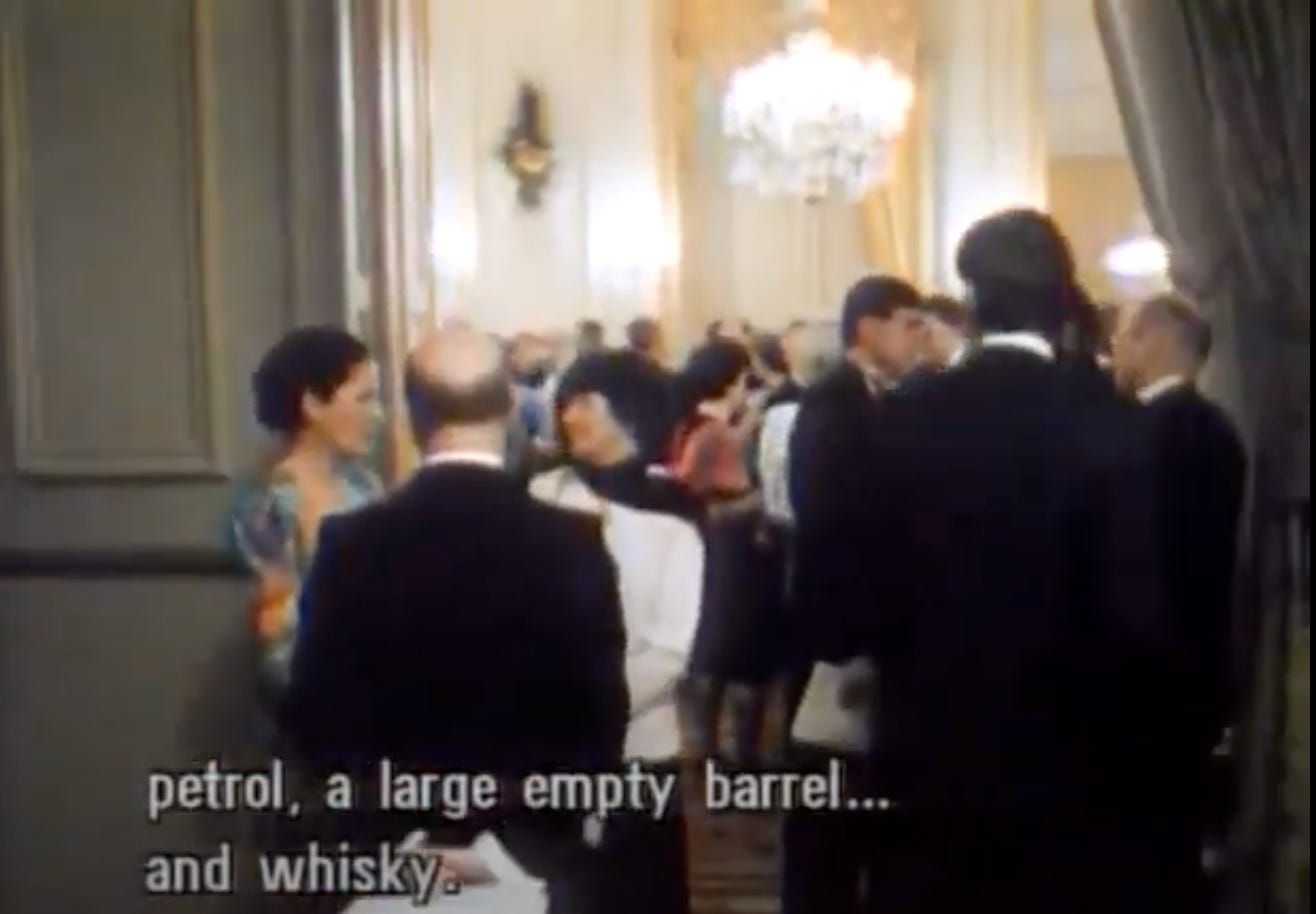
We move into the main hall, where hundreds gather, socializing. The Belgians notice the camera, watching intently as we pass by them. “The prophet takes care of his image, greeting you as a friend. A humiliated prophet, by the way. An unburied prophet.” Here, Peck positions the audience in the body of the ghost, circulating among those who stood by as he met his death — unburied, the ghost revisits the scene in order to “tickle the feet of the guilty,” to show his face and confront those who created the history that disavows him. Peck creates an ironic dichotomy between image and sound, illustrating the unconscious nature of violence within colonialism. Those in power live unencumbered, while those not in power must live the consequences. As Peck reiterates in this scene, the process of “making the body disappear” is a difficult one — not only do the Belgian policemen have to try twice to dissolve the bodies, but the prophet also remains unburied, able to circulate in the afterlife through the virtue of this film. While the Belgian media and government attempt to eradicate Lumumba’s image from public memory, part of him will always remain, as the “prophet takes care of his image.”
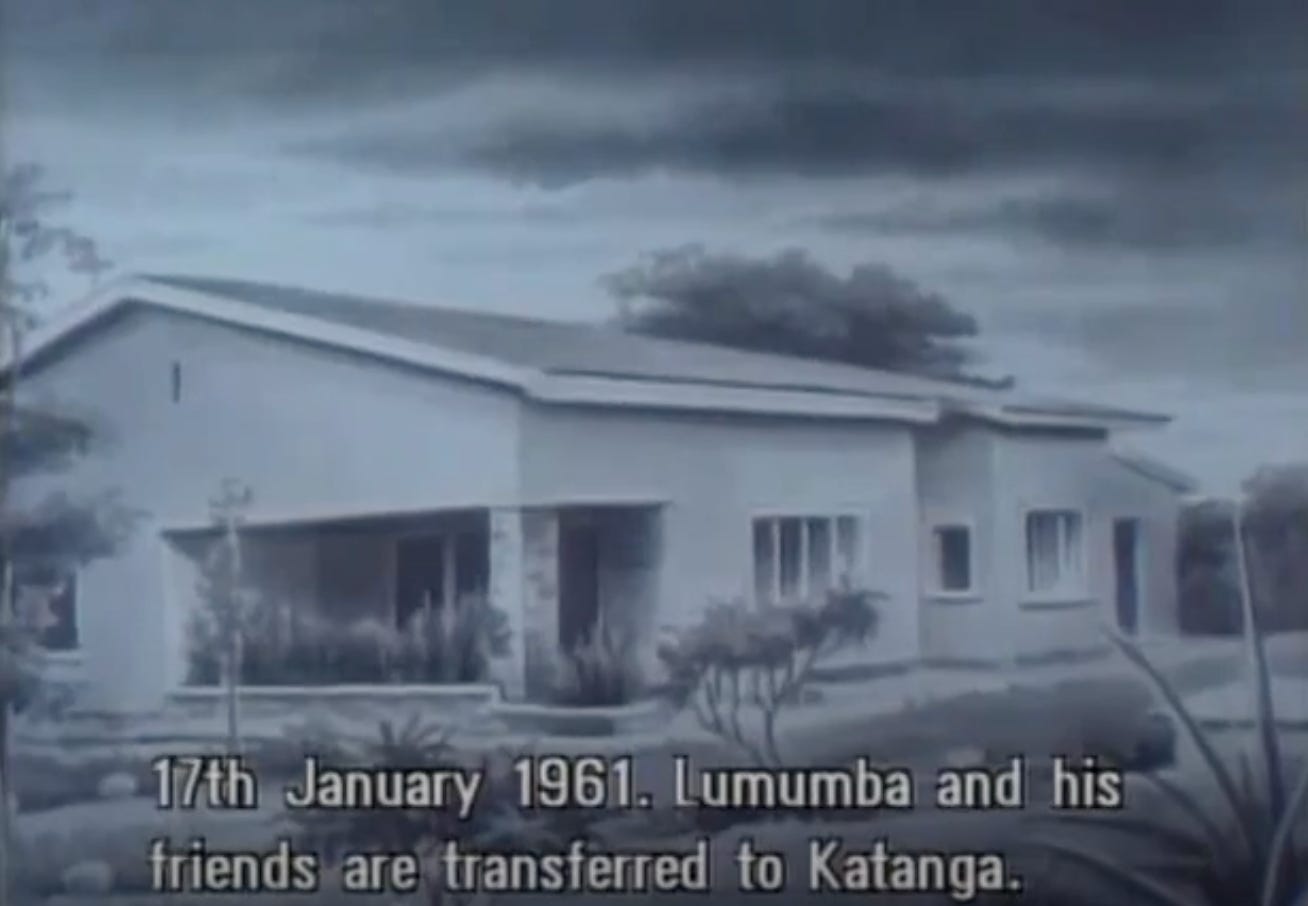
At the cut, the film presents us with a still image of a house. Peck dates the image, “17th January 1961. Lumumba and his friends are transferred to Katanga. In a house in the suburbs of Elisabethville they are beaten, humiliated, and tortured.” The camera presents us with another view of the house and begins to zoom in on the darkened window, searching again for an image that does not exist but instead must be imagined. While we are not given an explicit image for these acts, the film asks us to create them as the window expands to create black leader, the landscape of Peck’s own nightmares. Peck’s voice cuts the black, “at 22.00, a long convoy takes Okito, Mpolo, and Lumumba deep into the Savannah.”
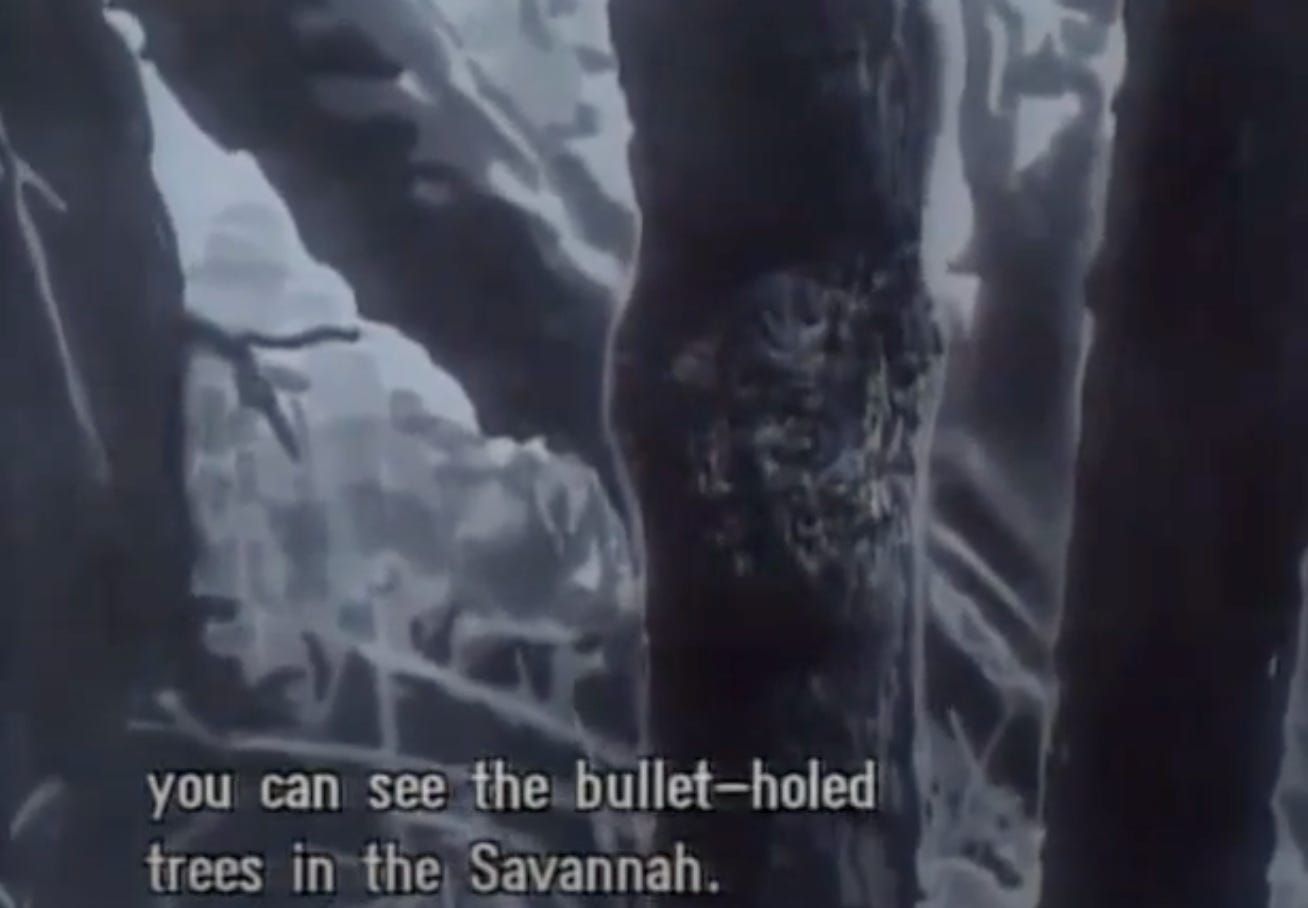
The black dissolves to show another still image, this time of two trees huddled close together in a sparsely populated forest. The camera, again, zooms in on the scene, focusing on the bark of the trees as Peck ends, “They say that only Okito trembled slightly before facing the firing squad. It must have been the cold. They say that still today, you can see the bullet-holed trees in the Savannah.” While this image does not depict the exact trees mentioned, Peck invites audiences to project the image of the bullet-holed trees onto the given image. In effect, we search the image for evidence, looking to witness the event, but ultimately experience our own projection.
As we see in these two sequences, Peck attempts to present a solution to the problematic he set up throughout the film — asked to choose between colonially mediated images and absent images, Peck creates his own. These images, simple and general in nature, serve as a canvas on which one can both imagine and confront the traumas presented — an unadorned canvas, but not a blank one. The trauma illustrated through the narration of these events is not be visually present in the image, but instead is beckoned to, pointing to that which is not accessible and yet affirming its existence. By decontextualizing reality, the photographic image allows audiences to gain access to a new reality, one that may, in fact, bring us closer to the original than the original could manage. Within the images of the house and grove of trees, Peck transmits raw material without defining it, asking audiences to look with intensity, actively searching and losing oneself in the incidental configurations of the environment.
Conclusion
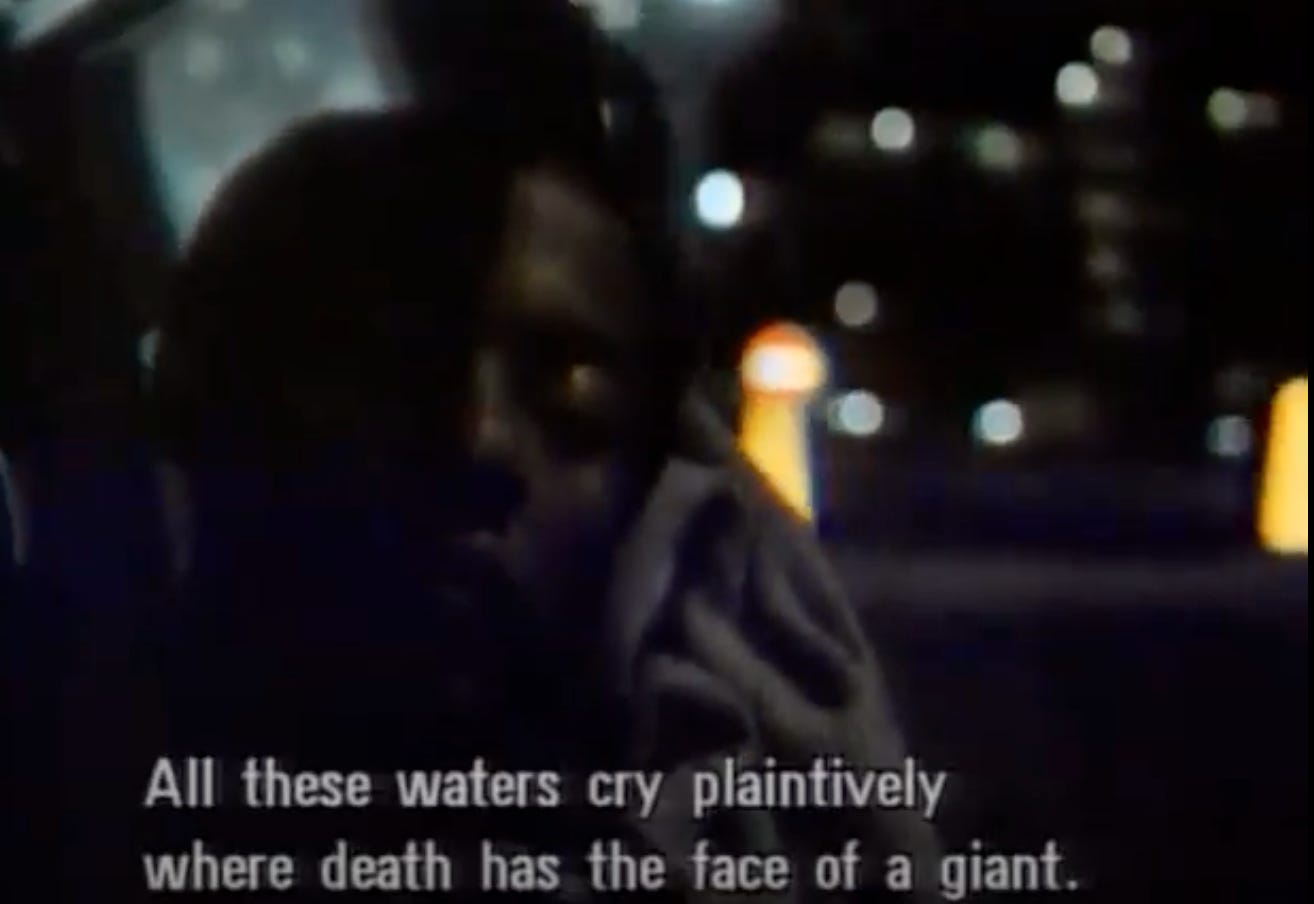
In the film’s final scene, we return to the darkened roadway that heralded Peck’s nightmares, as Peck’s voice once again recites the film’s opening poem. The camera occupies a meditative, estranged perspective, still and watching from above as cars speed below. As the poem comes to an end, however, Peck inserts a subjective position that is not present in the former scene — the film cuts to place us inside one of the cars, looking out the window at the lights and cars as they pass by. Meanwhile, he reads:
“On the long journey home, they disperse of the remains of the bodies. Burned bones, belt buckles, teeth… Why do Belgian motorways remain lit all night? I know my story is not a nice story, but it’s Patrice’s story. They say that Tolenga’s son is dead, but they are unable to show the body.”
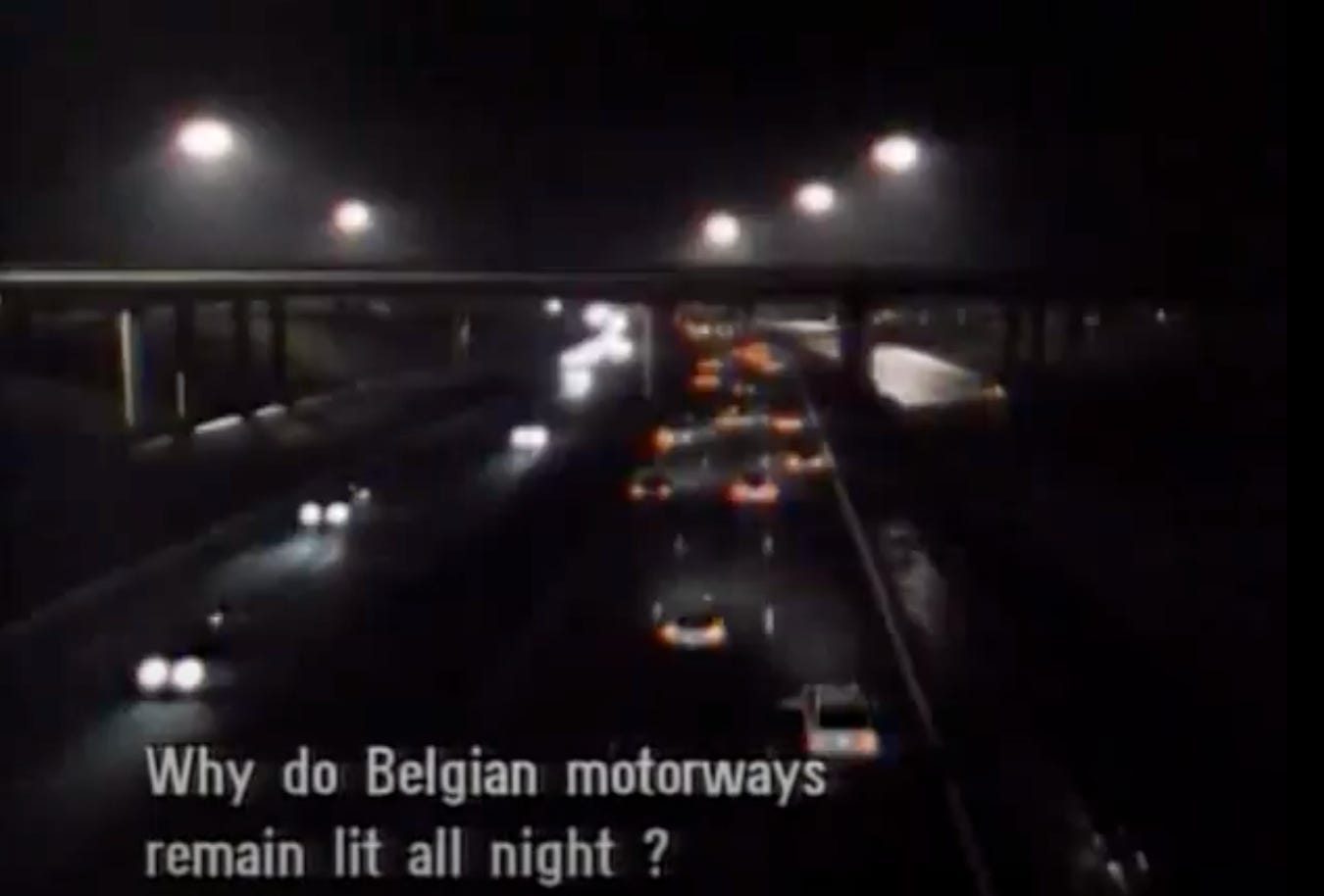
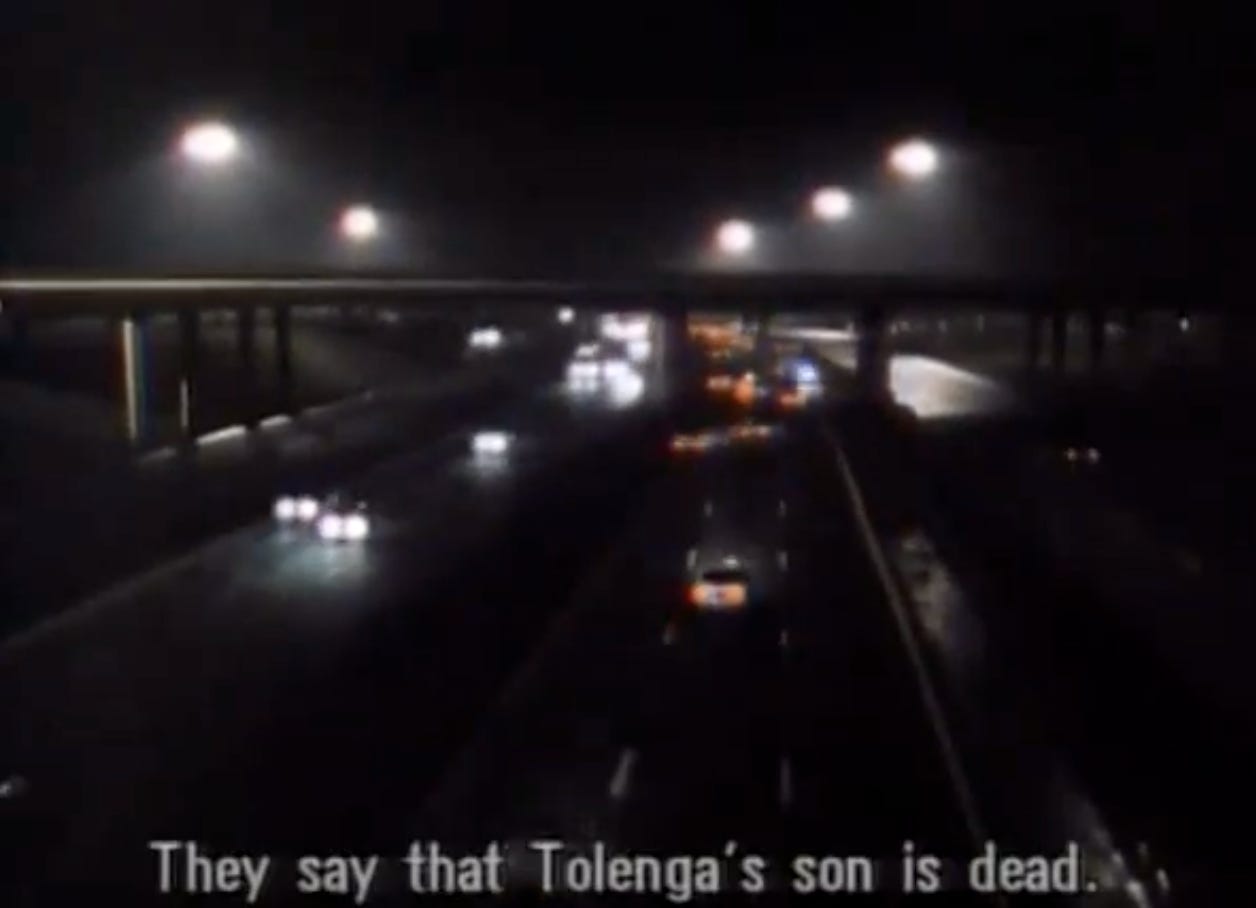
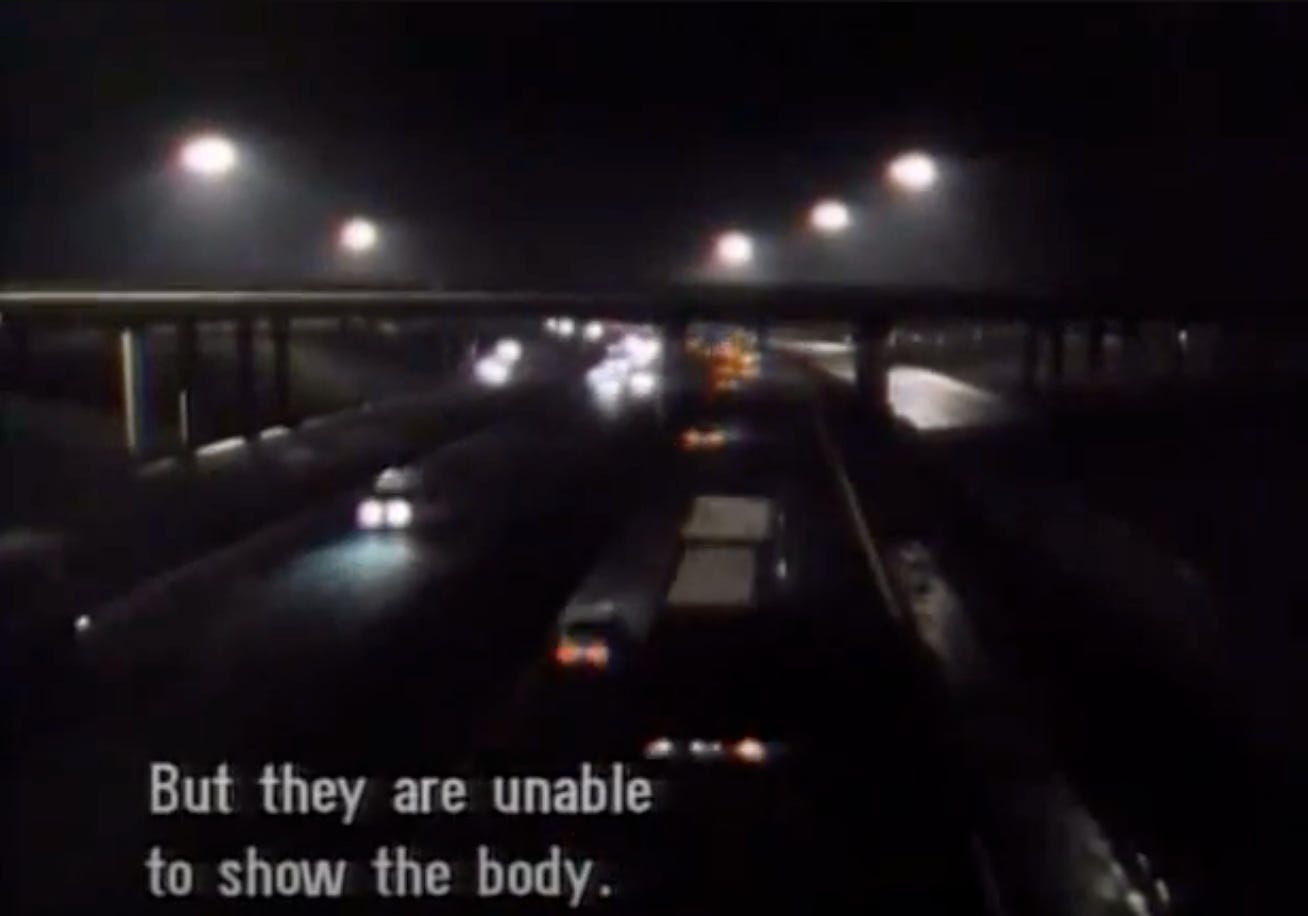
The camera cuts back to the estranged position, observing cars from above, the hum of traffic softly buzzing as the credits roll on the screen. Here, Peck reconnects the image to the nightmare — the passing of cars, signaling unrest, ephemerality, and anonymity troubles Peck, much like the nature of Lumumba’s story. In the end, Peck is still unable to “show the body” of Lumumba, instead searching for the missing pieces, the body parts, belt buckles, and teeth strewn along the highway. By changing from objective to subjective camera positions, Peck situates himself – and his audience – in a position of a searcher, one who scans for the truth while maintaining distance. By shooting inside the car, we see only what can be seen from the window, our search ability mediated by the glass and the speed at which we must move. “Why do Belgian motorways remain lit all night?” Far from home, Peck investigates that which is illuminated by colonial powers and regimes of knowledge, finding that dark, sinister deeds occur even under the guise of affluence.
The process of telling Patrice Lumumba’s story was not an easy one, nor was it a nice one. While uncovering Lumumba’s history, Peck is confronted with a series of traumas — colonial hegemony, manipulations, erasures, and violences – all of which pressure Peck to seek the periphery, fragmentation, and indeterminacy. As illustrated throughout the film, these strategies work to both illuminate alternative histories and present new traumas — unable to “show the body” of Lumumba, Peck instead must point to its fragments, creating an exquisite corpse that circulates and haunts. Peck’s battle with historical images and their absence results in a refusal of both, offering instead images that beckon to that which has been erased, offering a presence that acknowledges the trauma of absence.
Comments
Nothing yet. Say the first thing.
Sign in to join the conversation.