
Sixty seven years ago today, Hawaii officially became the 50th state of the United States of America.
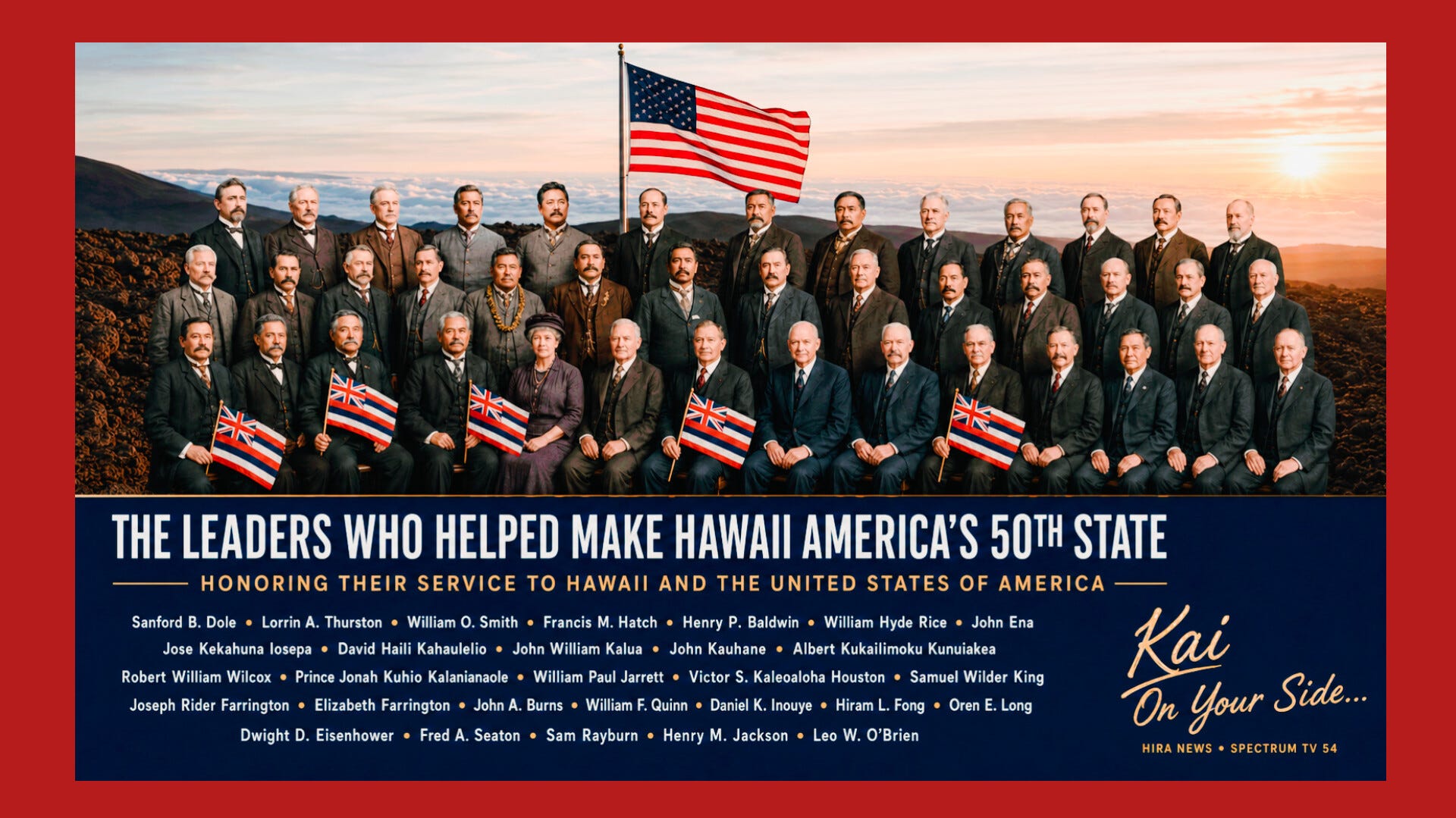
On August 21, 1959, President Dwight D. Eisenhower signed the proclamation admitting Hawaii into the Union. It was the conclusion of a long political journey through the Kingdom of Hawaii, the Provisional Government, the Republic of Hawaii and nearly six decades as the Territory of Hawaii.
These were separate periods in Hawaii’s political development.
The Republic of Hawaii existed from July 4, 1894, until annexation in 1898. Congress formally established the Territory of Hawaii through the Hawaiian Organic Act in 1900. It was the Territory of Hawaii that ultimately became the State of Hawaii in 1959.
The Republic pursued annexation. The Territory pursued full equality through statehood.
Congress passed the Hawaii Admission Act in March 1959. President Eisenhower signed it on March 18, subject to approval by Hawaii’s voters.
On June 27, 1959, the people of Hawaii were asked:
“Shall Hawaii immediately be admitted into the Union as a State?”
The answer was overwhelming.
A total of 132,773 people voted yes. Only 7,971 voted no. More than 94 percent of those voting on the proposition chose statehood.
The people of Hawaii selected their future. President Eisenhower completed the admission process on August 21, 1959, and Hawaii became America’s 50th state.
Hawaiians Who Helped Lead Hawaii Toward America
Hawaiians participated in the political institutions that moved the islands toward annexation, territorial government and eventual statehood.
Six Hawaiians were among the signers of the 1894 Constitution establishing the Republic of Hawaii.
John Ena was a Hawaiian businessman and public official who served during the Kingdom, Provisional Government and Republic periods.
Jose Kekahuna Iosepa, identified in government records as J. K. Iosepa, represented Hawaii at the 1894 Constitutional Convention and signed the Republic’s Constitution.
David Haili Kahaulelio participated in the Constitutional Convention and signed the Republic’s founding document.
John William Kalua was a Hawaiian lawyer and former Kingdom legislator from Maui. Kalua supported annexation, participated in the Constitutional Convention and served as president of the Annexation Club on Maui. He later served as a judge and returned to legislative service during the territorial period.
John Kauhane served in public office under the Hawaiian Kingdom and later participated in the Republic. He signed the Republic’s Constitution and served in its Senate from 1895 through 1898.
Albert Kukailimoku Kunuiakea also participated in the 1894 Constitutional Convention and signed the Constitution establishing the Republic.
These Hawaiians understood the importance of building a secure political and economic future for the islands. Their participation helped create the bridge between Hawaii and the United States.
Hawaiian Leadership in the Territory of Hawaii
Hawaii remained a United States territory from 1900 until 1959.
Territorial residents were American citizens, but Hawaii did not possess the full representation granted to a state. The Territory elected one delegate to the United States House of Representatives. That delegate could introduce legislation, participate in committees and speak for Hawaii, but could not cast a final vote on the House floor.
Five of the ten congressional delegates who represented the Territory of Hawaii between 1900 and 1959 were Native Hawaiian.
Robert William Wilcox became Hawaii’s first territorial delegate to Congress. His election placed a Hawaiian voice in Washington at the beginning of the territorial period.
Prince Jonah Kuhio Kalanianaole represented Hawaii in Congress from 1903 until his death in 1922.
Kuhio worked through the American constitutional system and became one of Hawaii’s most influential advocates. He played a central role in securing passage of the Hawaiian Homes Commission Act of 1920.
His service demonstrated that Hawaiians as American citizenship could stand proudly together.
William Paul Jarrett, a Native Hawaiian Democrat and former sheriff of Honolulu, represented the Territory of Hawaii in Congress from 1923 until 1927.
Victor S. Kaleoaloha Houston, a Native Hawaiian Republican and retired United States naval officer, served from 1927 until 1933. Houston advocated statehood and argued that Hawaii’s loyalty, military importance and years of national service justified full admission into the Union.
Samuel Wilder King, who was of Native Hawaiian ancestry, represented Hawaii in Congress from 1935 until 1943. He later served as territorial governor from 1953 until 1957.
King graduated from the United States Naval Academy and served his country as a naval officer. His governorship came during the final years of Hawaii’s statehood campaign.
Together, these five Native Hawaiian delegates represented Hawaii in Congress for more than two thirds of its territorial history. They worked within the United States government to represent the islands, protect Hawaii’s interests and advance its future.
Statehood Meant Equality
Statehood gave Hawaii the political equality that territorial status could never provide.
Hawaii received two United States senators, voting representation in the House and the right to participate fully in presidential elections.
The Admission Act transferred approximately 1.8 million acres of public land to the new state. Revenue from those lands was assigned to five public purposes, including public education, public improvements, farm and home ownership and the betterment of the conditions of All People Of Hawaii
Statehood gave Hawaii residents equal standing within the American constitutional system, a permanent voice in Congress and the protection of the United States.
The people living in Hawaii understood the importance of that opportunity. More than 132,000 of them voted yes.
Hawaii Is the 50th State
The vote was held. The people decided. Congress acted. The President signed the proclamation.
Hawaii became the 50th state of the United States on August 21, 1959.
That status is not conditional, temporary or open to reversal by Domestic terrorist activists attempting to replace the decision of Hawaii’s voters with their own CCP influenced political agenda.
Hawaii is not a foreign country. It is not an independent kingdom. It is not occupied territory.
Hawaii is one of the 50 states of the United States of America.
The United States is one of the greatest nations the world has ever created. Its Constitution protects individual liberty, representative government, equal citizenship and the right of Americans to hold their government accountable.
Hawaii culture Is American Culture, it's importance to celebrate the people that initiated the American inheritance. The United States provides Hawaii with constitutional government, national defense, economic opportunity and representation within the most powerful republic in the world.
Hawaii is safer, stronger and more influential because it is part of the United States.
On this 67th Statehood Day, we honor the Hawaiians who helped guide the islands toward America. We recognize the territorial leaders who spent decades seeking full representation. Most importantly, we celebrate the people who voted overwhelmingly to enter the Union as an equal state. With gratitude, Hawaii honors:
Sanford B. Dole • Lorrin A. Thurston • William O. Smith • Francis M. Hatch • Henry P. Baldwin • William Hyde Rice • John Ena • Jose Kekahuna Iosepa • David Haili Kahaulelio • John William Kalua • John Kauhane • Albert Kukailimoku Kunuiakea • Robert William Wilcox • Prince Jonah Kuhio Kalanianaole • William Paul Jarrett • Victor S. Kaleoaloha Houston • Samuel Wilder King • Joseph Rider Farrington • Elizabeth Farrington • John A. Burns • William F. Quinn • Daniel K. Inouye • Hiram L. Fong • Oren E. Long • Dwight D. Eisenhower • Fred A. Seaton • Sam Rayburn • Henry M. Jackson • Leo W. O’Brien
Their courage, service and vision helped make Hawaii America’s 50th state. Their descendants should forever be proud of the honorable place their families hold in Hawaii’s history and in the history of the United States of America.
Happy Statehood Day, Hawaii!
Proudly American.
Proudly the 50th star on the flag of the United States of America.
Eric Ryan and Kai Lorinc
HIRA News, Spectrum TV Channel 54
Hawaii’s Conservative Voice
HIRANews.com
Sources
National Archives, Hawaii Statehood, August 21, 1959
https://www.archives.gov/legislative/features/hawaii
Eisenhower Presidential Library, Hawaii Statehood
https://www.eisenhowerlibrary.gov/research/online-documents/hawaii-statehood
Hawaii State Legislature, Official 1959 Statehood Plebiscite Totals
https://data.capitol.hawaii.gov/sessions/session2009/bills/HCR85_.pdf
United States House of Representatives, Hawaii’s Congressional Delegates
https://history.house.gov/Exhibitions-and-Publications/APA/Historical-Essays/Exclusion-and-Empire/Hawaii/
United States Department of State, Constitution of the Republic of Hawaii
https://history.state.gov/historicaldocuments/frus1894app2/d506
Hawaii State Archives, Records of Hawaii’s Legislatures
https://ags.hawaii.gov/wp-content/uploads/2022/06/hsa_leg_fa_20220629revCK.pdf
Eric Ryan and Kai Lorinc
HIRA News, Spectrum TV Channel 54
Hawaii’s Conservative Voice
HIRANews.com
Comments
Nothing yet. Say the first thing.
Sign in to join the conversation.