
1. The world is the totality of socks, not shoes.
1.1. “I remember one time when Wittgenstein was mentioning Nietzsche’s remark: ‘We—i. e., philosophers—want to be learnt by heart.’ … he said that he could understand why certain ancient philosophers had tried to write what they had to say as poems.” (Rush Rhees)
1.11. “(Once or twice later he referred to his [own] manuscripts of the Investigations as ‘my poems.’)”
1.2. “I believe I summed up where I stand in relation to philosophy when I said: really one should write philosophy only as one writes poetry.” (Ludwig Wittgenstein)
1.3. In 1925, the singer Marie Fillunger, a close friend of Leopoldine Wittgenstein, gave her son Ludwig a pair of homemade socks.
2. Philosophy is not poetry, but prose.
2.1. Rhees: “I made some silly bantering remark such as: ‘Well, why don’t you do that?’”
2.11 “‘Yes’, said Wittgenstein. ‘Now let’s imagine what that would be like. Suppose I wrote it all in a poem. And then people would write about this, in Mind … !’”
2.2. Wittgenstein: “That, it seems to me, must reveal how far my thinking belongs to the present, the future, or the past.”
2.21 “For I was acknowledging myself, with these words, to be someone who cannot quite do what he would like to be able to do.”
2.3 “Just as I cannot write verse, so too my ability to write prose extends only so far, and no farther.”
2.31 “There is a quite definite limit to the prose I can write and I can no more overstep that than I can write a poem.”
2.4. “Never put a sock in a toaster.” (Eddie Izzard)
3. Wittgenstein’s Tractatus has been read as a modernist poem.
3.1. And his Investigations reason through the use of poetic imagery.
3.11. “What is your aim in philosophy?—To show the fly the way out of the fly-bottle.”
3.111. “The fly gets in but can’t get out. The stronger the wish to get out, the harder it is for it to get out. (It is fascinated by one way of trying to get out.)”
3.112. “If you want to let him out, you’d have to surround this by something dark. As long as there is light there, the fly can never do it.”
3.113. “If I am puzzled philosophically, I immediately darken all that which seems to me light, and try frantically to think of something entirely different. … The only thing to do is to go to an example where nothing fascinates me.”
3.2. “Socks are corridors into other universes, where other laws obtain.” (Annie Dillard)
4. Poets in verse and prose have followed Wittgenstein’s example.
4.1. In 2019, Signe Gjessing published Tractatus Philosophico-Poeticus.
4.11. “My intent for the individual lines in the poem,” she wrote in a foreword, “is that they may say what cannot be said.”
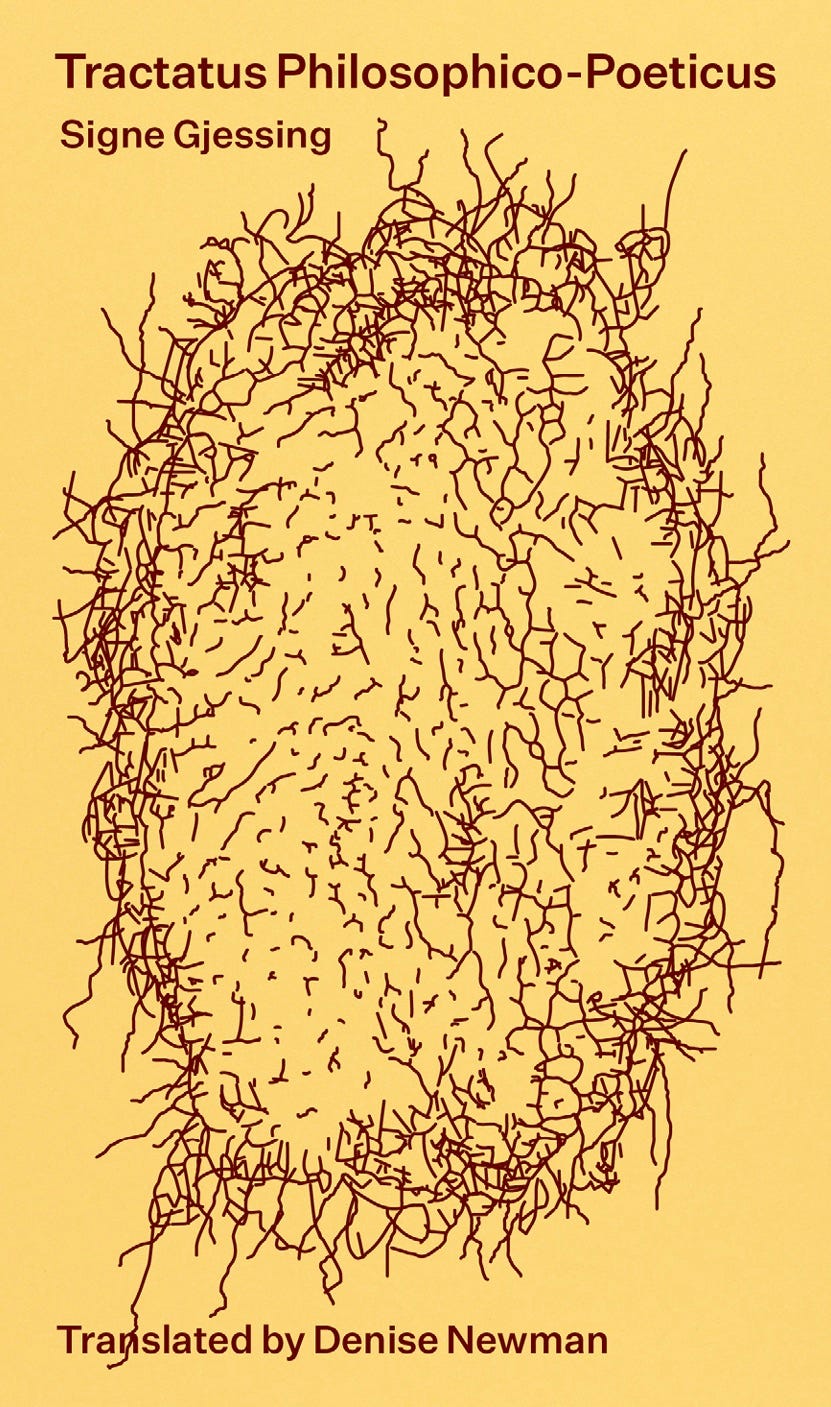
5. Wittgenstein did write verse: two poems about socks, 1925-26 (see Lindsay O’Connor Stern).
5.1. The first was a joking thank-you read aloud to “Filu” (Marie Fillunger).1
5.2. The second was influenced by the Austrian expressionist Georg Trakl’s “Helian.”
5.21.
Text within this block will maintain its original spacing when published
If you throw the fragrant veil of
                            true love on my head,
at the moving of the hands
the soft stirring of the limbs
bereft of sense becomes the soul.
Can you grasp it as it’s drifting
as it stirs with scarce a sound
and deep within the heart its imprint fixes.
At the sounding of the morning’s bell
The gardener through the garden’s space is passing
Touching with light feet the ground
the flowers rouse themselves and gaze
inquiring on his radiant,
peaceful face:
Who was it then who wove the veil around your foot
touching us gently like a breath of wind
Is even Zephyr too your servant?
Was it the spider, or was it the silkworm?
5.3. Is this line from Gjessing mere coincidence?—
5.4. Worlds seal off like a tree crown. Here lives my blood, the silkworm.
5.5. She goes on…
6. The world is No. 1.
6.01. The world is, if not an exception, then an exceptional occurrence of inexperienced creation.
6.1. Even if you subtract all the silk, the world is still the most cosmic.
6.11. It’s a good thing that we have silk to tell fairy tales to materiality, but do they have to be so long?
6.111. …
7. Were socks, for Wittgenstein, like van Gogh’s shoes for Heidegger?
7.1. We want to walk: so we need friction. Back to the rough ground!
7.11. But do not trample the garden in heavy boots, like workers.
7.22. Instead, tread delicately in socks,
Text within this block will maintain its original spacing when published
Touching with light feet the ground
the flowers rouse themselves and gaze
inquiring on [your] radiant,
peaceful face:
7.3. Philosophy leaves everything as it is.
Song for Filu
Text within this block will maintain its original spacing when published
Dulcet is the quail’s flutter
Dulcet the bulbul’s sweet lament
But Filu’s joyous melodies
Your heart fill with bliss rent and bent.
Soft is moss on the forest floor
Zephyr’s blest and fussy whispers
Softer Filu’s threads all woollen
When under foot curled in twisters.
The oak’s trunk everlasting
Quartz crested-mountain heights withal:
Eternal, Filu’s yarn enmeshed
Lifting strides, as if wing’d in sprawl!
No posts
Comments
Nothing yet. Say the first thing.
Sign in to join the conversation.