
How to read as the future falls apart—or is slowly shredded and sold for parts, cruelly, senselessly, not even profitably, in the end?
You could turn to someone who faced this dissonance and kept reading, like Virginia Woolf from 1933 to 1941.
Or, like me, you could turn to someone reading someone who faced this dissonance and kept reading: Cynthia Zarin on Woolf’s diaries in the LA Review of Books.
Or, like you, you could turn to someone reading someone reading someone who faced this dissonance and kept reading, as I am doing now.
In 1934, Zarin finds Woolf
trying, how ineffectively, to express the sensation of sitting here & reading, like an act in a play, how Hitler flew to Munich & killed this that & the other man & woman in Germany yesterday. […] Meanwhile these brutal bullies go about […] like little boys dressed up, acting this idiotic, meaningless, brutal, bloody, pandemonium.
In 1940, Woolf rereads Sense and Sensibility and contemplates suicide by carbon monoxide poisoning, as Hitler threatens to invade:
I will continue—but can I? […] A gritting day. As sample of my present mood, I reflect: capitulation will mean all Jews to be given up. Concentration camps. So to our garage.
“How do we at once resist tyranny and shop for haddock for supper?” Zarin asks.
New to me is the discovery that both Leonard and Virginia Woolf were listed in Hitler’s “Black Book” of those “who would be immediately arrested and handed over to the Gestapo when Britain was invaded and occupied.” It was under the shadow of that invasion that Woolf killed herself by drowning, April 1941.
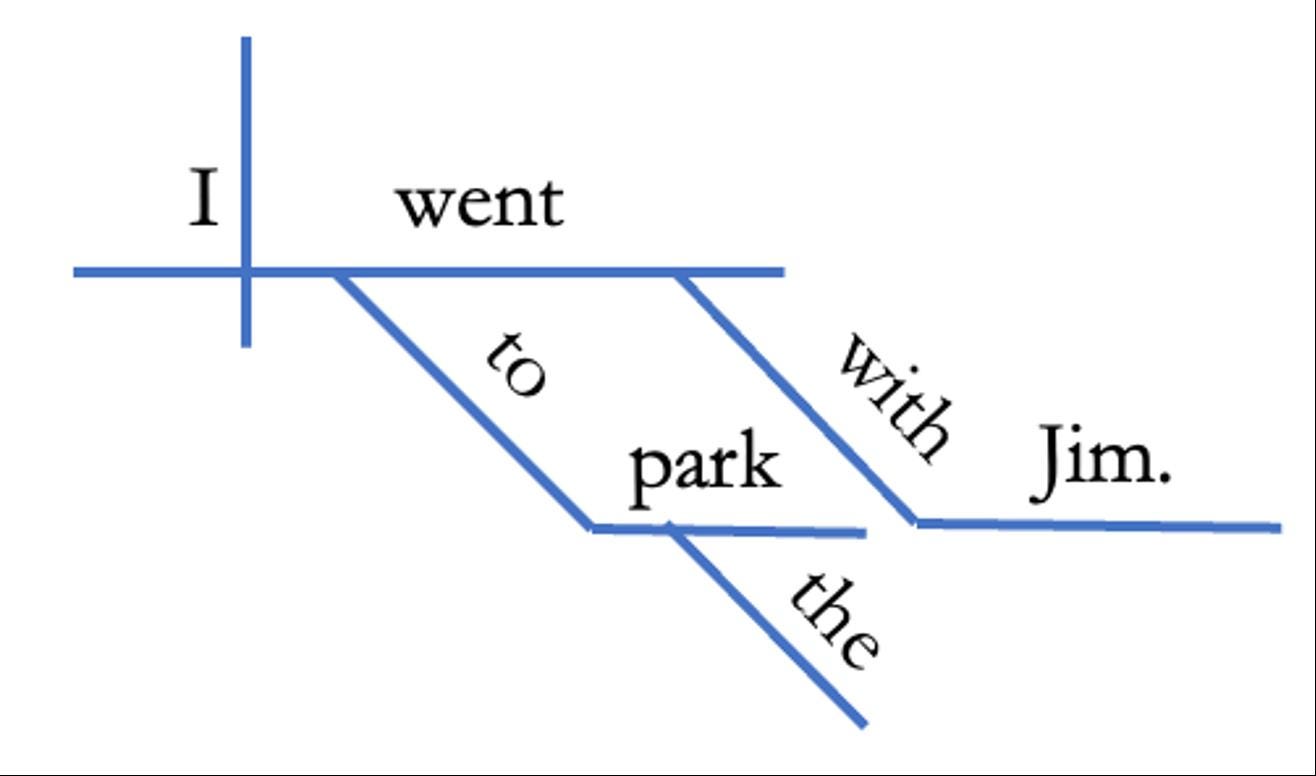
A different kind of reading, superficially, in Hannah Smart’s attention to a single 900-word sentence by David Foster Wallace, in a second essay from the LA Review of Books. Smart’s close reading turns on a year spent trying, and failing, to diagram the sentence—a skill I never encountered in school and whose point I find somewhat baffling.
The sentence in question inhabits the consciousness of a focus group coordinator, Terry Schmidt, working his way through an elaborate argument for dramatic action, disrupting the status quo, that he is bound to convince himself not to take. The sentence descends into clause within clause, like the circles of hell, yet it remains intelligible, and even gripping, throughout:
The effect, for readers, is that we feel constantly suspended on the brink of grammatical satisfaction whose denial Wallace disguises as mere postponement.
Smart reads the sentence, which conspicuously and extensively violates Foster’s own stylistic rules against redundancy and pompous verbiage, as a satire of the contemporary illusion “that something will happen if we simply sift through enough meaningless data”—since “the gratification we’re promised never arrives.” We’re insidiously induced to endure the drone of corporate bullshit.
She has a point. But it’s also possible to sink into the shallows of the sentence like a warm bath—900 words, reproduced in full in Smart’s piece, that are alarmingly engaging and enjoyable to read—intentionally deferring confrontation with a world one is unable to transform, and so to face.
No posts
Comments
Nothing yet. Say the first thing.
Sign in to join the conversation.