
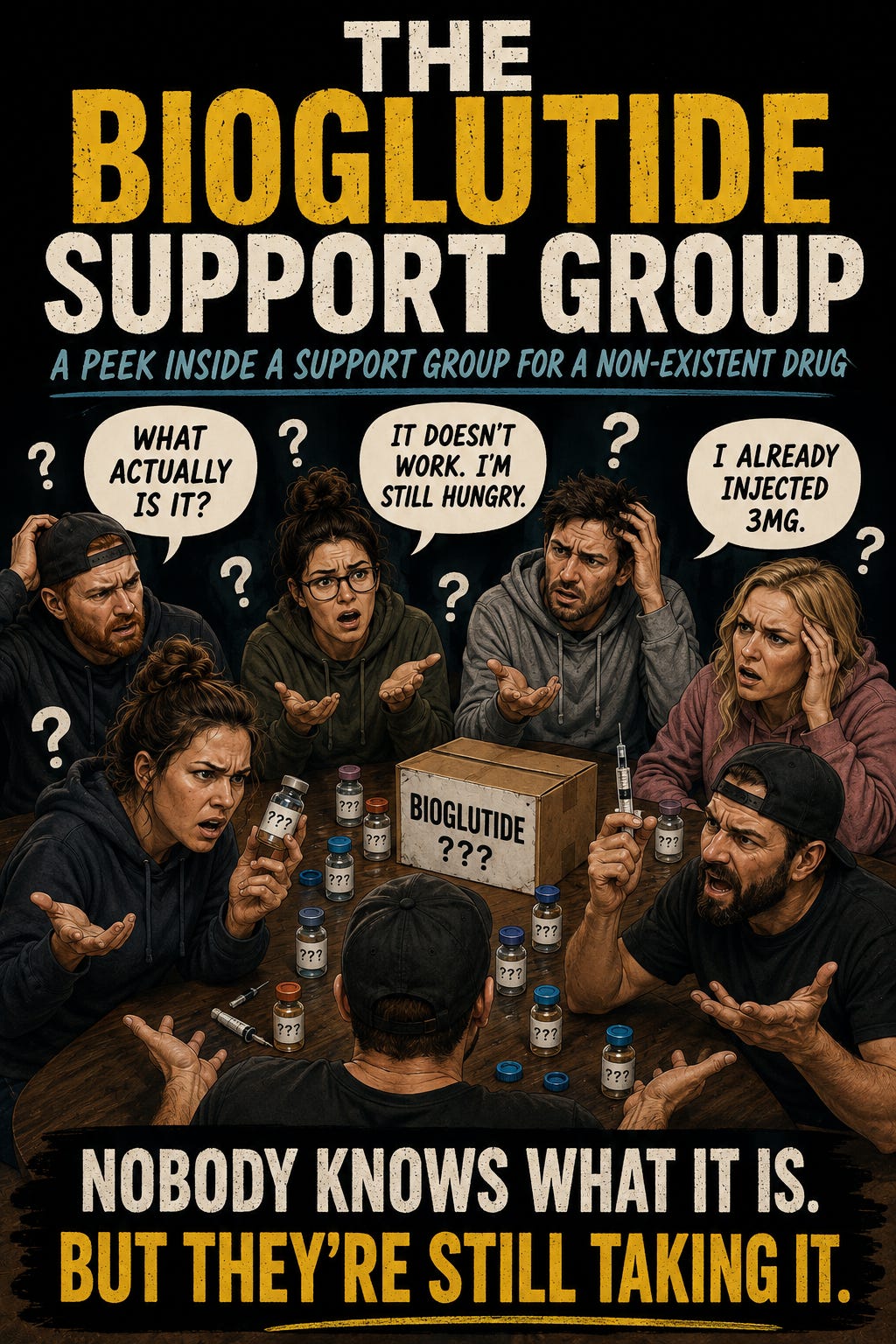
There’s something particularly entertaining about watching a support group form around a drug whose identity nobody appears able to establish.
Welcome to the Bioglutide support group. People have bought it. People are selling it. People are taking it. People are reporting that it DOES ABSOLUTELY NOTHING.
The only minor detail still outstanding is finding out what the hell it actually is.
Can We Get a COA?
The discussion starts with perhaps the most reasonable question imaginable:
“Can we get a COA for Bioglutide please?”
The response:

“We’re all waiting for that mate.”
Then comes the explanation for why apparently nobody can test it:
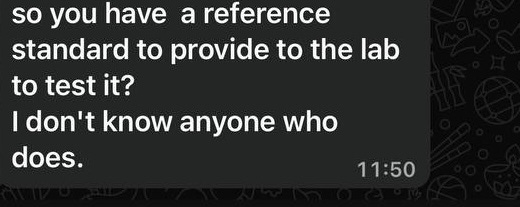
“So you have a reference standard to provide to the lab to test it? I don’t know anyone who does.”

And this misconception keeps appearing throughout the discussion. Apparently Bioglutide can’t be tested because nobody has a reference standard. Another person says they “can’t send it for testing yet,” while somebody else suggests it could take 6–12 months before a reference sample becomes available. There is a problem with that explanation.
You absolutely can send an unknown substance for analytical testing.
What you can’t necessarily do without an authentic reference standard and validated method is confidently perform every type of targeted identification or quantitative assay and declare, “Yes, this is authentic NA-931 at exactly X mg.” Those are two completely different things.
NMR and mass spectrometry can provide substantial information about an unknown compound without somebody first handing the laboratory a vial of authentic NA-931. We know this because it’s already been done.
Kimera Chems obtained raw material being sold as NA-931 from Sonwu API and sent it to NuMega Resonance Labs. Rather than asking NuMega to confirm something against an NA-931 reference standard that doesn’t exist publicly, the material was treated as an unknown. Kimera requested H-1 NMR and positive and negative ESI mass spectrometry, including a broad mass scan looking for the multiply charged envelope expected if the material were a peptide in roughly the 4000–5000 Da range.
The result? It wasn’t a mystery anymore.
The material was consistent with NA-831 / Traneurocin / cyclo(Pro-Gly), a tiny cyclic dipeptide with a molecular weight of approximately 154 Da. So “we can’t test it because there is no reference standard” isn’t a particularly good reason for selling an unidentified powder without investigating what it actually contains.
The Human Clinical Trial Has Already Started Anyway
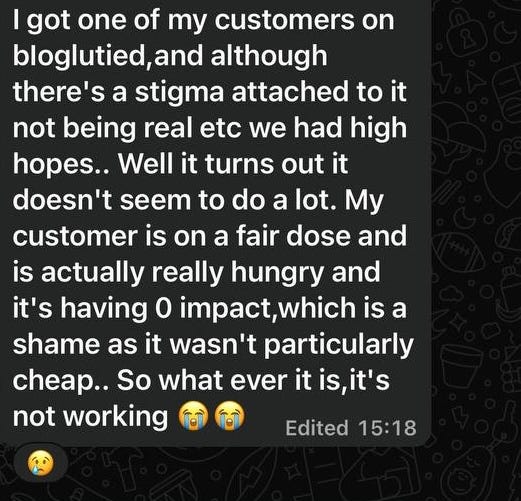
While everyone waits for this apparently impossible laboratory testing, there is another testing programme underway.
The customers.
One person reports putting a customer on Bioglutide at a “fair dose.”
The result?
They were really hungry and experiencing zero effect.
Another volunteer then announces:

“As your group Guinea Pig? I banged another 3mg and I can confirm I’ve had zero suppression.”
He was going back to Retatrutide. Excellent. We don’t know what the substance is. We don’t have a COA. We don’t have an authenticated NA-931 reference standard. We don’t have independent confirmation that anyone is manufacturing the alleged drug. But we do have someone administering another 3 mg to himself to see what happens.
If some of the “Bioglutide” currently circulating is actually NA-831/cGP, users waiting for the dramatic appetite suppression associated with GLP-1 drugs may notice very little at all. That would fit the reports appearing in the group, but lack of symptoms alone cannot identify what they were given.
Phase 1, WhatsApp edition.
Meanwhile, People Are Still Buying It
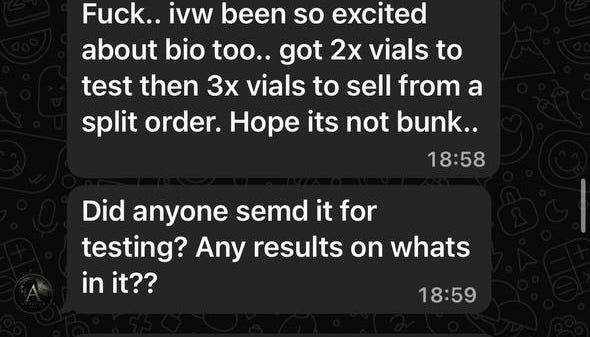
The best part is that none of this appears to have stopped the commercial operation. One person had already bought two vials for testing and another three to sell. Another had ordered some and was still waiting for it to arrive, only to discover from the conversation that the people already using it weren’t particularly impressed. Their response was beautifully understated:

“I’m already annoyed that it doesn’t work, and I haven’t even used it yet.”
Probably the first adverse event recorded before exposure.
But Who Actually Made It?

Eventually someone asks another rather important question:
Who manufactured it?
Surely, they reason, somebody knows what’s in it. They couldn’t simply have found a random crate of material and decided: “Oh, we’ll call this Bioglutide and ship it out.”

Someone immediately replies:
“It was called Blog. 😂”
At this point, satire becomes largely unnecessary. But underneath the joke is a serious question. If this is actually a manufactured blend rather than genuine NA-931, then somebody knows the recipe. The manufacturer knows what it put into it. The wholesaler should be able to obtain that information. The seller should know what it purchased. Yet the customers appear to be the ones trying to reverse-engineer the product after buying it.
“Someone Knows What’s in It”
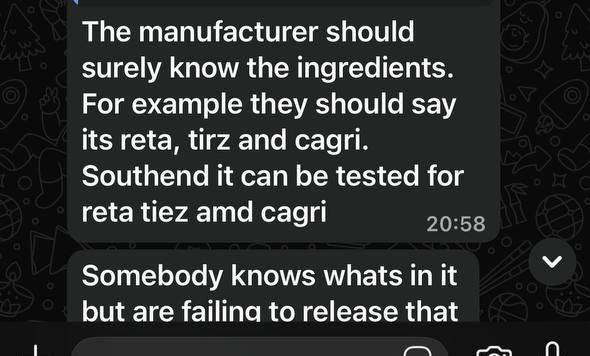
The conversation eventually arrives at exactly the right point:
“Somebody knows what’s in it but are failing to release that information.”
Exactly. One participant suggests that perhaps it contains known compounds such as Retatrutide, Tirzepatide and Cagrilintide. If that were the case, labs could specifically look for those compounds. And there is precedent for something very similar. Back in October, a product being sold as Bioglutide by Limitless was tested by Janoshik and found to contain Retatrutide and Cagrilintide rather than some novel NA-931 molecule. So there may not even be one universal substance being sold as “Bioglutide.”
One product has already appeared as a peptide stack.
The Sonwu API raw material examined through NuMega produced analytical data consistent with NA-831. Other products currently being sold under the same name remain unidentified. That makes statements such as “Bioglutide doesn’t work” almost meaningless.
Which Bioglutide?
Until the contents are established, two customers buying “NA-931” from different sources may not even be taking the same molecule.
Apparently, “Lose-Lose” Is Too Negative
There is one final moment that sums the entire thing up beautifully. After users had already reported zero appetite suppression, there was still no COA, and nobody could clearly explain what the product actually contained, someone described the situation as a “lose-lose.”
That prompted the response: “Have you tested it? Then before saying comments like this spreading negativity how about you do some actual research and prove something.”
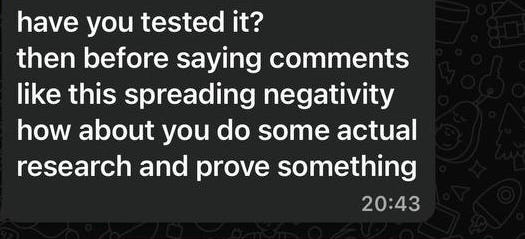
Which is an interesting standard of evidence when the product being defended apparently hadn’t been independently tested either. You can’t criticise it until you test it, but apparently you can sell it and take it before anyone has established what it is.
That’s completely backwards. The burden of proof shouldn’t sit with the customer questioning an unidentified research chemical. If someone is selling a product as NA-931, the seller should be able to provide credible evidence establishing what that product contains.
Instead, we have the Bioglutide Support Group: people buying it, taking it, trying to work out how to test it afterwards, and being accused of “spreading negativity” when they ask fairly obvious questions. Perhaps the best summary came from the person who asked:
“They didn’t just find a random crate of stuff and go ‘oh, we’ll call this Bioglutide’ and ship it out?”
At this point, I wouldn’t rule anything out. And judging by the reports so far, Bioglutide may have achieved something genuinely groundbreaking: a hyped weight-loss drug so ineffective it can’t even manage a placebo effect.
No posts
Comments
Nothing yet. Say the first thing.
Sign in to join the conversation.