
It’s incredible when “elite human capital” from both the left and the right manage to make arguments they presumably think will convince people of their favored policies, but that seem virtually crafted in a lab to cause populist backlash against them. There is absolutely nowhere this happens more than the topic of immigration.
Usually, it happens from the left, when pundits seem to temporarily forget that they’re supposed to be the party that supports workers, and make cluelessly aristocratic statements about how terrible it would be if the prices they pay to their servant class go up. Often forgetting small details, like the fact that 90% of American households clean their own homes and mow their own lawns. See for example this week’s tweet from Jill Filipovic, who is a bi-continental, big-media columnist with a law degree and BA in journalism and gender and sexuality studies from NYU, and thus the exact type of person to raise populist hackles with statements like this:

Unsurprisingly, this tweet did not go over well. Though getting ratioed by profiles with both blue-haired vaccine-lovers and flag-waving MAGA is somewhat impressive.

Meanwhile, on the opposite side of the coin, Richard Hanania makes essentially the exact same argument, just in reverse, wanting to lean in to the fact that low-skilled immigrants can provide a handy servant class for existing Americans to exploit:
If I were going to sell Groypers on higher levels of immigration, my pitch would go something like this: Guys, you’re totally right. We should care about the well being of white Americans first and foremost. And I’ve got some good news. There are literally billions of people out there who live on a few dollars a day. They would do anything to be here. And I mean anything. You can have your own butler and servants on your middle-manager at Walmart salary. Imagine how good it would feel to live like a British Lord. And the women, my God. Girls born here won’t even look at you unless they’re obese. You see how hot those Filipinas are, right? Well the average man in their country is 5’4. You’re a wealthy giant to them! Let’s do this. Don’t worry about crime. If they do so much as jaywalk they’re completely gone. We’ll make sure they never vote either. America First!
Now, Richard is at least honest about the fact that (1) his ideal system for US immigration is to model Dubai, and (2) he thinks anyone who thinks “things other than GDP matter” is a complete moron. And as the founder and President of The Center for the Study of Partisanship and Ideology, a think-tank funded by plutocrats to produce libertarian research, I’m going to guess that he thinks the US Gini Coefficient – though it just keeps rising and is one of the highest in the developed world – is just too darn low. At least he’s clear about his motivations.
For many decades, the specter of racism has successfully been used to suppress critique of immigration from the left on economic grounds. Any whiff of concern that millions of unskilled laborers flooding the labor supply would harm the existing working class was quickly stamped out with accusations that those concerns were just a ruse for racism and xenophobia. And besides, poor, starving, helpless immigrants who went through hell to get here and just want to work in horrific conditions for poverty wages deserve more sympathy than a bunch of lazy American white-trash, who are such losers they can’t find real jobs. Which, if one were a space alien, neutrally observing the measure of things, rather than a politician responsible for the well-being of the citizens they represent, makes a lot of sense.
So this narrative successfully shifted well-educated and well-heeled bleeding-heart sympathies from the native working class they traditionally supported to undocumented workers, and the issue basically vanished on the left. At most, one was allowed to protest that it’s the employers who should be punished, not the migrants themselves (even if they broke the law to be here), and that if we just had the proper redistributive taxes on the rich and solid worker protection, none of this would be a problem.
Which might make sense, if there was any possible universe where either of those things would happen, which there is not. E-Verify was established as an entirely free and incredibly easy system for employers to confirm the eligibility of their employees to work in the U.S. THIRTY YEARS AGO…and Congress has repeatedly refused to require that employers use it. Why? Because employers don’t want to, and our entire immigration system exists to serve the needs of employers, and neither party is willing to piss off its biggest donors with an incredibly simple law.
Anyway, the fear of BIG RACISM worked really well to mute leftish concern for labor, and Congress perpetually pretends to want to do something when really it does not, so today we have this:
Which is fine, because really, who is more sympathetic?

The problem, of course, is that this shift in policy and sympathies caused the working class to flee the Democrat party and join MAGA. Which somehow caught Democrats by surprise.
Well, as we all know, since Trump won his third election and Elon Musk bought Twitter, the “vibes” have shifted, meaning everyone now gets to be As Racist As They Wanna Be.
[I really feel I deserve applause for my restraint in NOT adding an image here of the 2 Live Crew album cover with the faces of Nick Fuentes and fellow pro-racists over the original Crew’s faces and under the be-thonged ladies’ bums, but I realize that’s the exactly the kind of thing he’d love, so I won’t].
So what’s the problem for Richard? Well, he correctly notes that recent opposition to H1-Bs has no valid economic argument behind it, or at least, not a very compelling one. H1-B workers are precisely the type of high-skilled immigrants that really DO provide all the wonderful things for the economy that the CATO Institute is always telling us…they help drive innovation, don’t commit crime or use welfare benefits, and add to the overall level of knowledge, skills, productivity and ultimately wealth of the country. And since there’s no great economic argument to be made against H1-Bs, the software coders who can’t find jobs have mostly just gone with straight-up racism as their gripe, rather than suddenly finding cause with their underpaid and under-employed working class brethren.
But here’s the amazing part! Richard’s concern is that once the door is opened to accepting labor-based reasons for opposing immigration, people on the right will end up supporting labor unions and minimum wages that track cost of living, and similar such horrors. And so, he writes “This leads to the question of whether explicit racism is preferable, because it helps avoid this problem.” Incredible. The elite liberal “but then I might have to pay my nanny living wages” type argument can perhaps be excused as mistakenly clueless, but “maybe we should encourage explicit racism to distract people from labor concerns” argument really takes the cake for breathtaking callousness. Bravo to Mr. Hanania for always finding the best possible argument to piss off everyone.
Though I don’t disagree that his “you can live like a feudal lord with your mediocre job, oh, and bonus, third-world chicks will be impressed because you’re 5’8” and manage a diner” argument would be appealing to the Groypers. I’m fairly certain that lowering women’s standards and getting to boss around brown people are essentially their only true policy goals. However, middle-class white boys who were raised being told by their mom that they’re smarter and better than everyone else, and who are infuriated to find upon entering adulthood that they face competition like everyone else and no one other than their mom thinks they’re special, and who have thus funneled all their disappointments and fury into fantasies about returning to a golden quasi-medieval age where they would be lords in charge of everyone (but never peasants and still with their high tech), are simply not a very large voting bloc. They’re wildly over-represented on X and other online platforms, because young dudes love to tell everyone their opinions and to go kill themselves, but a very small share of the population. Even if we assumed that literally every single white man in the country between the ages of 18 and 34 was Groyperish, which they are not, this is only 5%.
However, widely circulating the “we should be like Dubai so you can live like racist lords with desperate third world baes on call” message would send every conservative woman left in the GOP fleeing. As well as the very large and formidable actual working class base of MAGA. And it would swiftly annihilate the left’s aversion to talking about immigrant erosion of working class wages. In fact, I’m not sure I can actually conceive of a platform more likely to make leftists furiously oppose a policy than one framed as increasing the ability of right-wing white guys to exercise dominion over non-whites and women. This tactic may literally be the single best one I can imagine to bring about a 1920s style populist revolt to just shut down immigration entirely, that gets passed 90-10 like they did when they shut down immigration last century.
Forget about the fact that the United Arab Emirates sits upon a vast store of oil that requires virtually no productivity from its citizens, and therefore grants them land for free, pensions, child care, and every other welfare benefit you can imagine, while imposing virtually no taxes, and thus any comparison to the US is laughable. Or the fact that its citizens feel free to treat their migrant workers like vermin, regularly kicking and spitting on them in the street if they happen to make the mistake of eye contact.
Ultimately, on both sides here, the real issue no one wants to address is clearly summed up in this chart:
I was already well familiar with the huge drop in inequality that Americans enjoyed mid-20th century, which experts give various explanations for, from tax rates to post-war veterans just deciding to be nice to each other and get along. But when I started looking into the immigration data, the curve is just a bit too familiar. And it seems pretty weird that this is almost never put forth as an explanation, or at least a *factor* towards why we had such broadly-distributed prosperity in those years, which magically lines up to the only time in American history where the government decided to severely restrict low-skilled immigration.
(Skip this part if you know your immigration history)
The US had no citizenship or immigration laws, really, until the 1800s.
The first one was the 1864 Act to Encourage Immigration, to address labor shortages due to the Civil War, which made contracts for immigrant labor formed abroad enforceable by U.S. courts. This was extremely controversial and viewed as legalizing indentured servitude, with labor groups opposing it on the grounds that that it was only done so that employers could import cheap, contract labor to break strikes and suppress wages. It was repealed four years later.
Then for the next several decades, the US enacted various increasing restrictions, first prohibiting criminals or forced labor, then banning all immigrants from Asia, then banning polygamists and those with contagious diseases, and eventually banning anarchists, beggars, and prostitutes.
The 1921 Emergency Quota Act was adopted in response to the huge influx of southern and eastern Europeans, which imposed the first cap on immigration, and quotas, and this was made permanent in 1924, reducing the cap even further down to 165,000 total immigrants per year, keeping the total ban on Asian immigrants, and imposing a quota system that allowed only 2% of existing population in the US from each country to come from each country, which essentially meant just northern and western Europe and Africa, who weren’t that interested in immigrating anyway. This was passed overwhelmingly with virtually no objections, with a more than 90% vote in the House and Senate. This system ruled the day for the next 35 years, and immigration screeched to a halt.
The system was radically changed with the 1965 Immigration Act, which replaced the national origins quota system with a seven-category preference system emphasizing family reunification and skilled immigrants. No visa cap was placed on the number of immediate family members of U.S. citizens admitted each year. At the time, there was immense pressure from allies to stop being discriminatory, and internally from the civil rights movement and people being embarrassed by the clear discrimination against certain countries and racial groups. It was not particularly controversial, though it failed the first few votes, but the various subcommittee members assured everyone that the act was really no big deal and would not change much. Edward Kennedy’s remarks were typical: “the bill will not flood our cities with immigrants. It will not upset the ethnic mix of our society. It will not relax the standards of admission. It will not cause American workers to lose their jobs.” Seemingly most of the legislators really believed that to be the case, at the time.
Immigration of course skyrocketed over the next two decades and became controversial again. Reagan signed into law a grand bargain with his 1986 Amnesty Bill, which traded off granting a pathway to residency for the 2.7 million unauthorized migrants who were here, supposedly in exchange for cracking down harder on employers by implementing penalties on those who knowingly employed undocumented workers and ramping up border enforcement. No ever really enforced the penalties though, or employers just shifted the risk by using outsourcing companies.
It’s interesting that immigration is the one area where you find economists suddenly claiming that supply and demand somehow do NOT operate in the very simple and straight-forward manner you’d expect them to operate, and instead things get problematized as extremely complex with long time horizons that are difficult to calculate with numerous factors. I’ll be upfront here and say that my inclination to trust any given economist’s findings is not particularly strong, without knowing who funded the research. Lawyers hire economists to act as expert witnesses in litigation all the time, and trust me, they will expertly opine on anything you want them to, and make findings for any outcome they’re paid to. Also, the literature on this issue is very far from “settled” in the way that groups like the Cato Institute always want to make it appear. Instead, there are plenty of eminent economists with papers dissing and debunking each other’s theories.
But this really does not seem particularly complicated. The pro-business and pro-worker sides have been arguing about the very same thing for over a century now, just as they do in other countries. And even the groups who most highly favor ramping up immigration do not pretend that it doesn’t negatively impact the wages of the workers they compete with – which would be preposterous. Both Ms. Filipovic’s tweet and Mr. Hanania’s idea of selling racists on the benefits of cheap servants implicitly understand that the entire point of importing unskilled labor is to make such services as cheap as possible.
Therefore, when the George W. Bush Institute publishes pieces titled “Benefits of Immigration Outweigh the Costs”, they admit that “Yes, there are downsides - it lowers the wages of competing workers, while raising the return to capital and the wages of complementary workers. In other words, the immigration surplus does not accrue equally to everyone. It goes primarily to the owners of capital, which includes business and land-owners and investors.” Typically, they then note that such wage pressure only applies to existing immigrants and people without education, with a heavy implication that those are the people who don’t matter anyway.
So screwing over the already-poor people to bring in even poorer people gets hand-waved. The real issue here is that wages are one of the areas in economics that are in fact zero-sum. Libertarians constantly complain that everyone else insists on viewing transactions in zero-sum terms, even though trade benefits everyone. This of course is not true, and I don’t know a single person who denies the benefits of trade when parties can engage in specialization, or with respect to advancing technology, which is the main source of improving standards. The problem is that libertarians refuse to acknowledge that plenty of transactions ARE zero-sum, and how much a company pays to its workers versus its shareholders is about the clearest possible case of zero-sum that you get. One side wins, the other loses. There’s no pie expansion there, it’s simply a decision regarding splitting it.
Perpetual thorn in libertarians’ sides George J. Borjas, an economics professor at Harvard, puts this simply:
Somebody’s lower wage is always somebody else’s higher profit. In this case, immigration redistributes wealth from those who compete with immigrants to those who use immigrants—from the employee to the employer. And the additional profits are so large that the economic pie accruing to all natives actually grows. I estimate the current “immigration surplus”—the net increase in the total wealth of the native population—to be about$50 billion annually. But behind that calculation is a much larger shift from one group of Americans to another: The total wealth redistribution from the native losers to the native winners is enormous, roughly a half-trillion dollars a year. Immigrants, too, gain substantially; their total earnings far exceed what their income would have been had they not migrated.
When we look at the overall value of immigration, there’s one more complicating factor: Immigrants receive government assistance at higher rates than natives. The higher cost of all the services provided to immigrants and the lower taxes they pay (because they have lower earnings) inevitably implies that on a year-to-year basis immigration creates a fiscal hole of at least $50 billion—a burden that falls on the native population.
What does it all add up to? The fiscal burden offsets the gain from the $50 billion immigration surplus, so it’s not too farfetched to conclude that immigration has barely affected the total wealth of natives at all. Instead, it has changed how the pie is split, with the losers—the workers who compete with immigrants, many of those being low-skilled Americans—sending a roughly $500 billion check annually to the winners. Those winners are primarily their employers. And the immigrants themselves come out ahead, too. Put bluntly, immigration turns out to be just another income redistribution program.
Once we understand immigration this way, it’s clear why the issue splits Americans—why many low-skilled native workers are taking one side, and why immigrants and businesses are taking another. Our immigration policy—any immigration policy—is ultimately not just a statement about how much we care about immigrants, but how much we care about one particular group of natives over another.
And there’s the rub. Populists are not economically illiterate, nor falling for the “lump of labor fallacy”, they are advocating for their own economic interests. Just as the business owners are. And upper-middle class people mostly benefit by getting cheaper maids, landscapers, and nannies, so they are too. Trying to pretend this isn’t simply a clash of economic interests based on class is at best cowardly, and at worst dishonest.
But wait, don’t we have extremely low unemployment, which proves our labor market is flexible and the working class aren’t hurt at all by millions of people willing to work for peanuts?
No. Because when the current methods of calculating unemployment were first created in the 1960s, it never even occurred to anyone that it was possible that we would have millions of men with no jobs who aren’t even looking for work. There were no other options for them, at the time. They could work or starve to death. No woman would support them, and we did not yet have the disability and welfare safety net to keep them from starving. So unemployment is calculated as the ratio actively looking for and not finding work. But that hides the reality, which is this:
In fact, since we opened up the floodgates to immigration, the labor participation rate of the foreign born is actually higher than the native born. Which, perhaps makes one think “well good, just proves Americans are lazy bums and we need fresh blood.” Maybe so.
But all these non-working guys are not good for anyone. They’re unhappy and unproductive and get more pissed off by the year, and they cause a lot of problems for everyone and do a lot of complaining, and someone is supporting them.
When I was in high school, my mom purchased the building she lived in, and rented out the apartment below us. A white guy in his 50s lived there, who smoked pot all day long and didn’t seem to leave the apartment much. I asked her how he had a job if he was always at home smoking pot and watching TV, and she said he was on disability. He also mowed the lawn and did some maintenance work for rent credit, and seemed perfectly fine to me, so I don’t know what his disability was.
Apparently, there is no one government agency that can accurately track the various disability programs and how much is paid under Social Security, Veteran’s Disability, and Supplemental, but all estimates are that an enormous share of these non-working guys are supporting themselves in that manner, along with other programs like SNAP. Which should ALSO be factored into anyone’s cost-benefit analysis on immigration, as it simply beggars belief that at the same time we massively ramped up low-skill laborers, a bunch of American dudes decided that it’d be better to just live off the government in poverty and get stoned all day, and that that has nothing to do with losing jobs to workers willing to work for less.
To be fair, sitting at home in your apartment watching cartoons stoned does seem a lot better than working for the same amount in a stinking, morally eviscerating, slaughterhouse, or putting on roofs in 90 degree weather.
But lets not underplay the magnitude of the situation. For one thing, this also doesn’t take into account the fact that there has also been a massive plunge in teenagers working, over the same period, so that’s even more Americans who used to work and now they don’t. But sticking to the adults, according to Nicholas Eberstadt at the American Enterprise Institute:
Between 1948 and 2015, the work rate for men 20 and older (all postwar employment data are for the civilian noninstitutionalized population) fell from 85.8 percent to 68.2 percent — a drop of almost 18 percentage points. To put it another way: while many economists argue that the economy is currently at or near “full employment,” the work rate for men 20 and older was over a fifth lower than it was in 1948.
Here’s another way of thinking about the current work deficit for men. One reasonable benchmark for measuring that gap is the mid-1960s, when U.S. labor markets were apparently functioning at genuinely full employment levels. If age-specific work rates had simply held constant from 1965 to today, another 10.5 million men age 20-to-64 would have had jobs in 2015 — including an additional 6 million in the prime 25-to-54 group.
The rise of the unworking American man underscores the deeply antiquated and misleading nature of our primary measure of labor-market health: the unemployment rate. By that hoary yardstick, the employment situation for prime-age men in 2015 and early 2016 looks pretty good. But the unemployment rate, which calculates the percentage of people in the labor force who are without work but seeking jobs, was devised in an age in which mass withdrawal of working-age men from the labor force was inconceivable.
Between 1965 and 2015, the number of prime-age men neither working nor looking for work grew more than three times faster than the number in the workforce. Indeed, the economically inactive have come to eclipse the unemployed as the main category of men without jobs. By 2015, in any given month, there were on average three “unworking” prime-age men for each prime-age man out of work but looking for a job. At no point in the past two decades — not even during the Great Recession — have the unemployed exceeded the economically inactive among American prime-age men.
To be clear, he’s not the one tying things directly to immigration, that would be me. I can’t understand why these things would NOT be assumed to be related. Go back up and look at the chart.
Since I keep being told that it’s simply not true that massive increases in low-skill labor and people with no bargaining power erodes native wages, I thought I’d test out the income inequality thing by checking by state. Either it transfers money from the working class to the rich, or it doesn’t, right? And we have very different immigrant populations, depending on location, so this seems like a very simple calculation to run. Running the correlation between income inequality versus demographics by state, here’s how it pans out, looking at the share of a state’s population comprised of unauthorized immigrants:
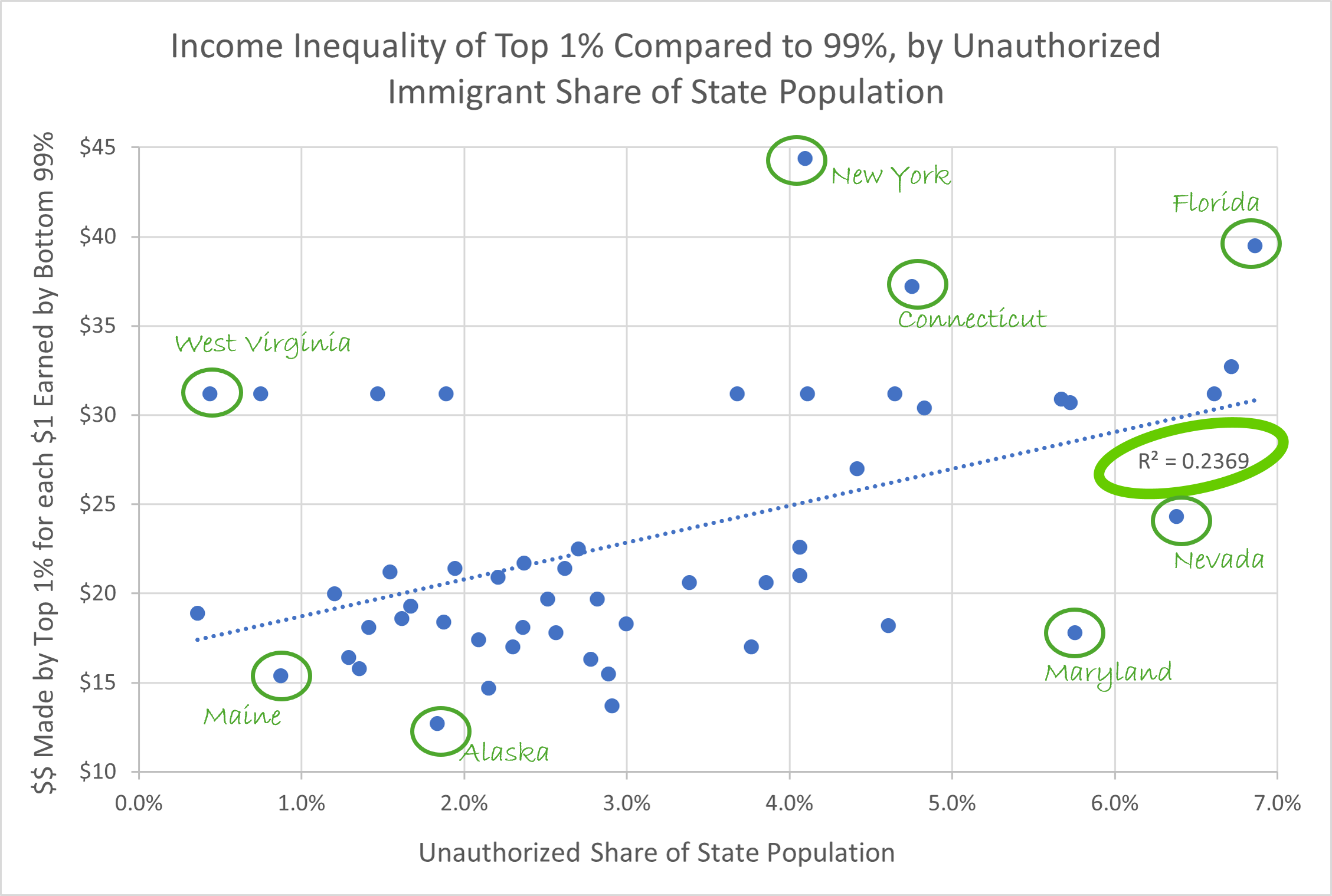
Looks pretty correlated to me. It certainly doesn’t explain it all, but that’s also not a random scatterplot.
Looking at this, I wondered how states with enormous numbers of unauthorized workers, like Nevada and Maryland, managed to stay below the trend line, and my guess is that it’s because they’re states that have massive unions for low-skill service sector workers. Nevada has the gigantic Culinary Workers Union, with members who are hotel maids, dishwashers, and similar jobs of exactly the type that unauthorized workers typically do. That probably helps a lot to keep legal workers’ wages stable. Similarly, Maryland has the Service Employees International Union (SEIU), which includes property service workers like janitors, landscaping, and building maintenance, and also a lot of home health and nursing home aides. This is different from other highly unionized states like New York, where union members are usually workers that don’t compete with immigrants, like public sector employees.
I also ran the numbers for income inequality by simple share of immigrants total, rather than focusing on just unauthorized workers, and interestingly, that correlation turned out to be even stronger:
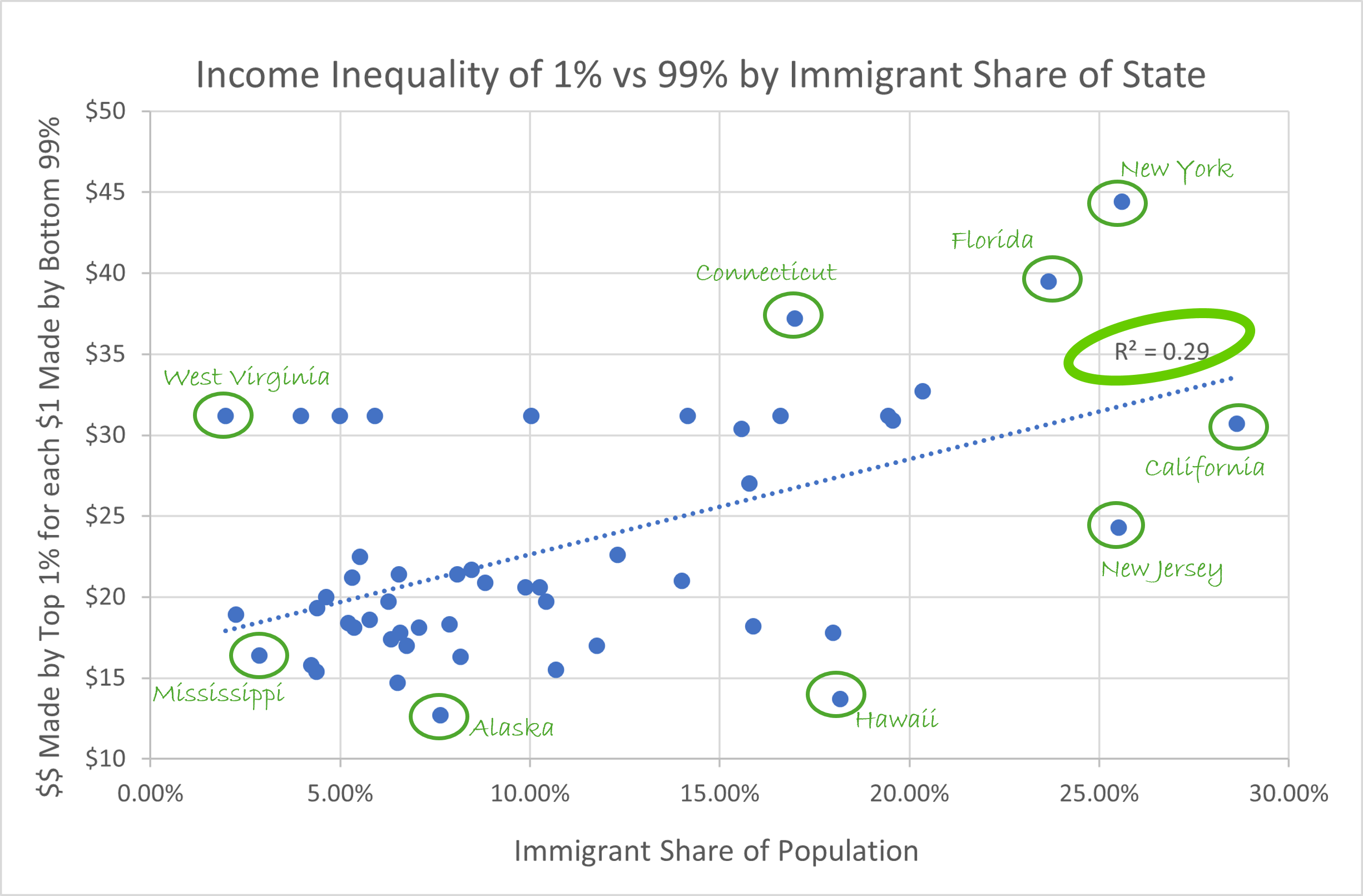
Here, the states coming in high on immigrant share but below the trend line are places with a lot of high-skilled immigration, like California with its tech workers, and New Jersey, which employs a ton of immigrant nurses and doctors.
As to why total immigrant share is actually MORE tightly correlated to income inequality than unauthorized worker share, well, that may be an uncomfortable question.
All I would really like is for politicians and pundits to stop pretending that this isn’t a fairly clear case of directly conflicting class interests. Yes, immigration is good for the economy if you measure it as a whole. Well, maybe. Actually, it appears to have literally zero impact on GDP one way or the other, or at least massive changes in immigration policy show no apparent effect:
But we DO know it is good for the immigrants themselves. And good for business owners. And hurts the interests of labor. All are true, so any policy is just picking your preferred winners and losers. And of course, none of this speaks to the morality of allowing unauthorized migrants to work and live in conditions that no one here would accept for themselves, which I feel is well-tread territory.
I have zero interest in racism or xenophobia. Or cruelty. I think most immigrants are hard-working, striving, lovely people who in all senses of the word “deserve” to be here, if one is judging by some global barometer of morality. But I don’t get to make global policy, none of us do, we only get to vote on what goes on here. I also have no problem with high-skilled immigration, and if well-paid urbanites want to start crying when suddenly they face competition instead of just some laborers they used to make fun of and tell to go learn how to code, I will have a hard time finding sympathy.
Perhaps some brave soul will propose a new grand compromise, that from now on we’ll welcome foreigners, but only if for each new entrant, we get to export one of our non-working natives that are living on the dole. I highly doubt most Americans would go for that, though given the utter disrespect and disregard shown for the working class over the past few decades, one never knows. But the current situation, where we get to keep paying for millions of prime-aged Americans living on welfare because they can’t afford food or rent without it, and keep accepting new arrivals to keep competing with them, and look the other way and ignore the millions who entered unlawfully, is unacceptable.
No posts
Comments
Nothing yet. Say the first thing.
Sign in to join the conversation.