
After hitchhiking the length of Turkey, my Romanian friend Adina and I needed to get from the Turkish city of Kars to Gyumri in Armenia, just a stone’s throw across the border.
However, the Turkish/Armenian border is closed, making a detour through Georgia necessary.
Standing just inside Georgia, a small car carrying three men pulled over and picked us up.

NEITHER OUR DRIVER nor his two friends speak English, but they know Russian and can understand my hybrid Slavic.
“Pochemu Armeniya?” our driver asks, (Why Armenia?), his tone suggesting offence that we don't wish to see Georgia.
We lie: Friends in Armenia.
A tall man in his forties is squeezed in the back with us. In the front passenger seat sits a younger man, similar look, possibly his brother. The driver looks like ex-special forces, fifty years old, grey-haired, barrel-chested, neck thicker than my thigh, head the size of a watermelon.
He is Georgi, local boy come good. Lives in Ukraine, where he owns a bar. Back in Georgia for a few days only, catching up with old friends, two of whom, Gocha and Levan, are in the car with us.
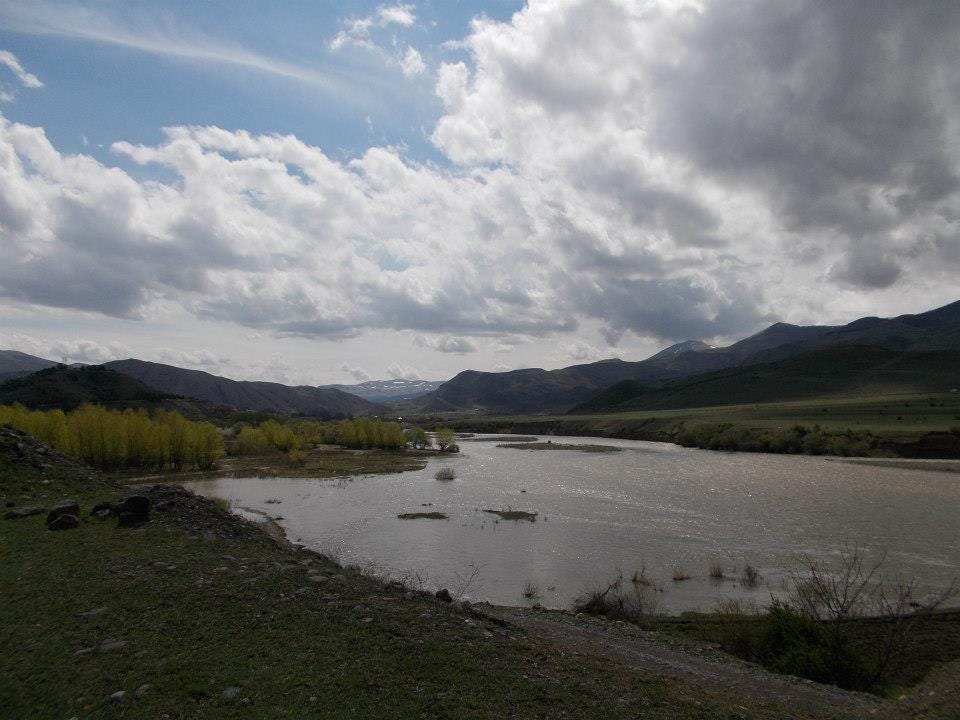
The drive takes us high into the hills, the greyness of Vale evolving into the rolling green fields and lush countryside of the Lesser Caucasus mountains.
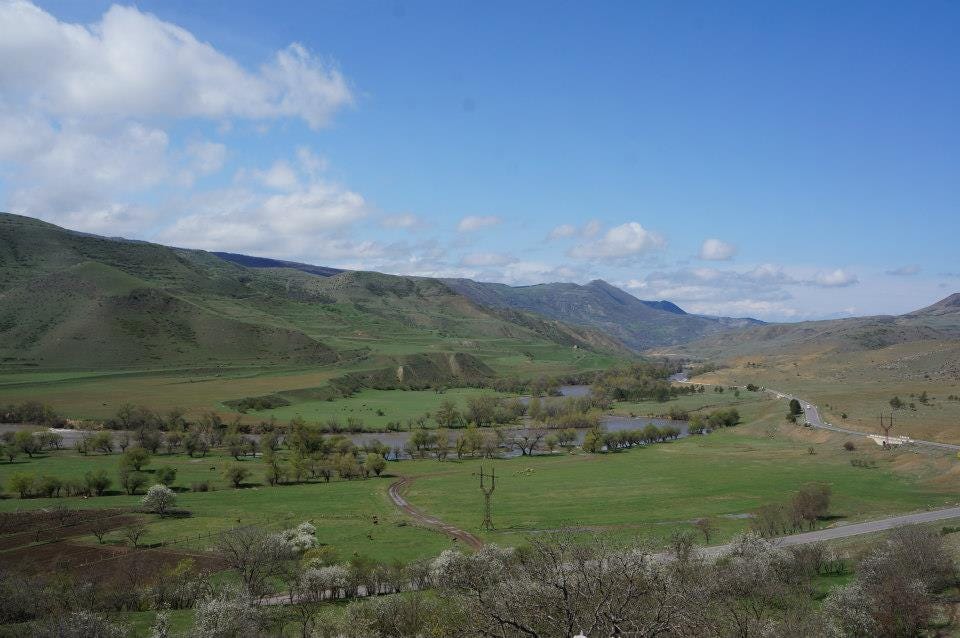
In the valley below, the mountains dip their feet into the river Kura. Houses are scattered far apart. Every few minutes we pass a church, all three men silently mark the cross on their chests, as peasants move along dirt paths on carts pulled by donkeys.
We arrive at a small house, its front a combination of wood and glass. Georgi takes our bags in one of his baseball glove-sized hands and carries them inside.
“Kris, Adina, coffee?”
Adina whispers: “We don't have time for this.”
I tell her it’s rude to turn down their hospitality.
The house is just one room, with a settee against the wall and a wooden table in the middle; a sink, hob and coffee pot, surrounded by a few cups in the corner; and a little walk-in storage room to the side, empty but for some tools and an unplumbed bathtub.
Levan makes coffee.
We take our cups outside and find Georgi in the adjoining field, collecting firewood. He vanishes down the path, returns a few minutes later carrying a large cooking oil container filled with homemade wine, pours each of us a glass.
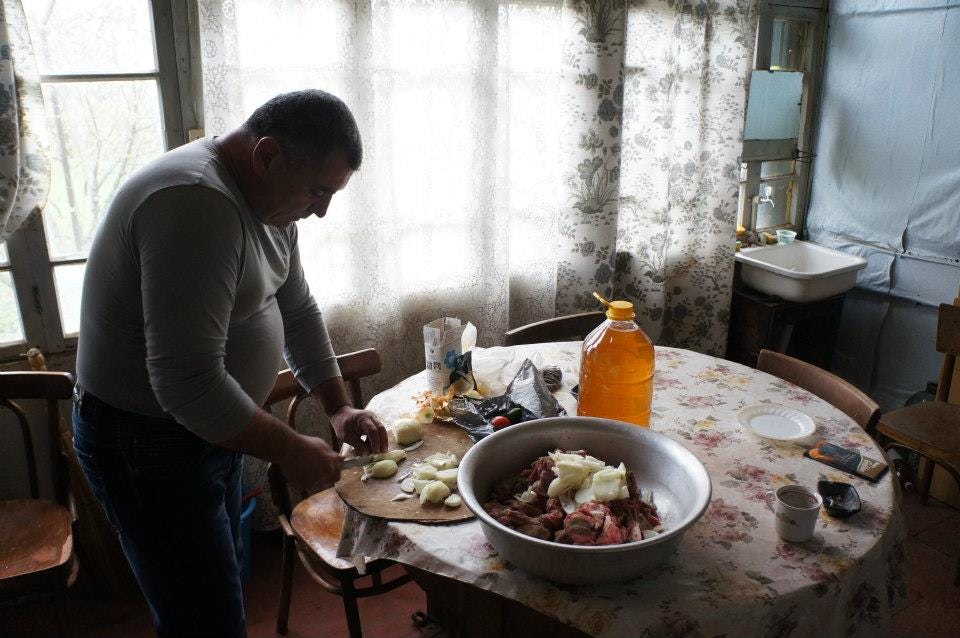
He disappears again. Then he returns with a huge metal bowl filled with onions, vegetables, and the flesh of a family of pigs.
Adina goes to stand outside on her own.
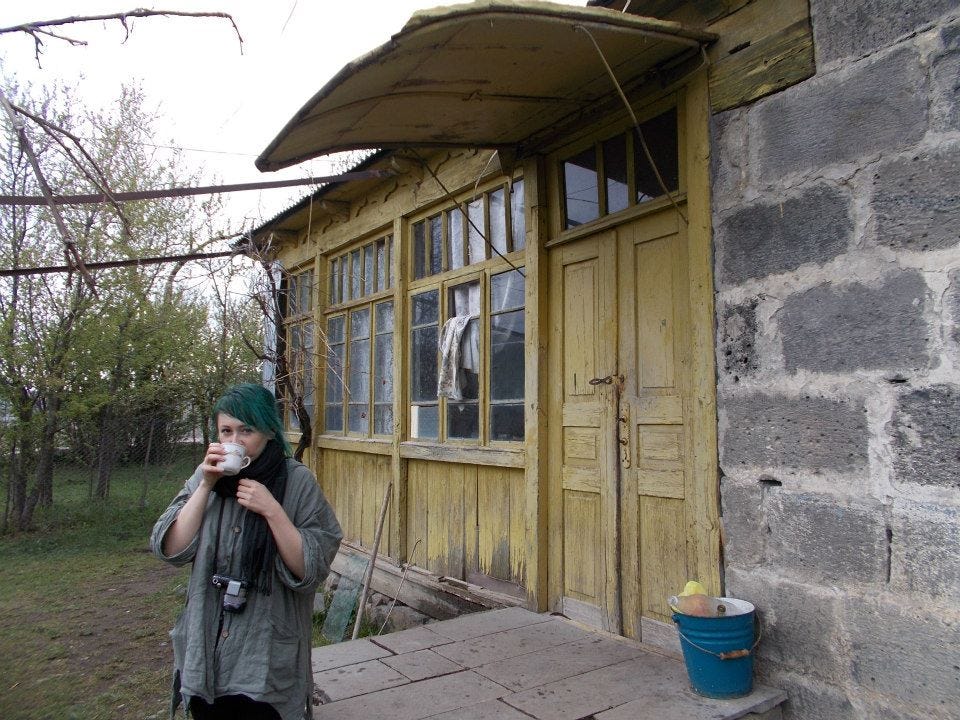
Georgi puts one of his gigantic arms around me, pats me on the back. Tells me the village is called Idumala. Then he says, “Kris, yest s nami. Armeniya utrom. Spat zdes.” (Kris, eat with us. Armenia tomorrow. Sleep here.)
He goes outside to wash his hands in the stone basin.
Adina steps back inside, looking annoyed.
“OK, we've finished the coffee,” she says, “Now let's thank them, say goodbye and get back down to the main road.”
“It seems we're staying for dinner,” I say.
“What? We don't have time for this! We need to get to Armenia TODAY!”
“It seems we're sleeping here tonight,” I say.
“What makes you think that?”
“Georgi just invited us.”
Before Adina can reply, Georgi returns with a second large container of wine, pours another glass of the golden liquid for each of us, then sets about preparing the meat.
Adina sits down on the settee, resigned to her fate.
Outside the house, the men of Idumala have shown up and are working as a team to construct a makeshift grill on which the meat will be cooked on skewers. Each of the new faces comes into the house to politely introduce himself and welcome us to their village, before going back outside to crack on with the work.
Levan, who disappeared after finishing his coffee, returns with another friend, and plonks down into the sink a plastic bag full of fish so fresh they are still jumping as though being electrocuted.
The men wave away our offers of help, as the sun slowly sets behind the mountains.
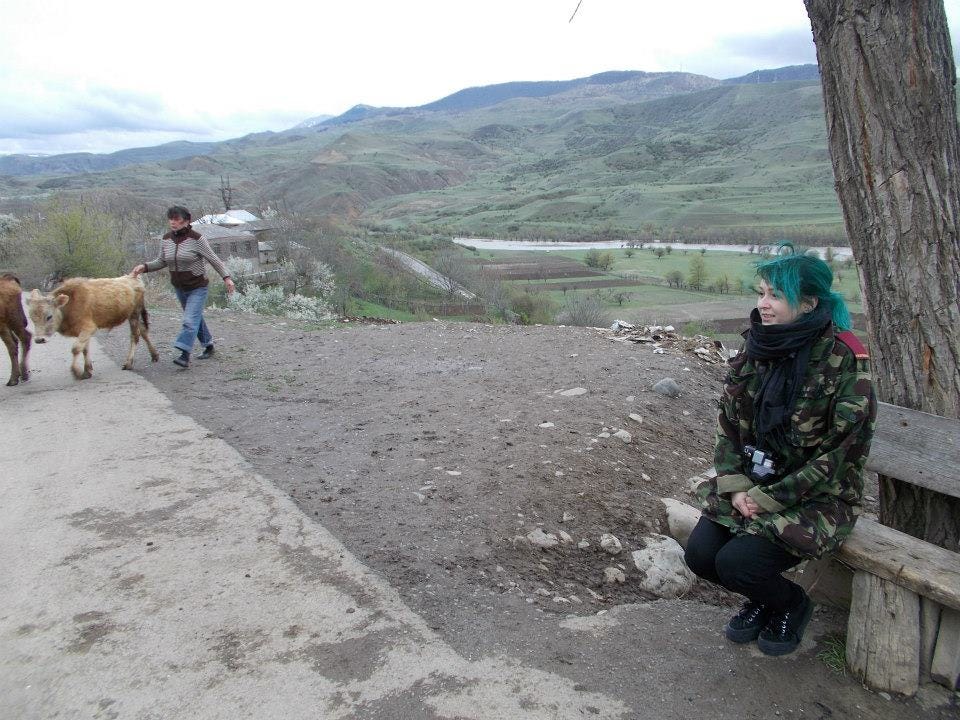
The house is so tiny, I wonder where we’ll sleep. There is no indoor toilet: a hole has been dug into the mud of an adjoining field, with a small wooden box built around it.
In front of the house, the boys have got the barbecue going and are standing watch over the grilling meat, licking their lips.
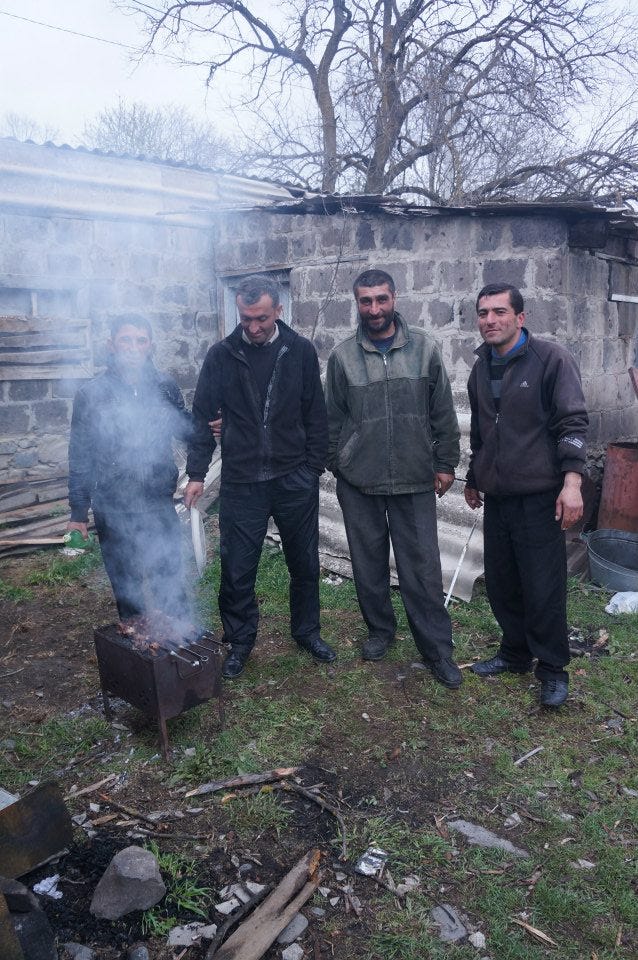
The smell of the cooking meat makes my mouth water. We drink more wine. Someone produces a plate of Georgian speciality Khachapuri (a hot and greasy bread, filled with a salty cheese called Sulguni). Georgi chops an onion and some tomatoes, adds salt and oil, puts the bowl on the table, along with a couple of loafs of fresh, crusty white bread.
The first of the pork arrives, carried into the house on skewers.
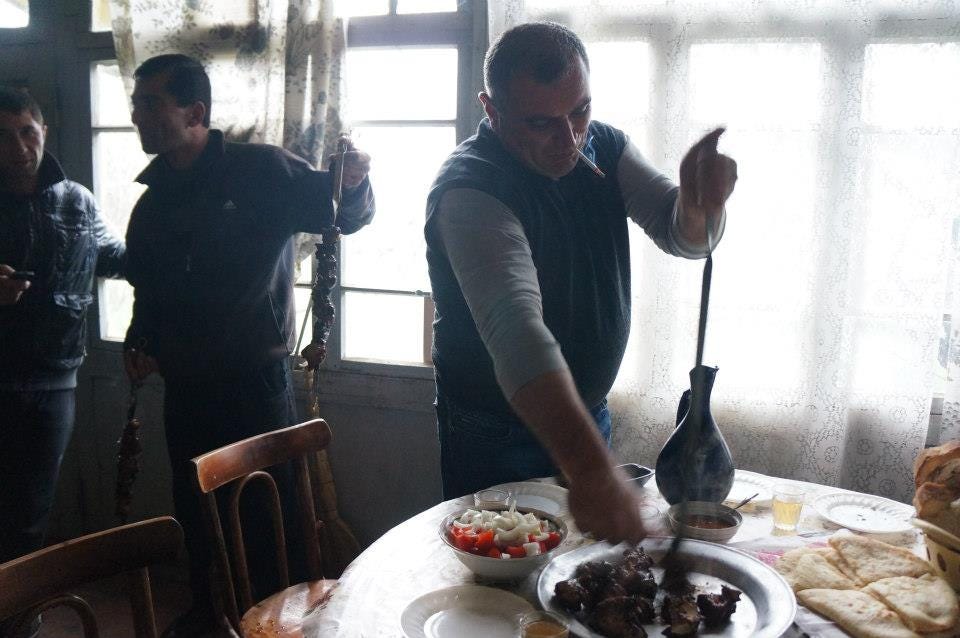
Some of the boys stay outside, grilling more meat. The rest of us sit around the table.
Georgi fills everyone’s glass with more wine. No cutlery, we eat with our hands. Cut the larger pieces of meat with a Swiss army knife.
Somebody shouts: “Gaumarjos!”
Georgi explains it means Cheers! in Georgian and is used to make a toast. A Gaumarjos must be given before every swig of drink.
We raise our glasses, “Gaumarjos friends!” is said in three languages - Georgian, Russian and English - and we sink our drinks in one.
Georgi pours everyone another glass and we Gaumarjos family.
I proceed to eat my own bodyweight in dead pig, as more glasses of wine are poured, this time women getting the Gaumarjos treatment.
Soon we have run out of things to Gaumarjos.
Friends, women, family, Georgia, Adina, mothers, fathers, brothers, sisters, animals, pork, the wine – everything has been Gaumarjos’d, always in three languages.
The boys from outside carry in a large plate of grilled fish and join us at the table.
“Gaumarjos ryba!” I shout, (Cheers to fish!)
“Gaumarjos ryba!” everybody shouts back, and the glasses are filled once more.
The feasting and drinking continue into the night.
Adina stopped downing her wine a long time ago and is pretending to take a sip each time a new Gaumarjos is made. I continue to match the boys glass for glass.
I stand up to make my way to the outhouse and almost fall through the door. Adina follows me outside into the pitch-black night.
“Are you alright?” she asks.
I tell her I'm fine, propping myself up against the side of the house, totally wasted.
Georgi welcomes me back to the table by handing me my glass, freshly filled. Someone carries another full container of the potent liquid into the room, even though we have only just started on container number three.

“Gaumarjos, um... Gaumarjos zhenskiny!” – We are Gaumarjosing women again.
Unexpectedly, one of the men says, “Kris, hashish?”
I hear myself saying, “Pochemu nyet?” (Why not?)
Adina turns to me slowly, raises her eyebrows: “Really?”
The man pulls a bag of potent smelling hash from his pocket, places it on the table, takes out his pouch of tobacco and papers, rolls a strong spliff. Passes it to me.
Its effects, combined with the alcohol, quickly take a hold, as the room begins to spin.
Soon, three spliffs are being passed around the table simultaneously.
One of the younger men at the table is in the Georgian army and fought against the Russians in the war of 2008. At the behest of the young soldier we Gaumarjos peace.
Georgi stands up and makes his way towards the small storage room. Before disappearing inside, he turns to us and says, “Kris … bang bang?”
“Where's he gone? What's going on now?” Adina says.
I tell her I think he’s gone to get a—
Standing over us, grinning like a madman, Georgi is brandishing a shotgun.

“Kris, you're not going to shoot that! No! This is not a good idea! You’re so drunk you can hardly stand! Do not start playing with guns!”
I tell her I am going to play with the gun.
I stand up and follow Georgi out the door, while the other boys laugh at Adina's sighs.
Georgi places the gun in my hands, shows me how to unlock it.
I point it up at the sky, click it back, pull the trigger.
BOOM!
Almost blows my eardrum.
Everyone, except Adina, pisses themselves laughing.
I hand the gun back to Georgi and instantly regret it, as paranoia sets in. The sight of Georgi with gun in hand and homicidal grin on face convinces me we’re going to die.
I sit back down as Georgian chatter flows around me, the men laughing in conspiratorial fashion. They’re going to rape Adina and make me watch, then kill us.
I Keep my eye on the shotgun: as soon as Georgi puts it down, I’ll grab it.
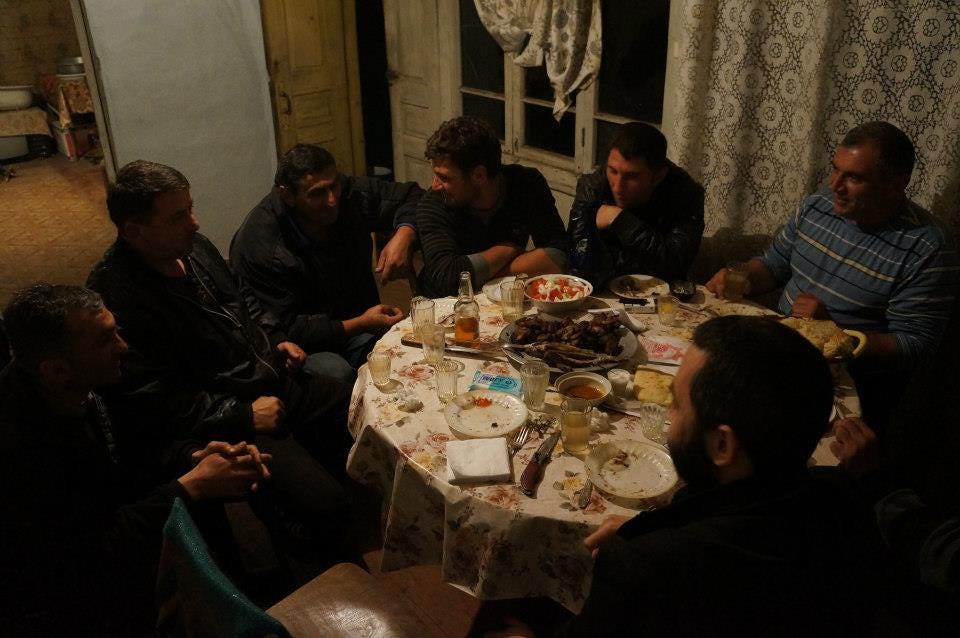
One of the boys asks in serious tone if I need to sleep. I wave his suggestion away.
“Spat v svoyem domye,” Georgi tells me, pointing to one of the men. (Sleep at his house.)
I stand up, wish everybody goodnight, then stagger out the door, followed by Adina and the man who is going to take us to his home. We jump into a Land Rover and drive for five minutes up a bumpy mud path until we reach a secluded house.
With the guidance of a torch, the man leads us up the outside stairs, into a guesthouse in the attic. He shows us to the bedroom and says he’ll come for us in the morning.
I kick off my shoes, fall onto the bed, black out.
The cock-a-doodle-doo of a cockerel jolts me awake. Sunshine fills the room, no curtains to block it out. I check the time on my phone: 5 a.m.
My head is going to explode. The painkillers are in my backpack, at Georgi’s.
I crawl down the outside stairs and across the field to use the hole in the ground. Then lie wide awake in my own personal hell for the next few hours, head pounding me into submission, Adina sleeping peacefully at my side.
I stumble down the stairs, wash my face with cold water from the well in the field.
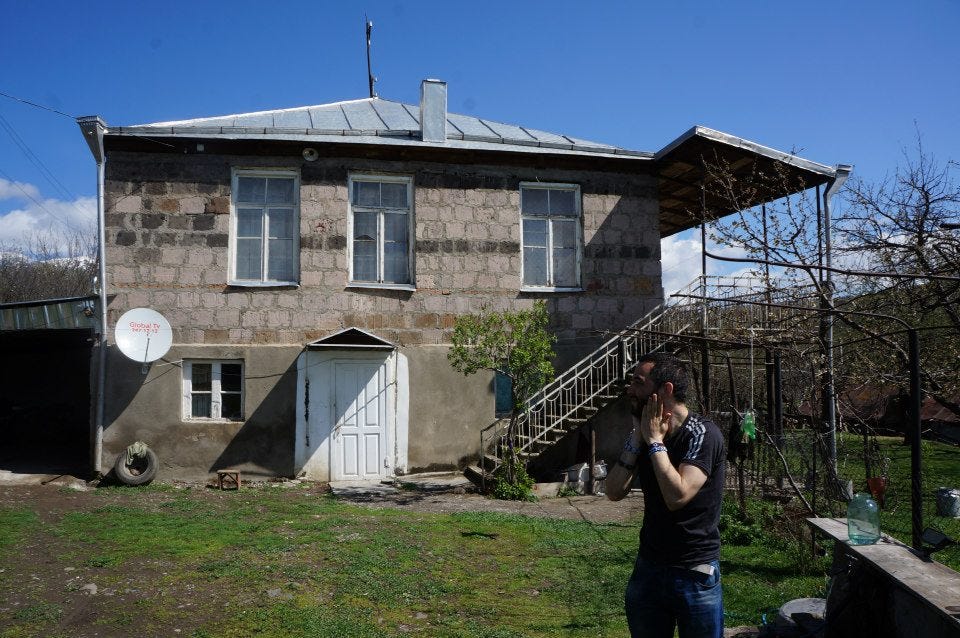
The owner of the house pulls up in his Land Rover, drives us back to Georgi's.
All the boys from last night are sitting around the table, drinking wine and cognac, eating fresh Khachapuri, looking like they've slept for twelve hours.
“Kris, Adina, cognac?”
I refuse the cognac but take the glass of wine forced into my hand and use it to swallow a couple of paracetamols.
“Gaumarjos friends!”
We sit and eat Khachapuri, drink more wine, I accept a cognac.
Georgi wants to drive us to a bus station and buy our tickets to Armenia, to guarantee our safety. We turn down his generous offer, it’s a beautiful day for hitchhiking.
The goodbye is quick but emotional.
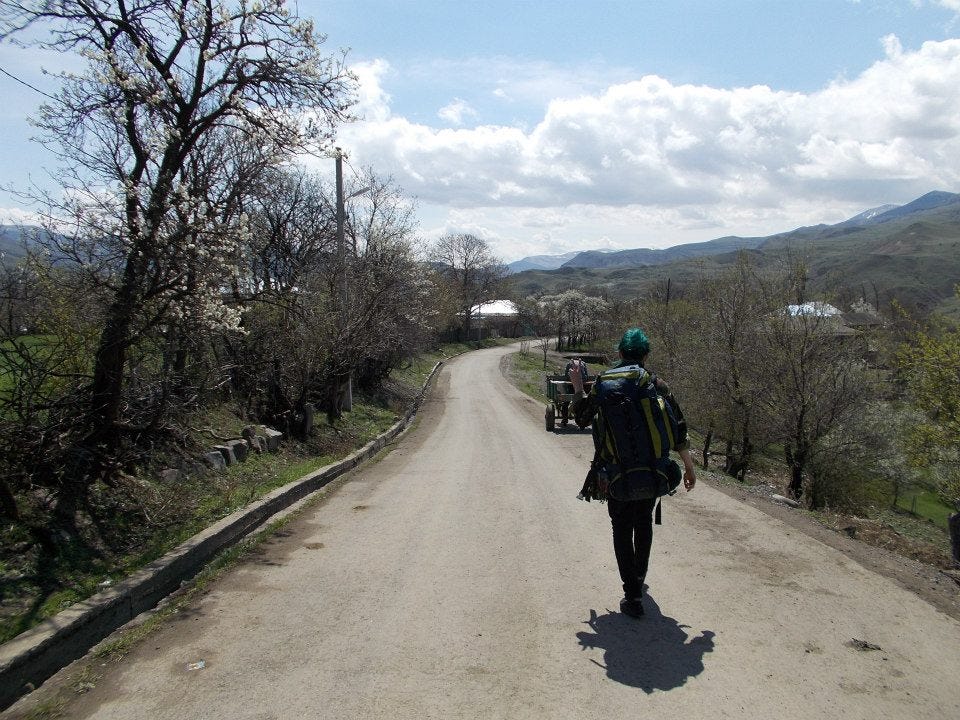
We waddle alongside the river Kura, hunched under backpacks, till we find the main road that leads to Armenia. From there, we’ll hitchhike across the border.
No posts
Comments
Nothing yet. Say the first thing.
Sign in to join the conversation.