
Trump’s recent Executive Order on Election Integrity proves the message is finally getting through: the voter rolls are the strategic foundation of every election. If the list is corrupt, the outcome can be corrupt — regardless of how the votes are counted.
Some assume that election fraud is a modern problem, born from our digitized voting systems. And yes, cybersecurity and voting systems expert Clay Parikh would readily tell you he would not trust any computer ballot tabulation — the ways these systems can be compromised are nearly endless, and the cost of securing them skyrockets with every layer added. Experts like Elon Musk have argued we should return to paper ballots and hand counting altogether.
But would paper ballots and hand counting guarantee free and fair elections?
Not necessarily. To understand why, we need to look at history.
The most infamous example of large-scale election fraud in American history didn’t involve a single computer. It was run by one man with a machine, a network of loyal operatives — and a deliberately bloated voter roll.
William “Boss” Tweed ran New York’s Tammany Hall political machine in the 19th century. His arrogance became legendary through newspaper editorial cartoons of the era, which depicted him declaring:
“As long as I count the votes, what are you going to do about it?”
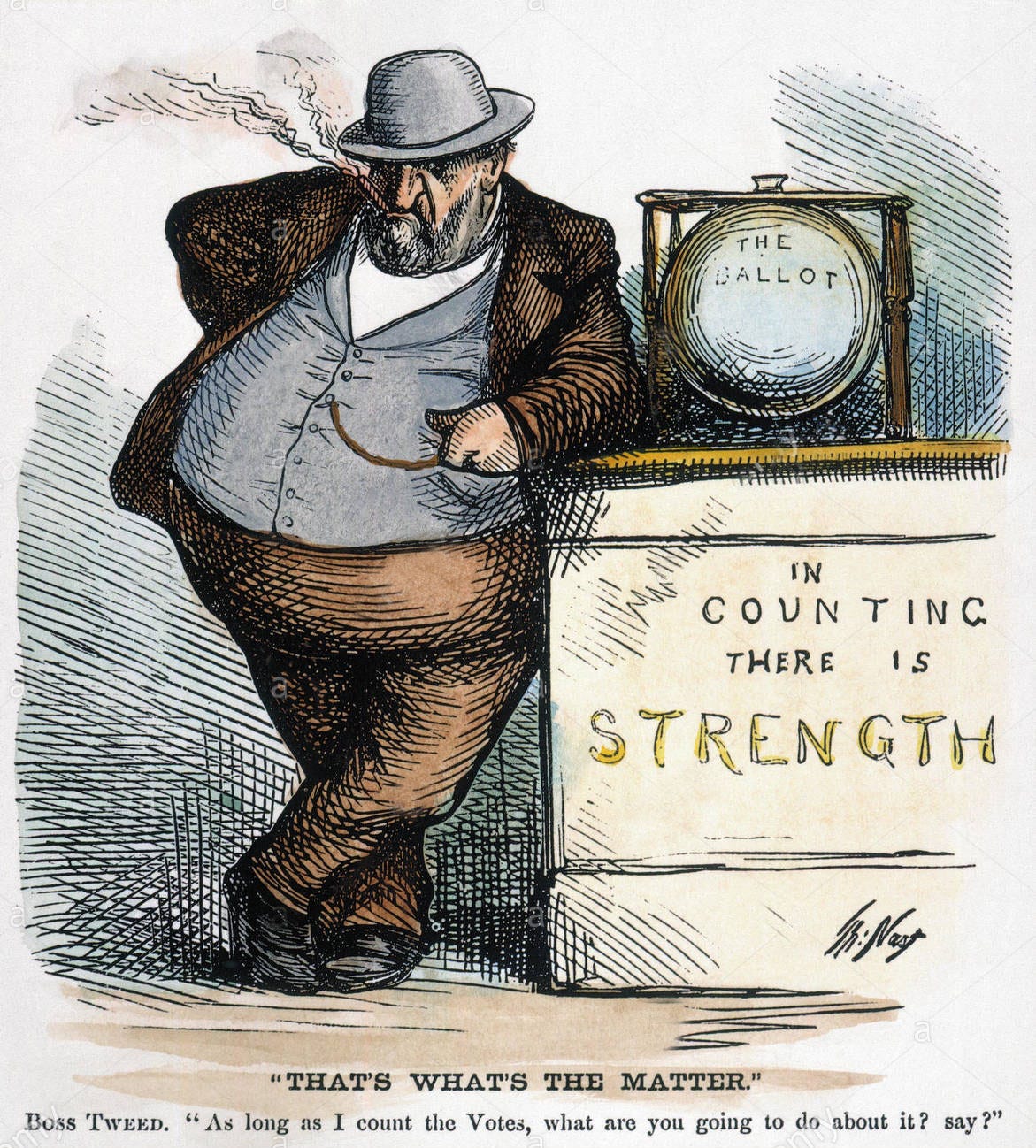
But Tweed’s real power wasn’t in counting the votes. It was in controlling who was on the list before a single ballot was cast.
Here’s how Tammany Hall manipulated the rolls:
Flooding the rolls with non-citizens. Tammany operatives worked the New York City docks, greeting arriving Irish immigrants with offers of food, lodging, jobs, and legal help. That generosity came with a price — loyalty at the ballot box. They steered immigrants through a naturalization process that had none of today’s checks, ensuring non-citizens ended up on the voter rolls. Stories grew of new arrivals being walked straight from the boats to the polls.
Padding the rolls with fake registrations. Beyond real immigrants, Tammany Hall simply invented voters — fictitious names at real addresses — to inflate the rolls and manufacture votes out of thin air.
Voting early and often. The most notorious Tammany tactic was sending the same operatives to vote multiple times across different precincts — swapping a coat, shaving a beard — then returning to cast another ballot as a different “voter.”
The result? The legitimate residents of New York City — some with family who had fought in the Revolutionary War and the War of 1812 — had their votes diluted and their city stolen from them.
Many of the election safeguards we have today exist specifically because of Tammany Hall. But those safeguards have serious gaps that remain wide open.
1. Voter Registration Was Supposed to Be Rigorously Verified
The voter registration application was never designed to have a 100% acceptance rate. It was designed to filter. The baseline requirement should be simple: prove the person on the rolls actually exists and actually lives where they claim.
In 1888, Republican Senator Matthew Quay organized a quiet door-to-door canvass of New York City, disguised as a routine “city directory” project. His operatives compiled a list of actual residents and used it to challenge Tammany’s fraudulent registrations and deter repeat voting. It worked.
That was 1888. Outside of the citizen-led canvasses that emerged after the 2020 election, when was the last time you heard of anyone systematically checking the voter rolls against who actually lives at those addresses?
2. The Citizenship Question Has No Enforcement Behind It
Every voter registration form asks: “Are you a U.S. Citizen?” But that question is largely unenforceable in practice.
My Venezuelan wife — who had just received her green card — was handed a voter registration form at the DMV in 1998. When I challenged the agent, the response was: “Everyone gets the application. They can just mark ‘No’ on the citizenship question.”
Why design a system that automatically generates disqualified applications? More importantly — how do county election officials actually verify citizenship? The short answer is: most of them can’t.
Election officials tell us the oath on the application is treated as sufficient. If an applicant checks “Yes” to citizenship, it is rarely challenged.
The vast majority of registrations flow through DMVs or other government agencies and are submitted electronically. Election officials almost never see applicants in person. Proof of citizenship almost never accompanies the form.
Common forms of ID do not confirm citizenship.
Social Security confirms lawful status.
Military ID confirms military status.
Student ID confirms student status.
Real ID confirms lawful presence.
Driver’s License confirms presence. (Five states note citizenship on enhanced DLs.)
Tribal ID confirms tribal status. (5 of 525 tribal ID cards have citizenship status.)
A “U.S. Citizen” response from SAVE can support confirmation when records match, but a non-match or “no record” does not disprove citizenship.
3. Voters Must Be Tied to the Right Precinct — and That Requires Accurate Addresses
The voter rolls don’t just determine who can vote — they determine where they vote and which ballot they receive. Every voter is assigned to a precinct based on their registered address. When addresses are wrong — because someone moved, died, or never lived there — every local race on that ballot is at risk of being decided by someone with no business deciding it.
This is where the rolls are silently failing millions of Americans right now. And most county election offices don’t have the tools — or the mandate — to find it.
These problems aren’t new. What is new is that citizens now have the tools to fight back — systematically, at scale, and with local, county, state and federally-sourced data and efficient tools that election officials cannot and should not ignore.
That’s exactly why we built ELLY — The Elector List™.
ELLY is a voter roll monitoring system that currently tracks the voter rolls across 44 states, running them through multiple layers of independent verification:
📬 USPS CASS Address Validation — flags registrations tied to invalid or commercial addresses
📬 USPS CASS DPV Address Validation — flags registrations tied to undeliverable addresses
📦 NCOA (National Change of Address) Matching — identifies voters who have officially filed a permanent change of address move from their registered location
🗺️ Out-of-County Cross-Matching — checks whether voters who moved have re-registered in their new county, flagging potential duplicate registrations
🗺️ Out-of-State Cross-Matching — checks whether voters who moved have re-registered in their new state, flagging potential duplicate registrations
🏠 Property Data Verification — confirms that registered addresses are actual residential properties, not commercial buildings, vacant lots, or nonexistent locations
📰 Obituary & Death Record Review — reviews state records, proprietary data and online obituaries and funeral home records
The result is a clear, actionable picture of where the voter rolls have problems — as well as the documented evidence needed to bring those problems to the people responsible for fixing them.
We are building a volunteer network across all 44 monitored states and DC. Volunteers review ELLY™’s findings for their own county, document the issues, and bring or send the verified data directly to their local election officials. County election offices also can have direct access to ELLY™’s data.
This is how you clean the rolls — accurate, curated data coupled with convenient, efficient tools to provide current, reliable evidence to the county decision-makers.
The Bottom Line
Boss Tweed was eventually brought down — not by a single crusader, but by ordinary citizens who demanded accountability and showed up with proof. The cartoons mocked him. The press exposed him. But it was the data — a methodical canvass of who actually lived where — that broke his machine.
We have far better tools than they had in 1888. We have ELLY™.
But tools don’t work without people willing to use them. If you believe every legitimate vote, including yours, deserves to be counted, if you believe that no fraudulent or illegal vote should cancel it out — then your local county needs you. Don’t allow yourself to be disenfranchised.
🗳️ Take Action Now
Visit TheElectorList.com to:
See what ELLY™ has uncovered in your state
Sign up as a volunteer reviewer for your county
Help bring verified findings directly to your local election officials
The voter rolls are the foundation of every free and fair election. Help us make sure that foundation is solid.
“No right is more precious in a free country than that of having a voice in the election of those who make the laws under which, as good citizens, we must live. Other rights, even the most basic, are illusory if the right to vote is undermined. Our Constitution leaves no room for classification of people in a way that unnecessarily abridges this right.”
Chief Justice Earl Warren in Westbury v. Sanders (1964)
If this article opened your eyes, share it. The more citizens who understand how the rolls work — and how they can fail — the harder it becomes for anyone to exploit them.
No posts
Comments
Nothing yet. Say the first thing.
Sign in to join the conversation.