
Imagine this. You move from Florida to Tennessee. You buy a house. You get a Tennessee driver’s license. You register to vote in your new county. You’re a responsible citizen — so you call your old county back in Florida and ask them to take your name off their voter rolls.
They ignore you.
You write a letter. Nothing.
You call again. The clerk tells you that you have to fill out some form — but they’re not sure which one. You ask them to email it. They don’t.
Two years later, you’re still on the voter rolls in a county where you no longer live, in a state where you can no longer legally vote. And nobody seems to care.
This isn’t a hypothetical. We’ve now heard from hundreds of Americans who tell us essentially the same story. They moved. They tried to do the right thing. Their old county simply refused to act.
Here’s the part that should make every American angry: federal law required that county to act. They didn’t have a choice. There is no decision to make. There is no local, county or state ordinance that over rules that.
In 1993, Congress passed the National Voter Registration Act — the NVRA. Most people know it as the “Motor Voter” law because it let people register to vote at the DMV. Buried inside that same law is a much less famous section that puts a hard, mandatory duty on every state in the country.
It’s called Section 8. And here’s the language that matters, in plain English:
Every state shall conduct a general program that makes a reasonable effort to remove the names of ineligible voters from the official lists of eligible voters — by reason of death, or change of residence.
Read that one more time. Notice the word “shall.” In legal writing, “shall” doesn’t mean “should” or “if you get around to it.” It means must. It is a command, not a suggestion.
And notice the other word: “remove.”
Not “flag.” Not “mark inactive.” Not “set aside for later.” Remove.
Nine years later, in 2002, Congress passed the Help America Vote Act — HAVA — and used the exact same word again: states must make a “reasonable effort to remove registrants who are ineligible to vote.”
Two federal laws. Both use the word “shall.” Both use the word “remove.” Both use the word “ineligible.”
So why isn’t it happening?
Here’s the trick. Federal law uses the word ineligible. But many counties use a different word: inactive.
These two words sound similar. They are not the same thing.
Ineligible is a legal status. It means a person no longer meets the requirements to be registered at that address. Maybe they died. Maybe they moved. Maybe they were never a citizen. Federal law says ineligible voters must be removed.
Inactive is an administrative label. It means the county has some reason to think the registration might be stale, but they haven’t done anything about it yet. The voter is still on the rolls. They can still receive mail. In many states, they can still request a ballot.
Federal law tells counties to remove ineligible voters. Many counties have decided, on their own, to mark them “inactive” instead — and then leave them sitting there. For years. Sometimes forever.
Those who were ineligible at the time of their registration, but were incorrectly granted voting privileges in error, are still ineligible, and should be removed immediately upon discovery. Examples include: registering with information on their application that is incorrect or registering an address that doesn’t exist.
This is the inactive shell game. It lets a county claim, with a straight face, that they’re “managing” their voter rolls — while not doing what federal law actually requires.
Also in Florida, it means Supervisors of Elections (SOEs) can ask for more of your tax money since their budgets are derived by the size of their voter rolls. This means Florida SOEs are incentivized to keep their voter rolls bloated.
The NVRA did create a legitimate use for “inactive” status: it’s supposed to be a short, temporary holding spot during a 30-day notice process. After two federal general elections — about two years and a week, at most — an unresponsive inactive voter is supposed to be removed entirely. But somewhere along the way, “temporary” became “permanent” database to “park” a voter registration for possible future use.
When citizens call their old county and ask to be removed, they’re often told, “You have to come in person,” or “We can only act if you fill out our specific form,” or “We can’t remove you. You have to wait until we find out on our own.” Every one is wrong.
The NVRA explicitly says that if a registrant gives written confirmation that they’ve moved out of the jurisdiction, the county can remove them — immediately. No 90-day waiting period. No multiple letters. No “wet signature” on the county’s own form or card. Done.
It also says counties must conduct a general program — meaning they have to go looking for these voters, not wait for the voters to find them. The Election Assistance Commission, which is the federal agency that helps states comply with these laws, specifically encourages counties to use data sources like:
USPS National Change of Address records
State and federal death records
Cross-state voter registration matching
EAC has been experimenting for several years, and a number of counties are already using proprietary data sources such as credit card agencies.
If a county isn’t using these tools — or worse, has the data and is ignoring it — that county is not making a “reasonable effort.” That’s a direct violation of federal law.
The Supreme Court agrees. In 2018, in Husted v. A. Philip Randolph Institute, the Court upheld Ohio’s right to proactively maintain its voter rolls — confirming that states are not just permitted, but expected, to go looking for registrations that need to come off.
On April 1, 2026, Governor Ron DeSantis signed Florida’s version of the SAVE Act, House Bill 991. The headlines praised it as a major election integrity win, requiring proof of citizenship to register to vote.
That part is good.
But buried in Florida law — and left untouched by HB 991 — is a provision in Florida Statute § 98.065 that should make every Florida voter sit up. Under existing Florida law, an “inactive” voter can stop their own removal from the rolls by doing one of three things:
Updating their registration
Showing up to vote in person
Requesting a vote-by-mail ballot
Stop and think about that third one for a moment.
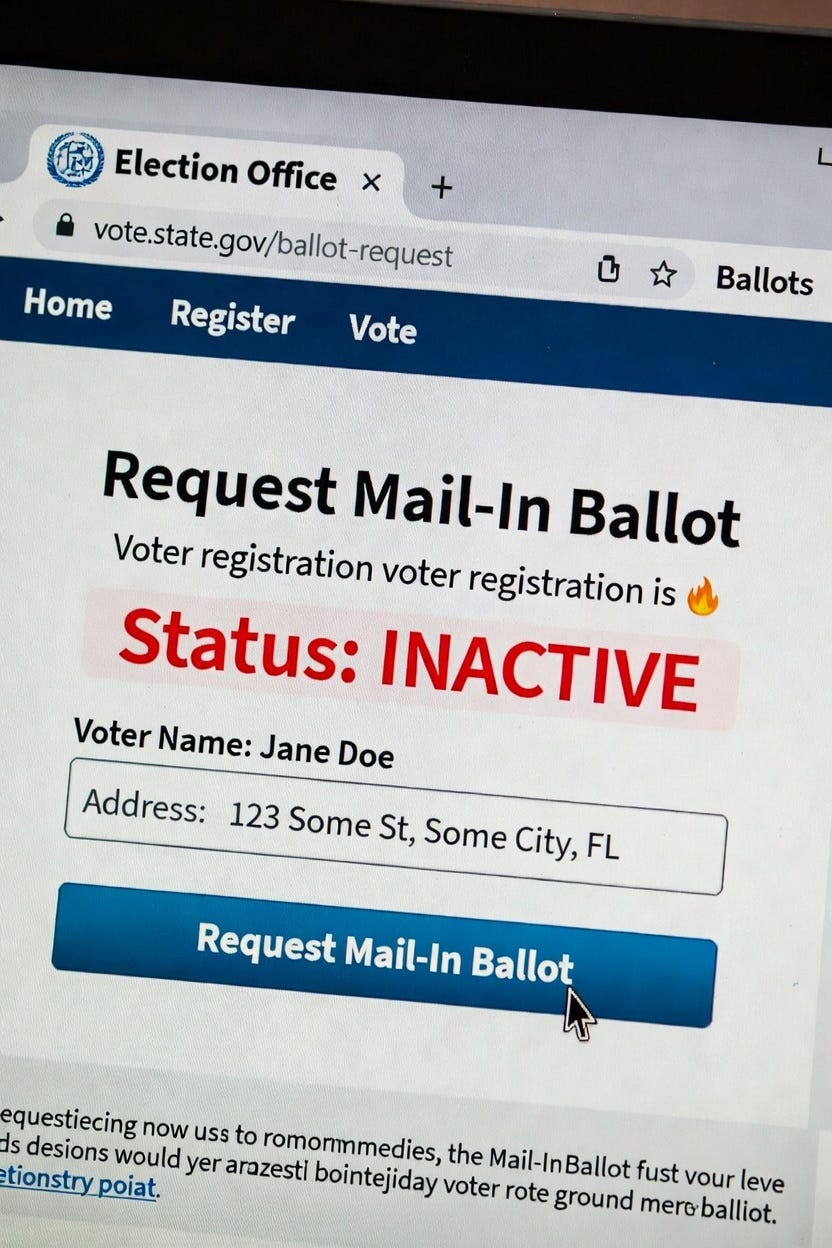
Florida’s voter rolls are public record. Anyone get them on request. That includes the names, addresses, and registration status of every “inactive” voter in the state — many of whom moved away years ago and don’t even know they’re still on the rolls.
Florida TODAY has nearly 2.7 MILLION inactive registrations on it’s voter rolls. That means 1 in every 5 registrations in our voter rolls is currently INACTIVE.
Now picture a sophisticated bad actor. They pull the public voter file. They filter for inactive registrations. They identify thousands of people who are Inactive, not voted for 3 or more federal elections, and then check the NCOA to see if they moved away. They update the mailing address - which changes the status to Active - to an address they have access to, ... like a UPS Personal Mail Box rented four months prior to an election under a fictitious name and address.
The request itself resets the removal clock under Florida law, which means the registration stays alive on the rolls — ready to be exploited again next election. And because the real voter has no idea this is happening, there’s no one to complain.
This is not a theoretical concern. This is a textbook identity theft scheme, sitting in plain sight, made possible by the gap between what federal law requires (removal) and what counties actually do (its easier: just mark Inactive and ignore).
The same Florida law that just cracked down on noncitizen registration left a wide-open back door for ballot fraud against Inactive voters. One hand giveth., the other hand left the screen door unlatched.
The fix is not complicated, and it does not require new laws. It requires counties to do what existing federal law has required them to do for the last 33 years:
Use the data. NCOA records, death records, and cross-state matches already exist. The information is sitting there.
Stop hiding behind “inactive.” The NVRA says remove. Not relabel.
Stop hiding behind “wet signature.” When the apply to vote elsewhere, a driver’s license, public benefits, homestead tax exemption, their wet signature is put on the application, serving as a legal attestation of their new permanent address.
Honor written requests. When a voter who has moved asks to be removed for the voter roll, federal law says you can do it that day. So, do it that day.
Close the mail-ballot loophole. A registration that is stale enough to be “inactive” should not be eligible to receive a mail ballot to an address where the voter no longer lives. Period.
In our next post, we’re going to show you exactly what happens when somebody does go looking for these registrations. We’ll walk you through the cross-state findings ELLY™ has uncovered — voters registered in two, sometimes three states at once, with verifiable evidence that the person has moved and re-registered elsewhere.
The numbers are bigger than most people think. The evidence is more solid than most people expect. And the federal law that requires counties to take action on the evidence has been on the books since 1993.
We’ll also show you what happens when ELLY’s findings land on a county election supervisor’s desk — and what citizens can do when those findings are ignored.
Visit TheElectorList.com
Use ELLY™ Verification Lookup if you want to:
Make sure your current voter registration is correct
See if someone voted using your current registration
Check if you’re still registered at your old address
Check to see if anyone else has been voting at your old address
Check to see if a decease relative still on the voter roll
Visit TheElectorList.com
Sign up as a volunteer reviewer for your county.
Help bring documented evidence to your local election officials.
Federal law says counties must remove ineligible voters. We have the tools and data to assist.
If this article opened your eyes, share it. The more citizens who understand the difference between “inactive” and “ineligible,” the harder it becomes for any bad actor to exploit.
No posts
Comments
Nothing yet. Say the first thing.
Sign in to join the conversation.