
Considering how long people have been scaring themselves with stories of bloodsuckers, it’s impressive that one of the most successful horror movies recently debuted is Robert Eggers’ Nosferatu. Vampires have had their ups and downs in the world of storytelling, with what some would argue is a peak occurring all the way back in the 1890s with Bram Stoker’s Dracula, to becoming a mockery of their former selves in the Twilight saga of the late aughts. Recently, adaptations of Anne Rice’s Interview series on AMC and a slew of Dracula interpretations in the last couple years such as The Last Voyage of the Demeter and The Invitation have propelled vampires, and more specifically, the classical vampire, back into the limelight.
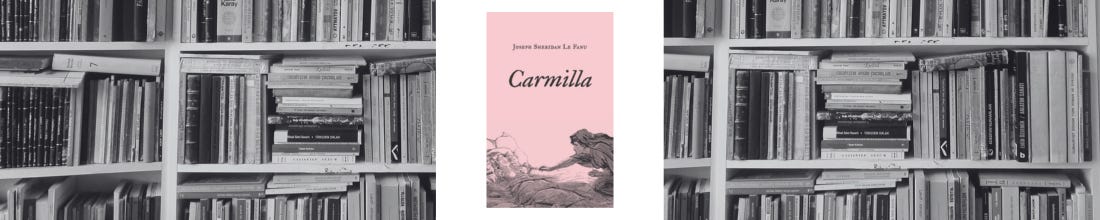
We’re officially in the age of the Dracula again. In light of this, my book club decided February was the month of Carmilla by J. Sheridan Le Fanu. A classic said to be the origin for many of the vampire mythos that became iconic staples of the genre in works like Dracula, Carmilla is often overlooked compared to it’s male-led contemporaries. I hadn’t even heard of it until I was in college and I’ve been an avid reader all my life.
But, as shown above, we still talk about Dracula to this day. His predecessors, no matter how iconic they may have been, seem to lose any credit for lore established before Bram Stoker set out to write his masterpiece. Before I read the book myself, I was convinced that it just didn’t hold up as well. After reading it, I hold an entirely different opinion.
Carmilla tells the tale of Laura, a young woman who lives a quiet and lonely life with her father and a handful of servants in Austria. After an unfortunate carriage accident, one of it’s passengers remains a houseguest of Laura’s castle— the beautiful and seductive Carmilla.
If you were going into this story blind and only aware of the blurb above and the fact that this book predates Dracula by about two decades, surely you would expect to read a psychological horror wherein our main character Laura tries desperately to pull her widowed father from the clutches of a bloodsucking monster. Surely Carmilla seduces the man of the house to seize as much power as possible, right? It is the late 1800s after all, there would be no financial or political gain to any other plan.
Except Carmilla isn’t interested in playing Victorian politics or growing her ranks of thralls like her descendants would be. The book actually turns out to be a character study into femininity and sexuality unlike anything I’ve ever read before, immediately established when Carmilla instead has her sights set on Laura in a romantic and devastating way.
Vampires have always been a literary metaphor for disease and desire, a cautionary tale against lust and promiscuity. In this story by Le Fanu, Carmilla embodies feminine desire and queerness in an overt way that clearly shows a narrative condemnation of both. Laura falls under the vampire’s spell quickly and seems to wrestle with her desire for Carmilla and her confusion over her growing and obsessive affection.
In my personal opinion, this book isn’t necessarily the sapphic vampire love story it is made out to be in Goodreads reviews. It is a product of it’s time, and while the overt homoeroticism that is written is progressive for simply existing, there is no question that Carmilla is portrayed as a predator and a corruptor of young women. She targets them across the Austrian countryside and they are dying in droves. The two young women we see her target have no mothers and are thus more easily drawn into a life of debauched sexuality.
In an age where the LGBTQ+ community is being demonized in America and our politics seem to move backward every day, Carmilla is a poignant read that reflects the regression of today’s policies in a horrific light. If an American Congressman tweeted tomorrow that lesbians are trying to break into American citizens’ homes to suck their daughter’s blood, it wouldn’t even make the front page because we’re so far beyond fear mongering.
However, it’s worth noting that Carmilla, as a character, is much more than a pointy-toothed demon that hides under beds and sleeps in a coffin (even though she most certainly does both of those things). She may in fact be the most complex character the book has to offer, and is a villain worth writing about.
Whether her seduction of Laura is a game to heighten her hunt or a genuine want for connection seems to even be a mystery to Carmilla herself. She does seem to crave affection and validation from her companions and/or victims. She professes her love earnestly on more than one occasion and frequently prompts Laura to validate their affections, whether physical or emotional. When Carmilla gets caught feeding on Laura in the middle of the night, she turns around and tells Laura she was experiencing the same horrors so they can revel in their fear together, manipulating her lover’s most vulnerable moments to her advantage. When we eventually learn of all the horror that Carmilla (or Millarca, or Mircalla) has wreaked in another wealthy family, we hear that she courted her young female victim there in something that resembled a love affair as well.
In a way, you can interpret Carmilla’s destruction as an insatiable insecurity. An optimist who was really rooting for a love story and a happy ending could say that Carmilla, outcasted by her sexuality and shameless desire for women, was seeking someone who could fulfill more than just lust. She admits to Laura that she has never been in love before, but she would be with her. The truth of that statement is up to the reader. Until someone returned her affections with as much passion and willingness to ostracize themselves from Victorian society as she had for the sake of love, she would continue to rip through Austria’s female population and destroy her own dating pool. Could Laura have been this soulmate?
We’re not to know, as in an ultimately disappointing ending, we hear from Laura how the final act’s deus ex machina, the Baron, finds Carmilla’s resting place, opens her coffin, stakes her in the heart and cuts off her head with little to no fanfare. If that seems out of left field in this write-up, just know that it was jarring in the book as well. Laura does remark that Carmilla is still on her mind, nearly a decade later. She still hears her footsteps and reflects on their relationship. And if the end of the prologue announcing Laura’s eventual death is interpreted a certain way, it’s possible she even killed herself to see her lover again. Or perhaps she, like all of Carmilla’s previous victims, simply succumbed to the venom still in her system.
There are a lot of aspects about Carmilla that I felt could have been improved upon. The ending and final act as a whole is one of my major gripes and I so wish that Le Fanu would have written a few more chapters to fix the pacing issues. I find this is a concern of mine in many classics, but I ultimately can’t complain because the literary landscape truly was so different in the Victorian age.
And ultimately, there are so many lenses to look at Carmilla through that I didn’t even touch upon. It’s influences on Dracula and other iconic vampire mythos, the obvious influence Carmilla had on Lucy in Stoker’s work, et cetera. I do think this one is a short read that is worth taking the afternoon to develop your own opinions about. I will be re-reading one of the annotated versions to see if I pick up on anything else that I would like to yap about, I just didn’t want to influence my first experience with the classic novel on a first read.
What do you think of the iconic work that so clearly inspired Dracula? Does Carmilla hold a candle to the vampire tales we still produce today? Sound off, I would love to discuss!
No posts
Comments
Nothing yet. Say the first thing.
Sign in to join the conversation.