
This analysis is for informational and educational purposes only. It does not constitute any investment, legal, tax or financial advice.
Poland is not an uninvestable market. It remains one of the most important economies in Central and Eastern Europe: large, strategically relevant, deeply integrated with the European economy, and still growing faster than many EU peers. The purpose of this playbook is therefore not to argue that investors should avoid Poland. That would be too crude and analytically wrong.
The argument is more precise: Poland’s risk premium is changing. The fiscal story is no longer only about deficits and debt. It is increasingly about the interaction between public finance, institutional credibility, regulatory pressure, monetary-policy constraints and firm-level operating costs.
The previous articles in this series showed the building blocks of the risk map. Poland is running a very large deficit in good times. The EU/EDP debt measure is already around the 60% reference value and forecast to move higher. Polish bond yields remain elevated versus nearby benchmarks. Registered unemployment is rising year on year. Micro-business closures have jumped. The state is already searching for revenue through sectoral taxes, excise duties, fees, levies and compliance infrastructure.
Individually, each of these signals can still be dismissed. Together, they define a Poland-specific fiscal-institutional configuration that institutional capital should monitor more closely.
This playbook translates that configuration into four lenses: sovereign risk, FX risk, equity and sectoral-margin risk, and FDI/corporate operating risk. It does not provide buy/sell recommendations. It provides a monitoring framework for investors, analysts, CFOs and decision-makers who need to understand how Poland’s fiscal risk spiral may affect capital allocation, hedging discussions, sector exposure and operating assumptions.
The paid section includes sovereign, FX, equity and FDI playbooks, 2026–2027 scenarios, a CEE comparator section and a monitoring dashboard for quarterly premium updates.
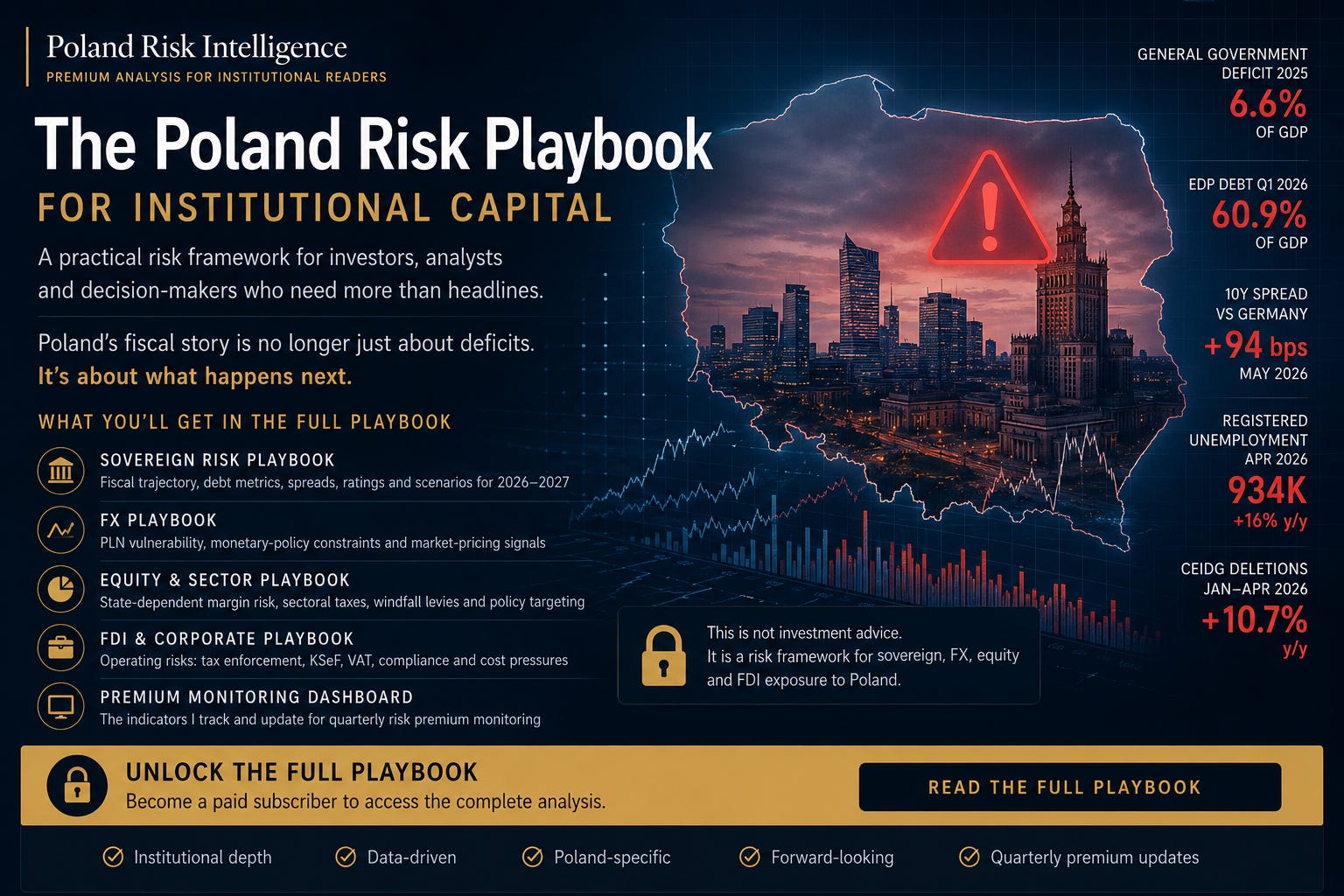
The central risk is not an immediate fiscal crisis. Poland still has market access, the banking sector is not in distress, the currency is not collapsing, and the economy remains structurally important. The central risk is a drift scenario: persistent deficits in good times, rising debt under the EU methodology, elevated yields, fiscal squeeze, weaker real-economy momentum and institutional hesitation.
For institutional capital, the key issue is whether the market is fully pricing this combination before the next slowdown arrives. The risk is not concentrated in one asset class. It can transmit through sovereign spreads, PLN sensitivity, regulated-sector margins, tax enforcement, compliance costs and corporate cash-flow risk.
The framework can be summarised as follows:
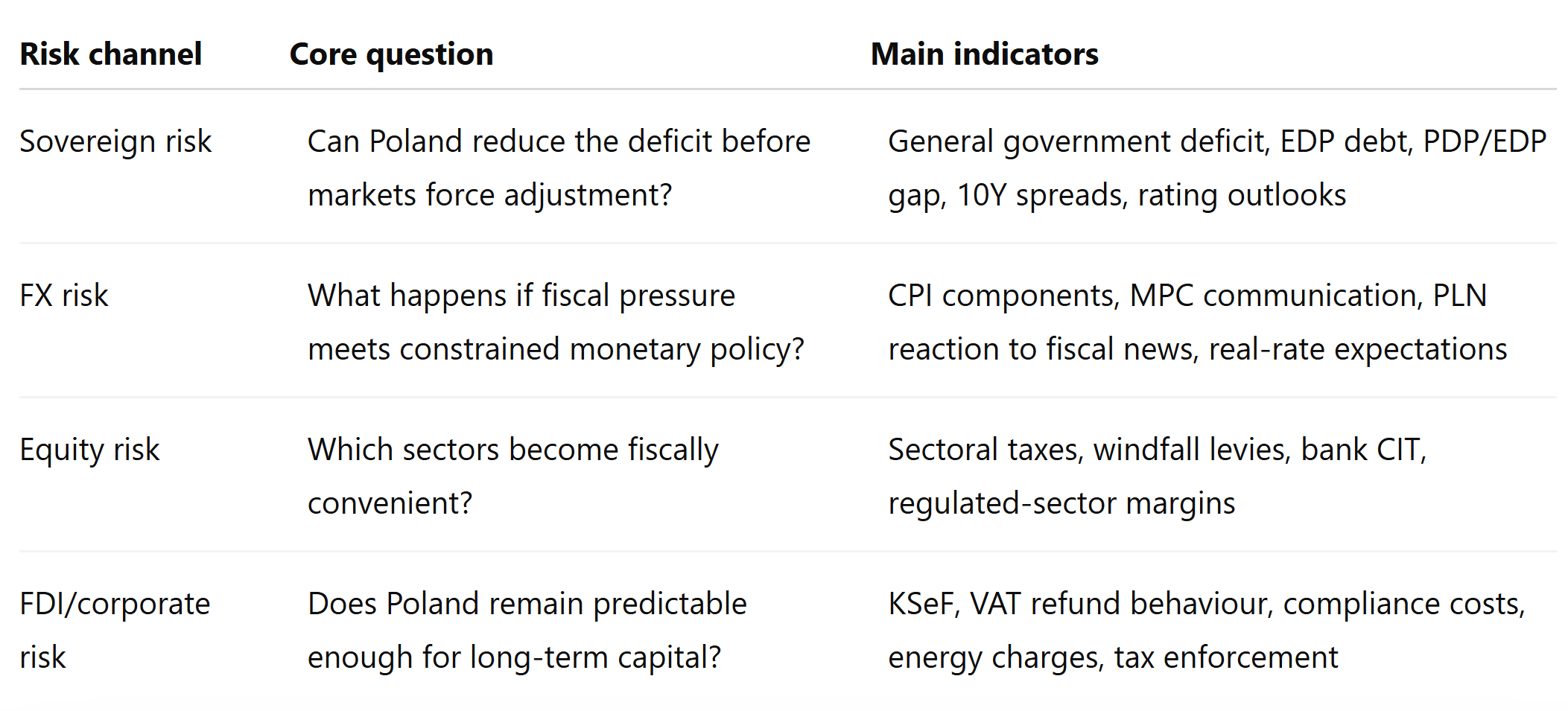
The most likely near-term scenario is not panic. It is continued fiscal drift combined with selective fiscal squeeze. This matters because such a scenario can remain politically manageable for some time while still changing the risk profile of Polish assets and operations.
The sovereign-risk question is not whether Poland can borrow today. It can. The more relevant question is whether Poland can restore a credible fiscal path before slower growth, higher debt-service costs or political constraints make adjustment more expensive.
The main distinction institutional readers should make is between short-term financing capacity and medium-term fiscal credibility. Poland’s short-term financing capacity remains intact. The sovereign-risk concern lies elsewhere: a country running a deficit above 6% of GDP in good times is using fiscal space when it should be rebuilding it. If growth slows, this starting point becomes materially less comfortable.
The most important sovereign indicators are:
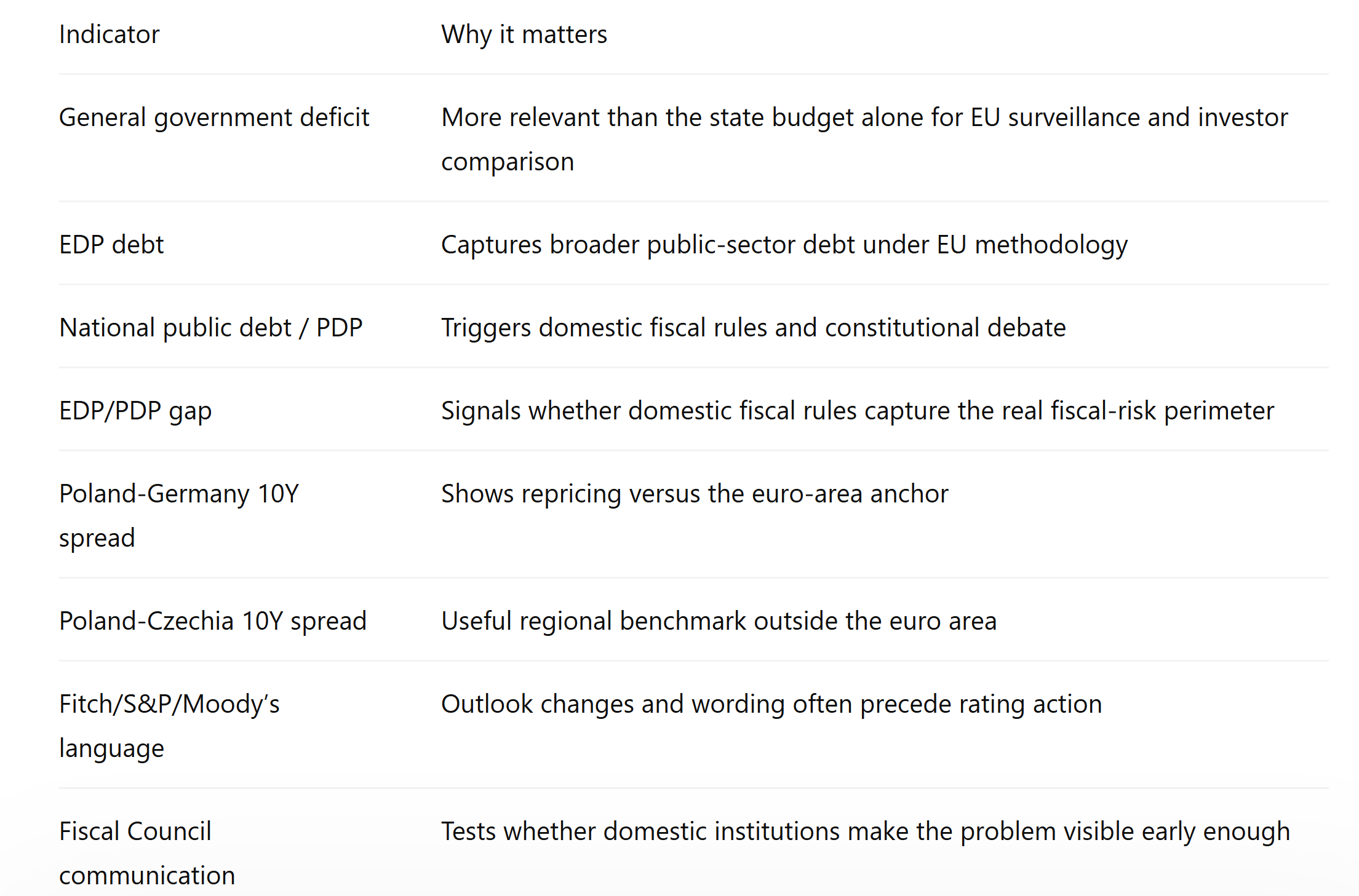
The key risk is a drift from a manageable fiscal position into a credibility problem. In that scenario, the market does not suddenly stop financing Poland. Instead, the price of financing rises, rating language becomes more cautious, and fiscal consolidation becomes increasingly pro-cyclical.
The most important sovereign-risk scenario is therefore not “Poland loses access to markets”. That is too extreme. The relevant scenario is: Poland remains financeable, but at a higher risk premium, with less fiscal room for counter-cyclical policy and more pressure to raise revenue through sectoral or quasi-tax instruments.
The gap between Poland’s national public debt measure and the EU/EDP measure is one of the most important institutional indicators in this series. It is not merely a statistical curiosity.
Under the national measure, Poland remains below the constitutional 60% threshold. That means the immediate constitutional trigger is not the central issue. Under the EU/EDP methodology, however, debt is already around the 60% reference value and is forecast to move clearly above it. For foreign investors, the relevant question is not which measure is “politically convenient”, but which measure better captures fiscal risk.
This is why the EDP/PDP gap should be monitored as an institutional credibility indicator. If the domestic fiscal rule appears increasingly disconnected from the broader fiscal-risk perimeter, investors may begin to treat the national rule as less binding than it looks on paper.
The practical interpretation is straightforward. A widening gap does not automatically imply manipulation or crisis. But it can create ambiguity. If the market concludes that domestic fiscal safeguards no longer constrain the relevant public-sector risk, the credibility premium attached to Poland can deteriorate even before any formal breach occurs.
PLN risk should not be analysed only through rate differentials, current-account data or global risk appetite. In the current environment, fiscal credibility and central-bank credibility matter more than usual.
The key question is what happens if fiscal pressure meets constrained monetary policy. Fiscal squeeze can affect inflation through excise duties, administered prices, energy-related charges, indirect taxation and compliance costs. These do not necessarily create a classic demand-driven inflation cycle, but they can raise the price level and complicate the path of monetary easing.
For FX analysts, the relevant risk is not immediate currency collapse. It is greater sensitivity of the zloty to fiscal news, rating language, central-bank communication and political conflict around fiscal consolidation.
The PLN dashboard should include:
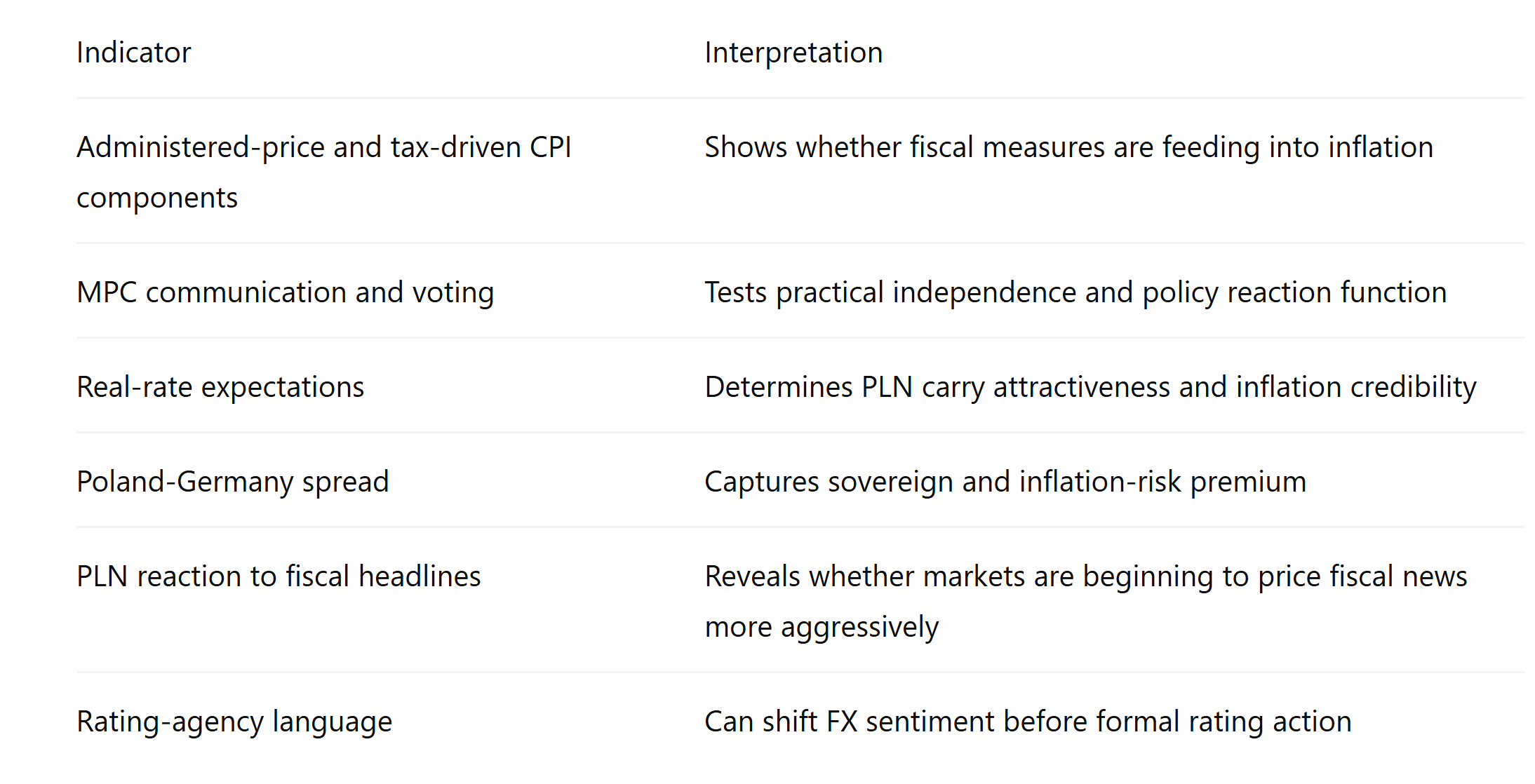
This is not a recommendation to hedge or not hedge PLN exposure. It is a framework for deciding when currency exposure deserves more active scrutiny. For institutions with material PLN exposure in 2026–2027, fiscal and monetary credibility should become part of the FX risk conversation, not a background variable.
A fiscally stressed state does not tax all sectors equally. It usually looks for sectors that are profitable, visible, regulated, domestic or immobile, politically defensible to tax, and able to absorb or pass on costs. This creates what I call state-dependent margin risk.
The point is not only that a new tax reduces earnings in the year it is introduced. The deeper issue is repricing of future political optionality. Once a sector is seen as fiscally convenient, investors must ask whether future profitability will be treated as a resource for the state.
The main sectors to monitor are:
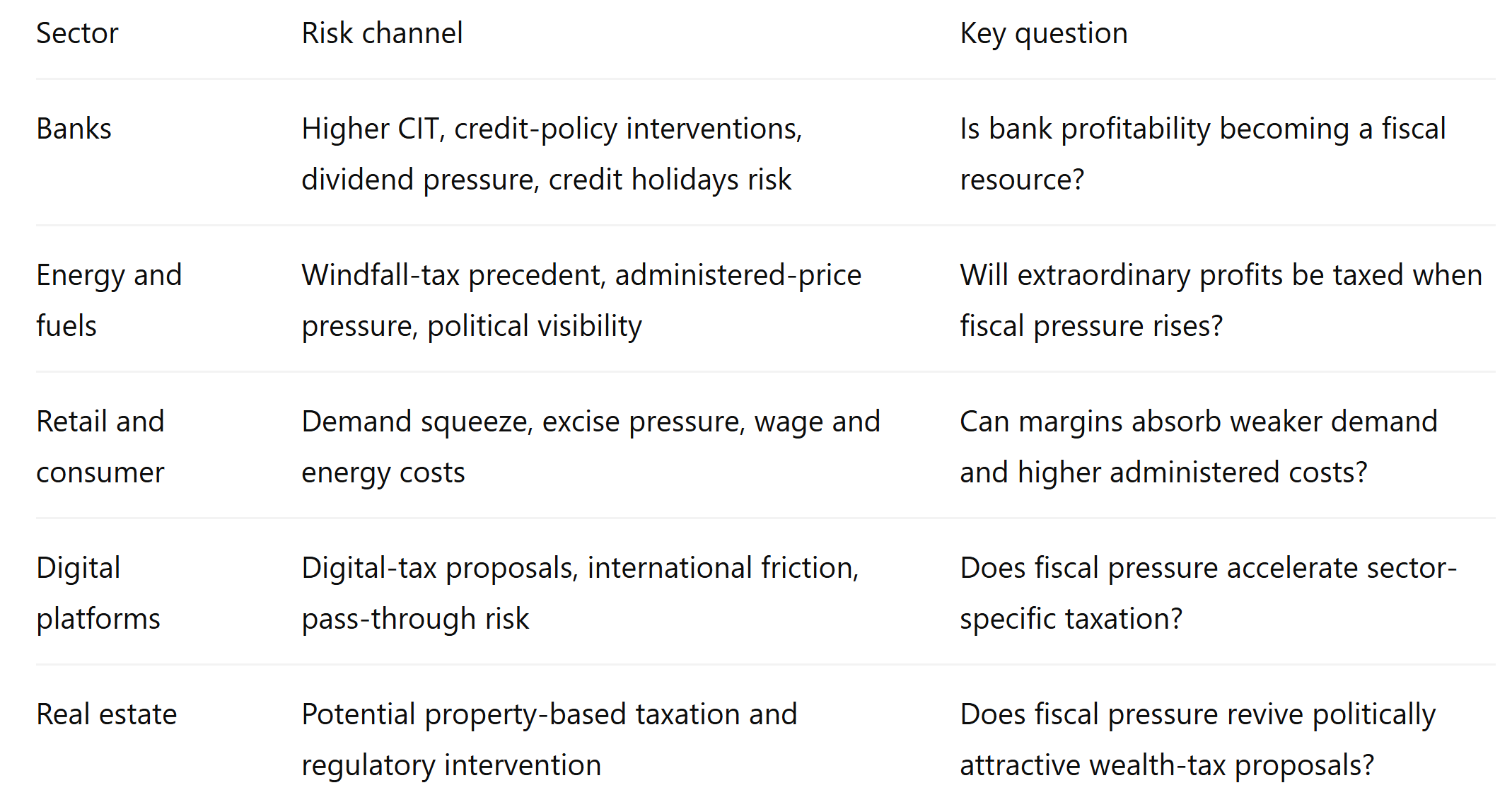
The clearest current signal is the higher CIT burden on banks and the proposed windfall logic in fuels. These are not isolated technical measures. They show that large, visible and regulated sectors can become instruments of fiscal adjustment.
For equity investors, the central distinction is between ordinary cyclical risk and state-dependent margin risk. The former is usually modelled. The latter is often underestimated until the policy decision arrives.
Poland remains attractive for foreign direct investment. The country has scale, EU membership, NATO relevance, manufacturing integration, nearshoring potential, a strong labour force and growing digital capabilities. None of that disappears because fiscal risk is rising.
The problem is different: attractiveness and operating risk can rise at the same time. A country can remain strategically important while becoming less predictable in tax, compliance and regulatory terms.
For CFOs and regional finance teams, the key risks are operational:
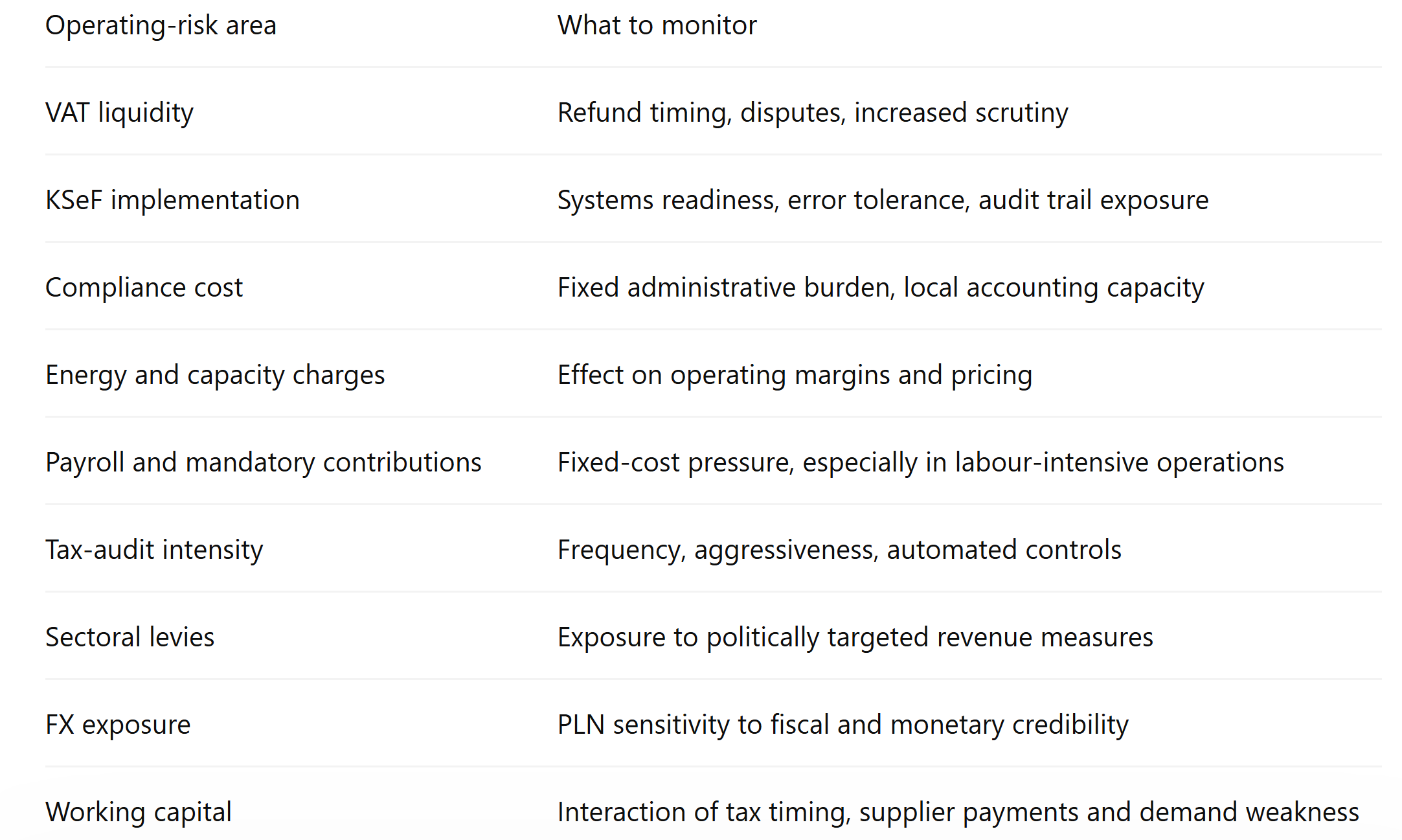
KSeF is especially important because it changes the information asymmetry between companies and the state. It is not only an invoicing reform. It is a fiscal visibility infrastructure. In a fiscally comfortable environment, that is mostly an efficiency and anti-fraud tool. In a fiscally stressed environment, it becomes part of the enforcement-risk map.
The CFO-level conclusion is practical: Poland should still be considered a high-quality operating location, but not under assumptions of stable fiscal and compliance costs. Local risk budgets should include tax-system digitalisation, VAT liquidity, enforcement intensity and the possibility of further sectoral fiscal measures.
It is tempting to treat the story as generic Central and Eastern European risk. That would be analytically lazy.
Poland is not simply “CEE”. It is larger, more liquid, more strategically important and more relevant to European manufacturing, security and capital allocation than most regional peers. At the same time, the current fiscal-institutional configuration is increasingly Poland-specific.
The relevant comparison is not Poland versus emerging markets in general. The relevant comparison is Poland versus nearby benchmarks such as Czechia, Slovakia, Lithuania and Germany where appropriate.
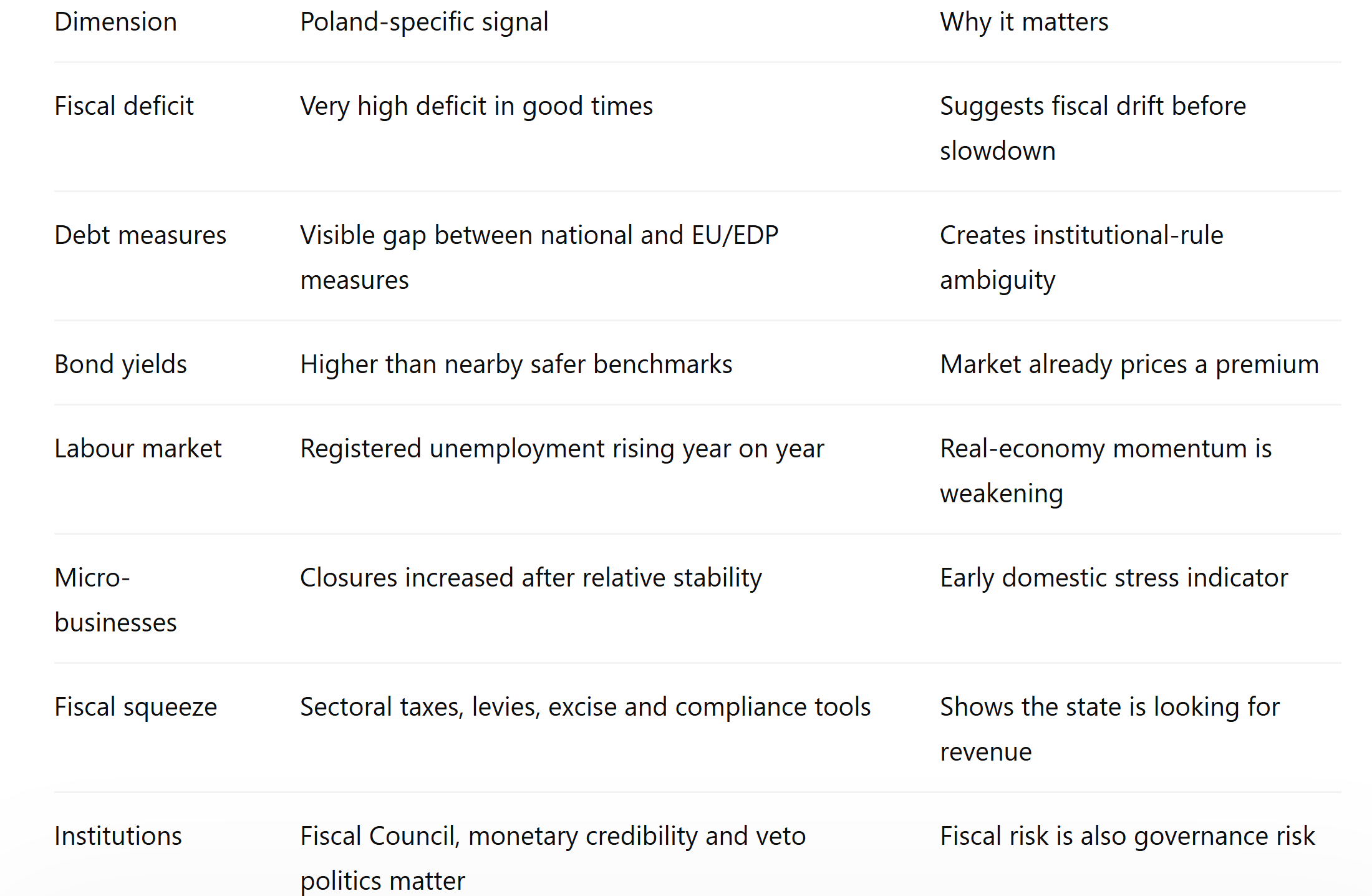
The comparison should not be used to argue that Poland is weak in every dimension. It is not. The better interpretation is that Poland’s strengths make the deterioration more important, not less. When a large, strategically important CEE economy begins to show fiscal and institutional warning signals, the consequences matter for more than domestic politics.
The institutional layer should not be treated as political gossip. It matters because fiscal-risk spirals are stopped by credible institutions before markets force adjustment.
There are four institutions to monitor.
First, the Fiscal Council. Its real test is not whether it publishes opinions, but whether it can make fiscal drift politically uncomfortable. If it becomes a reputational shield rather than an early-warning institution, its credibility value will be limited.
Second, fiscal rules. The key issue is whether the national debt framework still captures the fiscal risk that the constitutional threshold was designed to constrain. If investors increasingly focus on the EU/EDP measure while domestic politics focuses on the national measure, the rule can lose signalling power.
Third, the Monetary Policy Council. If fiscal pressure feeds into administered prices, indirect taxes or inflation expectations, monetary policy becomes harder. Formal independence matters, but practical independence under fiscal and political pressure matters more.
Fourth, the president-government relationship. Vetoes can block revenue measures, but they do not eliminate the fiscal gap. If revenue measures are blocked while spending remains high, the adjustment moves into borrowing needs, alternative taxes, enforcement or later spending cuts.
For capital, the governance conclusion is simple: fiscal credibility is not only a spreadsheet issue. It depends on whether institutions constrain the drift before markets do.
This playbook should be used through scenarios rather than one-point forecasts. The following four scenarios are sufficient for institutional monitoring.
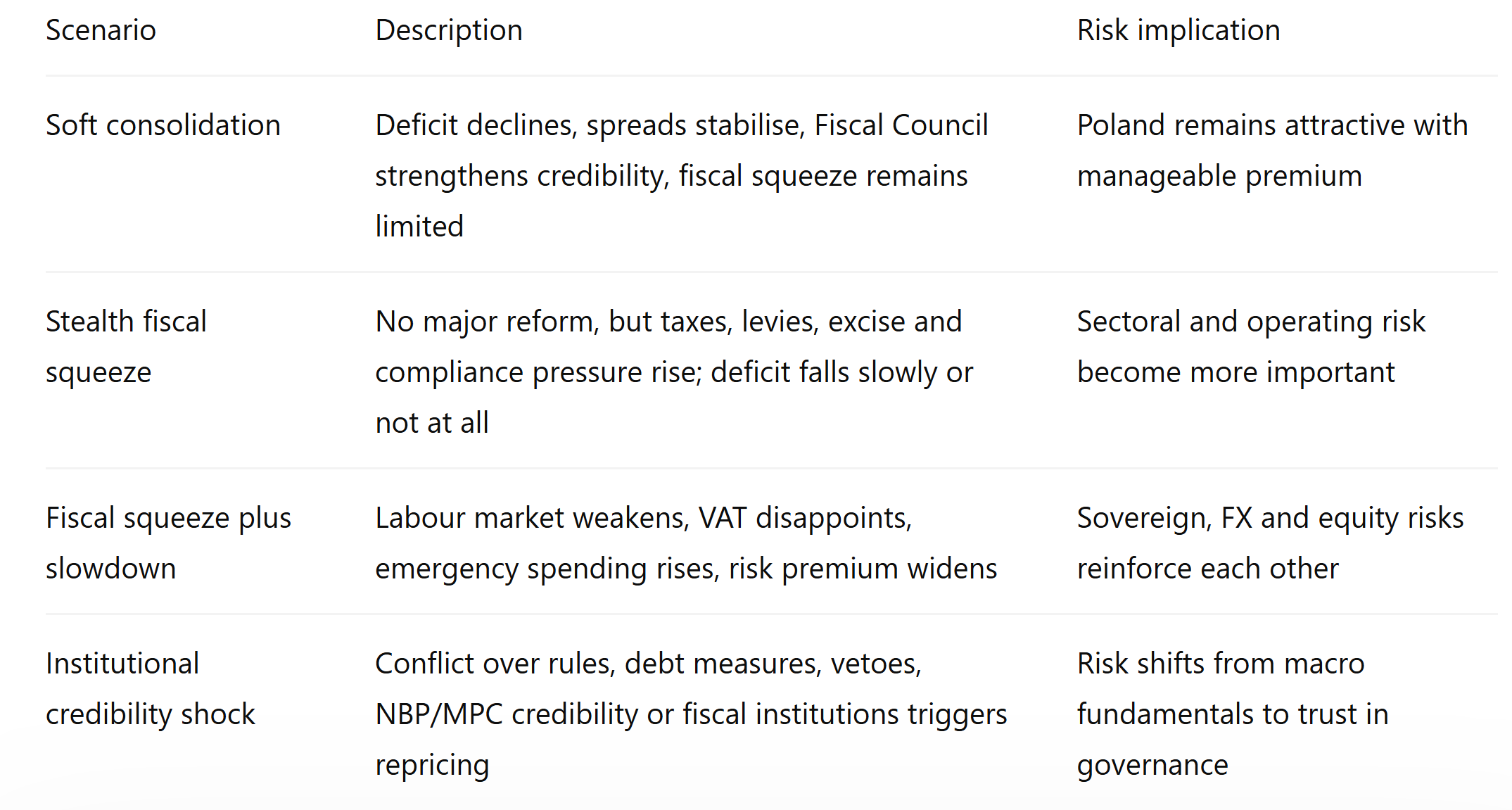
The most likely risk path is not a sudden crisis. It is Scenario 2 drifting toward Scenario 3. This would be harder to communicate politically than a shock, because it can remain gradual for some time. But for institutional capital, gradual deterioration is still deterioration.
This is the dashboard I would update in future premium notes.
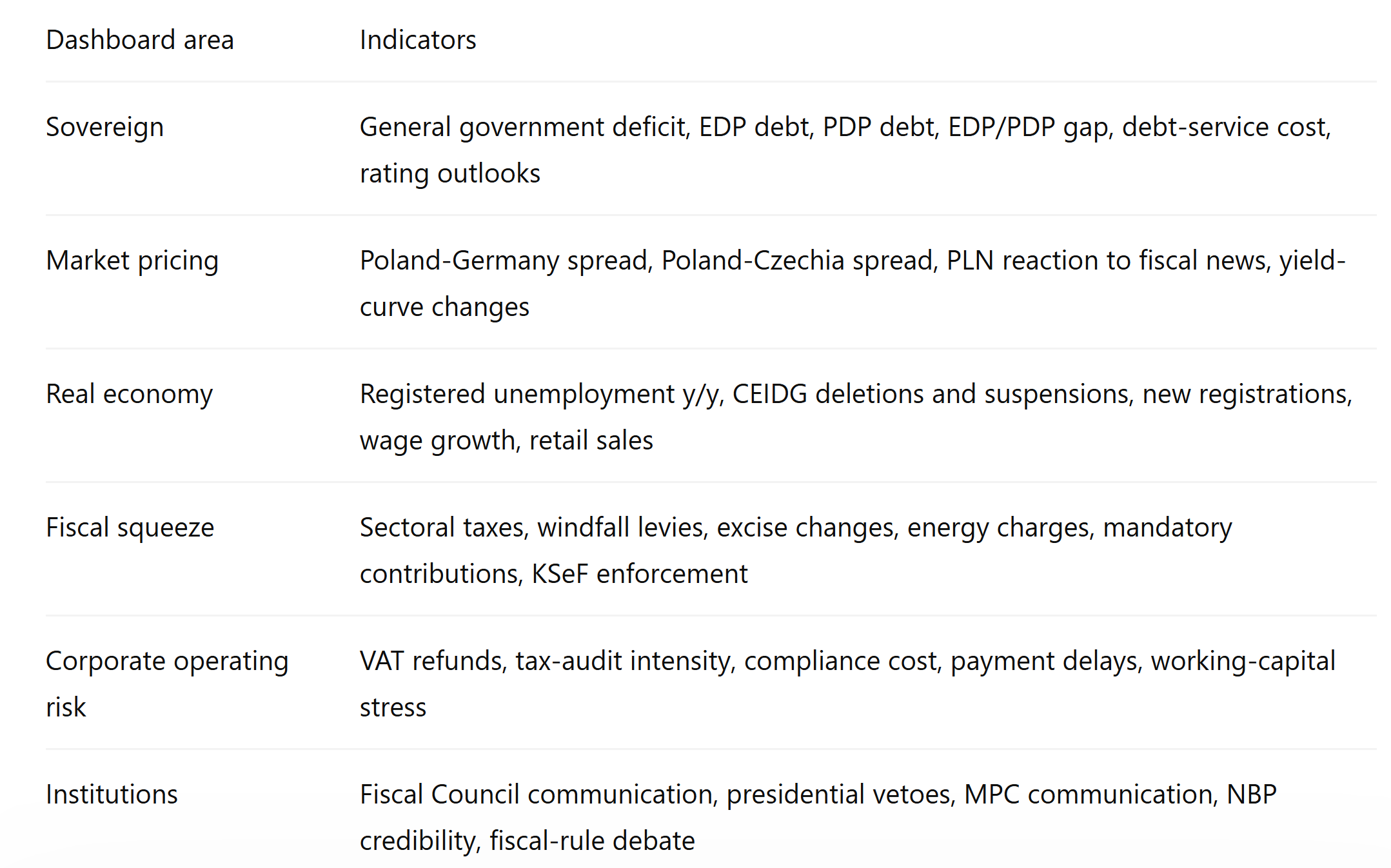
The dashboard should be read directionally. No single indicator will confirm or reject the thesis. The question is whether several indicators move together: high deficit, rising EDP debt, elevated spreads, weakening labour-market momentum, intensifying fiscal squeeze and institutional ambiguity.
This is not investment advice. It is a risk framework.
Institutional readers should consider whether their Poland exposure is being assessed too generically. Poland should not be treated merely as part of broad CEE exposure if its fiscal-institutional configuration is becoming more specific.
A practical approach would include five steps.
First, separate Poland-specific fiscal risk from generic CEE risk. The relevant question is not whether the region is volatile, but whether Poland’s fiscal trajectory, debt-measure gap and fiscal squeeze justify a distinct risk premium.
Second, monitor spreads rather than only headline yields. Absolute yields can be driven by global rates. Spreads against Germany and Czechia better reveal relative repricing.
Third, incorporate state-dependent margin risk into sector analysis. Banks, fuels, energy, large retail, digital platforms and real estate should be assessed not only through business fundamentals, but also through fiscal convenience.
Fourth, treat KSeF and tax enforcement as operating-risk variables. They belong in corporate risk models, especially for firms with complex VAT flows, local supply chains or thin administrative capacity.
Fifth, update the dashboard quarterly. Annual reviews are too slow for a fiscal-risk spiral. The signals will appear gradually: in budget execution, rating language, spreads, labour-market momentum, tax proposals and enforcement behaviour.
Poland is not uninvestable. That is not the argument.
My argument is that Poland’s risk premium is changing. The fiscal story is no longer only about deficits and debt. It is about the interaction between public finance, institutional credibility, regulatory pressure, monetary-policy constraints and firm-level operating costs.
For institutional capital, the relevant question is not whether Poland is already in crisis. The relevant question is whether the market is pricing the full fiscal-institutional risk before the next slowdown arrives.
My answer: not yet.
Comments
Nothing yet. Say the first thing.
Sign in to join the conversation.