
Crises rarely begin with panic.
They begin with signals that still look too small, too technical, or too early to matter. In mid-2007, I warned that the American financial crisis would not remain American (at that time almost nobody believed that there will be any financial crisis in the U.S.) and that Poland should prepare for a slowdown. In May 2019, I warned that Poland’s inflation was beginning to accelerate, even though the headline annual rate still looked manageable. The signal was not the level itself. It was the change in momentum.
The same logic applies today.
Poland is not facing a Greek-style crisis. It is not losing access to bond markets. The zloty is not collapsing. The banking sector is not in distress.
But this is not the right test. The right test is whether Poland is building fiscal resilience before the next slowdown — or consuming it before the slowdown has even arrived.
My answer is: Poland may be entering a fiscal risk spiral.
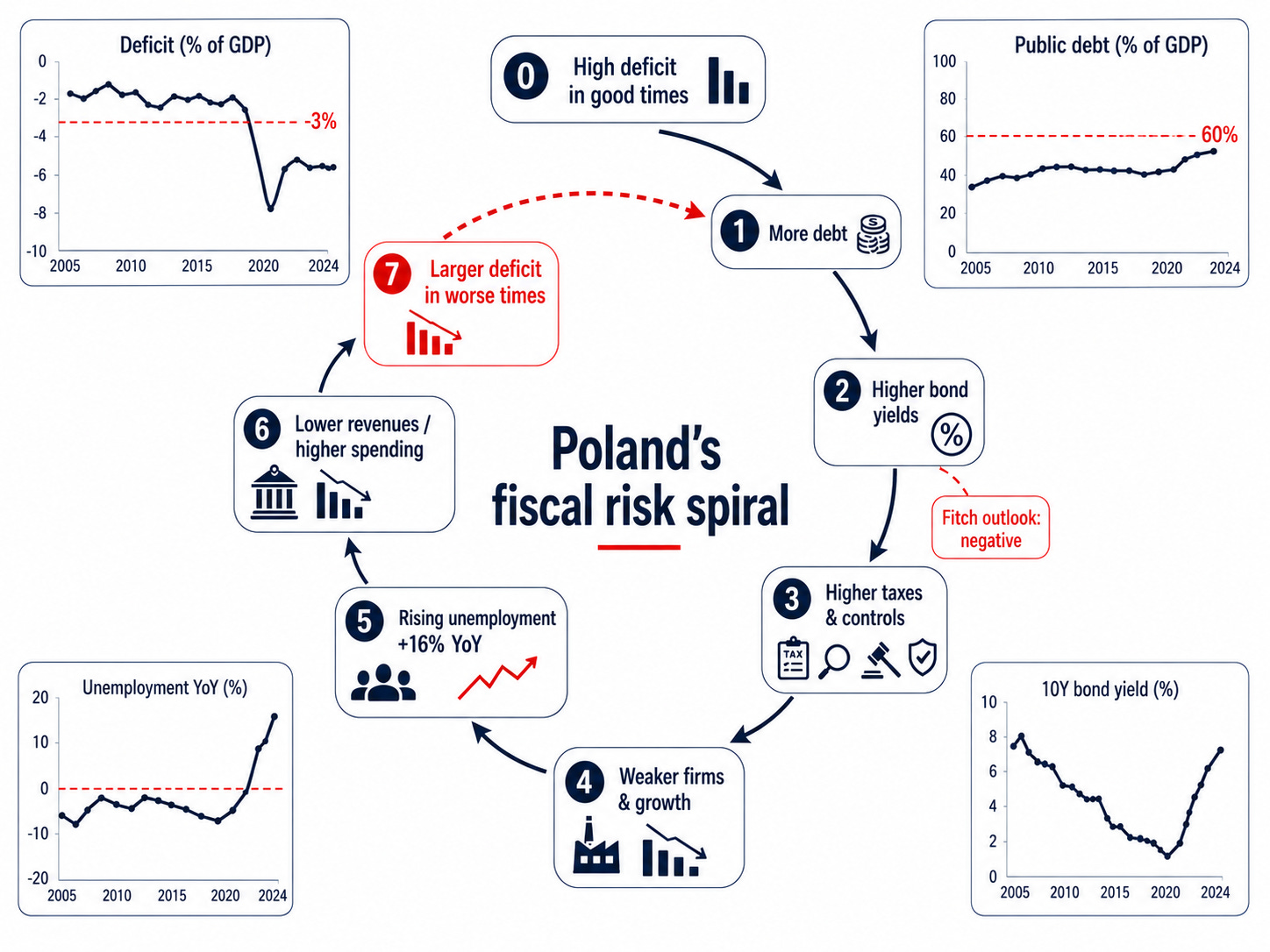
A high deficit during a recession may be a necessary policy response. A high deficit during war or a pandemic can also be justified. This is a fundament of contemporary neokeynesianism. But a deficit above 6% of GDP while the economy is still growing is different. It is a structural warning.
Poland’s problem is not simply that the deficit is large. The problem is that it is large in good times. This distinction matters.
Fiscal policy is supposed to provide a stabilisation buffer. In bad times, the state can borrow more to protect households, firms and employment. In good times, it should rebuild fiscal space.
Poland is doing the opposite.
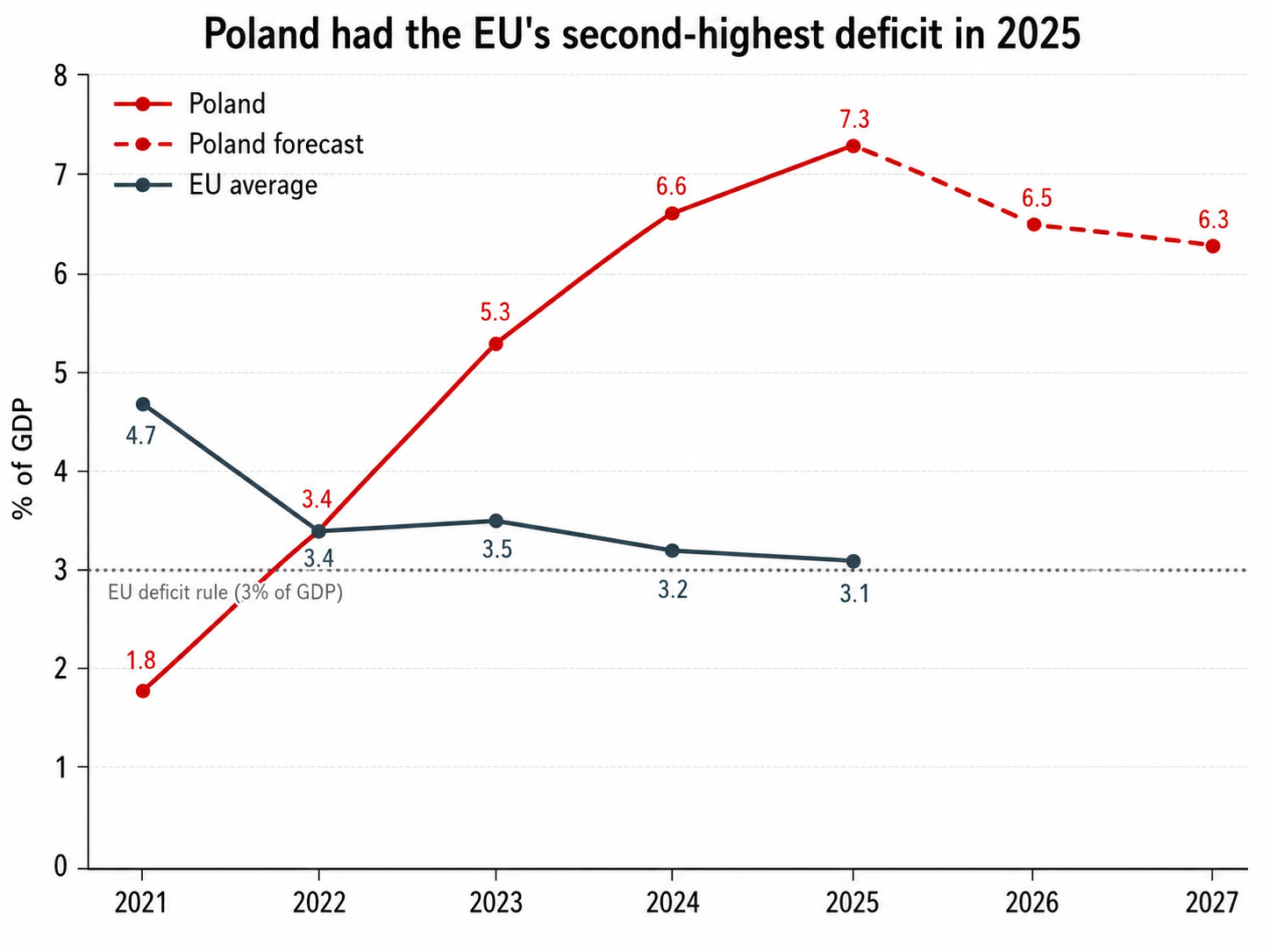
In 2025, Poland recorded one of the weakest fiscal positions in the European Union. Its general government deficit reached about 7.3% of GDP. Only Romania had a higher deficit. The EU average was close to 3.1% of GDP.
This is not a marginal deviation from the fiscal rule. It is a warning that Poland’s fiscal anchor is already weak before the next downturn arrives.
The issue is not whether Poland can finance the deficit today.
It can.
The issue is what happens if growth slows, debt service remains expensive, and the state enters the next downturn with a fiscal position that already looks like a crisis response.
That is how a fiscal risk spiral begins.
The fiscal risk spiral is simple.
A high deficit in good times leads to more debt. More debt raises borrowing needs. Higher borrowing needs can increase bond yields. Higher yields raise the cost of servicing debt. The finance ministry then looks for revenue: sectoral taxes, windfall levies, excise hikes, fees, charges, mandatory contributions and stricter enforcement.
Those measures are rarely neutral.
They raise costs for firms and households. Firms invest less, hire less, or close more often. Household purchasing power weakens. The labour market deteriorates. Lower revenues and higher social-spending pressure then create a larger deficit in worse times.
The loop closes.
This is why the question is not: “Is Poland already in crisis?”
The better question is: “Is Poland still building resilience — or already losing it?”
The debt story is more subtle than the public debate suggests.
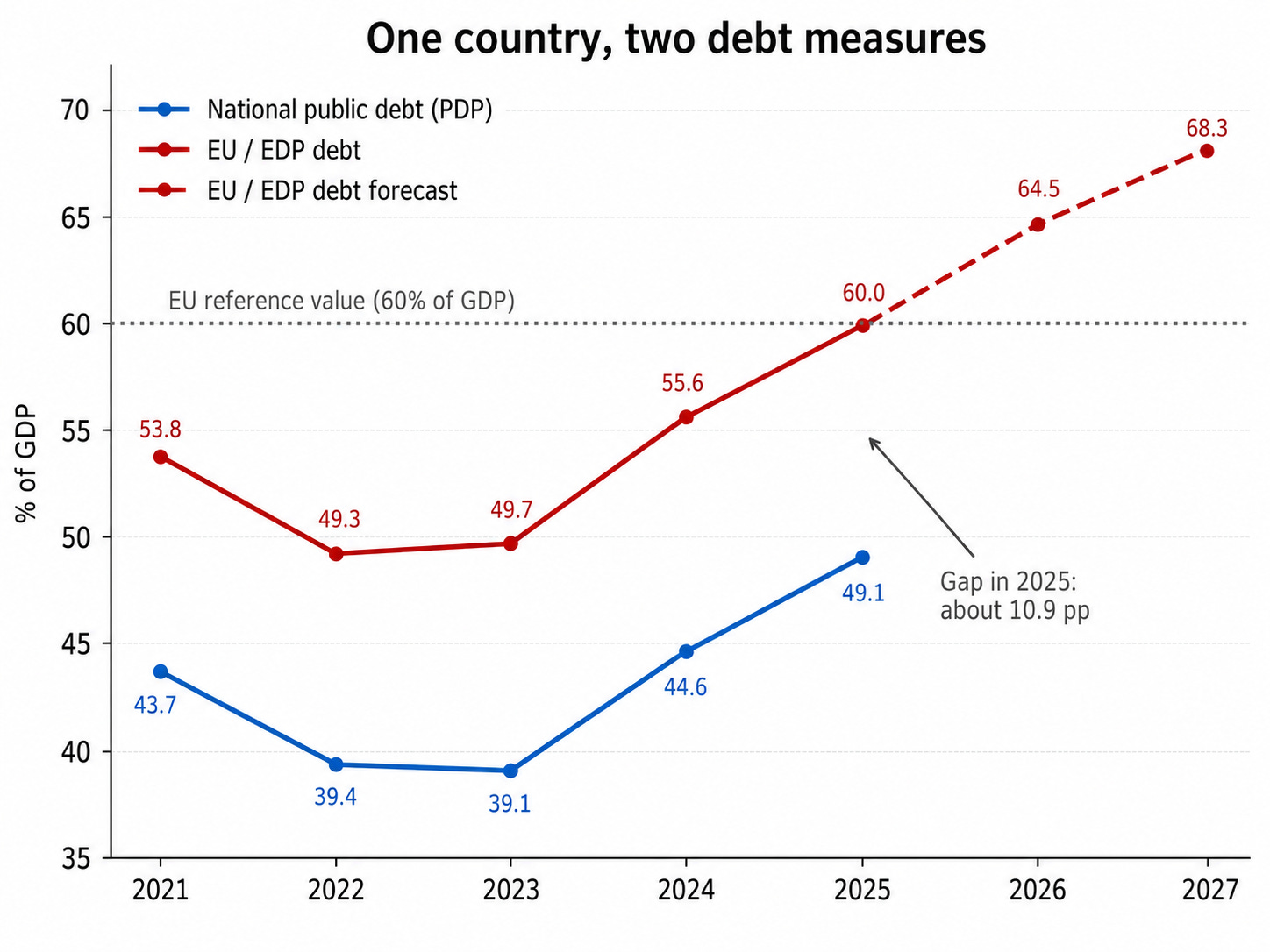
Under Poland’s national public debt measure, the constitutional threshold of 60% of GDP is not an immediate problem. At the end of 2025, the national measure stood at about 49.1% of GDP. That means there was still roughly 10.9 percentage points before the constitutional threshold.
But under the EU/EDP methodology, Poland’s debt was already around the 60% reference value and is forecast to move clearly above it.
This gap matters.
The issue is not that Poland has a national debt definition. Many fiscal systems have them. The issue is whether the national measure still captures the fiscal risk that the constitutional debt rule was designed to constrain.
A hidden 10-percentage-point debt gap is not an accounting detail. It is an institutional warning.
The lesson from Europe’s past fiscal crises is not that Poland is Greece. It is not. The lesson is narrower and more important: when markets begin to distrust fiscal numbers, the problem stops being only accounting. It becomes a credibility problem.
Poland is not there today.
But the gap between the domestic measure and the EU measure should be watched closely by investors, rating agencies and policymakers.
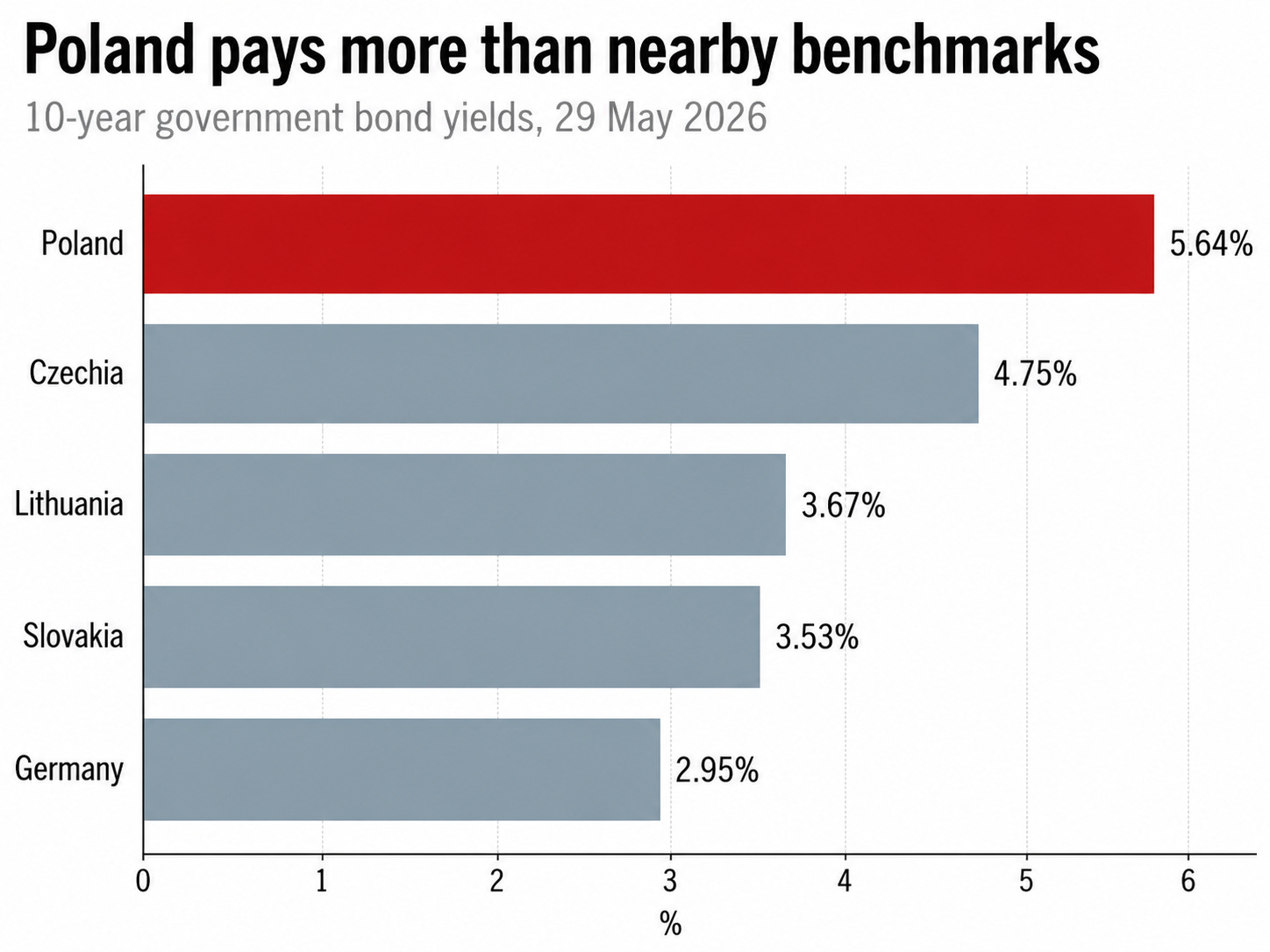
There is no bond-market panic. And that is not my argument. The argument is that Poland is already paying more than nearby benchmarks.
Polish 10-year government bond yields remain visibly above Germany, Slovakia, Lithuania and Czechia. This does not mean that Poland is close to default. It means that investors demand a higher price for holding Polish debt.
Markets do not need to refuse financing to send a warning. Sometimes the warning is simply a higher price for debt.
Fitch has already moved Poland’s outlook to negative. That matters. Rating agencies are not reacting only to political noise. They look at fiscal slippage, persistent deficits, debt dynamics and the credibility of fiscal anchors.
This is the point: Poland’s risk is not priced as panic. It is priced as deterioration.
That distinction is crucial. Panic comes late. Risk repricing comes earlier.
This is not only a Polish domestic debate.
For sovereign-risk analysts, the key issue is not whether Poland can borrow today. It can. The issue is whether persistent deficits in good times weaken fiscal credibility before the next slowdown.
For fixed-income investors, the key signal is not only the absolute level of yields. It is the spread against safer benchmarks and the direction of the fiscal story.
For FX analysts, the risk is whether fiscal pressure, inflation risk and monetary-policy credibility begin to interact.
For equity investors, the question is whether the state’s search for revenue will move into sectoral taxation and state-dependent margin risk.
For corporate decision-makers, the issue is whether Poland’s fiscal pressure will translate into higher compliance costs, more aggressive enforcement and a less predictable regulatory environment.
This is why the fiscal risk spiral matters. It links public finance, institutional credibility, cost of capital, firm-level decisions and macro resilience.
This is the first article in the Poland Risk Intelligence Series. This article focused on the macro-institutional warning: deficit, debt, bond yields and the fiscal-risk mechanism.
The next article will show why this is not only a bond-market story. The real economy is already sending early signals. The unemployment rate still looks benign, but the trend does not. Micro-business closures are also rising.
The third article will examine the fiscal squeeze already visible in taxes, levies, excise duties, fees and compliance infrastructure.
The final paid article will provide a Poland risk playbook for institutional readers: sovereign, FX, equity and FDI exposure, scenario analysis, and a monitoring dashboard for future updates.
Poland is not in a fiscal crisis today.
That is exactly why the warning matters.
The danger is not that Poland is already Greece.
It is not.
The danger is that Poland may enter the next slowdown with weaker fiscal buffers, rising debt, elevated borrowing costs and a fiscal system that is already searching for money.
Fiscal risk spirals do not begin with panic. And my purpose is not to share panic. It is to identify the signals that remain easy to dismiss before they become impossible to ignore.
Comments
Nothing yet. Say the first thing.
Sign in to join the conversation.