
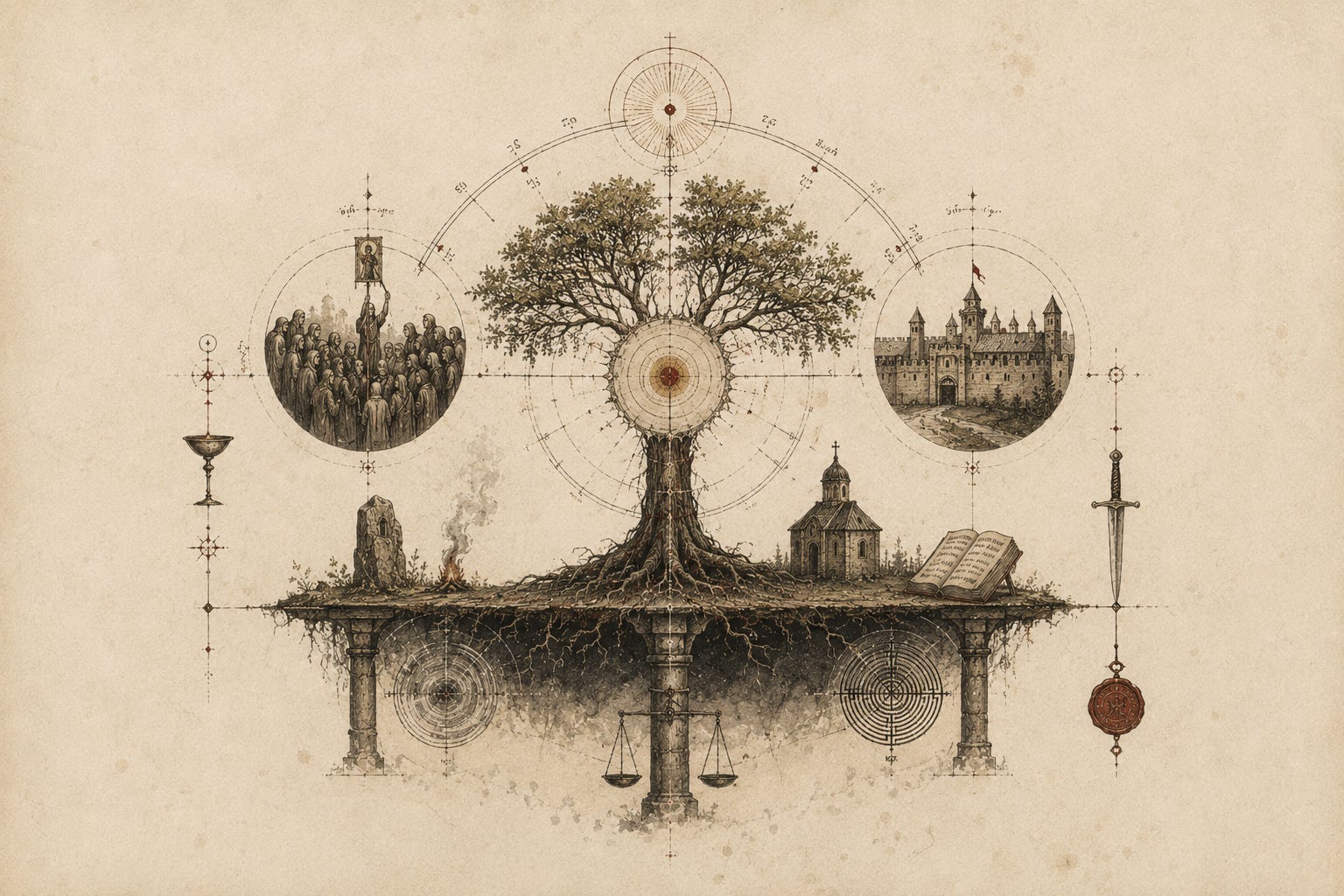
The index article can be found here.

There is a particular grammar to political crisis. It tends to repeat.
When the ordinary machinery of authority begins to fail, when compliance requires more enforcement than the system can sustain, when the gap between what institutions claim to be and what they visibly are becomes too wide to ignore, the social organism does not typically move forward toward something new. It moves backward. It reaches for something older, deeper, more fundamental than the procedures and offices whose legitimacy has drained away. It reaches for myth. For origin. For the figure who stands before and above the ordinary order and claims to be the embodiment of something the ordinary order has betrayed.
I have been thinking about this pattern for a long time. It appears in Rome when the Republic hollows and the Principate arrives draped in the language of ancestral restoration. It appears in revolutionary France when the Directory exhausts itself and Napoleon arrives as the embodiment of Roman virtue and Carolingian grandeur simultaneously. It appears whenever the thinning of deontic authority reaches a threshold at which enforcement can no longer hold the surface together and the social organism, rather than dissolving, performs a kind of immune response, reaching for the deepest available source of conviction, the mythic substrate beneath the institutional order, the place where legitimacy was first grounded and might, if the ritual is performed correctly, be grounded again.
The name for this pattern is sacral regression. And it is the subject of this essay.
Before examining what happens when secular authority collapses into the sacred, it is necessary to say precisely what the sacred is, not theologically, but structurally. Because the confusion between these two accounts is where most analysis of sacral regression goes wrong.
Mircea Eliade spent his career mapping the phenomenology of the sacred across cultures and periods, and his central finding is simple to state and difficult to fully receive: for the religious person in archaic and traditional societies, the sacred is not a category of experience but a mode of being. It is the real. “The sacred is saturated with being,” Eliade writes. The polarity of sacred and profane is experienced not as a distinction between two kinds of things but between reality and its absence — between the world ontologically grounded by divine act and the formless expanse that surrounds it.
This matters for our argument because it means the sacred is not primarily a comfort or an explanation. It is a foundation. It is the source from which the world’s claim to existence derives its warrant. And crucially for understanding sacral regression, it is locatable in time as well as space. The sacred time, for religious man, is the time of origins, in illo tempore, in that primordial moment when the gods acted and the world came into being. The myth that recounts this moment is not merely a story. It is the paradigmatic account of how things are constituted, the model to which every subsequent act of creation must refer if it is to partake of reality rather than merely of appearance.
Ritual, in this framework, is not commemoration. It is re-entry. The festival does not remember the cosmogonic moment; it reactualizes it, it makes the community contemporary with the creation, allows them to inhabit the sacred time, and thereby renews both the world and the people who perform the ritual. “Life cannot be repaired,” Eliade observes. “It can only be recreated through symbolic repetition of the cosmogony.” This is not metaphor. For those who inhabit the sacred order genuinely and pre-reflectively, the return to origins is the only available therapy, the only act powerful enough to address catastrophe, illness, failure of harvest, succession crisis, war.
The institutional essays in this series have been building toward this point from the other direction. When we described thick deontic authority, the condition in which institutions function as genuine reasons rather than threats, we were describing something that has the same structural character as Eliade’s sacred. Thick institutional authority is also saturated with being, in the sense that it organizes experience pre-reflectively, gives the social world its orientation and its solidity, and does not require continuous justification any more than a stone requires justification for being hard. The Background, in Searle’s terms, is the sedimented history of a community’s shared inhabitation of its own institutional order. It is, if you will, the secular illud tempus, the founding moment compressed into a pre-reflective disposition.
When this Background erodes, the community loses its sacred time in the secular sense. It loses the unreflective sense that the world is constituted and ordered and real. And then it begins to reach.
If you’d like to support this project and receive future essays, consider subscribing.
Durkheim understood what the reaching produces, and described it with a precision that still has not been surpassed.
In what he called collective effervescence, the heightened state of shared conviction generated by assembled bodies participating in common ritual, he identified the mechanism by which sacred power is regenerated. When people come together, animated by a common orientation, something happens that exceeds the sum of what any individual brings. “In the midst of an assembly animated by a common passion,” he wrote, “we become susceptible of acts and sentiments of which we are incapable when reduced to our own forces.” His example is the Night of August 4th, 1789 — an assembly that surrendered privileges overnight that its individual members had refused to surrender the day before and were surprised, the day after, to find themselves having surrendered. The assembly had generated something that none of its members individually possessed.
Durkheim’s account of this mechanism is ultimately an account of how collective representations accumulate force. The shared conviction, elaborated in common and sustained by the recognition of every other mind present, acquires an intensity “which no purely private states of consciousness could ever attain.” The voice that speaks for the assembled community carries an accent that no individual voice can produce alone. And this force, once generated, can be directed, into ritual, into law, into the shared behavioral norms that constitute the Background.
What Durkheim saw is that collective effervescence is the primary engine of sacred generation. The gods exist, in his framework, because and to the extent that they are collectively sustained, because the shared belief “commands acts which will realize it” through “the simple radiation of the mental energy which it contains.” Belief does not follow the sacred; the sacred follows sustained collective belief. This is why Durkheim says, in a sentence that should be read alongside everything else in this series: “Sacred beings exist only when they are represented as such in the mind. When we cease to believe in them, it is as though they did not exist.”
The engine of sacral regression, then, is not the sudden appearance of genuine sacred conviction. It is the deliberate triggering of collective effervescence to generate it. The assembly, the rally, the ritual performance, the spectacle of charismatic address, these are not merely political theater. They are attempts to reproduce the conditions under which Background conviction is sedimented: shared orientation, assembled bodies, common emotional register, the experience of being individually elevated by participation in something larger. The demagogue who fills a stadium is not simply performing. They are performing a ceremony, one whose design, whether conscious or intuitive, replicates the structure of Durkheim’s collective effervescence, because that structure is the only available mechanism for rapidly generating the normative depth that the depleted institutional order can no longer provide.
Max Weber gave this figure a name and a structural location. He called the type charismatic authority, the third form of legitimate domination alongside the traditional and the rational-legal, and he recognized it as “the specifically creative revolutionary force of history.”
Charismatic authority, in Weber’s account, is precisely what emerges when both rational-legal authority (the institutional order, the office, the procedure) and traditional authority (the inherited pattern, the custom, the recognized hierarchy) have lost their grip. The charismatic leader does not claim authority from an office or from a tradition. They claim it from their own person, from a gift, a quality, a direct relationship to power that the ordinary order cannot confer and cannot revoke. The followers of the charismatic leader do not obey because a procedure has been followed. They obey because they have experienced something in the presence of this person that they cannot reduce to procedural terms, because the leader seems to them to partake of something that transcends the institutional order and was present before it.
This is sacral regression in its most naked political form. The charismatic leader is effective not despite the collapse of institutional authority but because of it. They are the human face of illud tempus, the living hierophany, in Eliade’s terms, the place where the sacred manifests in a person rather than in a stone or a grove. They stand at the origin point, embody the founding gesture, claim to be the recovery of what has been lost.
Weber was precise about what charismatic authority requires for its maintenance. It must continuously prove itself. The gift must be demonstrated, through success, through miracle, through the visible working of the power the leader claims to embody. A charismatic authority that fails to demonstrate its charisma loses it. Not procedurally, it simply stops being recognized as real. And here Weber and Eliade converge with Durkheim in a way that illuminates the structural fragility of sacral regression: the sacred must be sustained by collective recognition or it ceases to be. The charismatic leader who is no longer believed is no longer charismatic. The myth that no longer generates genuine conviction is no longer sacred. It is merely a story.
This is the trap at the center of sacral regression as a political strategy. Genuine sacred conviction, the kind Eliade describes, the kind that grounds experience pre-reflectively and makes the world feel constituted and real, cannot be manufactured. It can be triggered, in something like the Durkheimian assembly, but only if the material for it exists: a population whose genuine need for orientation has not been permanently converted to cynicism, a tradition whose sacred forms still carry ancestral weight, a leader whose claim to embody the founding moment is not so obviously instrumental as to prevent the belief it requires. When these conditions exist, sacral regression can produce genuine renewal. When they do not, it produces spectacle, and spectacle, as the previous essays have established, is the theater of power that confesses its own absence.
Nietzsche saw the whole dynamic from a position of merciless clarity, and what he saw was not primarily a historical pattern but a perpetual mechanism, the way in which every table of values announces itself as a recovery of something ancient and true.
In the Genealogy of Morals, he traced the origin of moral value to acts of will, to the powerful who defined the good in their own image and whose definitions, repeated and institutionalized and eventually sedimented into Background, became the pre-reflective moral orientation of entire communities. The claim of such value-creation is always that it recovers something real, something prior, something that was always already there and has merely been rediscovered. “Peoples once hung over them tables of the good,” Zarathustra says. “Love which would rule and love which would obey, created for themselves such tables.” The tables are created by the powerful, but they are presented, must be presented, as given, as found, as belonging to the sacred time before the current order rather than as its founding act.
This is Nietzsche’s version of sacral regression, and it is the most philosophically disturbing version because it applies to genuine sacred founding as much as to its political simulation. Every illud tempus was, at some point, someone’s decision. Every cosmogonic myth was, at some level, a cultural production, an elaboration by particular people in a particular moment that then sedimented into collective Background and became, for subsequent generations, simply how things are. The sacred time that Eliade describes as the paradigmatic model for all creation was itself created. The question that Nietzsche forces us to ask is whether this changes anything, and the answer that this series has been building toward is: it changes everything about how we understand sacral regression and nothing about whether it can work.
Because if all values are created but must be experienced as given, then sacral regression is not an aberration or a failure mode of political life. It is its permanent structure. Every political order claims a founding moment that legitimates the present. Every institutional structure refers, ultimately, to something that precedes it, to a charter, a covenant, a revolution, a divine grant, that grounds its authority in something that feels like illud tempus, the sacred time before which the current order could not exist and from which it derives its right to function. The Nietzschean insight is that these founding moments are always acts dressed as discoveries. And the moment this is generally recognized, when the Background cynicism deepens to include the founding myth itself, the sacral regression has failed at the deepest possible level.
This is the scenario the world-building rules describe as the most destabilizing: not the weakening of a god or the thinning of an institution, but the collapse of the mythic substrate that grounds both. When the founding story becomes merely a story, when the illud tempus is perceived as a then rather than an always, the social organism has lost its deepest layer of conviction, and no political sacral regression can reach deep enough to restore it. Only genuine renewal can. And genuine renewal requires, as Nietzsche knew and as Eliade’s framework implies, not the recovery of the old myth but the creation of a new one, which is an act of such violence and such generativity that it transforms everything in its path.
This is the distinction that determines whether sacral regression stabilizes or merely postpones.
Genuine sacral regression, if such a phrase is not a contradiction in terms, occurs when the reach toward the sacred finds something there. When the collective effervescence triggered by crisis and assembly generates conviction that is not merely performed but genuinely inhabited. When the charismatic figure actually embodies something that the community recognizes, pre-reflectively and not just rhetorically, as real. When the return to the founding myth produces the experience of illud tempus, the community feeling itself contemporary with its own origin, renewed by the contact, capable of beginning again.
This happens. It has happened in history. The Reformation, at its origin, produced this in at least some of its participants: a genuine re-grounding of the sacred, a return to what was experienced as the originary text behind the institutional accumulation, a community that felt itself present at the founding. The result was not merely political change but a rewriting of the Background, a new pre-reflective orientation toward authority, scripture, conscience, and salvation that persisted for generations and structured experience in ways that neither the reformers nor their opponents could fully control.
What does not produce this is the political use of sacred forms by those who do not believe them, directed at populations whose need for orientation is genuine but whose cynicism about institutions is already sufficiently deep to make them resistant to the conviction the performance requires. This is the simulation, the regime that invokes founding myths it does not inhabit, that stages collective effervescence it knows to be staged, that deploys the charismatic figure as a communication strategy. The simulation can produce compliance. It cannot produce Background. And compliance without Background is, as this series has established, the definition of thinned institutional authority, which is exactly the condition that produced the crisis sacral regression was meant to address.
The simulation produces a peculiar kind of exhaustion. The sacred forms, deployed as instruments, gradually lose even their instrumental power, because what makes them instrumentally powerful, the residual genuine conviction they can trigger, is exactly what their instrumental deployment erodes. Each performance of collective effervescence that is recognized as performance, however privately and silently, withdraws a small deposit from the account of sacred legitimacy. The forms continue. The conviction drains. The ritual becomes, in Eliade’s terms, merely commemorative, a ceremony that remembers the sacred time without entering it, a performance that refers to the founding moment without making the community contemporary with it.
What remains is the frame without the picture. The language of the sacred without the sacred. The claim of illud tempus without the experience of it. And a population that has learned, through repeated exposure to the simulation, to recognize the grammar of sacral regression, and to feel, each time it is performed, a little less.
Durkheim made an observation that belongs at the center of this section. When the periodic crises that threaten the natural order occur, when the vegetation fails or the rain does not come, the sacred beings upon whom these things depend are understood to be passing through corresponding crises of their own. “They, too, have their periods of giving way.” And the human response is not passive: because the gods are sustained by collective representation, and collective representation is sustained by communal practice, people mobilize their forces to sustain the gods, to pour out the blood that fecundates, to scatter the germs of life, to perform the rites that reinvigorate the sacred beings by reinvigorating the shared belief that constitutes them.
In the world-building rules of this project, this mechanism is made literal. Gods thin as belief depletes. Not metaphorically, structurally. The entity becomes less corporeal, less present, less efficacious, as the conviction sustaining it weakens. Ritual performed without genuine conviction does not maintain the god at full strength. It commemorates, at best. Belief is the condition of perception and, more than perception, of ontological status.
This means sacral regression in such a world is not merely a political strategy. It is a cosmological emergency response. When the gods thin, as they will when the institutions that mediated their worship hollow and the ritual forms persist without the conviction that animates them, the world itself becomes less. The sacred sites lose their hierophanic quality. The boundary that was maintained by genuine collective belief becomes permeable to things from the other side, not because the boundary markers have been removed but because the believing community that constituted the boundary has stopped maintaining it from within.
In this framework, sacral regression is an attempt to restore the conditions under which the gods can persist. Not through political manipulation but through the recovery of genuine conviction, or through the manufacturing of something close enough to genuine conviction to restart the process of sedimentation.
The world-building rules establish that sacral regression in this setting is not a metaphor but a mechanism. When secular authority thins and the sacred forms are recruited to compensate, the result depends entirely on whether the recruitment generates genuine conviction or merely its performance.
Three specific dramatic principles follow from the essay’s argument.
The founding myth as the deepest vulnerability. Every political order in this world rests, ultimately, on a founding moment whose sacred status grounds all subsequent institutional authority. The prince rules because the land remembers the original covenant, because the founding story grants the current order its warrant. The most dangerous possible attack on such an order is not military defeat, not institutional corruption, not even the collapse of enforcement. It is the reframing of the founding myth, the introduction of an alternative reading that makes the origin story look like a production rather than a discovery, a choice rather than a given. A character who can accomplish this, who can insert the Nietzschean reading into the communal Background without appearing to do so, has struck at something that armies cannot defend.
Collective effervescence as a limited resource. In a world where belief has physical consequences, collective effervescence, the assembly of genuine shared conviction, is not infinitely renewable. Every time it is triggered artificially, without the conditions that would allow it to be genuinely inhabited, it depletes something. The sacred forms grow more familiar and less powerful. The assembly that once generated a Night of August Fourth produces, the next time, only a Night of Moderate Enthusiasm. A ruler who understands this will be profoundly conservative about the deployment of ritual, will resist the political temptation to stage collective effervescence for instrumental purposes, because every staging that fails to produce genuine inhabitation is a withdrawal from an account that takes generations to replenish.
The charismatic figure as cosmological event. In a belief-structured world, the charismatic leader who generates genuine recognition, whose presence actually triggers Durkheim’s collective effervescence, whose claim to embody the founding moment is experienced rather than merely argued, is not simply a political phenomenon. They are a hierophany. The sacred has manifested in a person. This gives them enormous power and a specific vulnerability: the power is real only as long as the recognition is genuine, and recognition is sustained only by continuous demonstration. The moment the charismatic figure is perceived as performing their charisma, the moment the Background reading shifts from “this person is what they claim to be” to “this person is claiming to be what they are not”, the sacred presence is extinguished. Not discredited. Extinguished. The hierophany ends. What remains is a person in a room with people who are no longer believing.
The world-building rule about the manipulator’s paradox, that awareness prevents full inhabitation, applies here with special force. The ruler who deliberately stages sacral regression knows they are staging it. That knowledge is the hairline fracture through which the conviction that would make it real cannot enter. The genuine charismatic figure does not stage their charisma; they inhabit it. They believe, at some deep level, what they are saying. This is what makes them actually dangerous, and actually capable of performing the cosmological work that sacral regression requires. And it is also what makes them tragic: because the inhabitation that generates their power cannot survive the self-consciousness that success tends to produce. Understand what you are doing well enough to do it deliberately, and you have already begun to stop doing it.
About Me & Index with links to my other work can be found here.

Comments
Nothing yet. Say the first thing.
Sign in to join the conversation.