
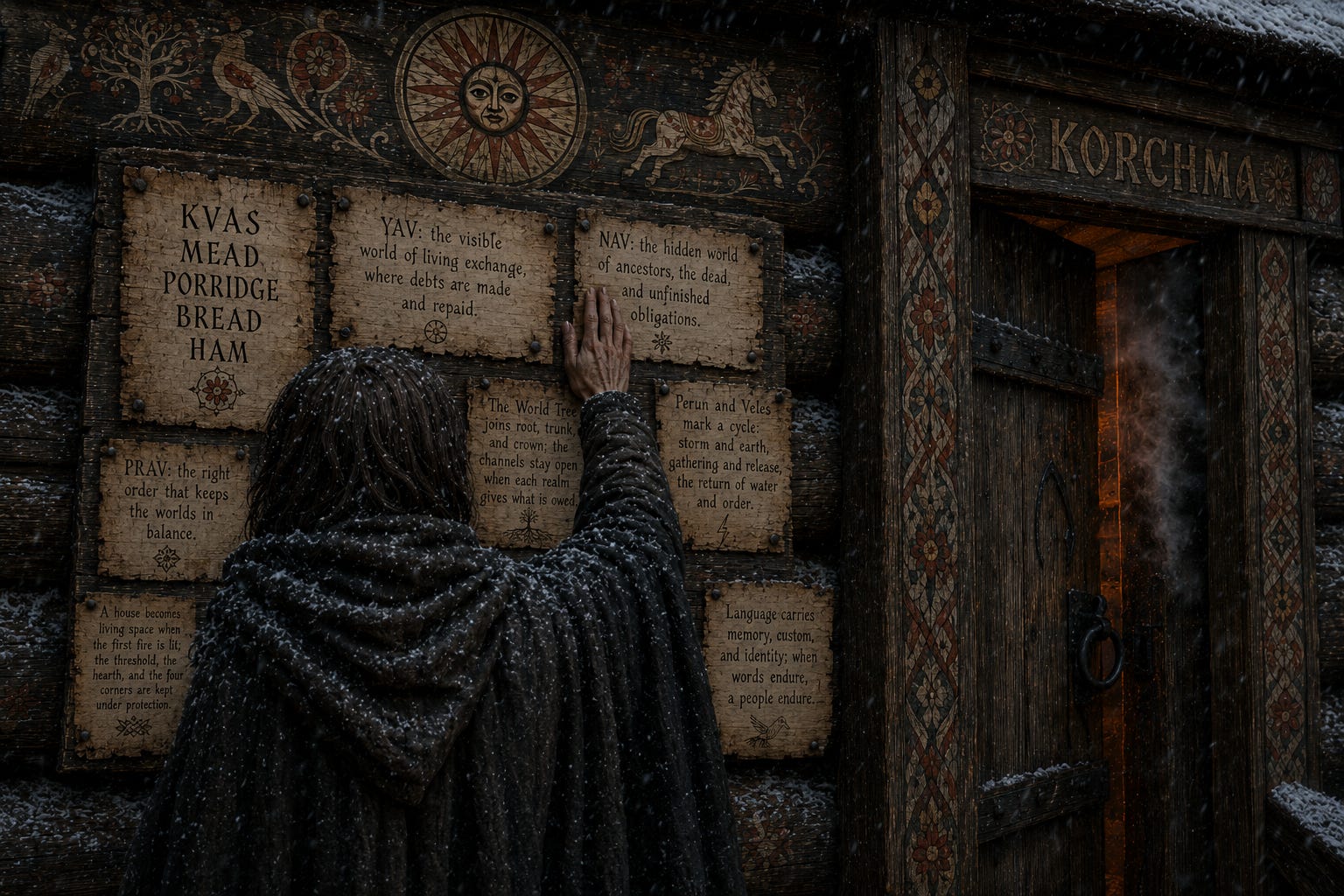
The Marionette is fully drafted and has been through a round of edits, and I am happier with it than I expected to be. It is a detective story, and it turned out to be something else as well. Eighteen years ago I wrote a piece called Puppeteer in the Shadow. This one stands beside it, takes the same idea, and looks at it from the other end. There is something strange about answering your own teenage work.
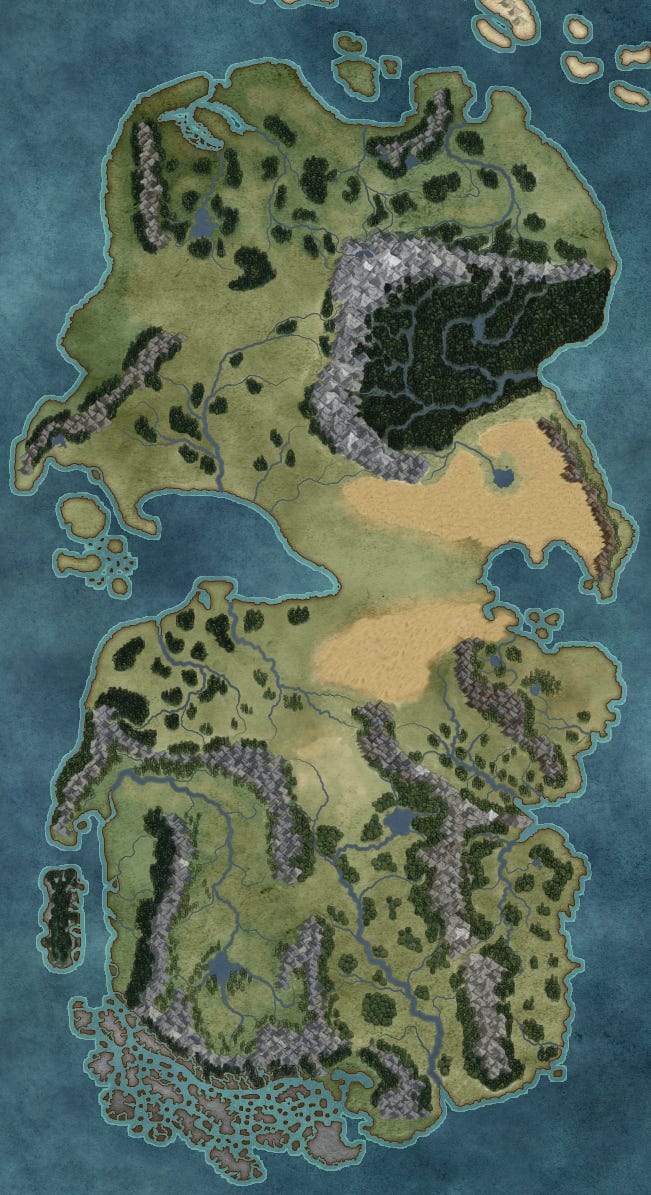
I have also spent about seventy hours on the map for the fantasy world, and one continent is almost finished. Coastlines, rivers, mountains. Seventy hours is an absurd number for something readers will glance at for four seconds, and I regret none of it, because the geography has already corrected two things in the manuscript that no amount of thinking would have caught.
And the science fiction has a direction now. I spent two days calculating gravitational slingshots to get my captain home across three hundred light years, and the arithmetic came back at somewhere between ten and thirty thousand years, mostly because he does not have the fuel to accelerate properly and none at all to slow down. He cannot get home. I checked more than twice, hoping for a kinder answer. So the answer is hibernation, an AI sending signals out into nothing, and a rescue decades or centuries later by people whose world he will not recognise. That is the next story, and it exists because the physics refused me.
There are more than 900 of you now, and the page has passed 9,400 views. I am going to keep the reflections short and save them for a rounder number.

The sign-up post is live and thirty writers have put their names down. Trios drawn at random, three images a month, three hundred words per story with each of you writing roughly a hundred, and three weeks to do it. You do not need to know anyone. That is the point.
Twelve of you signed up without telling me which genres you want. Pale Blue Glow Science Fantasy, F. P. Dawe (Author), J.A.Davidson, Joseph Mesler™, Cairn X. Petrick, Tilting at Windmills, Nissa Harlow, Yorviing, Caryn Cordova, A.M. Bowman, Bookfairy, Keeper of the Ink: drop a number in the replies on the sign-up post. 0 for happy with anything, 1 for fantasy, 2 for science fiction, 3 for wildcard. More than one is fine and most people have said 0.
And I need illustrators. Thirty writers have signed up. One illustrator has. That ratio needs help, and I want to be precise about what I am asking for, because I am not asking anyone to work for free. I do not want commissions. Point me at a piece you have already made and want more eyes on. You choose which one. Full credit, links back to you, and it runs at the head of a post that three writers and their readers will be sharing. If that sounds like your kind of thing, say so.
I am deep in the steppe material now, more than a hundred sources across Central Asia, and the whole series exists to test one idea: that the belief-architecture I traced through the Slavic world is a grammar rather than a set of practices, and that the same grammar applied to a different landscape should produce something recognisably related and completely different. It does.
Here is the cleanest example. In the Slavic world the landscape is governed by sovereigns. The lisovyk rules the forest, the vodianyk the river, the poludnytsia the field at noon. They are not gods. They are foreign powers, and the relationship is diplomatic: a treaty between parties of different natures, honoured with offerings, and withdrawn from when the terms are broken. The forest is a partner. It is not family.
In the Altai-Sayan mountains, the landscape is family. Each clan has its mountain, and the mountain is not a patron but a senior kinsman. You can see it in the rules around it. A married woman could not speak the name of her husband’s clan mountain, could not climb it, could not stand near it with her head uncovered or her feet bare. Those are not religious prohibitions. They are exactly the avoidance rules that governed her behaviour toward her father-in-law and her husband’s older male relatives. Among the Beltir, women called the mountain testem, my father-in-law, and meant it literally.
Then the detail that made me put the book down. When a clan was displaced and moved to new territory, the sacred mountain changed. The clan chief assigned a new one. Which means the mountain’s sacredness was never a property of the mountain. It was produced by the relationship, it lapsed when the relationship stopped being maintained, and it could be established somewhere else on new ground. That is the same law that runs under everything I write.
Two smaller things from the same reading. The cairns I posted about, the oboo, where every traveller crossing a pass adds one stone with a strip of cloth or a few horsehairs: the missionary Verbitsky recorded it among the Altai in the nineteenth century as an acknowledgment to the mountain for permitting the climb. What I like about it is that it needs no specialist at all. The shaman ran the elaborate rites. The cairn only ever needed one person, one stone, repeated for centuries.
And the drum. Telengit shamans of the southern Altai called their drum ak-chagal. Ak means sacred or pure. Chagal they could not translate. When Potapov recorded the word in the 1920s they were using it purely by inheritance, with the meaning gone. It was recovered by comparison: among the Yakuts and the Uighurs the same word names a horse of a specific sacred colouring, piebald, patched brown across the neck and chest. They had been calling their drum a sacred piebald horse for centuries without knowing the second word. And a Yakut shaman, recorded by Popov, sat on his drum during the enlivening ceremony, urged it with the beater as if with a whip, and called it a brave and obedient piebald horse and told it to gallop. The drum was never a symbol of the horse. It was the horse.
A short word to the people who took out paid subscriptions. It bought a second monitor, which sounds mundane and is not: the research for these essays lives in a dozen sources at once, and I have spent months of it in one window, flicking. The work is measurably faster now. That is what the support turned into. Thank you.
Best comment goes to Frances Roberts Reilly. I had said that there is a word I grew up with, tuga, that English keeps mistranslating as sadness, and asked what the closest thing in your language was. The answers came in from everywhere, and I will come back to them. But hers was a different order of thing. In Welsh Kale Romanes, tuga means sorrow, grief, care. It sits beside duk, pain or ache, from Sanskrit duhkha. It inflects: tuganes, sadly. tuganeder, sadder. Roughly forty-seven percent of Welsh Kale Romanes comes from Sanskrit and Hindi, and the word has survived a diaspora of more than a thousand years out of India, through Asia Minor, across Europe, into Wales and Ireland.
Everything else in that thread was a parallel: different languages reaching independently for the same feeling. This was the same word, with its consonants intact, at the end of a thousand-year road.
And the grief thread. I asked what your people used to do with grief before everyone started doing it alone. Matty Macaroo described the Appalachian sin eater: the dead laid out in the house for days, food set out on the last night, and one final visitor who ate all of it and carried the sins of the dead away with him when he left, usually a man of low standing and completely essential to the community. White Craw Press argued that Gaelic culture never suppressed grief but sublimated it, forcing sorrow into rigorous vessels: the pìobaireachd that drives loss through variation after variation and brings it back down to the ground note, the caoineadh that made mourning a shared vocal duty, the lykewake spent sitting up with the body over ale and stories. Then the part I keep thinking about. When Calvinism stripped the public ritual away, the grief did not disappear. It went somewhere else, into gallows humour and sentimental ballads. The form gets abolished and the need routes around it.
Thank you also to Caryn Cordova, Hai Dang, LC Douglass, Stephen Thomas, Just Judy, Kris Buckel - Library of Kris, Jacquie, Vesper L. Rayne, Jessica Huckabay, Mohammad Khan, Martyn Stanley, Doug Hauger, Marija, per LEY, Cairn X. Petrick, Nicci Mackay, E Dorr, Dirk Walvoord, Seth R. Mitchell☕️Fantasy Auth, Litharis Archives, Matthew E Meurer, Joe Crump, Histories & Hauntings, Darick Allan, Matty Macaroo and everyone else who turned up this week. Histories & Hauntings in particular went and did research on the first Forgotten Kin story, pointing out that bodies were not usually consigned to the Mississippi, that a boat would pull to shore and bury the dead in the nearest cemetery, and that they had seen such graves near Natchez or Vicksburg forty years ago. The record leans one way. The family tree still keeps the other. That is exactly the shape of the thing.
Forgotten Kin’s first story is up and three more are in. Forgotten Tales has two tales published and more in the inbox. Horynych needs illustrators. The board will be back next week.
About Me & Index with links to my other work can be found here.

Comments
Nothing yet. Say the first thing.
Sign in to join the conversation.