
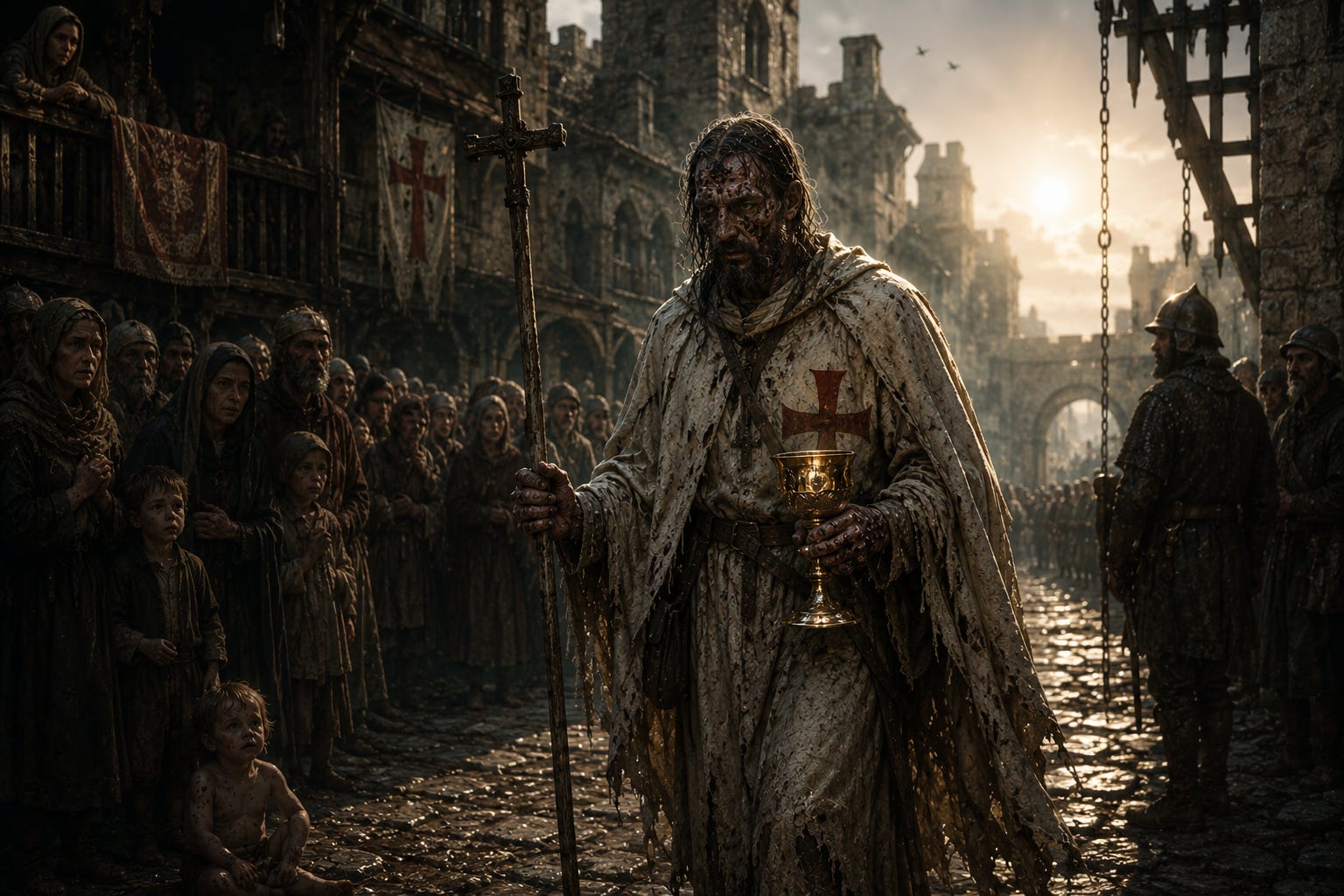
He came through the eastern gate at midmorning, when the light was still clean enough to show what he was.
The clapper announced him before his face did, the dry, wooden knock that every town in Christendom had learned to hear.
The market did not stop all at once. The fish women went first, because they were nearest the gate and because they had children with them. The cooper kept working through it, three strokes longer than anyone else. A cart of turnips was left standing in the middle of the row with nobody’s hand on it. Somewhere behind the stalls a dog went on barking at something that had nothing to do with any of this.
The smell reached the stalls before he did, and it was not the smell they had braced for. It was sweeter than that, closer to fruit than to meat, and it went through the fish and the bread and the tanner’s yard beyond the wall and came out the other side of all of them still itself. That evening people would find it again in their own bread and would not say so.
By the time his shadow fell across the cobblestones of the lower market, the steps were crowded with people pressing themselves backward into the alley’s shade. A woman on the upper gallery froze with her hand on the rail. A child, too young to understand the clapper, sat on the stones with a pebble closed in one fist and watched him pass with the untroubled attention that only the very young can sustain in the presence of the ruined.
The baker’s wife came out with half a loaf, got within four paces, and stopped. She set the bread down on the mounting stone at the corner and went backward the way she had come. Then she stood in her doorway and watched, and what she watched was not the man. It was the thing in his right hand.
And he was ruined. The linen that had once been pilgrim-white had gone the color of river clay. Beneath the cloth, the body had been changed. The disease starts with the hands, they always said, because it begins with what you touch. His fingers were mostly gone. His left hand gripped the staff. His right hand held the chalice.
The chalice was gold. It caught the morning light and held it. A man by the well began to cross himself, got as far as his forehead, and stayed like that with his hand raised until the leper had gone past him.
He did not beg. He did not speak. The day was already hot and he did not sweat, and he did not once shift the chalice to the other hand. He walked with the gait of a man who had understood, somewhere on the road between Acre and this unremarkable market square, that he was not going to arrive.
He had taken the cross in the year the Pope’s letter reached the provinces, a permission to believe that the place where God was most intensely present was not here. Not in the village. Not at the hearth. But there, in the East, where the sacred could still be touched by anyone willing to cross the distance.
He had believed this.
The Holy Land was nothing like what the priests had described. The light was white. Flat, annihilating white that left the world looking like a skull. And the sacred places were thin. Too many armies had fought over this ground. Too many prayers had been offered by mouths that did not mean what they were saying, and the accumulated insincerity had done to the holy sites what rain does to limestone: eroded them from within, leaving the form intact while hollowing the substance.
He had stood in the Church of the Holy Sepulchre and felt nothing. The place was so layered with the convictions of so many factions, each believing the site belonged to it alone, that the convictions cancelled each other out, the way two waves of equal force produce, at their collision, stillness. The holiest place in Christendom felt like an argument.
He had gone to the desert. The desert had no competing claims. Whatever God was, in the desert, God was not dressed in gold.
It was in the desert that he found the chalice.
He would not say where. What he gave the towns he passed through was a description that did not describe: a cave that was not a cave, a light that came from the stone itself, and on a shelf of rock, the chalice. Gold. Simple. Without inscription.
He had picked it up. The disease had begun that night.
The moment his fingers touched the gold. It felt like a question, he knew that the taking and the losing were the same act. That the chalice was not a reward.
In the city the holy places had a thousand mouths a day feeding them and were thin anyway. This one had him. Whatever a great church draws slowly out of a crowd across three hundred years, the chalice was drawing out of one man at the speed a single body can give it, and a body is not a crowd, and it does not last.
He passed through the market square. The clapper sounded. The chalice shone. His shadow moved ahead of him on the stones, elongated into a shape taller and thinner than the man who cast it.
At the west gate, the guard stepped aside without being asked. Not out of fear. Out of a sense that whatever was happening had been agreed to somewhere else, on terms that were not his to ask about.
He passed through the gate. The clapper faded. The market resumed. The woman on the gallery lowered her hand. The bread stayed on the mounting stone until evening, when a dog took it.
Years later, the tale had acquired the shape that tales acquire when carried by mouths rather than manuscripts. The chalice had become the Grail. The leper had become a knight. The disease had become a curse, or a test, depending on what the teller needed the story to mean.
But the oldest version, the one the grandmother told quietly, to the one grandchild she trusted with the things that were true rather than the things that were useful, did not have a knight. It had a man. And the man was not cursed. He had made an exchange, and the terms were clear even if they were terrible: you may carry the holiest thing in the world, but the carrying will cost you the hands that hold it, and the feet that walk with it, and the face that faces the world while bearing it, until what remains is not a man holding a chalice but a chalice being carried by what is left of a man.
The question she had been asking since she was the child on the cobblestones, the one who had watched him pass and had not looked away, was not why would God do this?
It was simpler. Harder.
Was the carrying worth the cost?
She had never found an answer, and she was old now. When the telling was done she said nothing else. She sat with her fist closed on her knee and did not open it.

About Me & Index with links to my other work can be found here.

Comments
Nothing yet. Say the first thing.
Sign in to join the conversation.